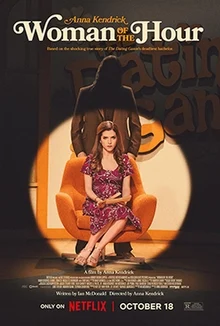
Woman of the Hour-2023

Woman of the Hour-2023

Director Anna Kendrick

Starring Anna Kendrick, Daniel Zovatto, Autumn Best

Scott’s Review #1,448
Reviewed October 21, 2024

Grade: A-

I never thought of Anna Kendrick as a quality film director or even a director. Her most notable acting role was Up in the Air in 2009 and I had nearly forgotten about her until watching the Netflix film Woman of the Hour (2023) in which she stars and directs.

She impressed the hell out of me in her directorial debut and since the film industry still needs more female directors I hope Kendrick keeps at it.

Woman of the Hour premiered at the Toronto International Film Festival in September 2023 but wasn’t released by Netflix until October 2024 so it’s technically a 2023 film.

Kendrick creates an intelligent work that serves as a compelling and taut thriller and a lesson in misogyny and objectification. Yes, it’s set in the 1970s and an argument can be made that society has progressed in that regard but not nearly enough as this film starkly reminds us.

An aspiring actress, Cheryl Bradshaw (Kendrick), who has had little success finding roles, is talked into appearing on an episode of the popular game show ‘The Dating Game’.

She crosses paths with a prolific serial killer, Bachelor #3 on the television show, 1978. He is Rodney Alcala (Daniel Zovatto) who is feared to have raped and murdered over one hundred women.

The audience is well aware of the actions of Alcala since the action goes back and forth from the present times (1979) and New York City in 1971 when he presumably killed his first victim.

I felt uncomfortable from the first scene and remained this way during the one hour and thirty-four minute running time. The film was too short.

Alcala doesn’t lurk around corners or break into apartments brandishing a butcher knife. Instead, he sweet-talks the women into posing for photographs or offers to help them out of a jam to gain their trust.

Kendrick doesn’t play softball with the audience. She gets the action going with a brutal scene where Alcala takes photos of a young woman in the plains. After he gets the woman to open up about her painful breakup with an ex-boyfriend, he strangles her. He revives her, then strangles her to death.

The victim is pitiful since she is already distressed over her ex. The audience sees a glimmer of hope in her eyes when she considers she may have finally met a nice guy. There is slight trust and it’s heartbreaking to see reality strike the poor woman.

Kendrick does it again in a side story from 1979 when events finally ended climatically. A young runaway named Amy, played wonderfully by Autumn Best, meets Alcala and spontaneously goes hiking with him in a remote location.

Best, through Kendrick, plays wounded not as victimized but as a strong woman with a will to live. Hardly cowering, she instead channels energy and outsmarts her pursuant.

I was continually impressed with how Kendrick weaved a thriller with female empowerment.

As good as those scenes are, the best sequence is during The Dating Game since there is so much going on.

We see the creepy Alcala and know that Cheryl will choose him. He knows how to schmooze, capitalizing on the other bachelor’s weaknesses. After he wins, bachelor #2 whispers a warning to Cheryl.

It gave me goosebumps.

Daniel Zovatto is a standout as the killer. His facade of Mr. Nice Guy made me trust him as most people would. He appears kind, friendly, and helpful. When he suddenly turns evil the actor gives a creepy smile on par with the one from the horror film Smile (2022).

I shudder thinking about the smile and film and Woman of the Hour (2023) has followed me since watching it.

An impressive directorial debut, Kendrick has the chops necessary to continue her journey. She acts well but her director talents are her superpower.
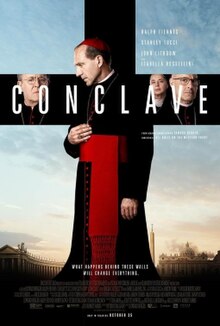
Conclave-2024

Conclave-2024

Director Edward Berger

Starring Ralph Fiennes, Stanley Tucci, John Lithgow

Scott’s Review #1,447

Reviewed October 17, 2024

Grade: A

I was fortunate to see the Conclave (2024) premiere at our local art theater before most public audiences had. I anticipate those who talk about the ‘twist’ at the end will be stunned. Initially, I was told there was a ‘twist,’ but I did not know what it was, so I wondered.

I’ll say nothing more about the ‘twist’.

Admittedly, the premise didn’t wow me, and I only saw Conclave because of the acclaim and awards season buzz surrounding it.

Heavyweight actors like Ralph Fiennes, Stanley Tucci, John Lithgow, and Isabella Rossellini didn’t hurt.

The end product is well-written, well-acted, and well-produced. Its tinge of push-pull between liberalism and conservativism feels timely and relevant.

It’s based on a 2016 novel written by Robert Harris.

The story is fictional and follows one of the world’s most secretive and ancient events: selecting the new Pope. Fiennes expertly plays Cardinal Lawrence, who manages this complex process after the unexpected death of the beloved current Pope.

Once the Catholic Church’s most powerful leaders, most eager to be elected the next Pope, have gathered from around the world, Lawrence uncovers a trail of secrets involving the dead Pope, secrets that could shake the foundations of the Church.

They are locked in the Vatican, protected from the outside world until the majority chooses the new Pope.

Edward Berger did a phenomenal job bringing the 1930 epic All Quiet on the Western Front (2022) to legions of audiences and a slew of Oscar nominations. All bets are that he does it again with Conclave.

The screenplay is written by Peter Straughan, primarily a British playwright. The action immediately begins with the Pope’s death, and the rest of the film is a slow buildup, sometimes even a crawl.

Halfway through, I wondered why Conclave was receiving so much notice. After the conclusion, I could not stop thinking about it for days.

Berger and Straughan play their cards close to their pockets throughout the play, toying with audiences who expect a traditional, mainstream affair before the rug is yanked from beneath them.

Dramas or thrillers with a religious theme, mainly centering around questioning the Catholic Church, usually risk dismissal or ridicule. I’m anxious to see how this plays out with Conclave.

In hindsight, more than the obvious, make Conclave worth talking about after the upside-down ride that results.

Lawrence is character-driven. He questions his faith and devotion and doesn’t want to be the new Pope. We’re not exactly sure why he wants to leave the Church. Is he involved in a secret scandal? Could he be in a relationship?

One intelligent scene mentions that a Pope should not be sure of his faith and should question it. Traditions can be tweaked for the times. A conservative leader mocks the Pope for ruining the Catholic Church with whimsical decisions, embracing the current times. Another liberal leader doesn’t think he went far enough.

It’s easy to see that Berger/Straughan/Harris have Pope Francis, who was elected in 2013, in mind. Having strongly brought more progressive thought to the Catholic Church, it’s easy to see the representation.

Fiennes gives a powerful performance as a decent man who tries to do the right thing without favoritism or conflict. He is subdued but strong-willed, and the performance is understated. He gives so much to a role that could be mistaken for too little.

Volker Bertelmann composes the score, which is reminiscent of All Quiet on the Western Front. It has a soft tone, is not bombastic, and slowly increases intensity during scenes. The buildup is tense and magnificent.

Conclave (2024) is a human story about humanity and imperfection. It’s also about human complexities, mistakes, and kindness. It magnifies the scope of the Catholic Church and reminds audiences that those shrouded within its wall are not without imperfections.

It also reminds us that even the Catholic Church has corruption.

Oscar Nominations: 1 win-Best Picture, Best Actor-Ralph Fiennes, Best Supporting Actress-Isabella Rossellini, Best Adapted Screenplay (won), Best Film Editing, Best Production Design, Best Costume Design, Best Original Score

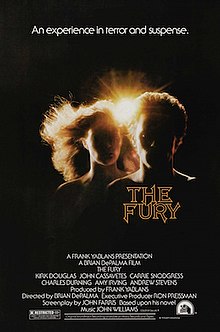
The Fury-1978

The Fury-1978

Director Brian De Palma

Starring Kirk Douglas, Amy Irving, John Cassavetes

Scott’s Review #1,446

Reviewed October 15, 2024

Grade: A-

The Fury (1978) is one of Brian De Palma’s films that flies under the radar and is underappreciated. It features many of his trademark effects, such as slow-motion camerawork, and includes actors who appear in more than one of his psychological thriller films.

The story might be more complicated than it needs to be, and while legendary actor Kirk Douglas gets top billing, he disappears for a good part of the film before returning towards the end. He hands the reins to Amy Irving, who capably carries the rest of the film.

This is a small gripe for a film that ranks pretty close to classics like Dressed to Kill (1980), Carrie (1976), and Blow Out (1981).

I’m as guilty as anyone else for underappreciating The Fury since it’s only my second time viewing it.

The all-star cast features John Cassavetes as the villain, Carrie Snodgress, Charles Durning, Douglas, and Irving. That’s enough to make cinema fans want to see it. There are also unique actors in small roles who flesh out the quirky cast in a major win.

The screenplay by John Farris was based on his 1976 novel of the same name, which feels a lot like a popular Stephen King novel.

The Fury utilizes the talents of esteemed John Williams, who scored such greats as Fiddler on the Roof (1971), The Poseidon Adventure (1972), and Jaws (1975), to name a few. The highly lauded composer aptly uses the music to enhance the overall product.

Events start in Israel when a plot separates CIA agent Peter Sandza (Douglas) from his son, Robin (Andrew Stevens), but the distraught father manages to see through the ruse.

He realizes that Robin is being held at an institute by Ben Childress (Cassavetes) because the teenager possesses supernatural powers that Ben intends to weaponize.

Meanwhile, Gillian (Amy Irving), a teen with telekinesis, forms a psychic connection to Robin and teams up with Peter to find and rescue him. They are forced to endure villains intent on destroying them for their own gain.

I am amazed how well the film, made in 1978, holds up tremendously decades later, considering the characters play dated video games and the automobiles are very 1970s. The overindulgence of 1970s ‘stuff’ is what holds the most appeal.

Appealing is the glimpse at hundreds of extras appearing in the many exterior Chicago scenes. While Gillian and her friend La Rue (Melody Thomas Scott) stroll down the boardwalk, they pass teams of regular people harkening back to a time long ago.

The unwieldy American sedans popular in the mid-1970s pepper the streets of Chicago. At the same time, the sofa and carpet styles of the time are prominently featured at the Paragon Institute, evoking a nostalgic hug of authenticity.

When the character Gillian is introduced during a high school sequence that parallels Carrie, the similarities are immediately apparent.

Carrie and Gillian are both high school students with psychic powers, including telekinesis, that harm people who physically touch or provoke them.

The kicker is that Irving also appeared in Carrie, but not as the title character.

The best scenes are when Hester (Snodgress) is struck and killed by a car propelling her bloody body through the windshield or when Institute employee, Dr. Susan Charles (Fiona Lewis) is tortured and spun to death over a lavish dinner table setting.

The food references are plentiful, mouthwatering, and fun to track. Hester and Gillian chat and giggle over heaping hot fudge sundaes, while scrambled eggs and dinner are mentioned during other scenes.

Some plot holes or inexplicable story points, like Robin’s turn into a psycho and turning on his father because another psychic will replace him, aren’t as compelling as other points of the film.

During one scene, Gillian has Robin’s powers transfer to her, causing her body to writhe and contort in an unconvincing way, and Irving looks plain silly.

Being a huge De Palma fan, I’m glad I dusted The Fury (1978) off the shelf because it’s a terrific watch with an exceptional cast. It contains many of De Palma’s trademarks, making it fantastic, especially for his fans.

Swamp Thing-1982

Swamp Thing-1982

Director Wes Craven

Starring Ray Wise, Adrienne Barbeau, Louis Jourdan

Scott’s Review #1,445

Reviewed October 14, 2024

Grade: B+

Wes Craven’s murky swampland, Adrienne Barbeau’s cleavage, and a battle of good versus evil make Swamp Thing (1982) a titillating watch.

It is marketed as a superhero movie and contains a famous cover art shot of the ‘swamp thing’ carrying a scantily clad Barbeau across a swamp. This is warranted since it is adapted from a DC Comics character of the same name.

Swamp Thing is pure camp and makes no bones about it.

There’s not a lot that is interesting from a story perspective other than a run-of-the-mill plot. The bad guy, greedily plotting to take over the world with a mysterious serum, is conquered.

But the visuals make Swamp Thing atmospheric, the bizarre romance works, and Barbeau carries the film, making it an entertaining one hour and thirty-one minutes.

Dr. Alec Holland (Ray Wise) is a botanist on the verge of a breakthrough to wipe out world hunger when special government agent Alice Cable (Adrienne Barbeau) arrives on the scene to protect him from a threat.

A brief flirtation ensues between the pair.

Psychotic scientist Anton Arcane (Louis Jourdan) wants to steal Holland’s research to boost his own fame. An unforeseen accident during the heist turns Holland into the Swamp Thing, an enormous plant-like creature that fights back against Arcane’s henchmen to save Alice.

Swamp Thing hints at Craven’s notoriously dark revenge film, The Last House on the Left (1972), though nowhere near as dark as that film.

The exterior settings resemble each other despite being filmed in different locales, and characters frequently charge or flee the woodsy atmosphere in peril. Watching on a streaming service provided a grainy video, which enhanced the film’s rawness and made a look less cartoonish.

A repeated watch might need better video production to notice subtleties missed during its first viewing.

I can’t be critical of Swamp Thing because it’s an enjoyable experience.

The early romance between Alice and Alec is nice, though limited. I confess to nearly being teary-eyed during a tender moment between Alice and ‘Swamp Thing’, now played by Dick Durock. After Alice is shot in the breast, she is tenderly healed and held by the creature.

Speaking of breasts, Barbeau bares them during a scene where she bathes in the swamp. The intent is sensational, and to showcase her ‘girls’ as much as her running around or being chained in a low-cut dress is.

Being a fan of Barbeau’s, this didn’t bother me as much as it should have, but where were the scantily clad men? They didn’t exist.

Also laughable is Barbeau as ‘damsel in distress’ when the actress is well known for tough girl roles like Rizzo in Grease or Maggie in John Carpenter’s Escape from New York, made only a year earlier.

As she meekly cried out for help, I couldn’t help but chuckle inside, especially since her character is part of a government security team sent to protect.

Jourdan is excellent as the evil Anton, playing the role over the top, like a standard superhero villain. This proves successful as we cheer on his ultimate demise.

The composer Harry Manfredini also scored most of the Friday the 13th film series (1980-2001), which is easy for fans with a knack for spotting eerie, 1980s-era soundtracks.

Swamp Thing (1982) may not be a cinematic genius, but there is enough to enjoy for the average viewer, especially early superhero fans. Barbeau and Craven make the film better than it would have been without them.

Four Weddings and a Funeral-1994

Four Weddings and a Funeral-1994

Director Mike Newell

Starring Hugh Grant, Andie MacDowell

Scott’s Review #1,444

Reviewed October 8, 2024

Grade: A-

Four Weddings and a Funeral (1994) is a surprisingly fresh and delightful romantic comedy and one of the better offerings of the 1990s.

It is likely an inspiration for Love, Actually, from 2003, which I have seen recently, and the two would pair well.

Both are British or set in the London area and have an English sophistication often lacking in American rom-coms.

The key to Four Weddings and a Funeral’s success is the writing. Storylines about real life emerge, and relatable, awkward, and flawed characters grace the page.

Lovelorn audience members who may have lost love or suffered from loneliness may relate most.

This is a huge win for a genre that often plays it safe or revels in predictability. Crisp writing goes a long way.

The main couple is played by Hugh Grant and Andie MacDowell, making them household names and propelling them to a successful decade in similar films, especially Grant.

Lovable Englishman Charles (Grant) and his group of friends seem to be unlucky in love. They frequently gather at parties or weddings, never finding what they truly want, and are linked together for life.

When Charles meets a beautiful American named Carrie (Andie MacDowell) at a wedding, he thinks his luck may have changed. But, after one magical night, Carrie, deemed ‘slutty’ returns to the States, ending what might have been a wonderful long-term relationship.

As Charles and Carrie’s paths continue to cross, usually at someone’s wedding and one funeral, Charles believes they are meant to be together, even if their timing always seems to be off.

Grant shines in his role despite believing his performance was hideous, at least before the film received many accolades.

Mike Newell, the director, provided conflicting direction, making it hard for Grant to play the role in a particular way.

His stuttering and confusion, though, are what make his character so endearing.

MacDowell is good, too. It’s not clear why she doesn’t drop everything right away and date Charles, or why she chooses to marry an older Scottish guy, but the story-dictated situations only make the characters shine brighter.

Once the first wedding occurred, I found myself hooked. I couldn’t wait to find out what three nuptials would be forthcoming and who the funeral was for.

Could it be a main character or even Charles or Carrie?

That makes Four Weddings and a Funeral compelling, especially as the supporting characters are fleshed out.

We get to know Fiona (Kristin Scott Thomas), a bitchy friend who seems to judge everyone she meets. Her snobbery slowly gives way to vulnerability when it’s revealed that she has always loved Charles.

Other characters like Tom (James Fleet) and Scarlett (Charlotte Coleman) provide comic relief, while a same-sex couple, Gareth and Matthew (Simon Callow and John Hannah), and Charles’s deaf brother David (David Bower) are part of the group, with no judgment of their sexuality or disability.

In 1994, this was a searing victory, and a feeling of inclusion is apparent.

The icing on the cake is a spectacular soap opera moment in which a bride and groom are about to take their vows, only for one of them to admit their love for another character.

Hysteria, a meltdown, and good old-fashioned drama commence, making the scene satisfying.

I didn’t expect to enjoy Four Weddings and a Funeral (1994) as much as I did. Audiences agreed, and the film was rewarded with two surprising Oscar nominations.

Oscar Nominations: Best Picture, Best Original Screenplay