Category Archives: Tearjerkers

Steel Magnolias-1989

Steel Magnolias-1989

Director Herbert Ross

Starring Sally Field, Shirley MacLaine

Scott’s Review #1,546

Reviewed August 29, 2026

Grade: B+

One of the better chick flicks to emerge from the late 1980s, Steel Magnolias is a 1989 tearjerker with drama and heart, done up in southern style. It has comfort, charm, and a bit of tackiness.

Specifically, Louisiana- the film was shot in that U.S. state, so the authenticity is evident in the vast number of exterior small-town sequences.

The film is reminiscent of Beaches (1988) and Terms of Endearment (1983), stories about female friendships and the trials and tribulations that come with them.

Although it’s geared toward a female audience, there is plenty for men to enjoy, though the male characters take a back seat to the women.

A dose of tissues may be needed since the film is a tearjerker.

Steel Magnolias uses various Louisiana backyards, houses, and the famous Truvy’s Beauty Salon, which the play the film is based on uses as the primary, or only, set.

M’Lynn (Sally Field) is the mother of bride-to-be Shelby Eatenton (Julia Roberts). As friend Truvy Jones (Dolly Parton) fixes the women’s hair for the ceremony, they welcome a helping hand from aspiring beautician Annelle Dupuy DeSoto (Daryl Hannah).

Annelle is new in town and has a secret past which the other townswomen are dying to unravel. The group includes the bitchy Ouiser (Shirley MacLaine) and the wealthy Clairee Belcher (Olympia Dukakis), who is recently widowed.

Diabetic Shelby has a health scare on the morning of her wedding to Jackson (Dylan McDermott), which is averted but doesn’t bode well for her hopes of having children.

Shelby and Jackson desperately want kids, so this is a major hurdle and caveat of the film.

As time passes, the women and their friends face tragedy and good fortune, growing stronger and closer in the process.

For most of the film, the beauty salon serves as the backdrop for gossip and dishing.

Steel Magnolias has a folksy, down-home appeal that viewers can enjoy. Part of the small-town appeal is its warmth and sense a home, and the film succeeds in making the viewer feel a part of this community.

Since the events span a couple of years, we see traditional holidays like Halloween and Christmas celebrated, and we see townspeople who have known each other their entire lives come together.

This is a wonderful feeling for the viewer.

The film is not a perfect 10 score, however. Because of the dramatic situations, it must incorporate some comic elements.

While generally successful, the bickering between Clairee and Ouiser works well; other portions fall flat.

MacLaine gets quick one-liners, which she delivers with gusto and is the hammiest of all the characters. As she marches across her backyard intent on telling someone off, or criticizes a former beau for looking older, her character crackles with life and energy.

However, the feud between Ouiser and M’Lynn’s husband, Drum (Tom Skerritt), is weak and more like screwball comedy. Each time Drum teases Ouiser’s excitable dog to irritate her, I cringed with annoyance.

On the wedding day, he fires a gun loaded with blanks to drive birds out of the trees so they do not interfere with the reception, and Shelby’s brothers cover her honeymoon car with inflated condoms as a prank.

These lighthearted situations seem juvenile and a pale attempt to offset the heavy dramatics, which are the strongest part of the film.

As an aside, I could have used a dose of equality and inclusion. I realize the film is set in the South, but every servant or hired help is black. Given it’s the 1980s, couldn’t this be modified even slightly?

Nonetheless, Steel Magnolias (1989) is a winner because of the connection between the women and the melodrama that takes center stage in the final act.

Roberts, as Shelby, gives a winning dramatic performance and was just on the cusp of superstardom. Parton is the core of the group and the most sensible, while Field, the lead character, also delivers rich drama.

I’d be remiss not to give props to Parton, who instills a trust and sensibility into her role. Oozing kindness, she gently incorporates a new community member as if she’d known her her entire life.

Truvy is just like Dolly herself, which is a big part of the heart that the viewer feels. It almost made me want to reside in Chinquapin Parish!

The film is a fluffy piece of nostalgia that brings the entire family together with warmth and provides a much-needed emotional outlet.

Oscar Nominations: Best Supporting Actress-Julia Roberts
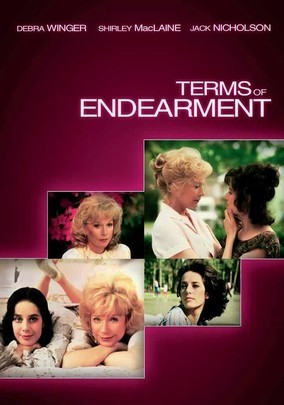
Terms of Endearment-1983

Terms of Endearment-1983

Director James L. Brooks

Starring Shirley MacLane, Debra Winger, Jack Nicholson

Top 250 Films #152

Scott’s Review #368

60004508

Reviewed January 9, 2016

Grade: A

Terms of Endearment (1983) is a sentimental favorite of mine, and while I am slightly embarrassed to include this chick-flick to end all chick-flicks on my favorites list, it is also a damned good sentimental film and makes me a bit weepy each time I see it.

It is pure Hollywood mainstream formula, but somehow Terms of Endearment works (romantic films are not usually at the forefront) and even won the coveted Best Picture Oscar in 1983.

That must say something.

So if it is so sappy, what makes it so great? For starters, it has exceptional acting all around, especially from the leads Shirley MacLaine, Jack Nicholson, and Debra Winger.

How can you go wrong with a talent of that caliber?

MacLaine and Winger play Aurora and Emma Greenway, a mother and daughter (the father is deceased) who share a lifelong love-hate relationship and live in the Midwest in the present.

Nicholson plays Garrett, a retired astronaut (and womanizer) and the object of Aurora’s affection.

The chemistry among all three is apparent- I sinfully find it delicious that Winger and MacLaine despised each other throughout filming, adding a layer of curiosity and intrigue to the film, and during their scenes.

Director James L. Brooks wisely balances the heavy drama with comedy, so the film does not become too overwrought.

For example, Garrett and Aurora have a humorous courtship, constantly bickering or misunderstanding each other- he is a womanizing playboy type and Aurora a domineering, insecure woman- they end up needing each other, nonetheless.

Unforgettable is the hilarious drive and the beach scene that the two share.  Even though the duo is tenuous and difficult, I love them all the same.

The tear-jerker scenes are emotional, especially the deathbed scene at the end of the film. There is so much raw emotion going on at once, and, a rarity in film, the child actors involved are real, believable, and flawless.

The film feels like watching a true, real-life drama play out. The heartache feels real, and the film as a whole feels very genuine.

Also interesting is Emma’s failing marriage to Flap (Jeff Daniels) and her subsequent affair with kind-hearted Sam (John Lithgow), as well as her departure from her mother’s hometown, the constant phone calls, and being in one another’s lives, just like a real mother and daughter relationship often is.

Terms of Endearment (1983) incorporates all of the elements that make a good, old-fashioned, dramatic tear-jerker, and I find myself a sucker for it each time that I watch it.

Oscar Nominations: 5 wins-Best Picture (won), Best Director-James L. Brooks (won), Best Actress-Shirley MacLaine (won), Debra Winger, Best Supporting Actor-Jack Nicholson (won), John Lithgow, Best Screenplay Based on Material Based on Another Medium (won), Best Original Score, Best Sound, Best Art Direction, Best Film Editing

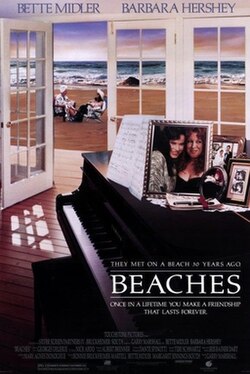
Beaches-1988

Beaches-1988

Director Garry Marshall

Starring Bette Midler, Barbara Hershey

Top 250 Films #162

Scott’s Review #352

Reviewed January 9, 2016

Grade: A

Beaches (1988) is a film that can easily be described as sentimental, sappy, and a chick flick- all in a derogatory fashion- but that, regardless, is a treasure to me.

I fall for this tearjerker every single time that I watch it.

It is not necessarily a great film, not high art, nor particularly edgy, but a good, old-fashioned, conventional film about friendship.

Bette Midler and Barbara Hershey give the film believability, whereas other similar films would appear contrived.

C.C. Bloom (Midler) and Hillary Whitney (Hershey) are lifelong friends from opposite backgrounds. Besides, they could not have more opposite personalities. C.C. is blue-collar, outrageous, and brash; Hillary is demure, rich, and sophisticated.

We meet our friends as young girls on the boardwalk of Atlantic City, C.C., hiding from her overbearing stage Mom, and Hillary is lost and wandering the boardwalk.

The two become fast friends despite their vastly different upbringings and stay connected through life’s ups and downs for over thirty years.

The chemistry between Midler and Hershey is great. I completely buy them as best friends through the years, despite having little in common.

Throughout their tender, emotional scenes and the knock-down-drag-out fight at the mall (a fantastic scene!), there is never a doubt about what they have.

They compete over a man, which ordinarily is a lame plot device, but in Beaches, it works because the two stars make it work.

Each actress puts her mark on the individual role. Midler’s C.C. is arrogant, feisty, and interesting as she begins as a “have-not” and becomes a “have”.

She becomes spoiled and pampered- all of the things she envies about Hillary. She does not handle wealth as well as Hillary because she lacks education. Hillary, an attorney, is classy and graceful.

These characteristics make it believable that the women would be at odds.

The last act is a weepy one as one of the women dies, leaving the other to pick up the pieces and move on- alone. This is a sad moment in the film, but the women’s devotion and loyalty are admirable.

Beaches (1988) may not be high art, but boy, will it get you reaching for the tissues.

Oscar Nominations: Best Art Direction

Saint Ralph-2004

Saint Ralph-2004

Director Michael McGowan

Starring Adam Butcher, Campbell Scott

Scott’s Review #1,118

Reviewed March 3, 2021

Grade: C

Saint Ralph (2004) is an indie drama that is overly sentimental and includes too many standard plot points.

This makes the film ho-hum and extremely cliched.

It feels like the attempt was to create a major studio film in independent clothes, but without the grit afforded most indies.

There are plenty of standard setups and by-the-numbers follow-through, rather than anything different or fresh.

The film is too charming, safe, and feel-good for my tastes. Maybe there are just too many similar movies made, so it doesn’t stand out very well.

And since it’s an indie, shouldn’t it strive for more edginess?

The message is meant to inspire, and in a way it does, but that only goes so far.

Saint Ralph is a story of a young man triumphing over insurmountable odds- wonderful but unrealistic.

The religious elements of faith, miracles, and the Catholic high school are lost on me, but some may champion those elements better.

I did enjoy the 1950s time period and its share of decade trimmings and set pieces, yet too often they feel stagey, and any authenticity doesn’t feel fresh.

Rather, like actors clad in period clothing.

The lead kid who plays Ralph (Adam Butcher) isn’t impressive enough, though Campbell Scott, who plays a priest with more wisdom than he probably should have, is the best thing about Saint Ralph.

If I’m being harsh, it’s unintentional, but Saint Ralph is a film I’ve forgotten about a day or so after seeing it. I like a film that sticks with me and makes me think about, and Saint Ralph just ain’t it.

It’s classified as a tear-jerker, and I didn’t shed one.

Ralph is a troubled kid. His father died in World War II, and his mother lies ill in a coma. He smokes and masturbates, resulting in adult intervention by way of strict Father Fitzpatrick (Gordon Pinsent) and kindly Father Hibbert (Campbell Scott).

He is encouraged to run in the upcoming Boston Marathon, and he trains mightily with the right encouragement.

He feels that if he trains hard and wins the marathon, his mother will be granted a miracle by God, wake up from her coma, and live happily ever after.

I won’t spoil the ending, but the conclusion will satisfy pious audiences.

I embrace films that feature a character championing certain hardships, and Saint Ralph does contain a youthful innocence and earnestness that holds some appeal.

I felt myself rooting for him to overcome his problems. No kid deserves those hardships.

The weakness is that I felt manipulated. Since the intention was to root for Ralph, it was clear where the film was headed, and the predictability was at an all-time high.

The training sequences are reminiscent of any sports film. Think of a young Rocky Balboa training for an upcoming fight. And the saccharine ending is riddled with predictability.

Saint Ralph (2004) will ruffle no feathers and only appeal to mainstream audiences seeking safe cinema. Most people will not remember it very well.