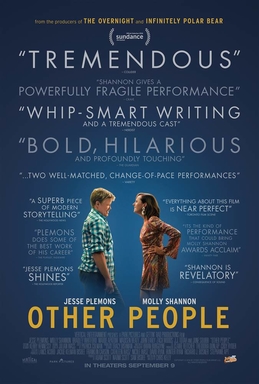
Other People-2016

Other People-2016

Director Chris Kelly

Starring Jesse Plemons, Molly Shannon

Scott’s Review #676
Reviewed August 24, 2017

Grade: B+

2016’s recipient of numerous Independent Film award nominations is equal parts a touching drama and equal parts witty comedy, providing a film experience that crosses more than one genre.

Is it a heavy drama, or is it a comedic achievement?

Without being sappy or overindulgent, Other People is a film that will elicit laughs and tears from viewers fortunate enough to see it. The subject is a tough one- a woman dying of cancer.

The title, in which one character states he always thought cancer was something that happened to “other people,” is poignant.

Jesse Plemons and Molly Shannon play son and mother. The film is both written and directed by Chris Kelly.

The very first scene is a confusing one and caught me off guard. We see the entire Mulcahey clan- father Norman (Bradley Whitford), three kids, David (Plemons), Alex, and Rebeccah, along with their dead mother Joanne (Shannon), all lying in the same bed, sobbing and clutching hands.

Joanne has just succumbed to her battle with cancer. This powerful opening scene, also the final scene, sets the tone as Kelly works his way back, beginning a year before the critical “death scene.”

Cancer is a challenging subject to cover in film, especially going the comedy/drama route.

The sensitive filmmaker must be careful not to trivialize the subject matter with too many comedic elements or heavy drama. Kelly successfully mixes humor and drama well, making it a cross-genre film.

He achieves this with capable talents like Plemons and Shannon. They share tremendous chemistry in every scene they appear in together.

Scenes that show David and Joanne crying in each other’s arms work well, as do others, such as when David takes a giddy Joanne to meet his comedy friends.

Most impressive is that the story in Other People is mainly autobiographical. Kelly, a gay man like the character of David, moved from New York City to Sacramento, California, to tend to his ailing mother, who had also died from cancer.

Actress Shannon reminded him so much of her that he had the fortune of casting the talented lady in his film- the part slated initially to go to Sissy Spacek instead.

Along with Joanne’s battle with cancer, a lovely story about David is included. A gay man, David has broken up with his boyfriend Paul, who previously lived together on the East Coast (though he still pretends to spare Joanne worry), and is returning to the West Coast.

Over the next year, we see Joanne and Norman slowly come to terms with David’s sexuality. The turbulent father/son relationship is explored during the film as Norman, initially hesitant to meet David’s boyfriend, Paul, pays for his airline ticket to attend Joanne’s funeral.

A slight miss with the film is the Norman/David dynamic.

Other than a few hints of Norman encouraging David’s struggling writing career and his obsession with David joining the gym and boxing, it is not clear what issue he takes with his son being gay or why he is uncomfortable with it. Besides the family being rather conservative, no other reason is given.

David’s sisters and grandparents do not seem to take issue with David’s sexuality, though it is not made sure if the grandparents are even aware of it. Is it a machismo thing with Norman?

This part of the story is unclear.

Still, Other People (2016) is a good, small indie film. It is rich with crisp, sharp writing and a tragic “year in the life of a cancer patient. ” The film also features good family drama and the relationships that abound when a family comes together and unites because of a health threat.

The film is nothing that has not been done before, but thanks to good direction, a thoughtful, nuanced approach, and one character’s sexuality mixed in, the film feels relatively fresh.

Independent Spirit Award Nominations: 1 win-Best Male Lead-Jesse Plemons, Best Supporting Female-Molly Shannon (won), Best First Screenplay, Best First Feature
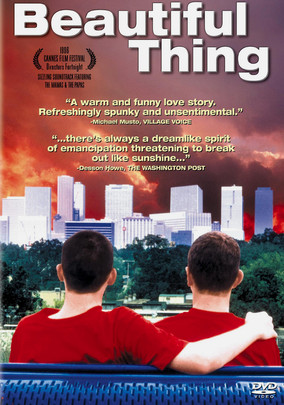
Beautiful Thing-1996

Beautiful Thing-1996

Director Hettie MacDonald

Starring Glen Berry, Scott Neal

Scott’s Review #675

Reviewed August 20, 2017

Grade: B

Based on the play of the same name, Beautiful Thing is a heartwarming 1996 British LGBT film written by Jonathan Harvey and directed by Hettie MacDonald.

Incorporating music from the Mamas and the Papas, and specifically Mama Cass, the film undoubtedly was groundbreaking upon release in the 1990s due to its taboo (at that time) gay romance. Still, in 2017, this film suffers a bit from both a dated feel and a play-it-safe vibe.

The action, as in a play, takes place almost entirely within a working-class London apartment building in the present.

The lead character is Jamie (Glen Berry), a high school student, intrigued by his male classmate and neighbor, Ste (Scott Neal).

He also must keep an eye on his flighty mother, Sandra, who changes boyfriends like the weather, and aspires to open her pub- she is currently dating neighbor and understanding hippie, Tony.

Ste is the other central character. Shyer than Jamie, he has a difficult upbringing, living next door to Jamie with an abusive father and brother.

Ste and Jamie eventually bond, and a secret love story begins as the young men conceal their relationship from everyone else.

In the mix is a vivacious black teenage neighbor girl, Leah, who is obsessed with Mama Cass’s records, which her grandmother owns and frequently plays. Leah and Sandra are engaged in a light feud, largely because Sandra believes Leah is a bad influence on Jamie.

Given that Beautiful Thing (1996) was made, the film deserves enormous praise for simply existing at a time when LGBT films were hardly the norm.

Watching in 2017, though, the film loses a bit compared with subsequent LGBT releases that broke more barriers in mainstream viewership and explored much darker themes (LGBT masterpieces like 2006’s Brokeback Mountain and 2016’s Moonlight immediately come to mind).

Beautiful Thing also has a safer, lighter touch than the aforementioned films, making it seem too much like fluff now.

Director MacDonald mixes in humor so that, while the message of a same-sex relationship is important, it is softened a bit by the comedy.

Specifically, the sidekick, Leah, lightens the message.

The supporting characters may get a bit too much screen time. Sandra’s giggle-worthy job interview, her attempts to do “respectable work” in an office environment, or her man-hungry escapades take away from the main story.

I also never felt any real threats or danger to the same-sex relationship. Sure, there is some brief disapproval, and a quick mention of Jamie not liking football (a negative gay stereotype that is unnecessary), combined with Ste’s abuse at the hands of his family, but even that is not perceived as a major obstacle to their, at that time anyway, shocking relationship.

On the other hand, the chemistry between the two leads (Berry and Neal) is wonderful and the best aspect of the film.

Both actors convey the emotions of the characters perfectly- both coming into their sexuality, Berry’s Jamie is the more confident one, asking Neal’s Ste, in a sweet scene, whether he has ever been kissed.

This leads to a sleepover that is innocent and tender rather than steamy or sexual. I completely buy the characters as young lovers, coming to terms with their own identities while supporting each other’s needs and becoming a good team.

The final scene, naturally accompanied by a Cass Elliot song “Dream A Little Dream Of Me”, is a touching, wonderful scene. Jamie and Ste dance together in broad daylight, for their entire complex to see, and subsequently are circled by both supporters and the curious.

As a show of support, Sandra and Leah join the boys and end their dispute.

Beautiful Thing (1996) offers a heartwarming conclusion to a fine, yet lightweight by modern standards, LGBT romantic film.

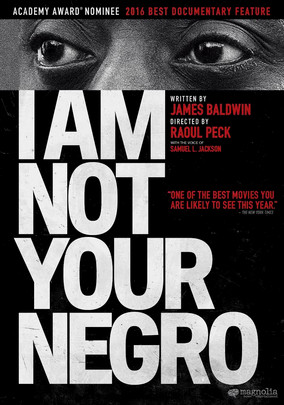
I Am Not Your Negro-2016

I Am Not Your Negro-2016

Director Raoul Peck

Starring Samuel L. Jackson

Scott’s Review #674

Reviewed August 19, 2017

Grade: B

I Am Not Your Negro, a 2016 documentary created by director Raoul Peck, chronicles an unfinished manuscript written by social critic James Baldwin, entitled Remember This House.

The memoir is a series of recollections by Baldwin, who died in 1987, of his experiences with famous civil rights leaders Malcolm X, Martin Luther King, Jr., and Medgar Evers.

Released in a year that saw similarly racially themed documentaries emerge, such as 13th and O.J.: Made in America, all were recognized with award nominations in several year-end ceremonies.

If comparisons are drawn, 13th, the most similar in theme to I Am Not Your Negro, is the superior piece. While interesting, the latter did not quite grip me as much as the former.

Still, I Am Not Your Negro is worth a watch if nothing else than to understand and be exposed to the continuing battle for racial equality in the United States.

The documentary revolves around the discussion and backstory of all the leaders mentioned. Old footage of each man is used for location shots and speeches.

A high point is Baldwin’s interview and his insight into his racial experiences, both positive and negative. Each leader, King, X, and Evers, receives roughly the same amount of screen time, and the best part is Baldwin’s dealings with each man.

I immensely enjoyed the multitude of scenes featuring racial history in cinema, and the harsh reality is that blacks have not been given their due until relatively recently in how their characters are portrayed.

As recent as the 1950s and 1960s, and arguably later than that, blacks were demeaned or treated as nothing more than secondary characters. Worse yet, some were portrayed for laughs or as caricatures.

A startling admission comes from Baldwin himself. An enormous John Wayne fan as a child, reveling in the joy of his films, it was a harsh reality to understand that the Indians in Wayne films, seen as the “bad guys,” were Black Americans, therefore himself.

Baldwin’s films were viewed through the innocent eyes of a child, but real life was harsher.

Samuel L. Jackson’s narration is unnecessary. Being a well-known name, the actor is distracted from the message. Jackson seems to read Baldwin’s words as if he were acting, and Baldwin and Jackson are two very different types of men, so the result is disjointed.

The most important takeaway that I Am Not Your Negro left me with is a crucial one. A better understanding of the historical plight of Black Americans and how far the United States has come in better racial equality.

Even more important, however, is the realization that we still have so much work ahead of us as a nation to ensure even better race relations, and this is a sobering message.

Oscar Nominations: Best Documentary-Feature

Independent Spirit Award Nominations: Best Documentary Feature

Tanna-2016

Tanna-2016

Director Bentley Dean, Martin Butler

Starring Mungau Dain, Marie Wawa

Scott’s Review #673

Reviewed August 18, 2017

Grade: A

Tanna, named for the tiny South Pacific nation of Vanuatu, close to Australia, was made in 2016 and nominated for the Best Foreign Language Academy Award.

It is a marvelous work in every way, but the crowning achievement is how this film was made.

Shot entirely on the island with a minimal budget and the use of nonactors, the result is a romantic yet tragic love story that will move its viewer to tears in its innocence and beauty.

Tanna is shot in the  Nauvhal and Nafe languages.

Film-makers reportedly spent seven months in the village of Yakel, immersing themselves in the tribe’s culture and civilization. The people are the last of their kind, rebuffing nearby colonial and Christian influences in favor of their traditional values and beliefs.

The film is based on a true story of love by two tribe members and played out by the villagers, each portraying a role close to their lives and hearts.

As the movie opens, we are immediately exposed to a tribal community living their daily lives. They wash, hunt, and wander through the jungles, exploring their natural surroundings.

The men wear simple penis sheaths, and the women are primarily topless. We sense a great community and a sense of togetherness.

When Dain and Wawa  (I am unsure if these are the “actors” names or the real-life people) lay eyes on one another from across the jungle, they instantly fall in love and secretly begin to spend time in a tender and romantic courtship.

A traditional rule is arranged marriage, which becomes a significant problem for Dain and Wawa as their love blossoms. When a neighboring tribe attacks the Shaman over a dispute regarding bad crops, Dain wants revenge.

When cooler heads prevail, the leaders of each tribe decide that Wawa will marry a member of the other tribe, leaving her and Dain distraught and desperate.

Their love is then tested ultimately.

The actors who play Dain and Wawa are authentic and truthful. Although they have never acted before or seen a camera, both pour their souls into the characters they portray.

This also applies to Wawa’s little sister, a goldmine in her honest portrayal. All the performances are rich.

Visually, Tanna is breathtaking. One thing is the exotic lushness of the green jungles, mixed with the gorgeous running streams and waterfalls. Still, the oozing volcano inhabiting the island is colorful and picturesque during the night scenes.

The entire film is shot outdoors and captures the tribal world incredibly well. Thus, the film immerses the audience wholly in the tribal world.

Comparisons to the William Shakespeare play Romeo and Juliet must be made.

The film is a romantic tragedy of epic proportions, and the doomed couple shares everlasting love and a bond that can never be broken.

The truth in this tale is genuine as the couple must agonize over a decision to either remain together or risk the threat of Dain’s life and Wawa’s freedom if they return to their native village.

The film is almost poetic, never more so than in the final act, set upon the glorious spitting volcano.

Sadly, films similar in richness and honesty are rarely made today, but Tanna (2016) stands out as a treasure in beauty and thought.

Interestingly, because of the real-life couple’s determination and strength, the age-old tradition of chosen marriages has since been lifted, and true love encouraged.

Oscar Nominations: Best Foreign Language Film

Annabelle: Creation-2017

Annabelle: Creation-2017

Director David F. Sandberg

Starring Anthony LaPaglia, Stephanie Sigman, Talitha Bateman

Scott’s Review #672

Reviewed August 17, 2017

Grade: B+

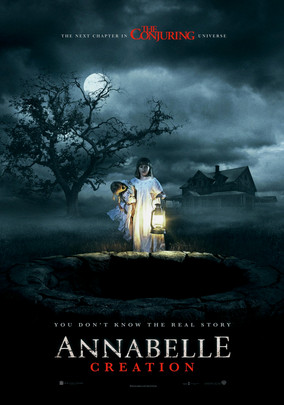
Annabelle: Creation (2017) is a prequel to the successful 2014 horror film entitled Annabelle and the fourth installment in a total of the popular The Conjuring series (2013-present).

Over just a few years, these films have become well-crafted, intertwined stories in the modern supernatural horror genre.

Compared to another latter-day horror franchise, Saw, Annabelle/The Conjuring elicits more of the classic spook factor rather than the gore associated with the Saw franchise (2004-present).

The time is 1943, set somewhere in the desert and mountainous region of California. Dollmaker Samuel Mullins (Anthony LaPaglia) and his wife Esther (Miranda Otto) live a cheerful existence with their young daughter, Annabelle, whom they nickname Bee.

The family attends church services regularly and plays cute games of hiding and seeking in their vast farmhouse and land. When one sunny day, Bee is struck and killed by a passing car, the couple is devastated beyond repair.

Twelve years later, a group of orphans led by Sister Charlotte (Stephanie Sigman) are invited by Mr. Mullins (Mrs. Mullins is now bedridden due to a mysterious accident) to spend some time at the farmhouse when their orphanage shuts down.

The six orphans, led by best friends Janice (Talitha Bateman), and Linda (Lulu Wilson) embark on the quiet farmhouse and immediately are met by strange goings-on, most notably a life-sized doll living inside a forbidden room, which Janice inevitably stumbles upon out of curiosity.

Stricken with polio, Janice has been left a disabled person, unable to move around very well.

As Janice discovers the creepy doll, or shall we say, Janice awakens the doll from a strange closet covered with bible verses, the doll terrorizes the girls. It wreaks havoc on Janice and Linda in particular.

An evil entity inhabits the doll, and the peculiar circumstances following Annabelle’s death years earlier rise to the surface as secrets are revealed and demons seek refuge in the farmhouse.

Annabelle: Creation is exceptionally well made and inundated with scary elements of surprise. The farmhouse, in particular, is a fantastic setting for a horror film—the remote locale, the eerie quiet, and the dark, unfamiliar layout of the house all come to fruition throughout the film.

Specifically, a scarecrow, a stairwell chair-lift, and the years between 1943 and 1955 are of special importance.

Besides the common horror elements that the film uses to its advantage, it is just downright scary and tense. On plenty of occasions, the cameras are positioned so that a figure or object could easily be lurking behind a particular character but out of sight from the audience.

Sometimes, nothing appears, and the scene goes on, but other times, a scare occurs that makes us jump out of our seats—this is good, classic horror at its finest. One knows not what is, or could be, coming next.

I did not find Annabelle: Creation predictable in the slightest, which makes the film succeed.

As if I was not entertained enough throughout the film, the final set of scenes, now some twelve years after 1955, brings us to the very beginning of 2014’s Annabelle. We witness the very first scenes of that picture, now making perfect sense and weaving the two films together in a compelling fashion.

Apt viewers will remember that Annabelle begins with a horrific, brilliantly crafted, and shot home invasion scene. Now, the storyline will make more sense, and viewers will experience an “oh wow” moment.

I was left with a couple of slight gripes about Annabelle: Creation.

The character’s appearances are quite modern-day—not the clothes per se, but the hairstyles, mannerisms, and figures of speech—and I never, for a second, believed the time was the mid-1950s.

To build on this point, and at the risk of an honest historical inaccuracy critique, a black orphan would never have resided with white orphans, let alone be one of the “popular girls,” nor would the orphans ever have been led by a sexy, Indian nun wearing heavy mascara.

I get that the filmmakers deemed inclusiveness a higher priority over historical accuracy. Still, these details are noticed and readily apparent as not having existed if the film were “real life.”

Furthermore, the point was repeatedly hammered home that the film was a massive supporter of Christianity and went out of its way to promote the goodness of religion over evil.

Annabelle: Creation (2017) reaffirms my belief that good, old-fashioned horror films can still be successfully made in the modern era, using elements firmly etched in the genre but used in a contemporary, scary, and sinister way.

Here’s hoping the creators come up with another good idea and create another segment in this thrilling dual franchise.

Fire At Sea-2016

Fire at Sea-2016

Director Gianfranco Rosi

Scott’s Review #671

Reviewed August 12, 2017

Grade: B+

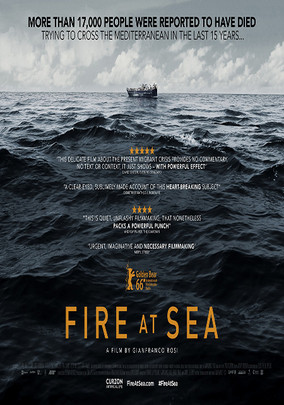
Fire at Sea was honored with a coveted 2017 Best Documentary Feature Oscar Award nomination, but despite this high achievement, it received largely negative reviews from its viewers.

This is not as surprising as it might seem.

The documentary was also the Italian entry for the Best Foreign Language Film category but was not chosen. It is a hybrid between a “typical” film and a documentary, making it all the more unique.

The lackluster comments are undoubtedly due to the documentary’s slow pace and the way it intersperses snippets of the story, which do not weave together with the main message.

Compounded by the length (one hour and fifty-four minutes is very long for a documentary), the work will not go down in history as a rousing crowd-pleaser.

But it is an important film.

The story tells of a group of modest individuals inhabiting a tiny Sicilian fishing island named Lampedusa between Sicily and Libya. The island is prominent for being a rescue area for migrants forging a treacherous journey from African countries (mainly Libya and Sudan) to the island for safety and medical treatment.

It is implied that the migrants do not stay on the island for very long. Lampedusa serves as a temporary sanctuary. It is not explained where the migrants go or what happens to them after medical treatment.

After a slightly tedious start, I immersed myself in the various stories and began to appreciate the slow pace.

I found this calming.

We see snippets of daily events: a young boy and his friend carve a face out of cactus plants. Later, the boy undergoes an eye exam and is told he needs glasses. We then see a lengthy scene of his family eating pasta.

We also get to know a resident doctor, grandmother, disc jockey, and scuba diver.

Admittedly, I began to wonder what a young boy preparing a slingshot or a grandmother preparing sauce had to do with the documentary’s main subject, migrants coming to the island.

Then I realized that director Gianfranco Rosi was telling a human story. The ordinary Lampedusa citizens’ lives contrast with the fleeing and terrified migrants.

I was able to put all the pieces together.

Fire at Sea is unusual, as it is told without narration and with dialogue in Italian containing sub-titles. These are additional unique aspects of the project, but I admired its essential message.

The most powerful scene in the film is a quiet one with a resident doctor describing his experiences with the migrants.

He professes how any decent person should help any needy soul and describes the grisly task of performing autopsies on the people (many women and children) who do not survive the harried journey across the Mediterranean Sea. Many die of hunger and thirst or are burned by the diesel fuels from the tiny boats they are stuffed into.

His long yet powerful account will move one to tears.

This testimonial speaks volumes regarding the influx of needy individuals, mainly from Syria, who need help from neighboring countries.

Some have been kind and have let individuals into their countries, while others have shunned the migrants (namely in 2017, the United States).

The honest account from the doctor summarizes the message of humanity that Fire at Sea represents.

Another powerful scene emerges towards the end of the documentary, as several African men are rushed from their ship to another ship and tended to by rescuers.

Sadly, the barely alive yet conscious men are not long for this world as a few minutes later, we see a series of body bags lined up containing the expired men. This tragic realization speaks volumes about the need for such humanistic individuals in Lampedusa.

Fire at Sea (2016) is worth watching. It is a story about the fiery waters the residents could see from afar during World War II. It teaches kindness and decency and reminds us that some people are just good, generous souls, all but willing to help those in need.

We can all learn from this documentary.

Oscar Nominations: Best Documentary-Feature

Punish Me-2005

Punish Me-2005

Director Angelina Maccarone

Starring Maron Kroymann, Kostja Ullman

Scott’s Review #670

Reviewed August 9, 2017

Grade: A-

Punish Me (sometimes titled Hounded) is a provocative 2005 German-language film that pushes boundaries and titillates the viewer with its racy themes of masochism and pedophilia that will be way too much for your average viewer to marinate and digest.

Some may be completely turned off (rather than on) by this film. However, for the edgy thinker, the film is quite the find. Unique, extreme, and thoughtful, Punish Me is an experience to remember.

Shot entirely in black and white (rare for twenty-first-century cinema) the film appears bleak and harsh, cold almost- and that is no doubt an intentional measure.

The grizzled German landscape (the city is unidentified), gives the film interesting and effective cinematography, transforming the black and white colors exceptionally well, whether the scene is set in daylight or nighttime. Something about the black-and-white decision is genius.

Elsa Seifert (Maren Kroymann) is a fifty-year-old probation officer. Married and raising a teenage daughter, she appears to live a stable, middle-class existence. When one of her charges, Jan (Kostja Ullman), a sixteen-year-old, handsome young man, gives pursuit of her, their relationship turns into an obsessive, lustful situation for both.

Jan, you see, likes to be sexually beaten, and, at first, hesitant, Elsa slowly gets immersed in Jan’s world.   When other characters begin to catch wind of the situation between Jan and Elsa, the film becomes intense.

Astounding to me is the fact that Punish Me is directed by a woman, Angelina Maccarone. This both surprises and impresses me. Thought-provoking is the female perspective in the film.

Elsa is not an unhappy woman- though she nervously chain-smokes in almost every scene.

She initially has no intention of being sucked into Jan’s eccentricities. As she awkwardly spanks him in their first steamy, sexual encounter, she is gentle, yet she quickly intensifies.

Is she insecure with her middle-aged body? She gets carried away by Jan’s charms, putting both her career and her husband at risk.

Can she stop herself before it’s too late?

One wonders a few things- How would this film feel if it were directed by a man? Maccarone centers the perspective on Elsa more than she does Jan- or are we to assume that Jan, at sixteen, is merely experimenting with his sexuality and therefore not the more interesting character?

This was my determination. Elsa has way more to lose than Jan does. We are not sure why Jan is so troubled, to begin with, or why he likes to be beaten- was he abused by his parents? sexually or otherwise? What deep-rooted issues does Elsa have?

I imagined the complexities offered had the film gone something like this- Elsa is a male character. Would the man-on-boy be too much? Is female on boy safer?

One wonders, but if Elsa was a male and Jan a female, I do not think the film would be half as controversial or daring. It would seem more exploitative or dare I say, conventional.

Instead, Maccarone turns the film into a psychoanalytical feast as we wonder what makes both Elsa and Jan tick and why they enjoy the discipline scene. Perhaps there is no clearly defined answer.

The supporting characters are not explored very well, other than a fellow troubled girl that Jan beds, commenting that she is too fat (she is not), or Elsa’s husband is revealed to have once had an affair with another woman pronouncing “it was only sex, not love”.

From this, one concludes that Elsa and her husband will reunite and resume their middle-class life together, but what will become of Jan?

Thanks to effortless direction and good choices by Maccarone, she makes Punish Me (2005) an examine-worthy look at sexuality, desire, and emotions.

Many will loathe the film or not bother to give it the time of day based on the subject matter, but the film is a treat for the creative cinematic lover and lovers of analysis.

13th-2016

13th-2016

Director Ava DuVernay

Scott’s Review #669

Reviewed August 5, 2017

Grade: B+

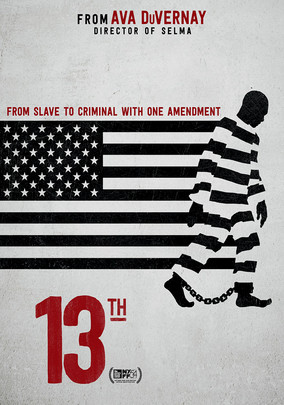
Hot on the heels of her successful feature film Selma (2014), director Ava DuVernay follows up with another race relations piece: an informative documentary entitled 13th, named after the Thirteenth Amendment to the Constitution of the United States of America, which abolished slavery.

The documentary, however, exposes loopholes in the Constitution and shows how progress has been too slow for black people since the Civil War and into modern times.

It looks at the escalating incarceration rates of the United States black population over the years and how the prison system as a whole has been used as both a money-making system and as a way of controlling minorities.

The documentary examines the United States prison system. It starts with an audio clip of former President Obama informing us that the United States has five percent of the world’s population. Twenty-five percent of the world’s prisoners are in the US, a direct message to those convinced that the US is the greatest country in the world.

This powerful message sets 13th off right as we explore why the statistic exists.

I thoroughly enjoyed the high production values of the documentary, including the modern graphics that edgily displayed the number of incarcerated blacks on screen.

13th does not feel dated or monotone as some documentaries do. Instead, it feels creative and nuanced with interviews and news clips of events such as the Civil Rights movement and Depression-era footage. Modern-day footage is included, representing over a hundred years of history.

A significant aspect of the 13th is its chronological progression through history, beginning with the Civil War and ending in 2017 when the unpopular Donald Trump was elected President of the United States.

The gloomy implication is that, with the current (2017) presidency, the minority population is still repressed and discriminated against by many political figures and that they are still primarily feared and blamed for the “perceived” high crime rates.

DuVernay’s central point is that many political figures use “scare tactics” to influence voters to vote a certain way and repeatedly fall for this strategy.

She analyzes the history and dissects several presidents’ terms and individual campaign messages, heavily featuring Nixon, Reagan, Clinton, Bush Sr., and Obama.

I love this aspect since it was a fresh history lesson for me on how the times have changed but have stayed the same.

13th avoids being too preachy and presents “both sides of the aisle.” Some feel that political figure’s harsh take on crime is not meant to repress minorities. A few of these folks are interviewed and given time to explain their viewpoints, but the film is mainly left-leaning in tone and views.

The negative portrayals of Trump, Nixon, and Reagan are proof of this.

Interviews with prominent activists such as Angela Davis, leader of the Communist Party USA, and a woman with close ties to the Black Panthers are informative. Considered a radical in her day (the 1960s), the documentary features clips of her interviews both then and now.

Current political figures Van Jones and Newt Gingrich are featured, giving 13th a crisp, modern, and relevant feel rather than a long-gone period.

Overall, I found 13th (2016) to be an educational and historical lesson in the challenges and race issues that people of color have dealt with over the years and how their world is still affected by current legislation and decisions by political figures (mainly white), who hold all the cards and repress people who speak out against them.

Oscar Nominations: Best Documentary-Feature

Independent Spirit Award Nominations: Best Documentary Feature

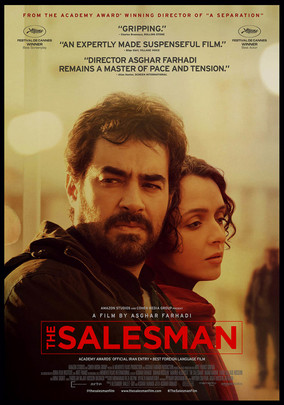
The Salesman-2016

The Salesman-2016

Director Asghar Farhadi

Starring Shahab Hosseini, Taraneh Alidoosti

Scott’s Review #668

Reviewed August 2, 2017

Grade: A

The Salesman is the latest film directed by Asghar Farhadi to win the coveted Best Foreign Language Film Oscar. 2011’s A Separation also won the crown, and 2013’s The Past, nestled between the other films, is nearly as good.

All contain mesmerizing and gripping plot elements that leave the audience in good discussion long after the film has concluded. That is what good storytelling is all about.

Rich with empathetic elements and crisp writing, Farhadi has become one of my favorite international filmmakers. Each of his pictures is as powerful in humanity as their counterparts.

Along with fellow contemporary Claude Chabrol (admittedly around a lot longer), similarities abound between the two creative maestros in the form of thrills, mystery, and differing character allegiances. I adore how both directors incorporate the same actors into their films.

Farhadi incorporates the classic stage production Death of a Salesman by Arthur Miller into the story. The play and the film contain similar themes- humiliation and secrets.

The young and good-looking couple, Emad (Shahab Hosseini) and Rana (Taraneh Alidoosti), are community theater actors living in metropolitan Tehran, Iran.

They have wonderful friends and companions and are popular with their close neighbors and theater buddies. Emad, a well-liked high school teacher, and Rana, a housewife, make a perfect couple, but their bond will soon be severely tested.

Forced to move from their crumbling apartment into temporary quarters owned by a theater friend, they are unaware that the former tenant worked as a prostitute and had a bevy of gentleman callers.

She carelessly left the unit, leaving behind all of her belongings for them to sift through. One night, when Rana is home alone, she inadvertently allows a mystery person to enter, which leads to a terrible incident.

The film centers on determining what exactly happened between Rana and the intruder. Is she hiding the truth? Can she and Emad overcome the implications of the events?

The audience is presented with a powerful, intriguing mystery to absorb and unravel. Throughout most of the film, questions are raised to be considered: Who was the intruder? Will Emad exact revenge? What happened?

The brilliance of The Salesman is that we, as the audience, never actually see the incident inside Emad and Rana’s apartment, so we are baffled by what has transpired. We merely witness the after-effects and the questions the characters (mainly Emad) have.

Is Rana being truthful? Did she know the man who entered the apartment? Was it even a man or perhaps the former female tenant? With Farhadi, anything is possible, but rest assured, a startling climax will ensue.

The genius is how the viewer’s loyalties will be divided by character and change within a scene.

In one tense sequence, a heroic character becomes the villain and slowly returns to being the hero again, which is a topsy-turvy experience!

The Salesman is smothered with a roller coaster of emotions and feelings.

The way that more than one of the central characters changes their motivations is essentially the film’s most tremendous success. Rana, Emad, and “the Man” are flawed, complex characters, and what a treat it must have been for these actors to sink their teeth into these roles.

A special mention must be given to the other actors involved in the film. The Salesman is fraught with great performances, big and small.

In addition to the leads (Hosseini and Alidoosti), the supporting cast exudes immeasurable talent. Farid Sajadhosseini as “the Man” is astounding, and his family members, who appear mainly in the conclusion, deserve much praise.

These minor characters appear during the most pivotal part, giving it the acting chops to pull the result.

Asghar Farhadi hits another one out of the park with The Salesman (2016), and how deserving is the Oscar win for this man, a director whose films are always sure to be compelling, thought-provoking treats?

I cannot wait for his next film.

Oscar Nominations: 1 win-Best Foreign Language Film (won)