Category Archives: Ghost Story

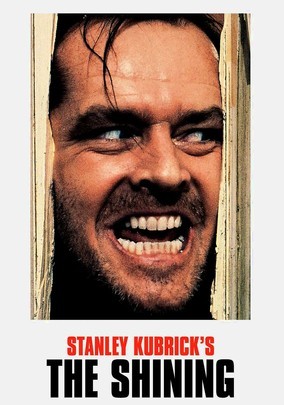
The Shining-1980

The Shining-1980

Director Stanley Kubrick

Starring Jack Nicholson, Shelley Duvall

Top 250 Films #21

Top 40 Horror Films #6

Scott’s Review #313
959008

Reviewed December 31, 2015

Grade: A

The Shining is one of the great horror masterpieces of all time.

Released in 1980, and atypical of the slasher craze that was rampant at that time, the film is a psychological ghost story with frightening elements, including a musical score, long camera shots, and a haunting, grandiose hotel set in a deserted locale.

Without the brilliant direction of Stanley Kubrick, The Shining would not be the masterpiece it is, to say nothing of Nicholson and Duvall’s talents in the lead roles.

Based on the popular horror novel by Stephen King.

Nicholson plays Jack Torrance, an author and alcoholic, who takes his wife Wendy (Duvall) and son Danny to serve as caretakers at the vast Overlook hotel, for the winter in snowy Colorado.

The lavish hotel will be deserted for the season, and Jack looks forward to months of peace that will enable him to complete his novel.

Unfortunately, the hotel is haunted by spirits of the past, and the added burden of the previous caretaker going mad and chopping his family to bits with an ax.

The real success of The Shining is that the hotel itself is a character with its own nuances. The hotel is deathly quiet as the Torrances take over for the season-long hallways are featured, and the forbidden Room 237 takes on a life of its own.

Creepy images of two young girls and red blood gushing from the elevators take over. Young Danny can communicate with the chef without speaking to each other. Jack imagines a gorgeous nude woman in the bathtub, only to discover she is a shriveled old hag.

The film’s cinematography, coupled with the looming, morose musical score, goes hand in hand and, in my opinion, is the reason for the film’s success.

Throughout the film, there is a sense of dread and a forbidden presence that works beautifully.

The first scene is an aerial shot of the Torrances driving along a mountainous road as they are interviewed for the caretaker position. The vast land and mountains, as we eventually see the Overlook, immediately convey a sense of isolation, which is really what the film is about.

These exterior scenes are also gorgeous to marvel at.

The crisp, gloomy winter scenes and the endless maze of animal shrubbery come into play in the film’s final act as Jack, now completely mad, chases Danny along snowy paths that seem to lead nowhere.

The catchphrase, “Here’s Johnny!”, that is uttered from an ax-wielding Nicholson, is permanently ensconced in the relics of pop culture.

Nicholson and Duvall have such dynamic and palpable on-screen chemistry that makes the film work from a character perspective. There is something slightly off about each character, readily apparent from the outset, but it has more to do with each actor’s rather non-traditional appearance.

I can imagine no other actors in these roles.

Author Stephen King, who reportedly despised the film version of his novel, has since grown to respect the film and Kubrick’s direction a great deal.

The Shining (1980) is one of my favorite horror films and one of my favorite films of all time.
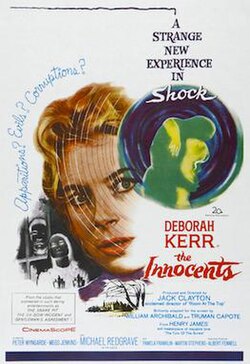
The Innocents-1961

The Innocents-1961

Director Jack Clayton

Starring Deborah Kerr

Top 250 Films #94

Top 40 Horror Films #17

Scott’s Review #639

Reviewed April 29, 2017

Grade: A

The Innocents is a 1961 British psychological horror film that tells a ghost story, based on the novella “The Turn of the Screw” by Henry James.

Although it is a horror film, it contains few traditional elements, such as contrived frights, jumps, and blood.

Instead, the film succeeds by using lighting and magnificent cinematography by Freddie Francis.

And, of course, fantastic storytelling and direction from Jack Clayton.

Deborah Kerr gives an excellent turn as a beleaguered governess hired by a wealthy bachelor (Michael Redgrave) to tend to his young niece and nephew, Flora and Miles.

The setting is a lavish yet creepy mansion located outside London. As the Uncle goes away to India on business, Miss Giddens, with no previous experience, is left to tend to Flora and Miles, who both begin acting strangely.

To complicate matters, Miss Giddens sees sinister ghosts lurking around the property. The ghosts are former household servants who have passed away, of whom Miss Giddens has never met.

Miss Giddens is assisted only by the kindly housekeeper, Mrs. Grose (Megs Jenkins), who tells her about the servants’ tragic deaths.

The Innocents, shot in black and white, uses sound to its advantage. This, combined with the interesting camera angles and focus shots—mainly of the ghosts Miss Giddens sees—makes the film unique and scary.

When Miss Giddens hears strange voices, she becomes convinced that Miles and Flora are playing tricks on her, engaging in games. The whispers’ sounds are haunting and do wonders for the effects, chilling the viewer as the film progresses.

Is Miss Giddens imagining the voices and visions, or is this an actual reality? Could the children be sinister and playing a vicious prank on her? Could Mrs. Grose be evil?

Nobody else within the household sees or hears anything amiss- or admits to it.

Kerr, a treasured actress, plays the part with emotional facial expressions and genuine fear, so much so that she wins the audience over as we side with and empathize with her character.

Still, is she a woman on the verge of a mental breakdown? Does she have past mental problems?

Like the uncle, we know nothing of her past, only that she claims to be the daughter of a minister. How, then, does she have stylish, expensive clothes? Could she only be pretending to be a governess? Has she run away from her past?

The Turn of the Screw is a true ghost story, but The Innocents is a bit different —it relies, successfully, on being more of a character-driven story.

As Miss Giddens becomes convinced that the servants’ spirits have possessed both children, she makes it her mission to rescue them from the spirits. We have an ominous feeling that events will not end well, and they do not.

Several scenes will frighten the viewer, as Miss Giddens sees a haggard ghost (the female servant) standing quietly in the distance by a lake while Flora dances chirpily; the image of the distant ghost is eerie and well shot.

The film draws comparisons to the classic Hitchcock film Rebecca (1940). Each is set in a large mansion and features complex villains portrayed as deceased.

Also, the main character’s sanity is in question.

With a compelling story and the nuts and bolts that deliver clever effects and a chilling conclusion, the film succeeds as an excellent, intelligent horror film.

With great acting all around, including fantastic performances by child actors, The Innocents (1961) scares the daylights out of any horror fan and uses exterior and interior scenes to make the film an all-around marvel.

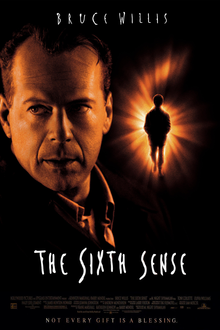
The Sixth Sense-1999

The Sixth Sense-1999

Director M. Night Shyamalan

Starring Bruce Willis, Haley Joel Osment

Top 250 Films #106

Top 40 Horror Films #20

Scott’s Review #182

Reviewed October 8, 2014

Grade: A

The Sixth Sense is a psychological thriller/horror film directed by M. Night Shyamalan, released in 1999, about ghosts, and was an incredible box-office and critical success at the time of its release, making the line “I see dead people” universally imitated.

Bruce Willis stars as Dr. Malcolm Crowe, a successful and admired child psychologist who lives a perfect life with his wife, Anna, in Philadelphia.

Enjoying a romantic night at home, Malcolm and Anna are interrupted by a deranged former patient, played by an unrecognizable Donnie Wahlberg.

Malcolm is shot by the patient, who also shoots himself, and the story picks up a year later as Malcolm takes an interest in Cole, a troubled 9-year-old boy, played by Haley Joel Osment.

Cole is a peculiar boy- an outcast taunted at school- who can see the dead.

He’s worried about his overworked mother, Lynn, who Toni Collette plays.

Meanwhile, Malcolm and Anna appear to be experiencing marital problems and lack meaningful communication with each other.

Anna begins to be pursued by a new beau, much to Malcolm’s chagrin. Malcolm and Cole develop a special bond as Malcolm convinces Cole to speak to and help the ghosts that he sees rather than be terrified of them.

As the plot slowly unfolds, Cole helps a recently deceased girl named Kyra Collins, who is around his age. Kyra gives Cole a videotape that reveals she was murdered and proves who killed her.

The subsequent scene is my favorite- there is a haunting quality to it, and the camera follows the events interestingly, slowly, and sedately.

The setting is a service at Kyra’s house, where family and friends gather to pay respects and support Kyra’s parents. Malcolm and Cole arrive and present Kyra’s father with the plain videotape.

The entire scene is powerful in its simplicity, yet it carries great emotional weight. It is slow, but devastating in its climax and reveals. Small nuances are revealed- why is Kyra’s mother wearing bright red when the other guests are all wearing black? Will Kyra’s younger sister be the next victim?

Superlative filmmaking.

A scene involving Cole’s teacher is riveting: sensing aspects of his teacher’s past, Cole realizes his teacher had a stuttering problem as a child.

When his teacher is condescending towards Cole, the young boy explodes with rage and begins a chant of “tuttering Stanley,” which reduces the teacher to childhood traumas.

Yet another powerful scene involves Cole and his mother sitting in a car caught in traffic- Cole admits the truth of his skill of seeing dead people to her and introduces an emotional story to her as proof.

This is a scene where Toni Collette shines brightly.

Well over a decade since The Sixth Sense was released, most people know the twist and the subsequent surprise ending, and it is such a joy to go back, see the manipulations in the story and in individual scenes, add them up, and revel in the clever way Shyamalan puts them together.

The Sixth Sense is not dated and is quite fresh, holding up tremendously well, and I still get chills during the big reveal all these years later.

But beyond this pleasure, the film is beautifully written. Somewhere between horror and psychological thriller, it successfully tells a ghost story with interesting characters and jumps-out-of-your-seat thrills that are not contrived or predictable in the traditional horror-film way.

From an acting perspective, Bruce Willis is amazing and under-appreciated as Malcolm- he is calm, cool, and collected. His performance is quite understated as the inquisitive and pensive psychologist.

More praise should have been reaped for Willis.

Haley Joel Osment gives an astounding performance of a lifetime- he emits an image to the audience of being strange yet sympathetic, and he relays his very frightening fear of the ghosts so well that the pain and conflict he endures are evident on his face.

Toni Collette is effective as the scared, concerned, haggard mother. Collette and Osment were rewarded with Academy Award nominations- sadly, Willis was not.

Shyamalan was subsequently ridiculed for his later films (The Village, 2001, and Unbreakable, 2001) – perhaps the manipulation and trickery from The Sixth Sense angered some people.

The Sixth Sense (1999) is a film that remains with you for days, weeks, even years, and can be revisited and rediscovered for an intelligent, chilling good time.

Oscar Nominations: Best Picture, Best Director-M. Night Shyamalan, Best Supporting Actor-Haley Joel Osment, Best Supporting Actress-Toni Collette, Best Screenplay Written Directly for the Screen, Best Film Editing