Category Archives: HBO

Game Change-2012

Game Change-2012

Director Jay Roach

Starring Julianne Moore

Scott’s Review #1,094
Reviewed December 23, 2020

Grade: B

Sarah Palin is an idiot. John McCain is not. We didn’t know that in 2008. We do now.

Somehow their different worlds collided as partners in crime for the 2008 United States Presidential election; she was the vice-presidential nominee to his.

McCain’s people wanted a fresh face, someone with charisma, who could help defeat the surging U.S. Senator from Illinois, named Barack Obama.

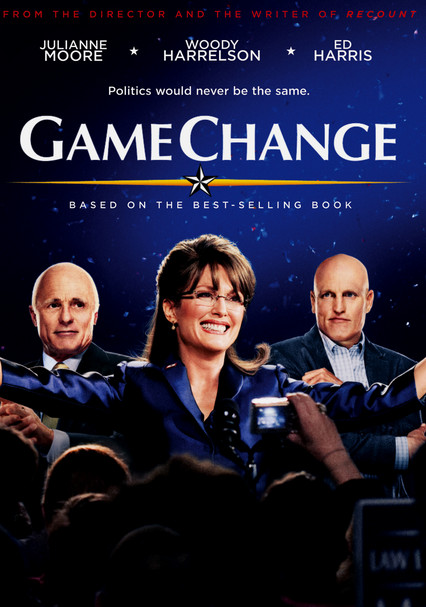
Game Change (2012), an HBO film, chronicles how an unknown female governor from Alaska was chosen as McCain’s running mate without proper vetting, leading to one of the biggest political fiascos of the twenty-first century.

The production is a well-acted, well-paced affair that makes even the most liberal viewer (me!) sympathize, ever so slightly, with Palin, who was thrust into the spotlight at lightning speed.

Julianne Moore takes center stage, giving the political figure empathy and some heart.

Woody Harrelson as the campaign’s senior strategist, Steve Schmidt, and Ed Harris as John McCain provide levity.

The acting is the film’s best part. Otherwise, the film might have been best served as a documentary (more about that below).

As believable as Moore, Harrelson, and Harris are, they feel like performances rather than authenticity. They try to give their best interpretations of the players instead of immersing themselves in their bodies.

Maybe that’s the point of the film?

I love how the film opens.

In 2010, after the debacle has ended, Steve Schmidt sits uncomfortably before Anderson Cooper from CNN.

He asks Schmidt whether Palin was chosen as VP because she would make the best vice president or because she could win the election.

The question is poignant and forms the basis of the entire film.

Another excellent sequence is set during the Republican National Convention. Palin’s speech is well received, bombastic even, and energetic, catapulting her as the potential saving grace of the party.

Sadly, for her, the campaign becomes concerned that she is ignorant about many political issues and grossly unprepared.

These scenes are the weakest- the audience laughably realizes she believes Korea is one country, and many other gaffes follow.

But, unless you’ve been hiding under a rock, this is common knowledge.

Game Change makes a mistake by editing too many snippets of real-life interviews and other news media moments. This detracts from the dramatization that is the intention and makes me wonder why a solid documentary wasn’t made instead.

Jay Roach, who directs Game Change, revels in close-ups, especially of Palin, perhaps as a nod to her being thrust onto every television station in the United States.

Danny Strong screenwrites the project.

The duo sets up the predictable situations nicely—Palin’s disagreements with McCain, the woman, not his choice. For reference, he wanted Joe Lieberman, a moderate from Connecticut who was considered “boring”.

Let’s give the most credit to Moore. The actress doesn’t exactly embody Palin. She is more like a dressed-up impersonator, hardly Charlize Theron flawlessly playing Aileen Wuornos.

But she does make the audience care about her and feel sorry for her. Palin had no idea what she was in for, nor did she know what she signed up for. Moore portrays the emotions well.

Moore carries the film. Palin became a source of venom and mockery after her embarrassing interview with Katie Couric, in which she couldn’t name any magazines.

She quickly became the whipping girl rather than the ‘it’ girl.

The message is competent without feeling preachy or overpowering, but Game Change feels a bit dull. Schmidt and Nicole Wallace chose Palin, making the enormous mistake of knowing very little about the woman.

Game Change (2012) is recommended for those who want to be entertained or who desire a history lesson without seeing the real people.

I still think a documentary would have worked better.
Behind The Candelabra-2013

Behind the Candelabra-2013

Director Steven Soderbergh

Starring Michael Douglas, Matt Damon

Scott’s Review #411

70274808

Reviewed June 18, 2016

Grade: A

I thoroughly enjoyed this HBO film about Liberace, whom I was too young to know much about before seeing it.

The film fully explores the excesses of his lavish lifestyle.

The standouts are Michael Douglas and Matt Damon, who are both exceptional in their portrayals of Liberace and his young lover. At times, both are unrecognizable and fully embody their characters.

I can’t attest to the story’s absolute truth, but the HBO film does a nice job of mixing joy, passion, heartbreak, sadness, and competition throughout.

The story undoubtedly bears a likeness to many Hollywood troubled relationships past and present.

The Normal Heart-2014

The Normal Heart-2014

Director Ryan Murphy

Starring Mark Ruffalo, Matt Bomer

Scott’s Review #198

70302186

Reviewed December 1, 2014

Grade: B+

The Normal Heart is a 2014 HBO television movie based on the true story of Ned Weeks, an openly gay AIDS activist/writer, played by Mark Ruffalo.

The film is set during the period when the epidemic first surfaced, from 1981-1984, and the challenges and frustrations faced, mostly within the gay community, to bring exposure and assistance to the disease.

Weeks was famous for building a group of passionate members who banded together to overcome these struggles.

Brad Pitt produced the film.

This is wonderful to know, as films with this content (AIDS) are often tough to produce. It’s wonderful that Pitt’s wealth and influence were used effectively.

At a vastly different time in the country to be gay, the government did very little to assist with financing for treatment or researching a cure for it, which is the main point of the story.

The talented cast makes this film what it is.

Matt Bomer plays Ned’s closeted gay lover, Felix Turner, one of the many casualties of the deadly disease. Bomer lost 40 pounds to prepare for the role.

Julia Roberts plays polio-stricken doctor Emma Brookner, who helped the sick when few others in the medical community would.

Other supporting actors include Alfred Molina, who plays Ned’s supportive, powerful attorney and brother, and Joe Mantello, who delivers a terrific meltdown scene as his anger and anguish over the government not taking the disease seriously finally bubble to the surface.

Finally, Mark Ruffalo plays Ned competently, but why the slight feminization? The real Ned Weeks was masculine. A needless stereotype the film (or Ruffalo) chose to pursue.

The film shows the discrimination faced by people living with AIDS, from an airline pilot refusing to fly a plane carrying a sick patient, to an electrician refusing to enter a patient’s hospital room to fix a television set.

It is sad to realize how ridiculous these unfounded fears proved to be.

According to the film’s statistics, a major point of the film is how the United States Government, specifically President Ronald Reagan, did very little in the way of funding or even wanting to discuss the issue for years following the initial outbreak, resulting in thousands of lost lives.

And why exactly is Reagan considered a great President?

It makes one ponder. It was only due to beloved Hollywood star Rock Hudson contracting and dying from the disease. Elizabeth Taylor used her star power to get people involved, which finally led to the topic being discussed and action taken on a federal level.

My slight criticism of the film is that it looks and feels like a television movie, similar in texture to HBO’s Behind the Candelabra (2013).

The colors are bright and vivid, and it looks television-like. It could have used darker lighting and perhaps a gloomier, more dour feel, especially given the subject matter.

Otherwise, thumbs up, and respect for bringing this story to millions of viewers and hopefully educating those who weren’t there.