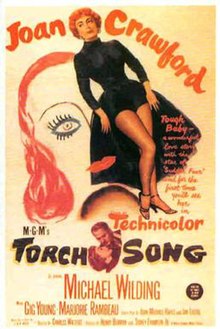
Torch Song-1953

Torch Song-1953

Director Charles Walters

Starring Joan Crawford, Michael Wilding, Gig Young

Scott’s Review #1,402
Reviewed September 25, 2023

Grade: B

Since I’m a huge fan of legendary Hollywood Actress Joan Crawford, I’ll willingly watch any of her films, both quality and mediocre.

Her style, confidence, clothes, makeup, and, yes, those eyebrows capture me every time I see her. She’s also a damned good actor.

Torch Song (1953) is a film made when her career was waning despite just scoring an Oscar nomination the year before for Sudden Fear (1952).

She would find success in the 1960s with Whatever Happened to Baby Jane? (1963).

The film is fun to watch because it reportedly best captures her true personality in a role that is realistic to who she was. Faye Dunaway even studied the role closely before she portrayed the star in 1981’s cult classic Mommie Dearest.

The story is about a talented and demanding Broadway star named Jenny Stewart, played by Crawford. She is used to snapping her fingers and having her every whim catered to without question. She rewrites scenes and fires talent for shows she stars in if she deems them beneath her.

One day, she meets her blind rehearsal pianist, Tye Graham (Michael Wilding), and finds herself attracted to him. At first, clashing over his refusal to put up with her bullshit, she comes to realize she admires him.

The feeling is mutual,l and the lovebirds tenderly nurture their budding relationship.

I’m unsure if non-Crawford fans would appreciate or enjoy Torch Song as much as we die-hards would. The story is essential, with few twists and turns, and it’s not hard to imagine that Jenny and Tye will wind up together.

Torch Song was famously spoofed by comedienne Carol Burnett in the 1970s on her television show when she replicates a dress rehearsal scene from the film in a hilarious fashion.

But Crawford is devilish and fierce in the film. She prances confidently in each scene wearing getups as outlandish as a haughty yellow nightgown with high-heeled slippers and a garish scene from the production wearing  ‘black face’!

When she yanks off her wig, revealing her messy red hair, black face, and wide, emotion-infused eyes as she desperately watches Tye exit the auditorium, the scene rivals any scary scene from a horror film.

Jenny is the star as much as Crawford is, and one wonders if she had the same ferocious clout as the fictitious character. We’ll have to ask the cast if any are still alive.

India Adams dubbed Crawford’s singing voice. She lip-syncs to the recording Adams originally made for Cyd Charisse in a number discarded from the 1953 film The Band Wagon.

When she belts emotional numbers like ‘Two-Faced Woman, the comic relief is unintentional. Adams sounds nothing like Crawford, which makes the dubbing glaring and nearly pitiful. Crawford had a decent voice and sang songs that were only available on the home video release.

Oddly, actress Marjorie Rambeau, who played Crawford’s mother, received an Oscar nomination for the role. Her performance is adequate but not Academy Award-worthy.

This must have irritated Ms. Crawford, who wasn’t known for being a gracious co-star. She must have felt usurped.

Crawford seamlessly carries the film from beginning to end credits like the seasoned professional she always was. She pokes her co-stars and chews up the scenery like nobody’s business.

Deserving of mention is actor Michael Wilding since he is equal to Crawford in performance. He never appears outshined or swallowed whole during a scene; instead, he relays good chemistry with her.

A mediocre Torch Song (1953) is made better by the mix of the competitive Broadway lifestyle and the star playing a ferocious and seasoned veteran.

Oscar Nominations: Best Supporting Actress-Marjorie Rambeau
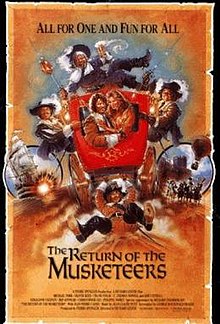
The Return of the Musketeers-1989

The Return of the Musketeers-1989

Director Richard Lester

Starring Michael York, Oliver Reed

Scott’s Review #1,401

Reviewed September 24, 2023

Grade: B

The Return of the Musketeers (1989) is the third Musketeers film directed by Richard Lester, following 1973’s The Three Musketeers and 1974’s The Four Musketeers.

George MacDonald Fraser wrote each screenplay.

This is key to mention because a strong continuity helps make the film fun and charming.

The results of the same person directing and writing resonate on screen in several ways. The characters feel truthful, and their motivations are clear.

A rich sense of the characters’ history is apparent, making the film a pleasing adventure for fans of the franchise.

After ambitious Oliver Cromwell (Alan Howard) overthrows the king, Cardinal Mazarin (Philippe Noiret) enlists a down-and-out D’Artagnan (Michael York) to rally the Musketeers against him.

Porthos (Frank Finlay) accepts the mission at once, but Athos (Oliver Reed) and Aramis (Richard Chamberlain) hesitate at first. Eventually, the three reunite, but they are soon torn apart by infighting and a situation from their past.

They get a chance at redemption when they are sent to England to save the life of King Charles I (Bill Paterson).

There is some slapstick play to endure, making The Return of the Musketeers feel juvenile at times when characters are bopped over the head or otherwise trip and fall in silly form.

For this type of adventure film, the plot is too complicated and veers in different directions a shade too often. I wondered more than once if I was in France or England.

This makes the minor characters difficult to keep track of, and Christopher Lee’s character of Comte de Rochefort once again has little to do.

The costumes and the French setting are a major victory, and the history lessons provided, especially the British and French kings and queens, are more than fulfilling.

We delved into our history books to determine which King Louis reigned when and who was aligned with the film (it’s Louis XIV during the 1600s).

The point of the film, made 15 years after the second film, is to please fans, and the result is a huge success.

I’m a sort of fan with my hubby being a big fan, and we both enjoyed the resurfacing of familiar characters.

It feels like old-home week. The reunion of the musketeers feels like witnessing a family reunion. As D’Artagnan, Porthos, Athos, and Aramis embraced each other, we felt their warmth.

Since the characters played by Raquel Welch and Faye Dunaway (Milady) were dead, a creative idea was to introduce her daughter, Justine, played by Kim Cattrall, into the story. Athos also has a son named Raoul, played by C. Thomas Howell.

This provides a further nod to history and introduces compelling lead characters who have a connection to familiar characters.

It is also an example of good writing and storytelling. Despite the characters being new to the audience, we already care about them because of their ties to other beloved characters.

To make the film more sentimental, a sad incident occurred during filming. Actor Roy Kinnear, who plays lovable Planchet, died following an on-camera accident in which he fell off a horse.

His role was completed using a stand-in, filmed from the rear, with lines dubbed in by a voice artist.

The film is dedicated to him.

Reuniting most of the original cast years later makes The Return of the Musketeers (1989) a warm experience.

Beautiful costumes, locales, and history raise the film above expectations, considering it’s a third installment.

Spoiler Alert-2022

Spoiler Alert-2022

Director Michael Showalter

Starring Jim Parsons, Ben Aldridge, Sally Field

Scott’s Review #1,399

Reviewed September 15, 2023

Grade: A-

Spoiler Alert (2022) comes dangerously close to being classified as a Hallmark Television Movie of the Week tearjerker with standard cliches and a predictable storyline. While the ending is no surprise, the film works incredibly well and fires on all cylinders.

I laughed, cried, and felt an enormous connection to the central characters in what could become a seasonal holiday watch.

I recently reviewed another film that, on the surface, sounded saccharin and contrived but pulled me in nonetheless. The lesson learned is not to make assumptions about the quality of films.

The direction is conventional, but the story and characters are absorbing and heartwarming with spectacular acting, especially among the two lead actors, Jim Parsons and Ben Aldridge. An added gift is the appearance of Sally Field in a supporting role as an overbearing but lovable mom.

In 2001, Michael Ausiello (Parsons), a writer for TV Guide, begrudgingly goes to a gay nightclub with his best friend in Manhattan. There, he meets photographer Kit Cowan (Ben Aldridge), and the two instantly connect.

As they begin dating, Michael struggles with insecurities about not being attractive enough for Kit, since he was an overweight child. Kit is athletic and good-looking, oozing confidence. Michael was a ridiculed kid watching soap operas with his mother and creating a pretend sitcom family.

He also overindulges in the Smurfs collection.

They both admit their fears of being in a long-term relationship since neither of them has been in one before, but they decide to continue dating.

Hurdles then plague the couple as Kit must come out to his parents, Bob (Bill Irwin), and Marilyn (Field), to explain who Michael is, and ultimately they all must face Kit’s stage IV cancer diagnosis.

I recognize how Spoiler Alert doesn’t possess the most original screenplay, written by David Marshall Grant and LGBTQ+ advocate Dan Savage, and based on a story written by real-life Michael Ausiello.

The tried and true story point of a gay male character struggling to come out to his parents has been done for decades in LGBTQ+ films.

The insecure partner feels inferior to the more confident partner, and it affects their relationship. This point has also been discussed before. Michael is convinced that Kit will dump him for someone else.

Hell, we’ve seen both of these cliches as recently as 2022 in Bros., a fantastic LGBTQ+ mainstream film that used both.

In Spoiler Alert, they work because of Parsons and Aldridge and the chemistry they have together, and the nuanced delivery of the characters separately.

While they each want love and a relationship, neither is desperate. As they banter back and forth, Michael awkwardly removes his clothes during their first intimacy, and the actors playfully frolic immediately at ease with one another.

Many cute scenes follow.

Events then grow serious as we move beyond Kit’s uneven coming out to his parents (of course, they embrace Kit and Michael instantly!) and dive headfirst into Kit’s cancer battle.

The film makes no secret that Kit will die of cancer. It’s practically shown in the opening scene as he and Michael lie in a hospital bed together, and Michael narrates the story.

It’s called Spoiler Alert for a reason. But instead of ruining the film, it only enhances the love story to come. We know that Kit and Michael become soul mates, and the pleasure is watching them grow and flourish together.

Since Michael’s mother, and presumed best friend, died of cancer, it only strengthens the investment in the character.

As Kit becomes weaker, my fondness for the two men becomes stronger. The maturity and love for one another are apparent, especially when Michael selflessly invites a man whom Kit had an affair with to say goodbye to Kit.

It’s a touching scene, but not as touching as the scene where Michael and Kit’s parents sob over Kit’s hospital bed.

Yes, Spoiler Alert (2022) may have manipulated me with a conventional film, but Parsons and Aldridge have better chemistry than most opposite-sex couples.

I thoroughly enjoyed my way through the film without dry eyes.

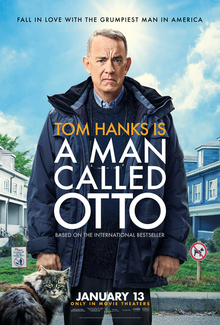
A Man Called Otto-2022

A Man Called Otto-2022

Director Marc Forster

Starring Tom Hanks, Mariana Trevino, Truman Hanks

Scott’s Review #1,398

Reviewed September 13, 2023

Grade: A-

I hedged slightly on seeing the film A Man Called Otto (2022) because it looked like an overly sentimental, predictable melodrama. It also missed out entirely during the 2022-2023 awards season, which means that the film had its share of critical detractors.

But I do love and admire Tom Hanks, both professionally and personally, even though he can be accused of choosing marginally safe material.

Though the film explores a tried and true formulaic setup, my heartstrings were immediately and severely pulled by the events in the movie. I may have been manipulated into teariness, but in the best of ways, and I didn’t mind a bit.

I enjoyed A Man Called Otto much more than I ever thought I would.

It is an American remake of the 2015 Swedish film A Man Called Ove, based on the 2012 novel by Fredrik Backman.

Otto Anderson (Tom Hanks) is a grumpy widower whose only satisfaction comes from abiding by and enforcing his neighborhood rules and regulations and criticizing and judging his exasperated neighbors.

When a young Hispanic family moves in next door, he connects with the no-nonsense and very pregnant Marisol (Mariana Trevino), leading to an unexpected friendship that softens and unnerves the crotchety man.

As the pair bond, the audience learns more about Otto and his deceased wife Sonya (Rachel Keller) through flashbacks. The once youthful and determined couple faces terrible obstacles as we realize why Otto has become so depressed and irritable.

A Man Called Otto is very conventional, polished, and sentimental, and could arguably be accused of being a tad dramatic. It’s not a dangerous film, nor does it present material viewers have never seen before.

Nonetheless, it works!

The reasons it works so well start with Tom Hanks. A two-time Oscar winner who has played many types of characters before, he portrays his character with flourishing comedy and dramatic gusto.

We like Otto even though he could be classified as an asshole.

Despite Hanks’s acting ability, he is only part of the enjoyment of the film.

Worth mentioning is that the very liberal Hanks and his wife Rita Wilson co-produced the film, and I’m glad they did.

A heavy dose of diversity and inclusivity is plopped into the film. Otto’s neighbors are a black couple who have been Otto and Sonya’s best friends for decades.

Otto confronts a teenager named Malcolm for delivering advertising circulars, and the boy recognizes Otto as his former teacher’s husband, recounting that Sonya supported him as a transgender student when nobody else did.

Sonya courageously led an effort to convince the other teachers to call Malcolm by his desired name respectfully.

Another win is the frequent flashbacks to when Otto and Sonya first met. A nervous but smitten Otto intentionally gets on the wrong train to bring Sonya a book that she has accidentally dropped on the platform.

They eventually dine in a nice restaurant, where he encourages Sonya to have a lovely entrée while he dines on a meager bowl of soup because of financial issues.

Truman Hanks (Tom’s son), Rachel Keller, and Mariana Trevino deliver outstanding performances in supporting roles.

Finally, a feral cat that reminds me of my darling cat Zeus stole my heart. He also steals Otto’s.

It’s these trimmings that make the film a crowd-pleaser and a charming sentiment. The story feels fresh even though other films have had the same type of message. A case could be made that Otto is Ebenezer Scrooge in a non-Christmas film.

I may not necessarily need to see A Man Called Otto (2022) again since it’s a one-shot deal type of movie, but I’m glad I did. The film reaffirms that there are good people in the world who selflessly look out for each other without needing personal gain.

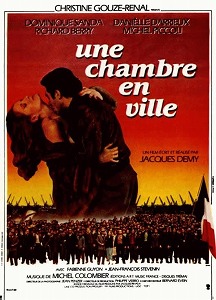
Une Chambre en Ville-1982

Une chambre en ville-1982

Director Jacques Demy 

Starring Dominique Sanda, Richard Berry

Scott’s Review #1,397

Reviewed September 10, 2023

Grade: A

Une chambre en ville (also known as A Room in Town) is a 1982 French musical drama film written and directed by Jacques Demy, with music by Michel Colombier, and starring Dominique Sanda, Danielle Darrieux, and Michel Piccoli.

Those familiar with Demy’s other works, such as The Umbrellas of Cherbourg (1964) and The Young Girls of Rochefort (1967), will be aware that his preferred genre is musical drama. In Une Chambre en Ville, the dialogue is entirely sung.

And those unfamiliar with his work are recommended to give his films a chance. They are flavorful and offer exceptional production design, to say nothing of other ingredients.

I liken the film most to The Umbrellas of Cherbourg because the story involves two people destined to be together, but who are thwarted by many obstacles that threaten to ruin their happiness.

Demy creates a distinct Shakespearean Romeo and Juliet final ending in the best possible way.

The story is set during a workers’ strike in Nantes, France, in 1955. A steelworker named Francois (Richard Berry) has a fling with the married daughter, Edith (Dominique Sanda), of his widowed landlady, Margo (Danielle Darrieux).

His girlfriend Violette (Fabienne Guyon), who works in a shop and lives with her mother, wants to get married, but he is unwilling, partly because they have no money and nowhere to live.

Oh, and he has also met Edith.

On the street, François is accosted by Edith, a beautiful woman who wears only a fur coat and has decided to take up part-time prostitution to pay bills. Her husband owns a struggling television shop.

The two have a blissful night together in a cheap hotel and fall madly in love.

Une Chambre en Ville is at first jarring because the dialogue is in the form of a song. But after merely a few minutes, I became invested and enamored with the characters. This occurs when Francois and Margo discuss the strike, and although she is upper class, she supports the workers.

They quickly bond.

Before this, though, the tone is set with black-and-white cinematography of the workers’ strike that quickly turns to color. My hunch is that Demy wanted to promote the seriousness of the situation and alert the audience that they were not watching a rosy musical with tap-along tunes.

There’s a message of pain, struggle, and depression, which doesn’t make the film a downer either.

As with Demy’s other films, the art direction and set designs are gorgeous. The director has a talent for introducing the most fragrant colors like red, yellow, blue, and green, which are powerful and enshroud the characters in pizazz and vibrancy.

The highlights are Margo’s apartment, drizzling with red color and contemporary patterns and furniture, and Edith’s husband’s television shop. The greenish hue reveals a tacky yet sophisticated French style. These and other sets are superior efforts.

The main attraction is Francois and Edith, and I was smitten with them almost immediately. Some may think this is odd because basically, Francois dumps his nice girlfriend for a sexy prostitute who flashes her naked body to him and then beds him.

Nonetheless, I became enraptured. They make ‘love at first sight’ seem believable and possible. The thing to remember is that they are both wounded by their circumstances and are reaching for their desires out of desperation.

The finale of Une chambre en ville is dazzling but painful to watch. I alluded to a Romeo and Juliet catastrophe, and this is no joke, as the star-crossed lovers meet a dire ending.

I won’t spoil the fun by revealing what happens.

Jacques Demy creates a film made in 1982 that feels nothing like a 1982 film, as we are believably transported to 1955.

Une chambre en ville holds up as well as Demy’s films made two decades earlier, and he proves none of his creativity and romantic dramatics have waned.

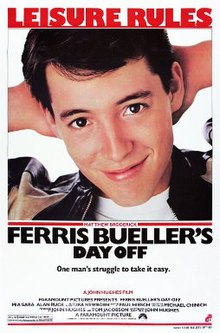
Ferris Bueller’s Day Off-1986

Ferris Bueller’s Day Off-1986

Director John Hughes

Starring Matthew Broderick, Alan Ruck

Scott’s Review #1,396

Reviewed September 7, 2023

Grade: B

Ferris Bueller’s Day Off (1986) is one of the best-known films in John Hughes’s collection of 1980s teen coming-of-age comedies.

On par with The Breakfast Club (1985) and Pretty in Pink (1986) in name recognition memory banks, especially for teenagers growing up in this decade.

Iconic moments like Ben Stein’s teacher’s monotone attendance roll call, the repeated phrase ‘Bueller’, and the term ‘Save Ferris’, which became the name of an alternative rock band, are legendary.

The film has its moments of creativity, and Matthew Broderick’s portrayal of the title character was charming and star-making.

Watching the film, though, decades later, the slapstick feels overwhelming to the drama, and there isn’t much angst like in other Hughes films.

There isn’t much deeper meaning beyond one day to skip school and go on an adventure.

This makes Ferris Bueller’s Day Off fun and lighthearted, but silly compared to more mature Hughes efforts. The film is about being young, free, and having fun, but not much more, and the hijinks between the students and the authority figures sometimes feel tired.

Ferris Bueller (Broderick) is brilliant at skipping school and getting away with it despite being an intelligent student. He causes the high school principal, Rooney (Jeffrey Jones), much irritation and ultimately pursues him to catch Ferris in the act.

The young man plans one final outing before graduation with his best pal Cameron (Alan Ruck) and his girlfriend Sloane (Mia Sara).  They ‘borrow’ Cam’s father’s expensive Ferrari and journey through the streets of Chicago.

Ferris’s sister, Jeanie (Jennifer Grey), seethes with rage at her brother’s antics while their successful but dimwitted parents, Katie (Cindy Pickett) and Tom (Lyman Ward), remain clueless.

The film’s strengths are the frequent shots of Chicago and of Broderick himself, which elevate it above mediocrity decades after its initial release.

Broderick followed in the footsteps of contemporaries like Michael J. Fox and Emilio Estevez as the cool, likable all-American boy next door. His performance makes the film better than it might have been, and the fun is watching him outwit rivals like the principal and other villains he encounters.

Hughes creates a nice ‘day in the life’ style that follows the characters from early morning until evening, which keeps the events contained well.

A high point of the film, and where it picks up steam, comes when the gang reaches Chicago. We suspect the teenagers, while they skip school via fibs, merely have a case of ‘senioritis’ and are otherwise superior students. This is confirmed by the sophisticated and intellectually stimulating places they visit.

They have lunch at a swanky French restaurant and visit the world-renowned Art Institute of Chicago for good old-fashioned culture. Not to appear too snobby, they hobnob with blue-collar folks at an afternoon Cubs baseball game.

Where Ferris Bueller’s Day Off feels dated is with the ditziness of Ferris’s parents. The teen easily bamboozles his parents with his feigned illness, and when his father notices Ferris in a nearby taxi cab, he shrugs it off as his imagination.

The most laughable instance of the parents’ cluelessness is when mom Katie, in the passenger seat, appears not to notice her son running in front of their car when sister Jeanie slams on the brakes. She instead scolds Jeanie for driving recklessly.

These and other setups involving the over-the-top principal feel more like cliches than genuine laugh-out-loud moments. But this was common in 1980s comedies.

Ferris Bueller’s Day Off (1986) feels fresh in some parts but dated in others, making the experience humorous but hardly legendary.

Whereas The Breakfast Club holds up very well, this film doesn’t hold up as well.