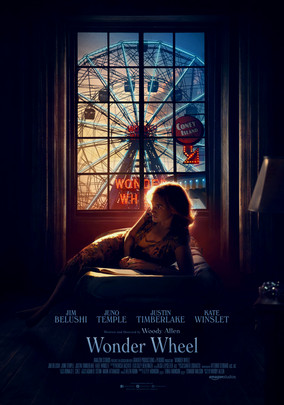
Wonder Wheel-2017

Wonder Wheel-2017

Director Woody Allen

Starring Kate Winslet, Jim Belushi

Scott’s Review #709
Reviewed December 31, 2017

Grade: B+

Woody Allen typically releases a new film each year, and 2017’s project is Wonder Wheel.

Set in 1950s Coney Island, a seaside beach in Brooklyn, New York, the film is an authentic-looking period drama, with lovely costumes and legitimate New York accents from all principal actors.

The story is pretty depressing, though, as a likable character is tough to find. However, Wonder Wheel contains fantastic acting, mainly on the part of star Kate Winslet, whose troubled character is the film’s focal point.

Winslet portrays Ginny Rannell, a struggling forty-year-old woman living in the seaside neighborhood and working as a waitress at a dingy Clam House. She despises her life and longs for a way out of the doldrums, yearning for the life she had years ago as an aspiring actress.

Her husband, Humpty (Jim Belushi), a carousel operator, has alcoholism. Together they raise Ginny’s son, Richie, a young boy who loves to start fires.

When Humpty’s estranged daughter, Carolina (Juno Temple), shows up on their doorstep, having provided information about her mobster husband, and subsequently “marked”, Ginny’s life slowly begins to unravel as she and Carolina pursue the same man, hunky lifeguard, Mickey (Justin Timberlake).

The film’s New York setting is an enormous plus and a standard of many Woody Allen films—the authenticity is apparent. The summer mood of the beach, sand, sunny boardwalk and beach scenes make the viewer feel transported in time.

The 1950s period worked as beachwear, and the amusement park sets were used to their advantage. The actors’ New York accents and the language and sayings are appropriate for the times.

The apartment that the Rannells rent is an excellent treat to the film. The set features a wonderful beach landscape during daytime and nighttime scenes so that the mood change can be noticed—these are all enticing elements to Wonder Wheel.

Enough cannot be said for Winslet’s talents, who make the character of Ginny come to life.

Undoubtedly a tough role for her to play, Winslet, who can make reading the phone book sound interesting, tackles the complex part and arguably gives one of the best performances of her career—my vote would still go to her portrayal of Hannah Schmitz from 2008’s The Reader.

Initially a sympathetic character, she longingly desires to return to the stage and perhaps find stardom as an actress and sees Mickey as her last chance. When events curtail her dreams, her character takes a sharp turn and does an unspeakable act.

I love Justin Timberlake’s acting talents. By 2017, he had successfully proven himself a major star in both the film and music worlds.

As the hunky, charismatic, yet studious and intelligent lifeguard, Mickey, he teeters between womanizer and earnest, love-stricken, young man.

Timberlake has taken on more interesting film roles beginning with the 2010s, The Social Network, and let’s hope there are more to come.

Juno Temple is just perfect as the naive Carolina. With an innocent, sweet personality, she yearns for love and a fresh start. Temple, known mainly for quirky independent film roles, fits a Woody Allen creation perfectly.

Finally, legendary actor James Belushi fills his character of Humpty with dedication, loyalty, and alcoholic rage. He adores Ginny but sometimes takes her for granted.

What a treat for fans of The Sopranos to see a couple of familiar faces appear as (what else?) mobsters. Tony Sirico and Steve Schirripa make cameo appearances as Angelo and Nick, henchmen for Carolina’s unseen husband, who is intent on tracking down and killing her.

Despite minimal parts, the actors seem to have a ball reprising similar roles that made them famous.

Wonder Wheel, shot in a similar tone to a stage production, draws comparisons to A Streetcar Named Desire, both with four principal characters- two male and two female, Ginny, Carolina, Mickey, and Humpty, all with some similarities to and some differences with storied characters Blanche, Stella, Stanley, and Mitch.

However, the comparisons can easily be studied and analyzed.

Woody Allen creates a film that can be appreciated chiefly for its top-notch acting talent, which is not surprising given the actor’s cast, and it is a compelling, never boring story.

The film is a downer, however, with no heroic characters. Thankfully, this is counterbalanced perfectly by a great New York setting, which is a high point of Wonder Wheel (2017) and cheers up the otherwise dour tone of the film.
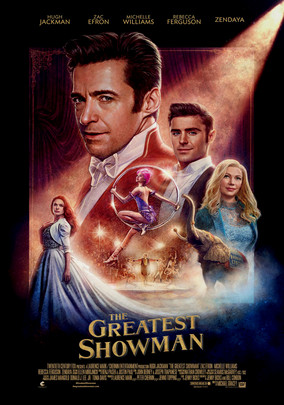
The Greatest Showman-2017

The Greatest Showman-2017

Director Michael Gracey

Starring Hugh Jackman, Michelle Williams, Zac Efron

Scott’s Review #707

Reviewed December 26, 2017

Grade: A-

A pure musical escapist film, The Greatest Showman (2017) holds a dear and relevant message. It elicits hope for outcasts everywhere by leading a story of acceptance and perseverance in the feel-good film of 2017.

Hugh Jackman leads the pack, starring as P.T. Barnum, a man struggling to create an entertainment show with live and unusual performers- deemed “freaks” in New York in those days- the 1800s.

The film is quite joyful and light, with many cheery musical numbers sure to leave audience members humming along for hours after the conclusion.

The Greatest Showman is a rags-to-riches story and a thoroughly enjoyable film.

Jackman is as charismatic and likable as Barnum, the entrepreneur and showman we meet as a young boy, the son of a poor tailor. He becomes enamored with wealthy young Charity (Michelle Williams), and the two eventually marry, much to the chagrin of her pompous parents.

Barnum and Charity initially struggle to make ends meet as they begin to raise a family, but eventually, they find success and wealth when the show succeeds.

The film chronicles Barnum’s rise to fame and the trials and tribulations (romantic, business) for several years, mainly through musical numbers.

Zac Efron is excellent as Barnum’s eventual business partner, Phillip Carlyle.

Director Michael Gracey’s supporting characters are creative, if not typical, mainstays of carnivals and circuses everywhere—the bearded lady, the fat man, and a man covered in tattoos are featured prominently.

It is unclear whether these characters existed or were created simply for plot purposes. Still, rumor has it that The Greatest Showman has taken great liberties with the factual accuracy of the real P.T. Barnum and his escapades.

This would be bothersome if not for this film’s wonderful message- acceptance and celebrating diversity.

Indeed, this is important for young people everywhere in today’s chaotic world.

Those expecting anything more substance than a cheery and bright holiday slice of enjoyment may be disappointed—some mainstream critics did not rate this film highly. Still, I am okay with a bit of escapist adventure on occasion.

The message throughout The Greatest Showman is quite good.

The best musical number is the show-stopping and anthemic “This Is Me,” Keala Settle is fabulous as the bearded lady who leads this important song. The number is empowering and energetic.

The chemistry between Jackman and Williams is not remarkable, but it is not altogether vacant either. Instead, it is simply decent and not the film’s strongest point. I sense better chemistry between Jackman and Rebecca Ferguson as grand Swedish singer Jenny Lind.

However, their “romance” is unfulfilled, and we will need to imagine its possibilities.

I adore seeing Efron in quality roles (think 2012’s exceptional The Paperboy), and his performance as Phillip is great. He shares a good bond with Barnum and has his romance with acrobat (and of mixed race) Anne Wheeler.

His values and earnestness make the character appealing as he is torn between riches and standing on principle.

The Greatest Showman (2017) may not go down in history as the ultimate top in filmmaking or even one of the best musicals. Still, the film dazzles the audience and provides a couple of hour’s worth of fun and entertainment—similar to how P.T. Barnum energized the crowds with a slice of make-believe; this is more than appropriate.

Oscar Nominations: Best Original Song-“This Is Me”

Bad Moms-2016

Bad Moms-2016

Director Jon Lucas, Scott Moore

Starring Mila Kunis, Kristen Bell, Kathryn Hahn

Scott’s Review #706

Reviewed December 20, 2017

Grade: D+

Bad Moms (2016) tries to do for women what The Hangover (2009) did for men and create a raunchy, R-rated party romp that haggard mothers everywhere can relate to and appreciate.

The film’s billboard displays the three main characters boozing it up under the caption “Party Like a Mother.” Perhaps since I am not a mother, I did not entirely gravitate toward this film, but Bad Moms fell flat for me despite a smidgen of mild laughs.

Primarily because of tired characters, gimmicky situations, and an over-the-top tone.

The film, written by the same individuals who wrote The Hangover, is a direct ripoff with a different gender in the driver’s seat.

The central character is Amy Mitchell (Mila Kunis), a thirty-two-year-old mother of two who is living a busy life in the Chicago suburbs.

Considered “old” by her hipster boss and with a porn-obsessed husband, she runs around frazzled and behind schedule most of the time.

After a particularly hairy day, Amy abruptly quits the school PTA run by militant Gwendolyn (Christina Applegate). She befriends fellow moms, sex-crazed Carla (Kathryn Hahn) and timid Kiki (Kristen Bell).

After she incites Gwendolyn’s wrath, Amy decides enough is enough and embarks on a plot to win the PTA presidency while dumping her husband and dating a hunky widower, Jessie (Jay Hernandez).

Admittedly, Kunis is very likable as Amy. She’s an incredible, energetic chick who most would love to befriend, and we empathize with her predicaments and schedule.

But this can only go so far in a comedic film. The setup pieces and the supporting characters are too plot-driven and lack authenticity. The result is little more than one root-able character.

As an actress, Applegate is quite capable, but Gwendolyn, the transparent foil, is primarily written as a cartoon character. Her bitchy comments to her underlings, who inexplicably are afraid to cross her, seem too staged.

Jada Pinkett Smith, in need of a paycheck, is disposable as “second in command” crony Stacy. Furthermore, Amy’s husband, Mike (David Walton), is portrayed mainly as a buffoon and childlike.

The point of these character examples is to stress that the film contains too many caricatures rather than characters

An irritating quality of Bad Moms that I cannot shake is that the film is written and directed by a duo of men! Jon Lucas and Scott Moore are the individuals in question, and the fact that the film, painted as a female empowerment story, is not written by females is almost unforgivable.

A case in point involves a bathroom scene where the ladies discuss uncircumcised penises, a dumb scene if you ask me, that is lousy taste considering men wrote and directed it.

In this day and age of Harvey Weinstein sexual harassment suits bubbling to the surface, the scene seems icky. It should not be this hard to find women to write for other women.

Of the additional trio of females, Kathryn Hahn’s Carla has a few funny scenes but is written as so sex-obsessed that it is impossible to take the character seriously, and the same goes for Bell’s Kiki.

When mousy Kiki finally lays down the law and tells her boorish husband to deal with their kids, it is meant to be a rah-rah moment, but instead becomes eye-rolling. Not the best actress in the world, Bell continues to get roles like this in sub-par films.

An attempt by filmmakers to make a girl film on par with male-driven raunchy comedies thrust on moviegoers over the years, Bad Moms (2016) comes across as too unoriginal and too desperate for laughs.

Undoubtedly hoping to win over the same audiences who flocked to the last funny female-driven comedy hit, 2011 Bridesmaids, the film falls flat and lacks genuine fun.

Kunis’s lead role and the sweet romance her character shares with Hernandez’s Jessie slightly bolster this.

The Shape of Water-2017

The Shape of Water-2017

Director Guillermo del Toro

Starring Sally Hawkins, Richard Jenkins, Michael Shannon

Scott’s Review #705

Reviewed December 16, 2017

Grade: A

Director Guillermo del Toro created a lovely Beauty and the Beast-style film, The Shape of Water (2017). It is gorgeous to look at, and the story is intelligent and sweet to experience.

Thanks to a talented cast led by Sally Hawkins, the film is part drama, part science fiction, even part thriller, but touching to one’s heart and a lesson in true love regardless of outward appearances.

Vanessa Taylor co-wrote the story, giving it a needed female perspective to perfectly balance the traditional male machinations.

The setting is Baltimore, Maryland, in the early 1960s. The Cold War is ongoing, pitting the United States and the Soviet Union against each other.

Both sides are mistrustful of the other.

Kindly and mute, Elisa Esposito (Hawkins) is a curious and whimsical young woman who works as a cleaning lady at an Aerospace Research Center.

When she stumbles upon a mysterious “shape” being held prisoner for experimentation, she slowly communicates with and befriends the creature, eventually falling madly in love with him.

The “asset,” as the scientists like to call him, is an amphibian/humanoid that needs saltwater to survive. Elisa sees an opportunity to help her love escape captivity, and off she goes.

Hawkins exudes warmth and fills Elisa with courage and astounding determination. Not uttering a word is a tricky feat for an actor to challenge, but instead of words, Hawkins successfully provides a vast array of emotions to reveal how Elisa feels.

Despite her “handicap,” she is a strong woman who speaks her mind on more than one occasion, using sign language to express her frustration. Hawkins gives a fantastic and believable performance.

In excellent and vital supporting roles are Richard Jenkins as Elisa’s friend and neighbor, Giles, a closeted gay man who works as a commercial artist. Jenkins fills this character with intelligence, heart, and empathy as he struggles with his issues of alcoholism and loneliness- unable to be accepted for who he is.

Octavia Spencer shines as witty and stubborn Zelda Fuller, Elisa’s best friend and co-worker. Zelda has her domestic problems but is forever there for her friend, and Spencer gives her character zest, humor, and energy.

Finally, Michael Shannon plays the dastardly and menacing Colonel Richard Strickland, the man who found the “asset” in the rivers of South America and has a lovely family.

Each character is written exceptionally well and has a storyline rather than simply supporting Hawkins’s character.

The audience becomes involved in Giles, Zelda, and Strickland’s private lives, and we get to know and care for them—or hate them, as the case may be.

Giles, harboring a crush on a handsome pie shop owner, is afraid to reveal his feelings. Zelda, with a lazy husband, dutifully takes care of her man, though she is as sassy as they come. And Strickland lives in an all-American family with a pretty wife and two kids, unaware of his shenanigans.

The film is a gorgeous and lovely experience with a magical element. The opening and closing sequences, shot underwater, resound in beauty as objects float along in a dreamy way.

The narrator (Jenkins) takes us on a journey to explain the events of the story.

At its core, The Shape of Water is a romantic love story, and my favorite scenes—those of Hawkins and the “asset”—are to be treasured. Yes, the two do make love, which may be too much for some, but the scenes are tasteful and important, showing the depth of the characters’ love for one another.

Cherishing is how Elisa uses music and hard-boiled eggs to communicate with the “asset.” When Elisa imagines the two characters dancing, the sequence is an enchanting experience reminiscent of Beauty and the Beast.

Other underwater scenes involving Elisa and the “asset” are tender, graceful, and filled with loveliness.

A key part of the film involves a story of intrigue between the Americans and the Soviets. While both are portrayed negatively, the Americans are arguably written as more unsympathetic than the Soviets.

Thanks to Strickland—abusive and vicious—and his uncaring superior, General Holt, we do not root for the government officials at all but rather for ordinary folks like Elisa, Zelda, and Giles, who are outcasts.

Interestingly, Dmitri (Michael Stuhlbarg), a Soviet spy scientist, is the only character working at the center who wants to keep the “asset” alive and is written sympathetically.

My overall assessment of The Shape of Water is that it is a film to be enjoyed on many levels and by particular varied tastes- the film will cater to those seeking an old-style romance, complete with some tasty French music.

Then again, the film can be considered a political espionage thriller, with a cat-and-mouse chase and other nail-biting elements.

Overall, the film has heart and truth and will appeal to vast audiences seeking an excellent movie.

Oscar Nominations: 4 wins-Best Picture (won), Best Director-Guillermo del Toro (won), Best Actress-Sally Hawkins, Best Supporting Actor-Richard Jenkins, Best Supporting Actress-Octavia Spencer, Best Original Screenplay, Best Original Score (won), Best Sound Editing, Best Sound Mixing, Best Production Design (won), Best Cinematography, Best Costume Design, Best Film Editing

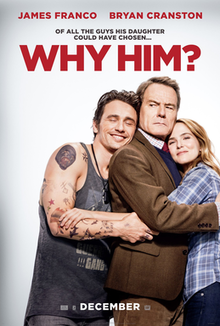
Why Him?-2016

Why Him? -2016

Director John Hamburg

Starring John Franco, Bryan Cranston

Scott’s Review #704

Reviewed December 6, 2017

Grade: D

Why Him? (2016) is epic film drivel starring quite capable actors in a mish-mash of dull, predictable stories, obnoxious characters, and a need to attempt to go raunchier and raunchier for a cheap laugh.

Why there is a market for films like this is beyond me as no thinking is required (maybe the film will please those fans!), but the film scores slightly higher than a solid “F” based solely on a few chuckles uttered thanks to the only dim bright spots in this mess, Bryan Cranston and Megan Mullally.

A story told dozens of times before in “slapstick comedy” fare, the premise is tired beyond belief. A good girl meets a bad boy, they fall head over heels in love and must deal with the aftermath of her parent’s meeting, and hating the bad boy.

The main gimmick is the rivalry between boyfriend and girlfriend’s father, like an unfunny Meet the Parents (2000).  A silly and uninteresting plot point about each character’s business success or lack thereof is mixed in as if anyone cares.

As with all films of this ilk, the story is wrapped up in a neat, tidy little bow by the time the credits roll, and all characters live happily ever after in perfect harmony.

In one of his most disappointing roles, James Franco plays Laird Mayhew, the wealthy, eccentric, thirty-something CEO of an upstart video game company.

He is foul-mouthed and comically speaks his mind or absentmindedly shows his ass on a Skype chat with his girlfriend Stephanie (Zoey Deutch) while her parents are linked to the chat at a birthday party.

Stephanie, a college student and girlfriend of Laird, invites her parents, Ned and Barb (Cranston and Mullally), along with their fifteen-year-old Scotty, for the Christmas holidays.

Predictably, Stephanie’s parents are appalled by Laird and want her to have nothing to do with him. When Stephanie arranges for Ned, Barb, and Scotty to stay at Laird’s spacious home, the antics take off as feuds and misunderstandings erupt.

The main problem with Why Him? is that director John Hamburg (famous for mainstream comedies such as Along Came Polly, 2004, and I Love You, Man, 2009) seems determined to push the raunchy comedy elements further with this idiotic film.

He makes Laird as obnoxious and crass as possible yet tries to make the character more “likable” by giving him a clueless quality; therefore, he is not mean-spirited and should be beloved by the audience.

The character does not work. Franco has played terrific roles- specifically in 127 Hours (2010) and  Howl (2010). As a fan of the talented actor, I expected more from him, but alas, some performances are only as good as the written material.

If there is a bright spot worth mentioning, it is with the casting of Cranston and Mullally.

Two actors are undeniably good at physical comedy. They do as much as they can with poorly written, stock-type roles. Cranston’s Ned, a middle-class small business owner from Grand Rapids, Michigan, is both envious and resentful of Laird, perhaps admiring the young man’s business savvy and regretting not being as successful.

Barb is a one-note, ditzy yet lovable wife, a role made slightly better by Mullally’s goofy portrayal. In one of the best scenes, Barb smokes pot and becomes a mess in her bedroom.

The following day, Ned is trapped on the toilet and has an embarrassing experience with Laird’s best friend, Gustav. While these scenes are juvenile, they are made better by the funny actors.

Suffering greatly from a tired and overused storyline that falls flat, unlikable, and dull characters, the film offers nothing of substance or worth.

Why Him? (2016) is entirely plot-driven with no character development or well-written characters.

The film is a complete waste of time. It results from a studio hoping to achieve box office success by churning out a poor comedy with wasted talent that will please only those audiences not expecting much from their films.

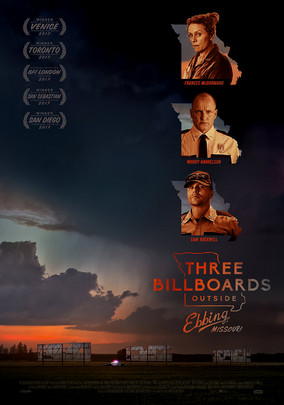
Three Billboards Outside Ebbing, Missouri-2017

Three Billboards Outside Ebbing, Missouri-2017

Director Martin McDonagh

Starring Frances McDormand, Woody Harrelson, Sam Rockwell

Scott’s Review #703

Reviewed December 4, 2017

Grade: A

Frances McDormand takes control of Three Billboards Outside Ebbing, Missouri, and never lets go. In the Martin McDonagh-directed 2017 vehicle, she rivetingly portrays an angry Midwestern woman seeking justice.

The up-and-coming director has also created such films as  2008’s In Bruges and 2012’s Seven Psychopaths.

Similar to these films, Three Billboards Outside Ebbing, Missouri, is peppered with dark comedic moments and vile, bitter characters. The film is a measured success because it is not your standard Hollywood production and is quite left-of-center.

The action begins as we meet McDormand’s Mildred Hayes, sitting alone in her beat-up station wagon, brooding by the side of the road, gazing at three tattered billboards.

She is both pissed off and thoughtful as she formulates a plan to purchase a year’s worth of billboards, questioning the local police’s ineptitude in finding her daughter’s rapist and killer.

Woody Harrelson portrays the Ebbing police chief, Sheriff Bill Willoughby, and Sam Rockwell plays the racist and dim-whited officer Jason Dixon, both displeased with Mildred’s activities.

Other casting decisions in small yet essential roles are Lucas Hedges as Mildred’s adolescent and depressed son, Robbie, and John Hawke as her ex-husband, Charlie, who is dating an eighteen-year-old ditz.

Peter Dinklage is well-cast as James, a local car salesman who is an earnest dwarf with a crush on Mildred.

Supporting roles are prevalent throughout the film, and small-town locales like Jason’s mother and Red, the owner of the advertising agency who rents the billboards to Mildred, shape the experience.

The casting in Three Billboards Outside of Ebbing, Missouri, is a strong point of the film.

The town of Ebbing is portrayed as dreary, blue-collar, and racist, which is just perfect for setting the tone of the film.

I suspect residents of the Midwest or the southern United States of America may have some issues with character representations. Jason is written as both racist and not too smart, and he encompasses numerous characters in the film.

Enough cannot be said for Rockwell’s performance, transforming from a hated character during the film’s first two-thirds to suddenly almost becoming the hero towards the end.

Props are also deserved by Harrelson’s Chief Willoughby- bordering on hick and racist, he also has a heart and cares about Mildred’s predicament- when a shocking event occurs, he becomes an even richer character.

It is worth pointing out and impressive to me as a viewer that the three prominent black characters—Willoughby’s replacement, Abercrombie, Mildred’s best friend and co-worker, Denise, and a kindly billboard painter—are each written as intelligent and sensitive, a fact I found to perfectly balance the other less sympathetic characters.

In this way, a nasty film becomes more satisfying.

Three Billboards Outside of Ebbing, Missouri, though, belongs to McDormand. She is successful at portraying a myriad of different emotions. From her sly eye-winking as she crafts a good verbal assault on whoever crosses her path, to an emotional breakdown scene towards the end of the film, McDormand embodies the character with depth.

In a gorgeous scene, she has a sweet conversation with a peaceful deer grazing nearby, and for a second, she imagines it could be her dead daughter reincarnated. The scene richly counterbalances other violent and brutal scenes.

McDormand manages to look downright homely in some scenes and beautiful in others.

A film will indeed divide viewers. Some will champion the film’s crisp writing and witty dialogue. Still, others will undoubtedly be turned off by some of the character’s foul language and nasty nature.

I found Three Billboards Outside Ebbing, Missouri (2017), sarcastic, gritty, and well-told. It is a versatile affair rich with layers and brimming with enjoyment.

Oscar Nominations: 2 wins-Best Picture, Best Actress-Frances McDormand (won), Best Supporting Actor-Sam Rockwell (won), Woody Harrelson, Best Original Screenplay, Best Original Score, Best Film Editing

Independent Spirit Award Nominations: 2 wins-Best Female Lead-Frances McDormand (won), Best Supporting Make-Sam Rockwell (won), Best Screenplay