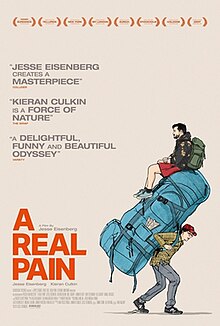
A Real Pain-2024

A Real Pain-2024

Director Jesse Eisenberg

Starring Jesse Eisenberg, Kieran Culkin, Jennifer Grey

Scott’s Review #1,452
Reviewed November 25, 2024

Grade: A-

A Real Pain (2024) is a well-written film about life’s emotions, experiences, joys, and pains. It wonderfully mixes comedy with drama, not one genre or the other but a pot of delicious flavors forming a potent concoction.

Jesse Eisenberg produces, writes, directs, and acts in his creation, making it his own. Kieran Culkin is a revelation as a troubled young man plagued by depression and ravaged by passion.

Emma Stone co-produces.

David (Eisenberg) and Benji (Culkin) play New York Jewish cousins with seemingly minor in common who reunite for a tour through Poland to honor their beloved grandmother.

David, a reserved and pragmatic father and husband, contrasts sharply with Benji, a free-spirited and eccentric drifter. Their personalities clash as Benji criticizes David for losing his former passion and spontaneity, while David struggles with Benji’s unfiltered outbursts and lack of direction.

In Poland, the pair meets up with a Holocaust tour group that each shares a link to the Holocaust history.

Emotional honesty among the group members and tour guide occurs during their week-long trip as brutal truths and past tensions surface.

A Real Pain is a character study with flawless writing. Eisenberg delivers an effort reminiscent of a Woody Allen film with punchy moments, neurotic characters, and cheeky humor.

Benji and David, more like brothers than cousins, admire and resent each other. Benji wishes he had what David does- a stable job, a wife and child, and peace of mind. David resents the way Benji lights up a room with his passion, quickly becoming center stage while David is forced to lurk in his shadow.

Together, the film belongs to Eisenberg and Culkin as their dazzling chemistry emulates from the screen.

From the first scene, we sense David’s frustration. He rushes to the chaotic airport, hurriedly leaving voicemails for Benji. But the carefree Benji has been at the airport for hours and dismisses David at every measure.

David is a nice guy who selflessly gives Benji the window seat and first dibs on the shower. But he secretly feels bullied by Benji’s selfishness.

David realizes that people always fall for Benji and give him a pass, which frustrates him. He essentially mocks and calls the tour group assholes but somehow is deemed ‘real’ or ‘honest.’

Benji is tough to like, but Culkin’s wounded blue eyes allow the audience to realize he is hurting and suffering from deep pain.

My only knock is why the tour guide, who is mocked and criticized by Benji, ultimately thanks him for his brutal honesty and more or less snubs David.

Compared to the otherwise honest writing, this scene feels forced and unrealistic.

Eisenberg flawlessly delivers a performance that showcases his range of emotions. Sufferingly patient, he explodes during a dinner scene, letting his emotions spill onto the table.

Eisenberg and Culkin’s great acting is showcased, especially during the scenes where they let their emotions rip. Their best scene together is atop a hotel, where they smoke pot and old wounds furiously come to the surface.

Besides the acting, Eisenberg, the screenwriter, immerses the audience in the importance of Holocaust history.

It’s not for the faint of heart. Powerful scenes of the tour group walking through  Majdanek concentration camp are hard to watch, with the knowledge that thousands were exterminated.

Led by a scene-stealing turn from Culkin and a bevy of creative talents by Eisenberg, A Real Pain (2024) is a powerfully funny, emotionally resonant dramedy that finds him playing to his strengths on either side of the camera.

Oscar Nominations: 1 win-Best Supporting Actor-Kieran Culkin (won), Best Original Screenplay

Independent Spirit Award Nominations: 2 wins-Best Supporting Performance-Kieran Culkin (won), Best Screenplay (won)
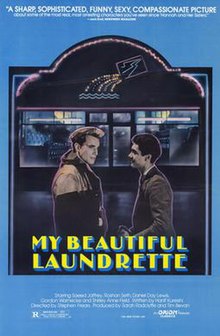
My Beautiful Laundrette-1985

My Beautiful Laundrette-1985

Director Stephen Frears

Starring Gordon Warnecke, Daniel Day-Lewis

Scott’s Review #1,451

Reviewed November 10, 2024

Grade: A-

My Beautiful Laundrette (1985) is an early LGBTQ+-themed British film directed by Stephen Frears. He would later become well-known for directing The Queen (2006).

Though the film is choppy and contains several stories, the LGBTQ+ story is one of the few in the genre to offer a satisfying, hopeful ending.

Later, and admittedly more defined, films like Brokeback Mountain (2006) and Boys Don’t Cry (1999) were harsher and more realistic.

The British flavor, interracial pairing, and class differences make My Beautiful Laundrette a lovely watch.

But it’s also all over the place.

In a seedy corner of London, a young Pakistani, Omar (Gordon Warnecke), is given a run-down laundromat by his affluent uncle Nasser (Saeed Jaffrey), who hopes to turn it into a successful business.

Soon after, Omar is attacked by a group of racist punks but realizes their leader is his former lover, Johnny (Daniel Day-Lewis). The men resume their relationship and rehabilitate the laundromat together, but various social forces threaten to compromise their success.

Omar’s father is an unhappy former left-wing journalist who has turned to alcohol. Nasser’s daughter, Tania, is meant to be Omar’s future bride, while Nasser is in love with his mistress, Rachel (Shirley Anne Field).

Besides these storylines, there is a complicated relationship between brothers Nasser and Hussein, and a drug-smuggling storyline.

While every story has some intrigue and shapes the structure, the male romance is not front and center enough to be completely developed.

Omar and Johnny are interesting because, despite their differences, they connect and are truly in love. Politically, Omar is left-wing, and Johnny is right-wing. Omar is upper class, while Johnny is working class. Omar is Pakistani, while Johnny is British.

Being 1985 and early in the LGBTQ+ genre, Frears focuses mostly on their romance and less on their differences. There is a brief sequence where Omar treats Johnny as a lowly employee, but for the most part, they are in love.

It takes a long time to showcase Omar and Johnny making My Beautiful Laundrette, only marginally an LGBTQ+ effort.

There is no mention of the A.I.D.S. epidemic, which would have made it a different kind of film.

The romance between Nasser and Rachel is marvelous. There are a couple of audience members who shouldn’t root for but do anyway. Rachel is the other woman, merely a mistress, but why is she so appealing? Why do Nasser and Rachel connect so well?

Shirley Anne Field pours kindness and empathy into her character, while Saeed Jaffrey relays his love for Rachel to Nasser. Yes, he is married, but the marriage is traditional, and his wife is Pakistani. We know that at another time Nasser and Rachel would have a chance.

When Tania snaps at Rachel and accuses her of being a woman who so easily lives off a man, Rachel reminds her that she does too. Rachel is from a different generation where opportunities for women are scarce.

Field makes the scene her own and wins over the audience, even though it could have been against her.

The Rachel/Nasser romance parallels the Omar/Johnny love story. Both couples live secret lives, hidden from the world.

This is evident in a powerful scene when the two couples are simultaneously romantic in the laundrette. Neither sees the other at first, but the audience sees both couples. This mirrors their mutual love, and it’s a beautiful sequence.

While there is sometimes too much to follow, most of the material is poignant and relevant, making My Beautiful Laundrette (1985) a film worth recommending.

It has an LGBTQ+ presence but is not restricted to that genre, offering other nice stories to the experience.

It also leaves one feeling hopeful, which is sometimes needed in cinema.

Oscar Nominations: Best Original Screenplay

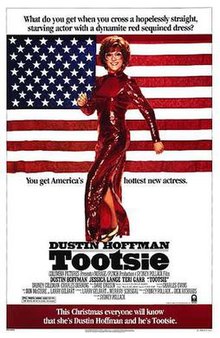
Tootsie-1982

Tootsie-1982

Director Sydney Pollack

Starring Dustin Hoffman

Scott’s Review #1,449

Reviewed November 2, 2024

Grade: A

Dustin Hoffman is perfectly cast in the romantic comedy Tootsie (1982), a blockbuster hit from 1982 with much going on within its cinematic walls and a progressive-leaning slant.

Sydney Pollack directs and also has a supporting role in the film.

In addition to Hoffman, Jessica Lange, Teri Garr, Dabney Coleman, and Charles Durning give all-star performances.

Tootsie is genuinely funny and a treat for anyone who has ever auditioned or been interested in acting or theater. The popular soap opera, or daytime drama, genre features directors, producers, and actors who intertwine.

Romance, drag, wacky setups, insecurities, and social commentary on gender inequality are analyzed, making Tootsie more relevant than most romantic comedies and an unforgettable experience.

Hoffman plays New York actor Michael Dorsey (Dustin Hoffman), a talented yet opinionated perfectionist unable to find work. His flustered agent (Pollack) sends him on a soap opera audition that goes poorly.

Michael decides to reinvent himself as actress Dorothy Michaels and wins the part. What was supposed to be a short-lived role turns into a long-term contract, but when Michael falls for his castmate Julie (Jessica Lange), complications develop.

Hoffman flawlessly merges with Dorothy, a feminist,  to make her a character the audience loves and champions. This is a risky assignment and could easily make the character a goof or cause them not to be taken seriously.

Not only does Hoffman look convincing in a dress, wig, heels, and a feminine southern accent, but he also makes us forget he’s a man.

The hilarity of other characters not knowing Dorothy is Michael is there when a romantic quadrangle develops. Neurotic Sandy Lester (Garr) is in love with Michael, while he is in love with Julie, who thinks Michael is Dorothy. Finally, Julie’s father, Les (Durning), falls for Dorothy.

The New York setting works wonderfully as struggling actors, greedy agents, and temperamental directors co-exist on tense sets, over dinners, and at many schmoozy parties. This presents the grit of New York show business in the 1980s, when the city was crime-infested and dangerous.

The hustle and bustle perfectly showcases the time.

Pollack and screenwriters, Larry Gelbart and Murray Schisgal, add satire to the soap opera, or as mentioned in the film, the politically correct, daytime drama world.

The horny and inept longtime cast member, John Van Horn (George Gaynes), needs a teleprompter while the sexy ingenue April (Geena Davis) prances around in underwear. Hurried script rewrites and pages of dialogue to memorize make the cast frazzled and rushed.

Tootsie takes an important, though lighthearted, approach to sexism, and at least it’s recognized. Dorothy scolds her boss and director, Ron (Coleman), for calling her demeaning nicknames like ‘Tootsie’ and for treating Julie, whom he’s casually dating, poorly.

Michael begins to realize that he doesn’t treat Sandy well either, so he learns from his experience of being judged as a woman on beauty rather than anything else.

It forces the audience to realize this, too. Tootsie was released in the early 1980s when women’s liberation was strong, and more women were in the workplace, so the message was timely.

The producer of the fictional soap opera is female, which enhances the gender message brought across.

Still, the comedy takes center stage, and the film isn’t a message movie. The funny moments feel fresh as the characters work their magic. Julie first assumes Dorothy is a lesbian when they nearly kiss, and Sandy thinks Michael is having an affair with Dorothy, which means he is having an affair with himself.

The antics go on and on, resembling the classic Some Like It Hot (1959), especially the tender moments between Les and Dorothy.

Tootsie (1982) holds up well decades after its release. Smart dialogue, witty sequences, and strong characters make it a timeless treasure to revisit often.

Oscar Nominations: 1 win-Best Picture, Best Director-Sydney Pollack, Best Actor-Dustin Hoffman, Best Supporting Actress-Jessica Lange (won), Teri Garr, Best Screenplay-Written Directly for the Screen, Best Cinematography, Best Film Editing, Best Original Song-“It Might Be You”, Best Sound