Popeye-1980

Popeye-1980

Director Robert Altman

Starring Robin Williams, Shelley Duvall

Scott’s Review #1,474

Reviewed March 31, 2025

Grade: C+

As a loyal fan of the legendary director Robert Altman, I had never seen his 1980 effort, Popeye, which starred his muse, Shelley Duvall, and then rising movie star Robin Williams.

My favorite Altman films, Nashville (1975), Short Cuts (1993), and Gosford Park (2001), are masterpieces sprinkling overlapping dialogue with enormous casts.

Qualities that I adore.

I hoped Popeye would follow the same formula, but strangely and disappointingly, it doesn’t. The end product feels nothing like an Altman film and is a wacky, jagged, attempted-comedy affair that leaves one disappointed.

Desperately, it regains some semblance of control in the midsection as sentimental, touching musical numbers surface, but this cannot save the film from mediocrity.

The entire affair seems rather pointless and overly messy.

When a muscled sailor named Popeye (Williams) journeys to the port town of Sweethaven, looking for the father (Ray Walston) who deserted him as a baby, he befriends an array of bumbling eccentrics.

He falls madly in love with dorky, sweet-natured Olive Oyl (Duvall).

Conflict erupts when it’s revealed that she already has a suitor, the jealous Bluto (Paul L. Smith). Popeye discovers an abandoned baby, Swee’Pea, whom he raises with Olive Oyl’s help, cementing their courtship. But when the spurned Bluto kidnaps Olive and the child, Popeye takes action with the help of his magic spinach.

Williams and Duvall are wonderfully cast and easily the best part of the otherwise ineffectual film.

The chemistry propels an investment in the couple despite the overreaching, zany dialogue. Williams dazzles with a cartoonish performance that befits the funnyman he played best during his career, despite turns towards more dramatic fare.

There is an infectious likeability factor that oozes from the screen. He’s also surprisingly cute.

Duvall nearly upstages Williams and everyone else with a maddeningly frenetic, manic, and excellent acting job. The actor was born to play Olive, even suffering from the nickname as a child.

Her constant and irritatingly grating ‘oohs’ are irresistible, and I mimicked her well before the credits rolled, much to my husband’s and my amusement.

The best moments occur midway through, with a combination of hits, such as ‘He Needs Me’ and ‘It’s Not Easy Being Me, which are performances by Duvall and Williams, respectively.

Both songs made me fall in love with the characters and made me thirst for more sentimentality over silliness.

You’d think I would have loved the film if for Williams and Duvall alone.

From the opening sequence, though, I found myself unamused and unenamored with the rest of the film.

Meant to be funny, the Taxman (Donald Moffat), Wimpy (Paul Dooley), and Bluto (Paul L. Smith) feel over-the-top and silly. They each lack any warmth or endearment and seem like caricatures of the cartoon.

The finale is meant to be edge-of-your-seat peril, with an octopus added to eat Olive Oyl and Swee’Pea, presumably. This is mixed with an uninspired performance by Ray Walston as Poopdeck Pappy (Popeye’s father).

Waiting for the spinach representation, but this comes too late in the game. Recognizing Popeye’s dislike for spinach, Bluto force-feeds it to him before throwing him into the water. The spinach revitalizes Popeye and boosts his strength, helping him defeat Bluto and Salty Sam.

Popeye celebrates his victory and his newfound appreciation of spinach.

If I made a list of Robert Altman films, I would rank Popeye (1980) toward the bottom. Reviled by critics at the time of release, the film has grown some appreciation over the years, but I’m not sure why.

Black Bag-2025

Black Bag-2025

Director Steven Soderbergh

Starring Cate Blanchett, Michael Fassbender

Scott’s Review #1,473

Reviewed March 30, 2025

Grade: B+

Steven Soderbergh offers Black Bag (2025), a taut spy thriller that is very slick and fast-paced. Wasting no time to lag or drag, he gets right down to the action in a quick one hour and thirty-four minute running time.

Stars Cate Blanchett and Michael Fassbender play British intelligence officers and husband and wife, George and Kathryn. His superior, Meacham (Gustaf Skarsgård), gives George one week to investigate the leak of a top-secret software program code-named Severus.

One of the five suspects is Kathryn.

Viewers familiar with Soderbergh’s films will recognize the familiarity of the tense electronic musical score by David Holmes, a frequent collaborator of Soderbergh. He scored the Oceans trilogy (2001-2007), which Black Bag resembles.

Those films, hits at the time, now feel less impactful, but Black Bag takes a similar style and envelops a modern, sophisticated London backdrop.

The immediate draw is Fassbender and Blanchett, who play exceptionally well opposite each other. Both stars light up the screen electrically, offering cat-and-mouse scenes that cackle with dry wit and sensuality.

George can always sense untruths and despises liars. As much as he loves Kathryn, he doubts her when he finds a movie ticket receipt in the trash for a film she claims never to have seen. But is she being set up?

The supporting characters are impressive, with Marisa Abela and Tom Burke as sparring partners and Clarissa and Freddie getting the meatier roles.

The best sequence is the riveting dinner sequence when George invites the four other suspects, all colleagues, to dinner. When he drugs their food to lower their inhibitions, he has them play a warped game of ‘Resolutions’ in which they make a resolution for the person to their right.

Since the other couples are each dating, this leads to revelations, squabbles, and a jealous stabbing.

Even in mainstream pictures, Soderbergh loves incorporating corporate work sequences and independent cinema/arthouse qualities. Propelled by the musical score, sometimes frenetic, there is a thrilling vibe even in quiet scenes.

He also loves closeup shots, which are especially important for Fassbender, Blanchett, and the dinner guests.

Nearly putting style over substance, the story, written by David Koepp, is complicated to follow. We assume that one of the dinner guests or Kathyrn’s boss, Arthur (Pierce Brosnan), is the rat, serving up a film whodunit.

Kathryn has access to a Zurich bank account containing ₤7 million in misdirected and unexplained funds, and there is something to do with a Russian operative who Kathryn flies to Zurich to meet.

The rest of the plot is gray, and after the film, I needed to read a synopsis to gain some understanding.

Small wonders that may have had little to do with the story impressed me. A simple scene in a crowded movie theater where Kathryn and George munch popcorn and flinch at scary scenes enhances the importance and joy one gets from watching a film in the movie theater.

The couple’s duplex London loft is pure magic to look at. As George prepares simmering food and quality wine in the vast kitchen with modern trimmings, their upstairs bedroom is equally enthralling with cosmopolitan furniture colors and just the right polish.

The couple is obviously worldly.

Black Bag (2025) is an entertaining film. Do not struggle to follow every nuance or story point, or you will be frustrated. Instead, sit back and enjoy the experience of a spy thriller with incredible music, sets, and stars.

Anything-2017

Anything-2017

Director Timothy McNeil

Starring John Carroll Lynch, Matt Bomer

Scott’s Review #1,472

Reviewed March 17, 2025

Grade: B

Anything (2017) is a sweet LGBTQ+ independent film written and directed by Timothy McNeil. It is based on a play that he performed in Los Angeles.

While it is nice to see longtime character actor John Carroll Lynch (Fargo, 1996, and Zodiac, 2007) in a starring role and Matt Bomer looking fabulous in drag, the film suffers from contrivances and treads lightly.

The stagey setups, cliched situations, and popcorn dialogue feel forced, and the ambiguous conclusion is unfulfilling.

However, McNeil and the cast deserve kudos for showcasing a story never told before and fraught with possibilities with a powerful ‘love is love’ message.

Deeply depressed after his wife’s death, Early Landry (Lynch) survives a suicide attempt and moves from a small town in Mississippi to flashy Los Angeles to live with his loving yet controlling sister, Laurette (Maura Tierney).

While there, he develops a complicated and tender relationship with a transgender sex worker named Freda (Matt Bomer). They bond over their shared loneliness and past traumas, sparking a friendship and gradually more.

Early immediately captured me. A hulking man, his kindness and gentleness ooze from him when he takes a run-down apartment in a shady section of L.A. Surrounded by drug addicts and questionable neighbors, he makes friends simply because he is lovely.

Because Lynch frequently plays villains, this was a nice change of pace to witness, and I suspect the actor also enjoyed it.

McNeil kindly writes the character as non-judgmental and savvy despite his Mississippi origins. Oftentimes, in cinema, a Deep South character is written as racist, stupid, or both.

Instead, Early is accepting of different lifestyles. Lynch effortlessly carries the film because he gives the character authenticity and sensitivity.

I wanted to be friends with him.

On the other hand, Freda’s character took most of the film to win me over. Her unpredictable, defensive, and cutting remarks imperfectly represent typical drag queen caricature behavior.

It also took me until the conclusion not to think of McNeil’s reason for casting Bomer as a vehicle to see the pretty actor in drag. Bomer is a great actor in anything he appears in and does his job effectively.

But when Freda callously insults Early when they first meet by nicknaming him ‘Havisham,’ a character from Charles Dicken’s novel Great Expectations, she seems cutting for the sake of being insulting.

I also wanted to know more about Freda. How did she wind up in Los Angeles as a streetwalker? What was her upbringing like? We can guess it wasn’t great, but not much is said.

My reaction improved to championing Freda after a fantastic, ill-fated dinner party scene. Early invites Laurette, her husband, and their son to his apartment for dinner to meet Freda. When Laurette quickly realizes Freda is transgender, she guzzles white wine and lets loose on Freda, fearing she is manipulating her brother.

Despite the story’s groundbreaking nature, the feeling is predictable. Of course, Laurette will object to the romance as much as Freda’s friends call her a dreamer for wanting a ‘9 to 5 life’.

Straight and narrow, Early shakes Freda’s drug dependency in only one night while enduring her venom, vomiting, and unbelievably quick recovery, almost in the snap of his fingers.

I wanted a more definitive conclusion and had questions left in my back pocket that were never answered. Will the couple move in together? What will Freda do for a living? Does Laurette even know Freda is a prostitute?

Unfortunately, Early and Freda never have a sex scene, so the sexual complexities of their assumed relationship feel swept under the rug.

Though sweet-natured and carefully plotted, Anything (2017) has so much more potential story to tell that the results feel lacking.

The Monkey-2025

The Monkey-2025

Director Oz Perkins

Starring Theo James, Christian Convery

Scott’s Review #1,471

Reviewed March 14, 2025

Grade: B

The Monkey (2025) is a macabre horror/comedy film based on a 1980 Stephen King short story.

The film is directed by Oz Perkins, son of legendary actor Anthony Perkins, forever famous for portraying Norman Bates in Alfred Hitchcock’s Psycho (1960).

He also wrote the screenplay proving that horror runs in his Hollywood royalty tinged blood.

Partnering with James Wan, who co-created the lethal Saw (2004-present) franchise, which The Monkey mostly resembles, adds experience and credibility to the project.

Deadly set pieces and dangling machinery just waiting to slice and dice willing victims to bits make the film a fun experience.

When twin brothers (Christian Convery/Theo James) find a mysterious wind-up monkey, a series of outrageous deaths tear their family apart, leaving them to live with their kooky aunt and uncle and ultimately estranged.

Twenty-five years later, after lying dormant, the devious monkey begins a new killing spree, forcing the siblings to reunite and confront the cursed toy.

For horror fans, the best part of The Monkey is the gruesome death scenes. Wan, well versed in eye gouging, decapitations, and torn limbs, must have inspired Perkins during the final cut.

Wonderfully wicked kills include a gorgeous bikini-clad female pool goer blown to bits, a busload of cheery cheerleaders decapitated, a shop owner disemboweled with a harpoon gun, a bowling ball decapitating another victim, and an unlikable victim being killed by a swarm of wasps.

The uproarious deaths are applaud-worthy because most of the victims are annoying or unsympathetic in some way. The audience delights in witnessing their endings in such gory fashion.

As the adult Hal/Bill Shelburn, Theo James carries the film as the charismatic, bookworm, Hal and the egotistical Bill. James, ridiculously handsome, looks even more adorable in glasses and shy awkwardness.

Hal attempts to reconnect with his son, Petey (Colin O’Brien), with whom he only spends one week per year. Rather than being an absent father, he strives to protect him from the terrible monkey.

Many supporting characters are played over the top and wacky, making the film a goofy horror/comedy. Elijah Wood appears as Ted Hammerman, Hal’s ex-wife’s new husband, while Adam Scott plays Hal’s and Bill’s absent father, with whom the monkey originated after a trip abroad.

As gory delicious as the blood and guts are, the story isn’t much of a highlight. The brother Bill is written as so much of an asshole that one wonders why Hal is so tolerant towards him.

The ending is predictable, and there is not much closure with the monkey. A half-assed explanation of whomever turns the key in the monkey’s back is immune from being killed or some such explanation didn’t wow me.

The film could be a Twilight Zone or horror series episode over a full-length production, running out of gas towards the end.

Oz Perkins is a rising director who creates a cruelly delightful film that feels like an independent production. Choosing to propel viewers into a gore fest over a scary film, The Monkey (2025) is a modest success.

Heretic-2024

Heretic-2024

Director Scott Beck, Bryan Woods

Starring Hugh Grant, Sophie Thatcher, Chloe East

Scott’s Review #1,470

Reviewed March 13, 2025

Grade: B+

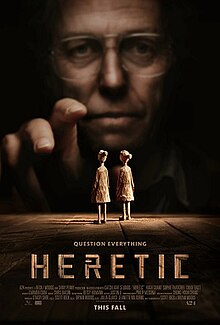
Heretic (2024) is a terrifying and thoroughly compelling horror film co-directed and written by Scott Beck and Bryan Woods. The pair most notably wrote the story for and co-wrote A Quiet Place (2018).

The premise of Heretic is rich in scariness, and the screenplay questions and challenges religion and the expected thought process of organized religion, targeting Mormons. It’s a thinking man’s horror film and hardly superfluous, like many genre films over the years.

I was pleasantly surprised at how much meaning the film had in addition to fantastic, traditional horror elements.

Two young missionaries, Sister Barnes (Sophie Thatcher) and Sister Paxton (Chloe East) are forced to prove their faith when they knock on the wrong door and are greeted by an initially kindly but ultimately diabolical Mr. Reed (Hugh Grant).

They become ensnared in his deadly game of cat-and-mouse.

Things get off to a perilous start when the pair embark on their bicycles for their next stop in a small town in the United States. They are mocked by a group of teenage girls while an impending snowstorm hovers in the sky.

What could go wrong when Mr. Reed offers the girls a warm living room and a wonderfully smelling blueberry pie his wife is baking in an unseen kitchen?

We, the audience, of course know that things will turn grim. It’s a question of when.

At first, Mr. Reed seems nice enough. Engaging the missionaries in innocent questions like their favorite fast food restaurants and stories of rock and roll makes the inquiries deeper and deeper, questioning their religious beliefs.

The most intriguing part of this process is that he makes good points. He educates the girls about the incarnation of the board game Monopoly and that religions are just recreations of other religions kept up to date.

Isn’t it all bullshit?

When he challenges them to choose between two luminous cellar doors things go batshit crazy.

I continue to be impressed when I see the ‘A24’ logo cross the screen. The independent production company specializes in high-caliber horror films with merit, and Heretic is no exception.

The winning formula is that the tension builds slowly and carefully. As the girls go deeper and deeper into the vast house, they have less chance to escape.

When Mr. Reed claims the locked front door cannot be unlocked until morning, the girls and the audience feel dread.

Once the poster boy for cute romantic comedies playing the hero, Hugh Grant has reached an age where he is willing to go full-throttle into character actor roles. His quick British charm and wit make Mr. Reed even more terrifying.

Playing against type, his cheery yet chilly demeanor is scarier than going for full-on crazy. His running tangents about theology scare, confuse, and challenge the girls.

Grant’s charm, gleaming blue eyes, and kind smile make him a creepy villain. He exudes trust, and we want to trust him, so seeing him play maniacal is a delight.

Thatcher and East are well cast as the Sisters, though I’m more partial to Thatcher’s character as she is the more non-believing and has more charisma than East. She’s also the stronger character more willing to stand up to Reed.

Like many horror films, the elements make the movie what it is. The first-hour setup is simply brilliant. The storm, the warm blueberry pie, and the intricately structured mouse maze-like house with creaks, dark stairways, and cellars all come into play.

Religious horror is creepy, and an attempted resurrection propels the story.

Like many horror films, the conclusion isn’t as good as the buildup. The logic involved in the more minor character’s motivations isn’t mainly explained or believable.

Beck and Woods, supported by A24, create a simple yet eccentric tale set in essentially one lonely house on one lonely night. They prove that a lavish budget or bells and whistles can’t replace a gripping, well-written story with intelligent dialogue.

Independent Spirit Award Nominations: Best Screenplay

Cruising-1980

Cruising-1980

Director William Friedkin

Starring Al Pacino, Paul Sorvino, Karen Allen

Scott’s Review #1,469

Reviewed March 9, 2025

Grade: B+

Cruising is a 1980 effort that brought the LGBTQ+ community into mainstream cinema at least for a brief moment shortly before HIV/AIDS changed its image and trajectory.

The film was derided by critics and gay rights protesters who believed it stigmatized them.

Decades later, Cruising has become more accepted and even admired by some, especially in the LGBTQ+ community. It’s a film most community members have heard of, which has made its mark in cinema history.

William Friedkin, famous for directing The French Connection (1971) and The Exorcist (1973), writes and directs the film, loosely adapting it from a novel by The New York Times reporter Gerald Walker.

The story is about a serial killer targeting gay men, particularly the men associated with the leather scene in the late 1970s. A psychopath is scouring New York City gay clubs and viciously torturing and stabbing gay men to death.

Resembling the victims physically, Detective Steve Burns (Al Pacino) is asked to wear leather attire and frequent the city’s hardcore clubs to lure the killer.

As Steve becomes immersed in club hopping, he begins to identify with the subculture more than expected. Meanwhile, he behaves distantly around his girlfriend, Nancy (Karen Allen), the police force’s homophobia becomes apparent, and the killer remains at large throughout one hot summer.

Initially, Richard Gere was slated to star, but Pacino ended up with the role.

Pacino, being Pacino, gives it his all in an uneven script and unclear character motivations. The ending is exceptionally muddled and peculiar, leaving an unsatisfying feeling, while I also somewhat admire its ambiguity.

Dusting off this relic was an absolute pleasure. It gave me a glimpse into the LGBTQ+ leather scene of long ago, with authentic New York City gay clubs and clubgoers.

Cruising also features a variety of exterior NYC locales, such as Columbia University, the Meatpacking District, and an opening view of the Manhattan skyline.

Though too young to remember the scene being showcased, I do remember traveling into Manhattan to go to work with my father as a very young boy, and the dangerous city I was always warned about.

Friedkin and cinematographer James Contner exceptionally depict New York City in the late 1970s/early 1980s. The gritty, crime-ridden streets capture the time, as in similar films Taxi Driver (1976) and Gloria (1980).

I also adore seeing the clubs and bars from an LGBTQ+ perspective, though I’m unsure if non-LGBTQ community members would appreciate this aspect of the film.

Nonetheless, fans of Pacino should add this to their list. While not on par with his most tremendous role as Michael Corleone in The Godfather series (1972-1995), he was in his prime before he started overacting and taking on inferior roles.

It’s also a damned good crime thriller!

Cruising reminds me of a Dirty Harry (1971) film, only set in NYC, particularly the killer. With a low and taunting voice and a fondness for teasing his victims before killing them, the similarities are apparent and work well.

The killer’s motivation is weakly explained in a flashback with his father.

Since we more or less see the killer’s identity early on, the film is not so much a whodunit until the final scene, when another character is found dead after the killer is apprehended.

Is the new killer Steve or the victim’s jealous boyfriend? Is Steve closeted? These questions are left unanswered.

The production is superior, and the glowing park scenes, with their shadows and insect sounds, only heighten the thrills and perils for the characters.

The film shows plenty of bare male asses, unusual for this time in American cinema, and dares to show plenty of simulated and apparent complete sex. Forty minutes of X-rated male-on-male action footage needed to be cut, in which Pacino may or may not have participated.

While the screenplay has gaping holes and the conclusion is less than satisfying, Cruising (1980) is a win in my book for showcasing an underrepresented group and taking me back to a fascinating time.

The Brutalist-2024

The Brutalist-2024

Director Brady Corbet

Starring Adrien Brody, Guy Pearce, Felicity Jones

Scott’s Review #1,468

Reviewed March 1, 2025

Grade: A

The three-hour and thirty-five-minute film The Brutalist (2024) captivated me from the first sequence.

Adrien Brody’s character László Tóth, emerges from what is revealed as a ship. He emigrated to the United States after being sent to the Buchenwald concentration camp and forcibly separated from his wife, Erzsébet, and orphaned niece, Zsófia.

As his ship enters New York Harbor, he sees the Statue of Liberty.

The sequence follows László in the dark, and the audience is confused and unaware of what’s happening. His wife reads a Hungarian letter amid the scene explaining the events.

This is a top notch first scene.

The film is very long, so if you can’t watch it in a movie theater, we recommend watching it in miniseries style and digesting the segments slowly.

While The Brutalist initially feels like a studio blockbuster extravaganza, it’s shockingly an independent film made for relatively little money.

It’s brilliant but slow and methodic with rich moments of raw emotion, and graceful humanity. Parts are edgy and artistically creative with a quiet bombast.

Events occur between 1947 and 1958; the conclusion is set in 1980.

Having escaped post-war Europe, visionary architect László is well-respected and admired in his home country. He finds his way to Pennsylvania, where the wealthy and prominent industrialist Harrison Lee Van Buren (Guy Pearce) recognizes his talent for building.

The central theme of The Brutalist is László’s struggles to achieve the American Dream. While a wealthy client changes his life, it comes at a price. Do we trust Harrison?

An early scene showcases Harrison’s bad temper, and we know this will come into play again, but it does at the expense of László.

There are so many wonderful facets to The Brutalist; some slowly build and reach a dramatic crescendo, and others continue to bubble under the surface, ripe for discussion after the film has ended.

Though sometimes conventional with a heartwarming story of an immigrant’s struggle to succeed in 1950s USA, it is anything but a mainstream film when looked at closely.

Is there an attraction between Harrison and László? Harrison has no wife and seems uninterested in women. László visits a prostitute and cannot perform; he dances with a gorgeous woman and cannot be seduced. He cannot have sex with his wife.

A male/male rape scene is both gorgeously shot and filled with animalistic brutality. It’s the most unconventional rape scene I’ve ever seen in cinema.

László is also addicted to heroin and has bouts of rage. Is his relationship with Erzsébet more a friendship than a romance?

Brady Corbet’s direction is flawless, led by astounding cinematography of rural Pennsylvania. An early shot of a speeding bus with the opening credits shifting sideways brims with fresh style and creativity.

The sophisticated costumes and makeup perfectly fit the era, which is even more reason to give it kudos on such a small budget.

The acting by Brody, Pearce, and Jones is terrific.

We finally meet Erzsébet (Jones) halfway through the film when she makes her way to America. Crippled, due to osteoporosis, she is a brave and confident woman, finding career work as a writer for a newspaper.

Jones enfuses confidence into a role where she could be the victim. In a late scene, she tears down the house in a powerful performance, interrupting a family dinner.

Pearce electrifies in the best role of his career. His sexuality might explain his Jekyll and Hyde personality and bouts of rage. After all, this was the 1940s and 1950s. The actor plays ambiguity so well that knowing what Harrison feels is challenging.

Finally, Brody is brilliant. In a role arguably similar to his character in The Pianist (2002), he is a clever man forced as an immigrant to play the lousy cards he is dealt. With raw emotion, Brody makes every scene real and powerful.

Is he better off in Hungary or Israel?

Corbet, who also co-wrote the screenplay, delves into the experience of an immigrant. He showcases discrimination, preconceived notions, and the hopes and dreams of one man with the cards stacked against him.

The Brutalist (2024) is a beautiful film with much to say. It has soul and grit and perfectly pays tribute to an experience in the 1950s while sadly feeling relevant to the discrimination still facing immigrants in present times.

Oscar Nominations: 3 wins-Best Picture, Best Director-Brady Corbet, Best Actor-Adrien Brody (won), Best Supporting Actor-Guy Pearce, Best Supporting Actress-Felicity Jones, Best Original Screenplay, Best Original Score (won), Best Production Design, Best Cinematography (won), Best Film Editing

Independent Spirit Award Nominations: Best Director-Brady Corbet