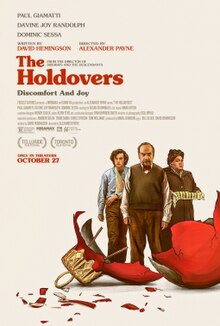
The Holdovers-2023
Director Alexander Payne
Starring Paul Giamatti, Dominic Sessa, Da’Vine Joy Randolph
Scott’s Review #1,410
Reviewed November 22, 2023
Grade: A
The snowy New England setting is just one of many aspects of The Holdovers (2023), director Alexander Payne’s latest release gets right. There’s a stuffy prep school, the tumultuous 1970-1971 in world politics, and teenage angst in the mix.
The early 1970s-era set pieces and Americana comfort food are brilliantly and prominently placed to offer security in a world with tragedy and loneliness The jazzy soundtrack also features hits of the time, embracing the viewer in beautiful nostalgia.
Finally, the three lead characters are well-defined and their complexities are displayed in raw form making them rich relatable flawed thanks to strong acting performances.
Paul Giamatti leads the charge as a sarcastic teacher with his great acting and meshes well with newcomers Dominic Sessa as a rival student and Da’Vine Joy Randolph as a kind but wounded cook.
Anyone who has seen Payne’s films like Election (1999), Sideways (2004), The Descendents (2011), or others knows that he sprinkles satirical depictions of contemporary American society in his works.
There is frequently sadness and morosity to the content saved from depression by warmhearted and caring characters.
I savored the quiet moments of human connection that were crafted in The Holdovers.
Events occur over about two weeks beginning at Christmas break and culminating in early January so holiday cheer and sadness are themes.
Paul Hunham (Giamatti) is a classics instructor at Barton University, a prep school outside of Boston. He is forced to remain on campus during Christmas break to babysit the handful of students with nowhere to go.
At first, despising each other he eventually forms an unlikely bond with one of them, a damaged, but witty troublemaker named Angus Tully (Sessa).
He also connects with the school’s head cook, Mary (Randolph), who has just lost her son in the Vietnam War (Da’Vine Joy Randolph) and shows romantic interest in Lydia Crane (Carrie Preston), a Barton faculty member.
Giamatti is terrific and my favorite character. As a grumpy teacher, the character could have been a one-note standard or stock. But as events go on we learn more about his past and despite being an authority figure he has demons and insecurities of his own.
During emotional moments he calmly offers a voice of reason which is a comfort. He’s stoic and rough around the edges but he genuinely cares about people making him likable.
Sessa and Randolph, despite being supporting characters each have their own stories.
There wasn’t much awareness about mental illness in 1970 compared to current times and Angus, who takes medication is fearful of spiraling down the same rabbit hole that cost his father his sanity.
Will he follow in his Dad’s footsteps?
A teary scene occurs when Angus visits his father in a facility. Hopeful of progress, Angus is quietly shattered when his father reveals paranoia about his food being poisoned by the staff.
Sessa provides a low-key performance that envelopes the character.
Randolph as Mary is kind yet depressed. She tries to find the good in people while realizing she’s been left out of the game in many instances. Her breakdown scene at a Christmas party allows Randolph to flex her mighty acting muscles.
I relished in the retro Christmas lights, the suburban houses with 1960s and 1970s living room and kitchen set pieces, the sweaters, the hairstyles, and the coffee mugs and plates.
The set designers flawlessly depict a time long ago.
I wanted to sit down and dine on Mary’s scrambled eggs and bacon or Lydia’s Christmas cookies. I yearned to sip a Miller Lite with Paul and Angus.
Finally, I smiled pleasantly at the movie theater scene featuring Dustin Hoffman in Little Big Man, an obscure American Western film from 1970.
With precision, Alexander Payne creates another outstanding film featuring the trials and tribulations of good characters dealt losing hands.
The Holdovers (2023) proves that a quality film with terrific writing, a moderate pace, and dramatic and comic moments, draws cinema fans to theaters as much as a cliched superhero film.
Oscar Nominations: 1 win-Best Picture, Best Actor-Paul Giamatti, Best Supporting Actress-Da’Vine Joy Randolph (won), Best Original Screenplay, Best Film Editing
Independent Spirit Awards Nominations: 3 wins-Best Screenplay, Best Supporting Performance-Da’Vine Joy Randolph (won), Best Breakthrough Performance-Dominic Sessa (won), Best Cinematography (won)