Category Archives: 1997 Films

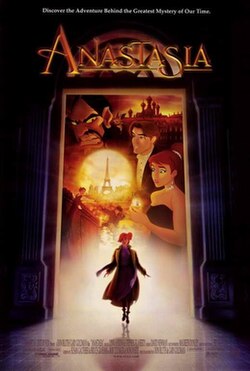
Anastasia-1997

Anastasia-1997

Director Don Bluth, Gary Goldman

Voices Meg Ryan, John Cusack

Scott’s Review #1,530
Reviewed April 27, 2026

Grade: B

Anastasia (1997) is an animated film that explores emperors, duchesses, and the Romanov royal family of Russia, offering an important early-twentieth-century history lesson.

Surprisingly, not a Disney film, it’s the first release from Fox Animation Studios, resulting in an overall decent effort. It has potency but lacks the magic of other darling animated creations of the past.

An evil and vengeful wizard named Rasputin (Christopher Lloyd) casts a curse on the royal family as a dazzling ball commences in 1916, and young Anastasia disappears as their palace is overrun by killers, leaving most of the family dead.

She and her grandmother, whom she eventually is separated from when the Dowager Empress Marie (Angela Lansbury) flees on a train, are saved by a mysterious servant boy who whisks them to a secret room.

Years later, the Grand Duchess offers a reward for Anastasia’s return, but finally gives up amid a legion of imitators and attempted schemers, leaving her flustered and hopeless.

Two Russians, Dimitri (John Cusack) and Vlad (Kelsey Grammer), initially plan to pawn off a phony discovered through auditions, but are shocked to learn that an orphan girl named Anya (Meg Ryan) is the real Anastasia.

Dimitri, who has fallen in love with Anya, is torn between his feelings and a potentially lucrative payday.

The film’s wintry backdrop is visually exquisite, with snow, lights, and the glitz and glamour associated with Paris, setting the story in Saint Petersburg and launching the action amid fabulous costumes and palace trimmings at the ball.

A dangerous train ride from Saint Petersburg to the east, winding up in Paris, is also a high point of the film.

The central characters, Anya, Dimitri, and Vlad, escape terrible fates that the evil Rasputin is plotting against them. They slink from first class to the luggage car to finally leap from the train itself in a daring escape.

They then stowaway on a ship bound for Paris.

The trio’s adventures make the film enjoyable and edge-of-your-seat at times.

Another highlight is a compelling sequence in which Rasputin gets Anya to sleepwalk to the edge of the ship, attempting to make her jump to her death. She sees her dead siblings in a sunny pool of warmth as they invite her to dive in and join them.

The glowing, hallucinogenic interplay of summer sun and winter-driving rain aboard the ship is both majestic and frightening. It also shows the connection between her and her siblings, as well as feelings of loss.

I wasn’t entralled with the characters of Rasputin or the hapless Bartok (Hank Azaria), a minuscule albino bat sidekick, who eventually ‘turns good’.

Rasputin, stuck in a mysterious limbo until he kills off the remaining Romanov (Anya), is portrayed as cartoonish and over-the-top. His threats become redundant, as does his one-note nature.

The characters’ situation is complicated by a weird situation in which, because of foiled attempts on the lives of Dimitri, Vlad, and Anya, they are forced to return to the ‘real world’ and kill Anya there.

It makes little sense, feels juvenile, and the characters were wisely omitted from the stage version.

The musical numbers are charming, but they do not knock it out of the park. Tepidly nominated for an Oscar nomination, “Journey to the Past” is okay, but nothing memorable either.

What works best is the romance between Anya and Dimitri, who have tremendous chemistry. Since he is immediately smitten with her, it is interesting to see how the film handles the eventual revelation of his villainy and his subsequent redemption.

Since it’s clear the film will have a ‘happily ever after’ ending, the anticipation of a final showdown reduces some of the predictability.

The reunion between Anya and her grandmother is touching and sentimental without being too mushy. Even in an animated film, powerful performances can be achieved, and the characters can touch their audience as much as a live-action film.

An entertaining film with heart and a intellectually stimulating backdrop, it has enough to recommend to children and adults alike. I could have done with a better villain or perhaps no villain at all, which makes Anastasia (1997) feel more juvenile and less sophisticated than it should have been.

Oscar Nominations: Best Original Musical or Comedy Score, Best Original Song-“Journey to the Past”
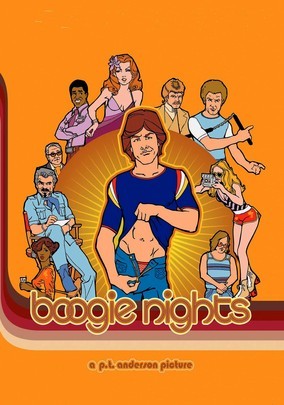
 

Boogie Nights-1997

Boogie Nights-1997

Director Paul Thomas Anderson

Starring Mark Wahlberg, Burt Reynolds

Top 250 Films #8

Scott’s Review #312

1180077

Reviewed December 31, 2015

Grade: A

Boogie Nights (1997) is a fantastic film about the pornography industry (The Golden Age of Porn) of the 1970s and 1980s, and does an excellent job of portraying the characters as human beings with feelings and emotions, rather than as nymphomaniacs or perverts.

They bond with one another as a family- a group of misfits striving to survive. This, and many other reasons, are why Boogie Nights is one of my all-time favorite films.

Written, produced, and directed by Paul Thomas Anderson (Magnolia, 1999; There Will Be Blood, 2007; Inherent Vice, 2014), he is a master at exploring the underbelly of society and the flawed, desperate characters who inhabit it.

Boogie Nights is no different.

The dysfunctional family is the film’s central theme. Most of his characters are unhappy, but they are survivors who desperately seek a piece of happiness.

Many of the Boogie Nights cast also appear in Magnolia.

Mark Wahlberg (Eddie/Dirk Diggler), Burt Reynolds (Jack Horner), Julianne Moore (Maggie), Don Cheadle (Buck), William H. Macy (Little Bill), John C. Reilly (Reed Rothchild), Heather Graham (Rollergirl), Philip Seymour Hoffman (Scotty), Malora Walters (Jessie), and Alfred Molina (Rahad Jackson), round out the large cast.

The film is set in Los Angeles and spans the period from 1977 to 1984. Although only seven years pass, much happens to most of the characters, and we experience their trials and tribulations.

The unique thing about Boogie Nights is that I care about every character, thanks to excellent writing and fantastic acting. They succeeded in earning my empathy. Boogie Nights is a highly character-driven film, which is an enormous part of its brilliance.

The cast is an ensemble, but the main character is Eddie Adams, a high school dropout whom we meet working as a dishwasher at a nightclub. He has an abusive mother who kicks him out of the house, leading him to audition for and move in with Jack Horner.

Jack is a patriarchal figure who shares a house with Maggie, the matriarch of the household, and Roller Girl, a fellow high school dropout who is always seen wearing roller skates. Eddie’s talent is his large “manhood”.

We watch Eddie, at first shy and polite, rise to superstardom in the porn industry, becoming rich and living a lavish, drug-fueled lifestyle, where his ego gets the best of him. He, like many of the characters, hit rough times as the early 1980s shift to videotape was the death of many 1970s porn actors’ careers.

The musical soundtrack plays a crucial role in the success of Boogie Nights. Many scenes contain songs that were hits of the time or prior, including “Sister Christian”, “Jessie’s Girl”, “God Only Knows”, “Got to Give it Up”, “Ain’t No Stoppin’ Us Now”, and countless others- so much so that the soundtrack is almost a character of the film.

We look forward to hearing what song might be featured next.

Later in the film, circa 1983, as things begin to spiral out of control for many of the characters, the musical score turns ominous, with low bass and a nighttime setting, and the lighting grows darker. Several stories begin to intersect on a late L.A. night on the streets.

Jack, filming a scene in a limousine starring Rollergirl and a young college jock they pick up off the streets, Dirk, forced to prostitute himself for $10 to a young man in a pickup truck, and Buck, who innocently stops to buy doughnuts for his very pregnant wife Jessie.

Each of these stories ends in brutal violence, and the tone is crucial to the scenes’ success. This lengthy scene bears a resemblance to a Quentin Tarantino scene in its macabre tone.

Particular favorite scenes include the heartbreaking scene when Maggie loses custody of her son, the New Year’s Eve party at Jack’s house, and the ill-fated drug sale at Rahad Jackson’s.

Each is heartbreaking, powerful, fraught with tension, or otherwise empathetic toward the characters, making them each quite powerful in different ways.

Induced in the drug sale scene is some black comedy- Rahad’s presumed Chinese houseboy has a fetish for firecrackers, which startle Dirk, Reed, and Todd, as the fear of possible gunshots fills the air. Maggie’s sob scene elicits an emotional response as we cry with her, and the New Year’s Eve turn of events involving Scotty and Little Bill is tragic.

Boogie Nights (1997) is one of my favorite films because it contains brilliant writing, characters who are fleshed out, damaged, and human, a killer soundtrack, and a dark, mysterious industry (porn) that is both misunderstood and categorized.

Thanks to director Anderson, we see the people in this lifestyle as real individuals with their own issues, yet also with full hearts and kindness.

Oscar Nominations: Best Supporting Actor-Burt Reynolds, Best Supporting Actress- Julianne Moore, Best Screenplay Written Directly for the Screen

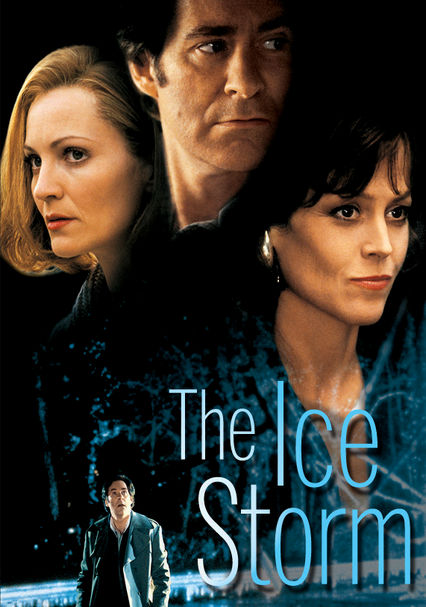
The Ice Storm-1997

The Ice Storm-1997

Director Ang Lee

Starring Kevin Kline, Joan Allen, Sigourney Weaver

Top 250 Films #60

Scott’s Review #850

Reviewed January 1, 2019

Grade: A

The Ice Storm (1997) is a brilliant film directed by Ang Lee of Crouching Tiger, Hidden Dragon (2000) and Brokeback Mountain (2005) fame.

The film is based on a 1994 novel of the same name, written by Rick Moody.

The brilliance lies in the rich way the characters are written, with coldness, repression, and loneliness being central themes.

The film is astonishingly genuine and fresh with an authenticity rarely felt so wholly in adult family dramas.

The period is 1973, and the events take place in New Canaan, Connecticut, a wealthy suburban town.

Two dysfunctional families, the Hoods and the Carvers, co-exist during the Thanksgiving weekend as each deals with repression and escapism amid alcohol and sexual experimentation.

Both the adults’ and the children’s lives are prominently featured in the story. Ben and Elena Hood (Kevin Kline and Joan Allen) and Jim and Janey Carver (Jamey Sheridan and Sigourney Weaver) head the families.

While Ben and Janey carry on a secret affair, Elena lives an unfulfilled existence, craving more from life but not knowing how to get more and reduced to consulting self-help books for support.

Wendy Hood (Christina Ricci) enjoys sexual escapades with multiple boys. At the same time,e Paul Hood (Tobey Maguire), home from boarding school, takes the train into New York City to see a rich classmate, Libbets Casey (Katie Holmes).

The most wonderful aspect of the film is that the story is a slice of life, but with clever nuances. Since the families are rich, why should the viewer feel sympathy for any of the characters, let alone root for them?

Ben and Janey lounge in bed after sex; he is chatty about nonsense, and she is bored and depressed.

During a holiday neighborhood gathering, a kinky “key party” develops, where participants swap spouses for the night, resulting in titillation and excitement.

The bold and controversial writing is exactly why The Ice Storm scores so many points. The characters are cold and frozen, unlikable and selfish, but might that be the point?

All seem unhappy and tired of their dull, small-town existence, craving whatever little excitement they can muster.

Written similarly to American Beauty (1999) the films could be watched in tandem for evenings of Gothic and macabre story-telling.

My favorite character is Elena, as she has the most sensibility. She is lonely and ignored by her husband, dutifully going about her day with little emotion.

She feels temporarily excited when she develops a romantic crush on a neighbor, only to quickly realize the most she can ever hope for with this man is a fling.

Her character is fleshed out as she yearns for more than she has. The other characters are largely selfish and pampered.

The film’s conclusion, however, is monumental as it changes the perceptions of some characters and softens them. A tragic death brings characters together in a powerful way.

Again, the writing in The Ice Storm is the most interesting and compelling appeal.

The acting among the entire cast is professional, heartfelt, and brazen, but the written dialogue and interesting situations make this film rise above others of a similar genre.

Lee’s direction is brilliant, as the blustery winter atmosphere is central to the story in more ways than we might initially think. The frozen power lines and slick, windy country roads evoke a cozy feeling, as if harboring family secrets and scandals.

The bitter yet beautiful ambiance is a soothing and compelling aspect of the film, and Lee portrays it with precision.

As an independent drama, The Ice Storm has a low budget and features big-name stars. The film could easily be performed as a play, but its cinematic elements and fantastic writing make it a memorable, storied piece of filmmaking.

Ang Lee frequently incorporates astounding character development in his works, and The Ice Storm (1997) has all the qualities of a masterpiece.

Jackie Brown-1997

Jackie Brown-1997

Director Quentin Tarantino

Starring Pam Grier, Robert Forster

Top 250 Films #124

Scott’s Review #356

60010514

Reviewed January 9, 2016

Grade: A

Quentin Tarantino’s Jackie Brown (1997) is a fantastic film and one of the few to have a solely female lead (Kill Bill Volumes I and II are the others) and successfully re-launched the careers of stars Pam Grier and Robert Forster after too many years on the sidelines.

Grier’s earlier films heavily influenced the 1970s blaxploitation genre.

Jackie Brown is one of Tarantino’s more obscure films, but it is brilliant nonetheless and filled with slow, plodding yet tremendous scenes.

Grier plays the title character, Jackie Brown, a flight attendant for a small Mexican airline who smuggles money from Mexico to the United States to supplement her income.

When she is caught and threatened by the Feds to help them catch a much larger fish, she plots to use both sides to her advantage and walk away with the money.

Jackie develops feelings, and a sweet relationship ensues with Max Cherry, a bondsman played by Forster.

Mixed in with the plot are Tarantino staples: Samuel L. Jackson as Ordell Robbie, a crooked drug smuggler; Robert De Niro as Louis, a former cellmate of Ordell’s; and Bridget Fonda as Melanie, a dizzy stoner girl.

As is always the case with Tarantino films, Jackie Brown features a stellar cast just chomping at the bit to deliver the best performances they can, aided by rich, crackling dialogue written for them.

The writing is always fantastic in Tarantino films, and Jackie Brown has plenty of plot twists and turns.

My favorite scene by far is the one involving the transfer of money at the local Mall. Rich with flavor and atmosphere, it is a marvel. Jackie and Max engage in small talk at the food court before the transfer is to take place- Jackie then goes to a fitting room where the “switch” will occur.

Throughout this sequence, the tension is incredibly high, and the film turns into a nail-biter.

Tarantino, not one to focus on a romantic storyline, gives Jackie Brown a unique quality by featuring the respectful and delicious romance between Jackie and Max. This adds layers to the mainly bloody and crime-laden film.

In contrast to this relationship is the volatile relationship between Louis and Melanie, which ends in tragedy.

I love how the film is set in Los Angeles. Sunny, bright, with a stuffy and superficial element to the action, mixing the beach and the hot weather with a crime story, manipulation, and double-crossing works so well.

Giving aging Hollywood stars a deserving comeback, Tarantino weaves a complex, adventurous, and well-paced crime drama featuring veteran actors who deliver the goods.

Jackie Brown (1997) is a treasure in a world of Tarantino’s other treasures and a must-have for all the director’s fans and fanatics.

Oscar Nominations: Best Supporting Actor-Robert Forster

Titanic-1997

Titanic-1997

Director James Cameron

Starring Leonardo DiCaprio, Kate Winslet

Top 250 Films #160

Scott’s Review #327

1181461

Reviewed January 6, 2016

Grade: A

1997’s Titanic is a sweeping, gorgeous epic, directed by James Cameron, that is perfection at every level.

This film has it all: romance, disaster, gorgeous art direction, and flawless attention to detail.

The film will make you laugh, cry, and fall in love with the characters, even though you know the inevitable outcome.

The film is based on the real-life sinking of the RMS Titanic in 1912, when the ship collided with an iceberg.

I have witnessed this film being derided for being a “chick flick” or too “sappy”, but I vehemently disagree and feel it is a classic for the ages.

Titanic successfully re-invented the Hollywood epic.

Jack Dawkins (Leonardo DiCaprio) is a penniless artist who meets high-class socialite Rose DeWitt (Kate Winslet) aboard the luxurious Titanic, on its maiden voyage from the coast of England to the United States.

Rose is engaged to cagey Cal Hockley (Billy Zane).

Depressed, Rose contemplates diving overboard to her death, but Jack saves her and convinces her otherwise. They spend time together, and he draws her portrait. As their romance blossoms, Cal catches on and plots revenge.

In the mix is Rose’s snobbish mother, Ruth, played by Frances Fisher.

The main theme of the film is social class and the divide between the haves and the have-nots.

James Cameron demanded perfection from this film, and he sure got it. Every detail of Titanic is flawless and historically accurate, from the dining room silverware to the costumes to the set pieces barely visible in the background.

Cameron even had a replica of the original Titanic built for filming purposes- with limitations, but what a vast undertaking this must have been.

That, along with the smoldering romance between Jack and Rose, is what makes Titanic one of my favorite films.

Two fantastic scenes are when Jack is taken under the wing of Molly Brown, played by Kathy Bates. Molly is not the snob that many other upper-class people are, and she lends Jack a tuxedo so he will look dapper for Rose. She also tenderly teaches him the appropriate way to use silverware.

Tragically, the other scene is more melancholy- a gorgeous classical piece plays in the background as the vast ship is engulfed in water and slowly sinks, causing many deaths.

At well over three hours long, the film’s conclusion is quite sprawling, and one feels as if one is aboard the ship. By this time, I was invested in the characters, both lead and supporting, and the tragedy that ensues is both a marvel and heart-wrenching.

Titanic (1997) is a film that must be viewed on the big screen for full effect, and is a timeless masterpiece that has aged perfectly.

Oscar Nominations: 10 wins-Best Picture (won), Best Director-James Cameron (won), Best Actress-Kate Winslet, Best Supporting Actress-Gloria Stuart, Best Original Dramatic Score (won), Best Original Song-“My Heart Will Go On”, Best Sound Effects Editing (won), Best Sound (won), Best Art Direction (won), Best Cinematography (won), Best Makeup, Best Costume Design (won), Best Film Editing (won), Best Visual Effects (won)

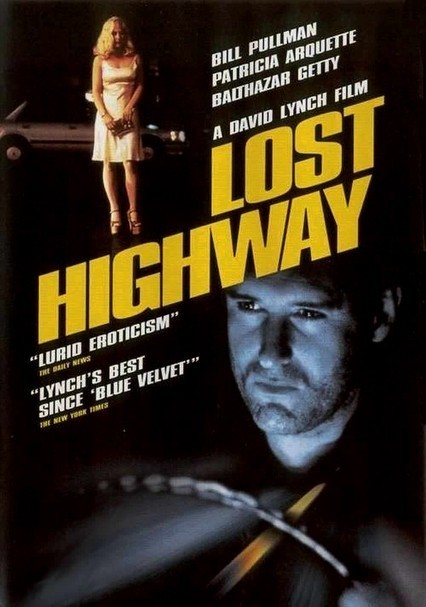
Lost Highway-1997

Lost Highway-1997

Director David Lynch

Starring Bill Pullman, Patricia Arquette

Top 250 Films #211

Scott’s Review #868

Reviewed February 17, 2019

Grade: A-

David Lynch, forever known for his odd and mind-boggling productions, released what might be his most bizarre offering, Lost Highway (1997).

Dreamlike and downright hallucinogenic, the film is impossible to dissect and is open to endless interpretation.

Characters morph into younger or different versions of themselves, or even into different characters entirely, making the film best experienced rather than overanalyzed.

The most enjoyment comes from the fabulous atmospheric elements.

Lost Highway is set in Los Angeles, where we meet saxophonist Fred Madison (Bill Pullman), a nightclub employee who lives with his glamorous wife, Renee (Patricia Arquette), somewhere in the Hollywood Hills.

The couple begins receiving envelopes containing VHS tapes of footage of their house, followed by more invasive tapes of them being filmed while sleeping in their bedroom.

Spooked, they enlist the help of a pair of incompetent detectives.

The events begin to grow more complex with the introduction of a menacing mystery man (Robert Blake) and sequences involving a dismembered Renee, and Fred’s subsequent incarceration for her murder.

Fred suddenly morphs into a young auto mechanic named Pete Dayton (Balthazar Getty), who is released into his parents’ care while being followed by the two detectives.

Pete embarks on an affair with Alice Wakefield, a mirror image of Renee, who is the mistress of powerful Mr. Eddy (Robert Loggia). Pete and Alice plan to escape together, leaving their troubled lives behind.

Any attempt to make more sense of the story than outlined above is fruitless, as a torrent of questions could be raised. The obvious ones are why does Fred turn into Pete (looking completely different), and why does Renee turn into Alice (looking similar)?

What do random scenes of a burning desert cabin mean? What does the bizarre and hazy lesbian sequence with Marilyn Manson have to do with anything?

Discerning the logic and attempting to unravel the mystery will lead to frustration.

The best advice is to immerse yourself in the film and let it manifest in your mind. The terms “dreamlike” and “hallucinating” are often used to describe films, but they are perfect adjectives for Lost Highway.

The stories do run parallel, so the challenge is not following each of them but rather understanding how they connect. The stories also merge in a circular pattern with a rhythmic effect and a satisfying ambiance that lured me immeasurably.

My favorite characters are Alice and Pete, largely because of the actors who portray them. Not appearing until the second half, Getty and Arquette infuse their roles with passion and energy.

I immediately rooted for them as a couple, as their tender and smoldering chemistry was immediately felt. Arquette blazes as a sexy temptress and Getty as the handsome and earnest man submitting to her prowess.

Eagle-eyed viewers may notice comparisons to Russ Meyer’s devilish sexploitation film Supervixens (1975).

The most notable are the dual character representations, the auto mechanic occupation, the locales (more than a few Los Angeles roads seem identical), and various sequences featuring a weightlifter, a gas station drive-up, or other eerily similar scenes.

Whether there is a direct correlation between the films is unknown, but it’s fun to observe.

The musical score and soundtrack are high points, adding both mystique and aggression through the featured hard rock songs. Marilyn Manson’s “I Put a Spell on You”, Rammstein’s “Heirate Mich”, and The Smashing Pumpkins “Eye” are used in important scenes.

The soundtrack release was a huge success on modern rock radio, achieving Gold record sales status.

At the time of Lost Highway’s release, the film was not well-regarded by critics and was dismissed as not making much sense.

In the decades following, the film has garnered more acclaim and, as with a fine wine, has aged well. The beautiful cinematic tone, creative design, and images have become more revered over time.

For a perplexing and cerebral experience, look no further than Lost Highway (1997), a delicious companion piece to the Lynch masterpiece, Mulholland Drive (2001).

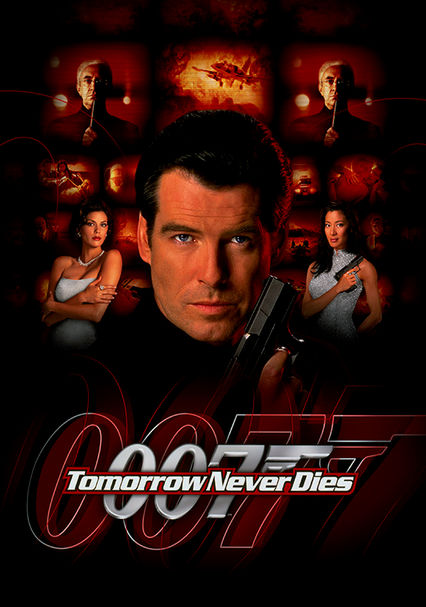
Tomorrow Never Dies-1997

Tomorrow Never Dies-1997

Director Roger Spottiswoode

Starring Pierce Brosnan

Scott’s Review #1,394

Reviewed August 28, 2023

Grade: B

Pierce Brosnan made four appearances as the legendary film character, James Bond. While he gets a marginal thumbs-up as a whole and is not my favorite Bond, he has the ‘look’ and suave charisma.

This works in his favor and makes him entirely believable, even with every ridiculous one-liner or flat line of dialogue.

Tomorrow Never Dies (1997) is the second chapter in the Brosnan book and is only marginally superior to GoldenEye, made two years earlier in 1995. All bets are that the two subsequent Bond films starring Brosnan nosedive quickly.

All good Bond films must include specific qualities such as a strong villain, a sexy yet strong ‘Bond girl’, dazzling stunts and chase scenes, a memorable theme song, and more than one exotic locale.

It’s just what the blueprint is and must never be broken.

Therefore, Tomorrow Never Dies feels more like the producers, director Roger Spottiswoode, and writer Bruce Feirstein sought a check-the-box exercise rather than creating anything brilliant or memorable.

I deem this film rather ordinary. Not bad, but not superior either, falling in the middle of the road when compared to other Bond franchise films.

Media mogul Elliot Carver, played completely over the top by actor Jonathan Pryce, wants his news empire to reach every country on the globe. Still, the Chinese government will not allow him to broadcast there.

Carver then decides to use his media empire to wage war between the Western world and China. Thankfully, James Bond (Brosnan) is on the job and travels to China to stop him with the help of Chinese secret agent Wai Lin (Michelle Yeoh).

Anyone who knows a Bond film knows that the plot is secondary to the aforementioned necessary characteristics.

The story either got too complicated as the film progressed, or I lost interest because, at some point, all I could recall was a news media tycoon trying to start World War III over television ratings.

Yeoh is an exceptional ‘Bond girl,’ though the dose of progressivism, diversity, and female empowerment she brings to the table makes the term beneath her. Her charisma and martial arts chops make her a kick-ass rival, though she naturally ends up head over heels for Bond.

Still, the lengthy scenes between Yeoh and Brosnan do convey strong chemistry as they take down the bad guys and save the world together.

I expected a bit more from Teri Hatcher’s character, Paris Carver, a former girlfriend of Bond who is now Carver’s trophy wife. The setup was superior, and the love triangle could have gone further than killing off her character after just a couple of scenes.

As great an actor as Pryce is, it’s tough to believe he’s the same actor who made films like Two Popes (2019) and The Wife (2017) so good. He turns Elliot into a caricature, dead set on controlling the world, proving that an actor can’t always bring a mediocre script to life.

Tomorrow Never Dies takes viewers to lavish locations such as Bangkok, China, Hamburg, Germany, and London. The tone has a definite Asian feel, which works as well as You Only Live Twice did in 1967.

Finally, the title theme song and opening performed by Sheryl Crow is abysmal, but oddly sounds much better in the version that plays over the ending credits.

I marginally recommend Tomorrow Never Dies (1997), mostly for those in the Brosnan camp, of which I am aware there are many.

Its best quality lies in the degree of equality between Bond and the main female character, Wai Lin, which is further proof of how relevant the franchise remains.

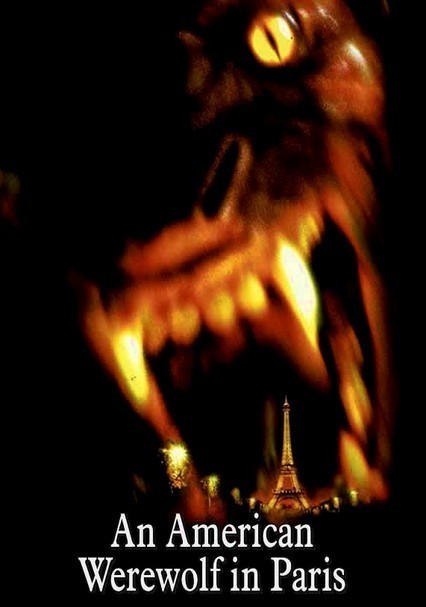
An American Werewolf in Paris-1997

An American Werewolf in Paris-1997

Director Anthony Waller

Starring Thomas Everett Scott, Julie Delpy

Scott’s Review #1,289

Reviewed August 12, 2022

Grade: C+

While fun, An American Werewolf in London (1981) is not in my top 10 best horror films ever.

Werewolf flicks were never my go-to films in the genre, and while I appreciate the incorporated humor, the product is entertaining but not much more.

I’ve gained more appreciation for that film than for the follow-up, the haphazard and goofy An American Werewolf in Paris (1997).

The only elements it gets right are culturally satisfying locale shots of Paris, France, and an underappreciated starring role by charismatic actor Thomas Everett Scott.

An American Werewolf in Paris is a completely watered-down version of An American Werewolf in London, but with little to no connection to it. Considering the sister European cities, it’s a missed opportunity and quite a shame that cross-connection wasn’t utilized.

Three handsome young American male tourists traverse Europe for some fun and, naturally, to meet females. The main focal point is Andy (Everett Scott), who is virginal and serious.

The group arrives in Paris and witnesses an attempted suicide by Parisian Serafine Pigot (Julie Delpy). Andy can amazingly save her from jumping off the Eiffel Tower by diving after her and catching her in the nick of time.

He is injured and transported to the hospital, but eventually locates Serafine.

While on a date at a nightclub with her, Andy is suddenly attacked and bitten by a werewolf. The next day, he discovers that Serafine is also a lycanthrope and that he is beginning his transformation into one of the beasts.

The overall tone of An American Werewolf in Paris is silly and amateurish. The situations work poorly, like when Andy and Serafine are having coffee at a Paris cafe, and he pretends a condom he is chewing is bubble gum.

Later, he stumbles upon ditzy American Amy Finch (Julie Bowen), and they have a graveyard adventure that leaves her un-dead and vowing revenge on Andy.

Anyone expecting authenticity, like the full nudity of the human/werewolf during the transformation, will be severely disappointed by the deliberate lack of skin; the actress, Delpy, bares her breasts.

Otherwise, it’s bare chests only for the males, which is unfair to viewers expecting the running-through-the-forest-naked sequences as in An American Werewolf in London.

It’s a stretch that both Andy and Serafine catapult from the Eiffel Tower and, later, the Statue of Liberty, with barely more than a scratch and very little peril to enjoy.

The wacky plot involves bad-guy Claude (Pierre Cosso), his henchmen, and a drug that induces transformation.

They hold a Fourth of July party to attract American tourists to slaughter, and Serafine’s stepfather is revealed to have created a drug with the opposite intention that led Serafine to kill her mother accidentally.

It’s all weak and uninspired, making an overcomplicated storyline increasingly contrived as the film progresses.

The makeup during the transformation sequences is lacking, especially compared with the superior special effects of An American Werewolf in London.

The CGI used looks fake. And, how could you not compare the two films?

Despite all of the negatives, An American Werewolf in Paris has a moderate presence of fun, but only when Everett Scott appears. He, as Andy, is such a likable guy, wearing his heart on his sleeve, that we root for him to ride off into the sunset with Serafine.

Everett Scott and Delpy don’t have the greatest chemistry, but this can be forgiven because the film is really about the werewolves.

There are no characters to root for besides Andy, and every Parisian character is written as inflexible or as any number of French stereotypes. The only relevant Parisian references are the locales, though most are built sets to replicate the real places.

There is little need ever to see An American Werewolf in Paris (1997) again, since it pales in comparison to the superior An American Werewolf in London (1981).

The Game-1997

The Game-1997

Director David Fincher

Starring Michael Douglas, Sean Penn

Scott’s Review #1,226

Reviewed February 5, 2022

Grade: A-

The Game (1997) is a fantastic cat-and-mouse ‘game’ created by director David Fincher, who always gets some street cred where I’m concerned.

The thrills come a mile a minute, reaching a crashing crescendo in the final act.

It’s a film that produces a roller coaster, edge-of-your-seat thrill-ride, or whatever metaphor serves you best. The result is the same- a fantastic and deliciously wicked experience.

Hollywood A-listers Michael Douglas and Sean Penn team up with chemistry and radiance as brothers with a rivalrous streak.

But who is the cat and who is the mouse is the question of the day as the puzzle pieces continue to mount.

Anyone who knows Fincher’s work, especially films like Seven (1995) and Zodiac (2007) realizes that atmosphere and storytelling are his sweet spot and The Game never disappoints.

It grasps the viewer by the neck and never lets go.

The screenplay is intelligent and daring. Now, before anyone gets their knickers in a bit of a twist, I do not dare say that The Game is on the level of Zodiac or Seven, both masterpieces in my opinion.

But The Game plays its cards well and measures up well if we are ranking Fincher films.

Nicholas Van Orton (Douglas) is a successful banker who keeps mostly to himself, spending most nights alone in his luxurious home. When his estranged brother Conrad (Penn) returns to town on his birthday with an odd gift, Nicholas’s suspicions are piqued.

The gift is a personalized, real-life game that he cannot resist accepting. Beginning slowly, the game grows increasingly personal, and Orton fears for his life as he eludes agents of the mysterious game’s organizers.

With no one left to trust and his money all gone, Orton must find answers for himself before he goes off the rails into psychosis.

Let’s discuss everything but the story first.

The look of The Game is stunning, with perfect lighting and shadows exhibiting the mood. The editing, whether in rapid-fire motion or slow-motion, is brilliantly effective.

Do we feel sorry for the characters? That would be a resounding no, but that’s also the fun of The Game. As Orton spirals down a dark and mysterious path, we are not too invested in the character, so watching the ‘game’ is all the more enjoyable for the viewer.

The message delivered after The Game can either be loved or hated by viewers. I, for one, loved it. Chaos and uncertainty can be argued to be better than complacency, but is it? Nicholas may argue his case when his life is turned on its head.

The conclusion, while unsettling, is riveting and mind-blowing.

Penn has rarely been better, given a healthy dose of mystique and caginess, matched against a musical score that casts a ghostly light on his scenes. The actor does his best when playing a black sheep or an estranged character type, so Conrad is ripe for the picking.

Sandwiched in release between Seven (1995) and Fight Club (1999), both much better remembered than The Game (1997), that is a bit of a shame.

The film deserves a good dusting off, and fans of Fincher will undoubtedly enjoy piecing together a good, solid perplexity, or at least attempting to.

I Know What You Did Last Summer-1997

I Know What You Did Last Summer 1997

Director Jim Gillespie

Starring Jennifer Love Hewitt, Ryan Phillippe, Sarah Michelle Gellar

Scott’s Review #1,182

Reviewed September 29, 2021

Grade: B+

Capitalizing on the wild success of the mid-1990s horror resurgence led by Wes Craven’s Scream (1996), I Know What You Did Last Summer (1997) was a popular low-budget popcorn hit.

The year 1997 was like 1979 or 1980 when the slasher craze (part Deux) was still fresh and intriguing.

The film is fun with superior direction and a dark ambiance that works quite well for the genre.

A slew of other imitators would follow this release, including the tepid I Still Know What You Did Last Summer in 1998, but the first one is formulaic entertainment done well.

It wisely cast youthful stars of the day, chomping at the bit to be the killer’s next victim.

One hot July 4th night in the small coastal town of Southport, North Carolina, a group of four teenagers runs over a fisherman and dumps his body in the water, vowing never to speak of the incident again.

Some members of the group feel little remorse, while others are racked with guilt.

The four principals are Julie (Jennifer Love Hewitt), Barry (Ryan Phillippe), Helen (Sarah Michelle Gellar), and Ray (Freddie Prinze Jr.).

Predictably, one year later, Julie receives a frightening letter, and the group reconvenes. They fret and worry that they have been seen or, worse, that they will be exposed. The letter states, ‘I Know What You Did Last Summer.’

Someone begins to follow them, especially Julie, clad in a fisherman’s gear and wielding a meat hook.

In a way, he is a combination of other horror villains like Jason, Freddy, and Michael Myers, but we know neither his identity nor his motivation.

Does he want money or blood?

One of the groups incorrectly pursues who they think is the killer and is unceremoniously run down and terrorized. The bloodletting only continues as other townspeople become involved in the events, some amid a local Independence Day parade.

There are some obvious inclusions to the story to make sure audiences are aware they are watching a slasher flick and a teen-targeted genre flick.

This is no wonder since the screenwriter, Kevin Williamson, was best known for teen-themed writing for television’s Dawson’s Creek.

I Know What You Did Last Summer borrows from so many 1980’s slasher-flicks like Terror Train (1980), Prom Night (1980), and My Bloody Valentine (1981) that it’s a given that Williamson and director Jim Gillespie spent weekends shacked up with popcorn and sodas while watching these films for reference material.

The killer is masked. This is to make damned sure we know that we are watching a whodunit and that at the finale the killer will be exposed- think the big reveal in every Scooby-Doo episode.

Could the killer be one of the teens themselves?

Julie is immediately the ‘final girl’ simply because she feels the most guilt and is the most pursued, perhaps for that very reason.

Other necessities like the asshole jock (Phillippe), the mean girl (Bridgette Wilson), and the red herring are added on like clockwork.

We know that Julie will be the one to survive.

Still, the premise is quite compelling and immediately hooked me. I also knew that I was being manipulated, but I did not care. I couldn’t wait to find out who the killer was.

The final sequence, which ensures a sequel, is delicious and an obvious ode to Brian De Palma’s films.

A year later, in 1998, Julie is in college in Boston. As she enters the shower, she notices the words “I still know” written in the steam on the shower door.

Moments later, a dark figure crashes through it as Julie screams!

I Know What You Did Last Summer (1997) is straight-up, by-the-numbers mainstream horror, but the familiarity doesn’t detract from the enjoyment. You know what is right around the bend, and you can’t wait to get there.

Hercules-1997

Hercules-1997

Director Ron Clements, John Musker

Voices Tate Donovan, James Woods, Danny DeVito

Scott’s Review #1,109

Reviewed February 7, 2021

Grade: B-

Hercules (1997) is a modern-day Walt Disney film that centers on Ancient Greek mythology. The premise is one I find fascinating, and the characters of Hercules, Zeus, Hades, and Pegasus are the focus.

The names alone hold intrigue and appeal, but the film is only an adequate watch.

The product feels “produced” and lacks the authenticity and sincerity that are rich and seamless in beloved Disney classics like Snow White and the Seven Dwarfs (1937) or Bambi (1941).

Besides the initial story intrigue, the animations are nothing particularly special, and it feels too kiddie-like.

It’s like comparing The Beatles’ Sgt. Pepper’s Lonely Hearts Club Band is a historical album, to a latter-day solo effort by Paul McCartney, and that’s being generous.

It may be fine, but it can’t hold a candle to the former.

And “fine” is not what I wanted from a Disney film. That’s what I felt about Hercules. It’s okay and entertaining, but not up to snuff as compared with finer films.

The film is equipped with a fantastic villain, though the best part of Hercules is not the mythological elements. James Woods, who voices the character of Hades, is wonderful, and I’m hardly a James Woods fan, but for other reasons, like his politics.

Anyway, the rivalry and competitive edge of Hercules and Hades are unique and compelling and will hold one’s attention.

It all begins in a perfect Disney way when Hercules (Tate Donovan), a son of the gods, is snatched as a baby by Hades and forced to live among mortals as a half-man, half-god.

When he becomes an adolescent, Hercules must undergo a rite of passage on Earth to prove himself worthy to live with the gods on Mount Olympus.

With his sidekick, Philoctetes (Danny DeVito), in tow, Hercules must learn to use his strength to defeat evil creatures.

The strong message is written in Hercules to appeal to a sense of good overthrowing evil. It’s a Disney film, trust me, it will.

Though predictable, the story feels good in a world where far too often the bad guys get away with bad things and the good guys don’t get enough credit.

Appealing and targeted mostly to kids, the film made a ton of money, which means a lot of kids saw it. A great reminder is that with any luck, truth and honesty will win out. So will remaining true to oneself.

Woods makes Hades a villain with an edge rather than a generic, cookie-cutter type. Hades speaks rapidly, like a used car salesman trying to sell a customer a good deal. We can tell we are being swindled, but there is fun in that.

Megara (Susan Egan), Hercules’ intended love interest, works for Hades, adding a layer of intrigue.

Unfortunately, the romance between Hercules and Meg never gets off the ground or works well. The main issue is that there is little chemistry or romantic potential between the couple.

Meg isn’t my favorite Disney character. She is a sarcastic damsel whom Hercules saves from the centaur Nessus.

After Hercules and the others leave, Meg is revealed to be Hades’ servant, having sold her soul to him to save a lover who then left her. She’s had a tough life and finally does the right thing, but I never felt invested in the character.

The main song from the film is okay, but rather forgettable. The title of “Go the Distance” is a song of determination, but also generic and unmemorable.

The look of the animations has a 1990s vibe, with bright, vibrant colors that feel “of the time” rather than classic or alive.

A decent effort, Hercules (1997) hits its mark sometimes and misses completely at other times.

I was enraptured by the historical and mythological gods and the trappings that go along with that mystique, but the modern spin didn’t work and only made me yearn for the classics from the 1940s and 1950s.

Oscar Nominations: Best Original Song-“Go the Distance”

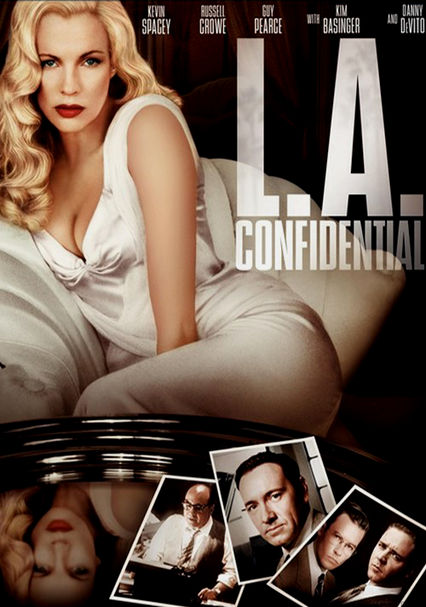
L.A. Confidential-1997

L.A. Confidential-1997

Director Curtis Hanson

Starring Guy Pearce, Kevin Spacey

Scott’s Review #1,102

Reviewed January 19, 2021

Grade: A

An enormous critical and commercial hit in 1997, L.A. Confidential spins a tale of intrigue and mystery set in the 1950s, with plenty of big-name stars to go around.

The film can be classified as a throwback, neo-noir escapade, but it’s quite stylistic and fleshed out.

It’s well-made, with slick elements and a Hollywood look and feel, and it’s the seduction and bevy of secrets that will keep viewers glued to their seats, trying to guess what happens next.

As if it doesn’t have enough great elements a powerful whodunit is constructed leading viewers to question if the bad guys are good or the good guys bad.

Stalwarts like Kevin Spacey, Kim Basinger, and Danny DeVito bring star power, while unknowns at the time, Russell Crowe and Guy Pearce are the real reasons to tune in.

L.A. Confidential has a seemingly endless, tangled web to absorb and unravel, but the film is well-paced and never overcomplicates itself. The strong art direction and musical score make it a delight to the eyes and ears.

The film is fraught with a saucerful of secrets just waiting to be brought to the surface.

Based on the James Ellroy 1990 novel of the same name, it’s the third book in his L.A. Quartet series, the others being The Black Dahlia (1987) and The Big Nowhere (1988).

All focus on the Los Angeles Police Department, corruption, and scandal. The former was adapted into an unsuccessful 2006 film starring Josh Hartnett and Scarlett Johansson.

I love films set in the City of Angels with a focus on Hollywood darkness lurking beneath the sunny and swanky exterior. Especially effective was the 1950s, post-World War II, when everything seemed to be coming up roses.

Naturally, murder is the offering of the day.

To summarize, three policemen, each with his motives and obsessions, tackle the corruption surrounding an unsolved murder at a downtown Los Angeles coffee shop in the early 1950s.

Detective Lieutenant Exley (Pearce), the son of a murdered detective, is out to avenge his father’s killing. The ex-partner of Officer White (Crowe), implicated in a scandal uncovered by Exley, was one of the victims.

Sergeant Vincennes (Spacey) feeds classified information to a tabloid magnate (DeVito). Basinger portrays Lynn Bracken as a glamorous prostitute.

It’s nice watching the film with the knowledge of the big stars Crowe and Pearce would become. Also interesting is seeing Spacey when he was a big star, eventually destined to become Hollywood mud due to a scandal.

That’s the beauty of watching a classic film: it adds a realistic element unknown at the time of its first release.

From a romantic angle, it’s fun and juicy to wonder who Lynn, a Veronica Lake lookalike, will wind up with. Basinger has chemistry with all of the handsome cops, and one wonders who she will screw and screw over.

The role is the best of Basinger’s career.

L.A. Confidential is a film that can be viewed multiple times to notice intricacies missed during the first go-around. It harkens back to the 1940s in style, pizazz, and texture.

There is something for everyone, and it develops well beyond the film noir genre.

It contains great acting, exceptional writing with twisting storylines and events, bloodshed, and thrills. It is an exceptional crime drama, almost on par with one of the greats, Chinatown (1974).

The 1990s were an excellent decade for well-made films, and L.A. Confidential (1997) is near the top of the pile.

Oscar Nominations: 2 wins-Best Picture, Best Director-Curtis Hanson, Best Supporting Actress-Kim Basinger (won), Best Screenplay Based on Material Previously Produced or Published (won), Best Original Dramatic Score, Best Sound, Best Art Direction, Best Cinematography, Best Film Editing

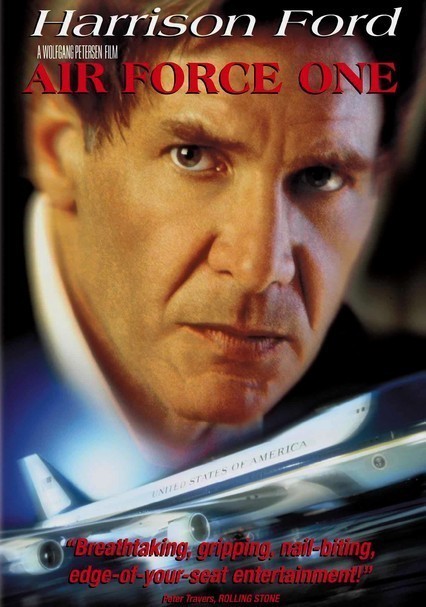
Air Force One-1997

Air Force One-1997

Director Wolfgang Petersen

Starring Harrison Ford

Scott’s Review #1,085

Reviewed November 21, 2020

Grade: B+

If ever a straight-ahead, summer blockbuster, popcorn flick existed, Air Force One (1997) is it.

Surprisingly, this is not a bad thing. It’s not cerebral, but it’s never dull.

The film has hooks and muscle and assembles a thrill ride, edge-of-your-seat action fest. Some would say this is just what the doctor ordered, and they’d be right, provided the mood is for a mind-escaping, meat-and-potatoes affair.

Air Force One is pure Americana.

With a patriotic musical score and a clear hero and villain, it’s easy to know who to root for. Suspension of disbelief is mandatory since some scenes are as implausible as Santa Claus shimmying down a chimney on Christmas Eve, but the film is entertaining.

The action is non-stop.

At the tail end of his prime action-star years (the 1980s and 1990s), Harrison Ford plays James Marshall, the president of the United States of America.

After making a bombastic speech in Moscow vowing never to negotiate with terrorists, a group of them led by the dastardly Ivan (Gary Oldman) hijacked Air Force One with the president and his family on board.

Marshall, a former soldier, hides in the cabin of the plane and races against time to save his family and those aboard the flight from the terrorists.

The plot is implausible and hokey, and it reeks of plot points meant to carry the story along, but surprisingly, the film works. There is no way a president would ever race around performing stunts aboard an airplane, conquering the villains like clockwork.

But Ford has the charisma to make us believe it could happen, and his character is a family man, a Vietnam veteran, and a Medal of Honor recipient.

Can this guy be any more perfect?

Oldman, always reliable as a villain, is perfectly cast. His character’s motivations are simplistic and nationalistic. Ivan believes that the collapse of the Soviet Union has ruined his country, and somehow it’s the fault of the United States.

The reasoning is silly, but it’s in keeping with the patriotic nature of Air Force One- the ‘us versus them’ mentality. The United States is good; Russia is bad.

It’s what middle America wants, and the target audience of this film is clear, back to the Cold War.

Wolfgang Petersen, who directs the film, knows his way around the action genre. After all, he crafted the memorable Das Boot (1981) and Outbreak (1995). The film has a Tom Clancy-Patriot Games meets Die Hard (1988) style.

Petersen meshes the score with the quick editing style to layer the film with more action than slowed-down conversational scenes. We know how it’s going to end, but enjoy the ride.

On closer inspection, the film is not just for the guys.

Glenn Close is cast as a female Vice President and a strong gender-twisting presence. Kathryn Bennett is a bold, careful woman, and the implication is that she is more than capable of taking over should anything happen to the president.

Her scenes mostly take place in the White House Situation Room and provide a nice calm as she is pressured by the Defense Secretary (Dean Stockwell) to declare the president incapable.

The scenes between Stockwell and Close are very strong.

Air Force One (1997) is a cliché-riddled and mainstream Hollywood creation to the max. Both the pacing and the pulsating style make the film a guilty pleasure and quite enjoyable.

When the mood strikes to kick back and relax with a fun, action-packed affair, this one is your choice. Just don’t dissect the details too much or expect real-life to mimic art.

Oscar Nominations: Best Sound, Best Film Editing