The Passenger-1975

The Passenger-1975

Director Michelangelo Antonioni

Starring Jack Nicholson, Maria Schneider

Scott’s Review #259
70042799

Reviewed July 19, 2015

Grade: A

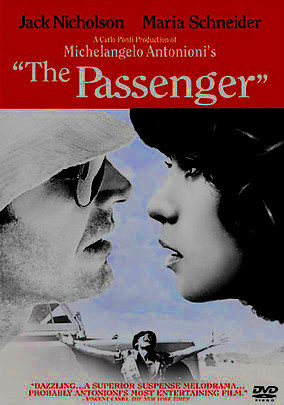
A true art film in every sense of the word, The Passenger (1975) is a thinking man’s film, not for those content to munch on popcorn and escape the day’s stressors.

It’s custom-made for a film fan willing to ponder its meaning, revel in its slow pace, and appreciate it as an art form.

The Passenger is tough to “get” for most of its over-two-hour running time, but its complexities are also its most beautiful qualities.

To say that the film will leave the viewer with questions is quite an understatement, but it is pleasing to analyze and draw conclusions about its meaning.

Michelangelo Antonioni directed this film and is well known for Blowup (1966) and Zabriskie Point (1970), neither of which I have seen as of this writing.

Jack Nicholson stars as a journalist named David Locke, who is on location in Africa (specifically the Sahara Desert in Chad).

David’s assignment is to produce a documentary film. While there, he mysteriously assumes the identity of a businessman named Robertson, who he finds dead in his hotel room.

This task is easy because David and Robertson look very much alike. As events unfold, it becomes clear that Robertson is involved in arms dealing and smuggling related to the ongoing civil unrest in the country.

Flashbacks reveal David’s former life, including his friendship with the businessman and his relationship with his wife, Rachel, and these scenes are interwoven with the current action until the narrative becomes more linear.

The film is complex, to say the least. The initial scene, in which David spontaneously decides to switch identities, is excellent. We wonder what David’s motivations are, and what is the appeal of his taking over another man’s life? Who is the man? Why is David so unhappy in his own life?

The film succeeds immeasurably because the plot is not simply told to the audience, as in so many other mainstream films. Events seem genuine and not forced for plot purposes.

In the current time, wherever in London, Rachel sadly mourns the assumed “death” of her husband David, though we learn that Rachel has secrets of her own she has been hiding and suffers from tremendous guilt.

To further complicate matters for everyone, she is attempting to find the businessman, since she has learned that he was the last person to see her husband alive. Also mixed into the story is a mysterious young woman whom David meets when the story moves to Barcelona, Spain.

What makes The Passenger so compelling to me is its intricacies- story as well as camera styles. The seven-minute-long shot towards the end is brilliant filmmaking, and the climax is quietly intense.

The camera focuses on a hotel room, then switches to the parking lot, and returns to the hotel room. I was transfixed by the character of David, struggling to empathize with him while all the while enjoying an intelligent character study interwoven with a story of political intrigue.

I do not claim to understand everything about The Passenger and will surely need more viewings to make sense of it all, but the film fascinates me.

In a time of mediocre films, how refreshing to stumble upon a forgotten relic from 1975 and have a renewed appreciation for film as an art form.
Love and Mercy-2015

Love and Mercy-2015

Director Bill Pohlad

Starring John Cusack, Paul Dano

Scott’s Review #258

80017274

Reviewed July 17, 2015

Grade: B+

The life and times of the Beach Boys’ famous and troubled lead singer, Brian Wilson, is finally played out on the big screen (apparently many attempts were made to make a film) as Love and Mercy (2015) chronicles his difficult upbringing, unrivaled success, and his interesting life in later years.

He suffered from schizophrenia, traveled down a paranoid, nervous path, and was manipulated by a family friend who served as his doctor and main caregiver.

Thankfully, he weathered the storm due to his future wife, and remarkably still performs and entertains in 2015.

His musical career began in the 1960s.

The biopic features many well-known Beach Boys tunes to hum along to and be entertained by. It’s not a happy film nor a downer either.

It’s somewhere in the middle of the two and the life story of a rock star.

There is a risk in this. If the film is too sentimental it will fail. Love and Mercy do it correctly.

The film is not a sing-along, trip-down-memory lane film for lighthearted film fans. Rather, it is dark, murky, and troubling at times (the psychedelic scene when a young Brian is imagining different voices and noises in his head is rather frightening).

Wilson is played by two actors, first in the 1960s and later in the 1980s.

Paul Dano stars as a young Wilson in the early stages of his career, filled with passion for life, art, music, and talent beyond belief, but clearly in the onset stages of paranoia, thanks to his critical father. He is a demanding, angry man, possibly envious of Brian’s talents as a songwriter, who always wanted more from Brian.

Wilson’s father managed Brian and his brothers success but at a huge cost, and was ready to bail when the “next big thing” came along.

Miraculously, through conflict with his father and other members, Wilson completed the Beach Boys masterpiece, Pet Sounds, a groundbreaking album from the late 1960s. The film shows the struggles faced to achieve this success.

In later years John Cusack takes over the role of Brian. By this point in his life, he is damaged and he is a full-blown neurotic, insecure, and dependent on his psychotherapist, Dr. Landy, brilliantly played by Paul Giamatti.

Landy has control of Wilson’s assets and will destroy anyone who interferes in this.

The scenes in which he screams at and berates a drugged-out Brian Wilson to create music are tough to stomach. When Wilson romances their future wife Melinda Ledbetter, played by Elizabeth Banks, she ultimately saves his life as she is determined to rescue Brian from the wicked abuse and adjust the toxic levels of medications he was kept on.

I left the movie theater unsure of the factual accuracy and pondered the following questions.

Did Brian’s wife swoop into his life and “save” him as neatly as the film explains? How instrumental was the maid in this process? Was the Wilson brothers’ father as much a monster as the movie portrayed him? Was Giamatti’s vicious psychotherapist role true to life or were the aspects of Love and Mercy embellished ever so slightly for moviemaking magic?

One wonders, but from a film perspective, Love and Mercy (2015) works well as a work that takes risks, does not go for softness or niceness, and gives a character study that is quite admirable.

Independent Spirit Award Nominations: Best Supporting Male-Paul Dano

Cake-2014

Cake-2014

Director Daniel Barnz

Starring Jennifer Aniston, Adriana Barraza

Scott’s Review #257

80017263

Reviewed July 14, 2015

Grade: B+

Cake (2014) is a film about a woman suffering from chronic physical pain and depression that she constantly battles after a terrible accident that she was involved in.

Jennifer Aniston gives a wonderful performance as Claire Simmons, a grumpy, sarcastic, bitter victim of unimaginable loss. Aniston’s performance is the best part by far.

It is interesting to note that Aniston Executive produced this film.

Similarly and somewhat sadly, Reese Witherspoon had to produce her own 2014 film (Wild) centered on a female role for both women to showcase their powerful acting chops. Too few films about women are made these days unless female star power is used, which is too bad.

Claire has been through hell and back.

As the story opens, Claire sits angrily in a support group filled with other women with problems. One of the women, Nina, (played by Anna Kendrick) has just jumped off of a freeway overpass to her death—a giant photo of her glares jarringly at the other women.

When Claire prods about the details of the death and uses sarcastic tones, she is politely asked not to return to the group by the lead counselor, Annette, (played by Felicity Huffman).

Claire returns to her well-maintained Los Angeles home and the audience is introduced to her well-meaning housekeeper and confidant, Silvana, played by Adriana Barraza. Barraza herself gives a powerful performance.

Nina appears throughout the remainder of the film in visions as Clare debates suicide.

Let me discuss Jennifer Aniston’s performance in particular. I thought it was amazing and she was shamefully overlooked for an Oscar nomination.

She was superior to at least a couple of the other Best Actress nominees from 2014 (Felicity Jones immediately comes to mind as one).

Her character of Claire starts as a bit of a shrew but gradually becomes quite sympathetic as the story becomes layered and the audience gets to know what makes her tick.

We do not know how she came to be in her predicament initially. We know she was in a terrible accident, but it slowly takes time for all of the details to emerge. We only know she is in pain and angry. Claire’s relationship with Silvana is an interesting one.

They spar, Claire takes Silvana for granted at times, but throughout the film, a close friendship emerges between the women. In a touching scene, they hold hands as they sleep.

Two scenes in particular are heartbreaking and honest. A man played by William H. Macy emerges on the doorsteps of Claire’s house and she is engulfed in rage at his appearance.

The power that Aniston emits in this scene is unrivaled. In another scene she sees a portrait hanging on her living room fireplace mantle given by a friend- she bursts into tears and sobs emotionally. At this point, the plot makes more sense and we feel Claire’s raw pain.

The subject matter of depression and suicide is not a cheery one, and Cake delves deeply into this territory. The film is a bit of a downer, slow, and, at moments, drags a bit, and teeters on the verge of a lifetime television movie (yikes!), but MUCH better than that thanks to Aniston’s compelling portrayal.

With a lesser actress, the film might have felt watered down and safe.

Some light moments fail. For instance, when Claire “blackmails” Annette and bribes her with vodka for the address of Nina, this seems very trivial and silly.

Thanks in large part to a gripping performance by one of Hollywood’s underrated talents, Cake (2014) takes a film on the border of being one-dimensional to a grander level of dynamic acting by its leading lady.

A supporting cast of similar talents helps the film rise above the mediocrity it may have been if served by lesser casting choices.

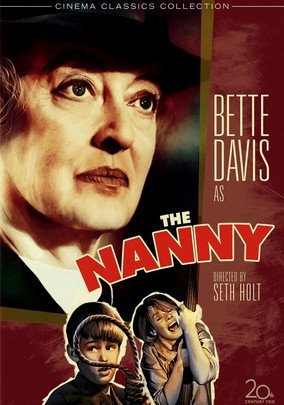
The Nanny-1965

The Nanny-1965

Director Seth Holt

Starring Bette Davis

Scott’s Review #256

70089620

Reviewed July 11, 2015

Grade: B

The Nanny is a 1965 Hammer productions thriller starring legendary film icon Bette Davis as a mysterious nanny caring for a ten-year-old boy named Joey.

Joey has recently been released from a mental institution and returned home to resume everyday life, but has he been “cured”?

There is obvious tension between Joey and Nanny, but the audience doesn’t know what that tension is precisely. Why do they dislike each other? Why is Joey afraid of her?

As the plot unfolds, the suspense and tensions thicken as various events occur and Joey’s parents and Aunt Pen are further fleshed out. Past events are revisited, and the story becomes thrilling.

At one point, long before Joey’s return home, his younger sister has drowned, and the circumstances are vague. It has devastated the family, including Nanny. Joey has been blamed for her death, though he insists that Nanny is the culprit.

Nobody except the neighbor girl believes Joey, and the audience wonders who to believe and who to root for: Joey or Nanny. Davis, like Nanny, brings a warmness to her character, but is she sincere? Is it an act? Is Joey a sweet boy or maniacal?

These questions race through the audience’s minds as the film progresses. When Virginia, the mother, eats tainted food, the obvious conclusion is that the Nanny poisoned it since she prepared it. But why? Did she do this?

As the plot is slowly explained, there are a few chills, though the ending is not too surprising.

Any film starring Bette Davis is a treasure, though admittedly, it is not her finest work. Still, her finest work is challenging to match.

The Nanny is a good film, though not great. It is shot in black and white, which is a nice touch for a thriller.

The main reason to watch Davis’s performance is that it is always mesmerizing. Traditionally playing gruff, mean, or bitchy parts (especially in her later years), The Nanny allows Davis to play a sympathetic role.

She is seemingly sweet, proper, well-organized, and a perfect nanny on paper.

The role of Virginia, played by Wendy Craig, is a bit too neurotic and slightly over-acted. She is rather one-note as the fretting mother worried about her son. The character of the father is also a bit one-dimensional.

The Nanny is more of a classic thriller from the 1960s that is often lumped together with some of Bette Davis’s other films around the same period (Dead Ringer-1964, Hush, Hush, Sweet Charlotte-1964, and Whatever Happened to Baby Jane? -1966), and are in large part superior to The Nanny. As a stand-alone, it is a decent film.

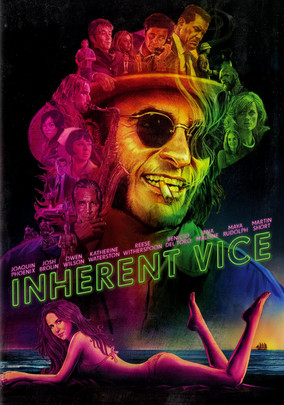
Inherent Vice-2014

Inherent Vice-2014

Director Paul Thomas Anderson

Starring Joaquin Phoenix, Josh Brolin

Scott’s Review #255

80013545

Reviewed July 7, 2015

Grade: A-

Inherent Vice (2014) is a bizarre detective film noir-type experience, set in 1970 Los Angeles.

Directed by the superb Paul Thomas Anderson (Boogie Nights-1997 and Magnolia-1999), the film has weirdness and incoherence that is a marvel to experience.

Fans of a straightforward plot will not be thrilled with this film, but for fans of Anderson, this will not disappoint. It has a complex plot, but the payoff is grand and a thinking man’s film.

The protagonist is Larry “Doc” Sportello (Joaquin Phoenix), a stoner private detective, contacted by his mysterious ex-girlfriend Shasta. She is worried about attempts by her boyfriend’s ex-wife and new lover to kidnap him and have him committed.

Mickey, Shasta’s boyfriend, is a wealthy real-estate developer.

Doc is also hired by two other people- one a former heroin addict looking for her missing husband, and the other a former convict looking for a prison mate who owes him money and is a former henchman of Mickey’s.

All of the stories intersect and such oddities as a peculiar massage parlor and a ship named the Golden Fang come into play throughout.

The intersecting stories lead to the revelation of a drug ring. I had little idea what was happening but was still enthralled by it.

There is an unpredictability surrounding Inherent Vice that is so pleasing and captivating. Joaquin Phoenix is compelling as Doc, a damaged character whose past is unclear.

When Doc is, by all accounts, framed for the murder of a convict and interrogated by the police, we wonder what history he has with them and what led him to branch out on his own as a private investigator.

Detective “Bigfoot” Bjornsen, wonderfully played by Josh Brolin, is a rival of Doc’s, though it is unclear why. “Bigfoot” is frequently seen with chocolate-covered phallic objects in his mouth and is married to a severe, overbearing woman.

Most characters are peculiar and have strange nuances, yet are never fully fleshed out, instead of remaining curious and thought-provoking.

Reese Witherspoon, Benicio Del Torro, and Owen Wilson appear in small yet pivotal roles.

Quite reminiscent of Roman Polanski’s Chinatown (1974) and Robert Altman’s The Long Goodbye (1973), in both the California setting and the plodding, slow-paced, magnificent storytelling, Inherent Vice is a confusing gem, but by all means a gem worth seeing and reveling among the intrigue.

Just don’t try to make too much sense of it all.

Oscar Nominations: Best Adapted Screenplay, Best Costume Design

Independent Spirit Award Nominations: 1 win-Robert Altman Award (won)

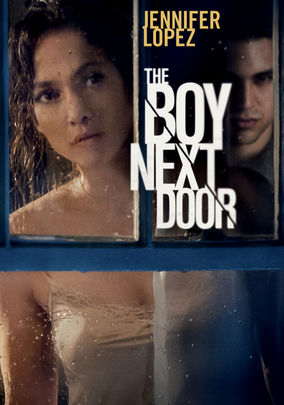
The Boy Next Door-2015

The Boy Next Door-2015

Director Rob Cohen

Starring Jennifer Lopez

Scott’s Review #254

80013272

Reviewed July 5, 2015

Grade: C-

A steamy direct rip-off of the 1987 classic film Fatal Attraction, The Boy Next Door (2015) is a mainstream thriller starring Jennifer Lopez as a separated suburban Mom raising her son alone.

One day a handsome young man, Noah (Ryan Guzman), moves in next door. He makes friends with her son and develops an unhealthy obsession with her.

The film is your basic thrill ride with some jumps mixed in but predictable as they come and is safe mainstream fare.

Claire Peterson (Lopez) lives a cozy suburban existence with her socially awkward teenage son Kevin (Ian Nelson) and works as a literature teacher at the local high school.

She lives a modest yet successful life.

Her estranged husband Garrett (John Corbett) has cheated on her with his secretary.

One day a hunky twenty-year-old neighbor, Noah, moves in, takes a shine to Kevin and an attraction develops between Noah and Claire, despite him being half her age. The audience knows that there is something off.

The inevitable happens, a lonely Claire winds up in bed with Noah after a disastrous blind double date with her friend and confidant Vicky (Kristin Chenoweth), also the vice-principal of Claire’s school.

The sex scenes are titillating and sensual with lots of skin.

I went into my viewing not expecting an invigorating or thought-provoking film and was not disappointed.

The film is lightweight, predictable, and has a lifetime television movie feel. The acting is not great and the setups are seen a mile away. When Claire and Noah meet there is instant chemistry between them but there is also a sinister quality to Noah that the audience is aware of.

There is no doubt he will make trouble for Claire.

As we progress we become aware that Noah has a temper, another setup for things to come. If he feels wronged he strikes back. Once Claire realizes their passionate night was a mistake, Noah becomes obsessed with and vengeful of Claire and everyone around her.

The plot is filled with one implausibility after another. I could list silly nuances for hours, but here are a few that immediately come to mind.

I do not buy Jennifer Lopez as an intelligent, sophisticated, literature genius (despite the film hysterically having her wear nerdy glasses) nor the good-looking Ryan Guzman (Noah) as a scholarly expert in literature either.

This is done to construct the plot with no believability whatsoever.

Throughout the film, Noah can do whatever he wants, somehow hacking into Claire’s computer, arranging for printouts of his liaison with her to fly endlessly from the ceilings, tampering with brakes, and seamlessly splicing Claire’s voice into conversations.

The entire film is ridiculous and unbelievable, but, again, it’s what I expected it to be.

The ending surprised me abruptly with no cliffhanger or hint at a sequel as is common with thrillers. Perhaps the filmmakers had low expectations for audience turnout.

One jarring point is that Jennifer Lopez, clearly Latina, plays a character in a suburban neighborhood, named Claire Peterson. Nowhere is her Latina heritage mentioned. The character is about as white as you can get.

A dumb, entertaining ninety minutes of escapism, The Boy Next Door is not a good film (2015) but fun. Some thrilling moments, some fun to kick back relax, and take it for what it is.

It is comparable to a McDonald’s hamburger, you know what you will get and expect nothing more.

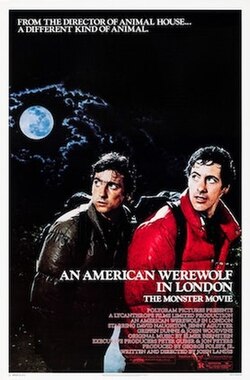
An American Werewolf in London-1981

An American Werewolf in London-1981

Director John Landis

Starring David Naughton, Griffin Dunne

Scott’s Review #253

Reviewed July 2, 2015

Grade: B

A melding of British-American horror and comedy, An American Werewolf in London (1981) provides entertainment while also being a campy and silly.

While two American buddies, Jack and David, traverse the English countryside with backpacks in tow on a spring break jaunt of sorts, one is viciously attacked and killed by a strange werewolf, setting off a series of strange occurrences that play out over the remainder of the film.

From this point, the film is told from the perspective of one of the males, as the other appears to him in visions, warning him of his inevitable transformation into a werewolf.

An American Werewolf in London does not intend to mock the horror genre, but it is certainly campy and over-the-top.

Despite the cult-classic accolades thrust upon the film, which I respect, it is not among my favorites.

I would have preferred it to tilt more towards the horror classification rather than the comedy, because it comes across as some spoof, with the main characters overacting.

The film has a silly quality. It is light fare instead of dark or morbid, and even the kills are meant to be fun, not horrific. In a way, it is almost cheesy, and that is not a compliment.

This is not to say that the film is completely subpar. It is decent, but not very believable, and I think that is a distraction and a missed opportunity.

However, my favorite characteristics of this film are the makeup/special effects and the musical score, which features such fitting treats as “Moondance”, “Bad Moon Rising”, and “Blue Moon”.

Sense an intelligent theme? The makeup, especially during the reanimation sequences, is creative and still impressive today, considering the film was made in 1981.

Besides, the best scene of the film is undoubtedly the “Slaughtered Lamb” scene when Jack and David stumble upon the aptly named pub filled with interesting, blue-collar-looking locals.

When one of the tourists inquires about a mysterious five-pointed star on the wall, the pub dwellers grow angry and cold, leaving the young men confused and intrigued.

This scene is full of interest, and I only wish the pub characters had more of a chance to shine, as they seem benevolent and have potential backstory.

I would have enjoyed learning more about the history of these folks.

Sadly, the focus is by and large on Jack and David and a poorly constructed love interest- Nurse Alex Price, who is not to be taken at all seriously and played for one-dimensional laughs.

A lighthearted, sort-of fun late-night flick, An American Werewolf in London is a cult film, though I would not agree with the “cult classic” distinction.

Oscar Nominations: 1 win-Best Makeup (won)