O Fantasma-2000

O Fantasma-2000

Director João Pedro Rodrigues

Starring  Ricardo Meneses

Scott’s Review #1,363

Reviewed May 25, 2023

Grade: B

The target audience for a film like O Fantasma (2000) can only be gay men or anyone macabre enough to want to see male pornographic eroticism mixed with sadomasochism.

There is more than one scene that is straight-up pornography. I’ll spare the details but most kinds of sex are on full display and do not look staged or faked.

It’s the type of film that I’m still digesting and ruminating over. I suppose that’s better than having forgotten it.

The director, a gay man named João Pedro Rodrigues, doesn’t sugarcoat the film’s subtext, which is a young man’s painful journey into self-awareness and homosexuality.

The film is set and shot in and around Lisbon, Portugal. Unfortunately, any palatial, lush, or culturally significant landmarks are not used. Instead, seedy, dark, and industrial areas are.

During the night, brooding, lonely Sergio (Ricardo Meneses) works as a trash collector. In between garbage dumps, he embarks on an increasingly dangerous journey of anonymous sexual encounters. Soon, he becomes fixated on one handsome stranger and ‘plows’ down a haunting path.

The opening scene immediately plunges the viewer into a subversive world. Two men, one clad completely in leather, the other naked, are engaging in rough anal sex. We do not who they are or how they figure into the story…….yet.

Speaking of story, O Fantasma doesn’t have much of one. Besides the brief synopsis listed above, Sergio spends a good amount of time playing with his dog, having sex with a policeman, and rebuffing his female co-worker Fátima (Beatriz Torcato) advances.

Oh yeah, Sergio also has time for more rough outdoor sex with his male boss, Virgilio (Eurico Vieira), drinking from puddles, and taking a dump in his clothes.

O Fantasma all seems rather pointless when its shell is peeled back and it’s dissected a little. I get that Sergio is a gay male who is self-hating and conflicted but I feel like I’ve seen that angle played enough times, and no, O Fantasma doesn’t turn about face and offer a happy ending.

Young men struggling with their sexuality in any way need not see this film. It will undoubtedly veer them off the next nearby cliff.

With that footprint relayed, a more mature gay man will find erotism and some titillation to experience and what’s so bad about that? But, O Fantasma is for grown-up audiences and tastes only.

To say that there are enough bare asses displayed to go around is a severe understatement. The naked front male appendages make frequent appearances both erect and flaccid. Oral and anal sex are given equal screen time and one poor bunny rabbit doesn’t stand a chance again an angry and hungry man.

I’m still cringing from that scene.

O Fantasma is a disturbing viewing but never boring. It’s not quite cerebral or artsy but boy does it mesmerize. I’ve never seen a film quite like it nor do I think I ever need to see it again.

This film would never have been made in the United States but European filmmakers get away with so much more skin and sex. That’s just a known fact.

Actor, Ricardo Meneses, doesn’t possess much acting range nor does he need to. He simply needs to glare, sulk, and stalk to make his character’s intention clear. He’s got a great body and even looks good when he sniffs a shower stall and licks Fátima’s face.

A peculiar dog reference abounds throughout the film, the sniffing, licking, and using of two real dogs among its cast. Does Sergio feel dog-like because of shame over his sexuality and/or his need for depravity and degradation?

I both liked and disliked O Fantasma (2000) but longed for a less ambiguous conclusion and a happier resolution for Sergio.

Major props to Rodrigues for crafting an innovative if not haunting production.
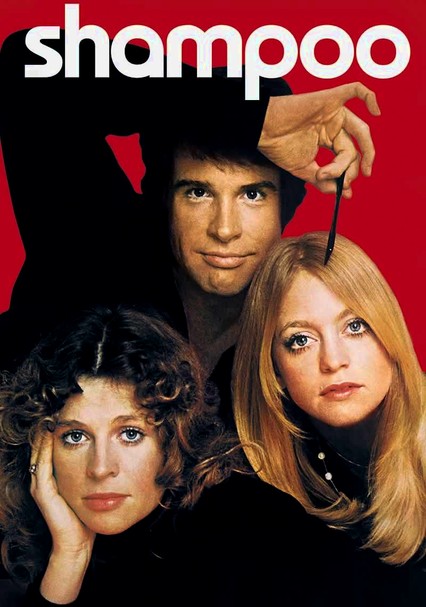
Shampoo-1975

Shampoo-1975

Director Hal Ashby

Starring Warren Beatty, Julie Christie, Goldie Hawn

Scott’s Review #1,362

Reviewed May 19, 2023

Grade: A-

Shampoo (1975) is a dark comedy that reminds me greatly of a Robert Altman film, without the customary overlapping dialogue found in his works.

The political environment against the posh Los Angeles backdrop emotes the vibes of The Long Goodbye (1973) and Nashville (1975) with enough sly satire and humor to generate a comparison.

Of course, the film, nestled in mid-1970s cinema greatness, is in the right decade. Further, the 1968 setting is perfect for the Los Angeles mood, where the Manson killings, hippies, sex, drugs, and rock n roll were all commonplace.

Listening to the soundtrack of The Beatles, Jimi Hendrix, Jefferson Airplane, and other familiar bands of the late 1960s makes Shampoo a grand slam of authenticity and richness.

Director Hal Ashby, who created the dark-comedy classic Harold and Maude in 1971, hits it out of the park again with Shampoo, a study of love, loneliness, and a sense of belonging and fulfillment.

I wasn’t won over right away, and the film took me a while to warm up to, if I’m being honest, but by the end, I was a big fan, especially of the writing.

But some of the slow-build films are the best.

The film takes place against the backdrop of Election Night in 1968, when, eventually, shamed former president Richard Nixon won the presidency. The characters bounce from one election party to the next but barely notice the outcome, choosing booze and lust over politics.

Beverly Hills hairdresser and notorious cad George Roundy (Warren Beatty) runs into trouble when his bedroom antics interfere with a possible business deal with the influential Lester (Jack Warden).

George is sleeping with Lester’s wife, Felicia (Lee Grant), and his best friend and ex-girlfriend, Jackie (Julie Christie), in addition to his current girlfriend, Jill Haynes, played by Goldie Hawn.

Part of why Shampoo sneaks up on the viewer is that it’s not a laugh-out-loud comedy in a physical way. Instead, the intelligent dialogue and the development of its characters are the winning formula.

We first meet George in bed with his older mistress, Felicia, who we assume might be his girlfriend. When he makes an excuse to check on Jill, we realize he is playing the field, but with no ill intent.

He genuinely likes the women he beds, but despite his antics, he feels empty and mindlessly trudging along.

A wonderful scene atop the Hollywood Hills brings George’s peril to a climax when he professes his love for one of the women, but is it too late?

Beatty, who co-wrote the screenplay, fleshes out his character’s motivations well. He really only wants happiness and a successful business. Some of the action takes place in his salon, where he meets his conquests.

The scenes between Beatty and Warden work particularly well, especially when Lester discovers George in a precarious situation, or three, assuming he is gay.

Let’s not forget the ladies. The triple bill of Christie, Hawn, and Grant is a force to be reckoned with. Grant is an interesting character since she has all the wealth she wants, but instead loves the financially struggling George. Should we feel sympathy for her?

Jill presumably will find happiness with a director smitten with her. They seem like a quality pair, and Christie’s Jackie also makes out well at the conclusion of the film.

Surprisingly, the presidential election is more of a background effect and is largely ignored by the characters, who have better things to worry about.

Ashby mostly has the news telecasts and election returns blurred intentionally. The point made is that Nixon’s cheating is a reflection of the self-obsession affecting the United States during that time.

Despite his flaws, the audience nonetheless roots for George. This is a testament to the writing of Beatty and Robert Towne and the rich, slow build that Ashby provides to Shampoo (1975) amid a shiny yet tarnished Los Angeles veneer.

Oscar Nominations: 1 win-Best Supporting Actor-Jack Warden, Best Supporting Actress-Lee Grant (won), Best Original Screenplay, Best Art Direction

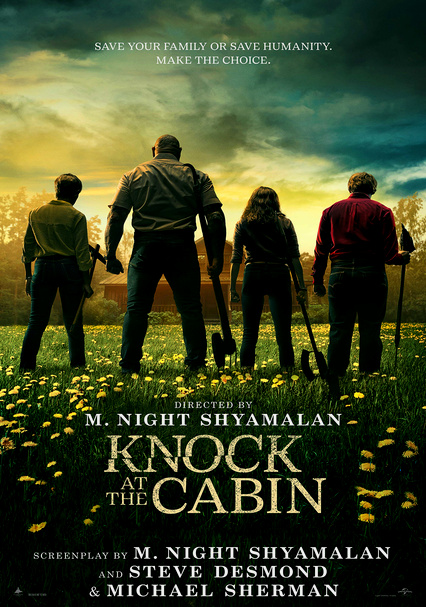
Knock at the Cabin-2023

Knock at the Cabin-2023

Director M. Night Shyamalan

Starring Dave Bautista, Jonathan Groff, Ben Aldridge

Scott’s Review #1,361

Reviewed May 14, 2023

Grade: B+

Most M. Night Shyamalan films follow a pattern in which there is either a twist ending or a thought-provoking message to stew over during and following the film. They also include a supernatural element. That’s why his films intrigue and keep certain audiences coming back for more.

The director’s films are never boring and his fascination with the odd and macabre aspects of life is contagious.

Knock at the Cabin (2023) is just such a film with a suspenseful premise immediately eliciting intrigue if the trailers do it justice. An isolated cabin in the middle of nowhere is the perfect setting for a horror film as the character’s vulnerability is evident.

The film is based on a 2018 novel called The Cabin at the End of the World by Paul G. Tremblay.

Featuring the impressive inclusivity of a white male same-sex couple with a young adopted Asian daughter got my attention immediately. Much credit to those involved for straying from the tried and true and risking the label of a ‘gay movie’.

Married couple Eric (Jonathan Groff) and Andrew (Ben Aldridge) are happily vacationing at a remote cabin in rural Pennsylvania with their daughter Wen (Kristen Cui). One day, while collecting grasshoppers Wen is approached by a hulking man named Leonard (Dave Bautista) who befriends her.

When Leonard and his friends take the family hostage they demand that the family make an unthinkable choice to avert an apocalypse. At first, thinking the group is psychotic, the family slowly starts to question what is real and what is not while the clock rapidly ticks toward doomsday.

The win with Knock at the Cabin is there is not a dull moment during the one hour and forty minutes running time. Shyamalan uses lots of closeup camera work that keeps the level of peril at a maximum.

Within the first few minutes, a gleeful Wen goes from chattering with her grasshoppers to suspiciously eyeing the approaching Leonard. The audience sees him in the background and it’s a powerful moment of apprehension.

Who is this hulking behemoth and why is he coming to her family’s cabin? Wen and the audience ask the same questions.

Soon the perspective shifts to the other characters led by Andrew and Eric. Though armed, the strangers seem nice enough. There is a nurse named Sabrina (Nikki Amuka-Bird) and a young mother named Adriane (Abby Quinn). Sure, there is a convict named Redmond (Rupert Grint) but he seems reformed.

The couple ponders whether the strangers have innocently fallen into some weird message board cult or are completely nuts. Through the use of backstory scenes, the audience learns that Andrew and Eric have not always had it easy being shunned by Andrew’s parents and harassed in a bar.

Could the strangers be targeting them for their lifestyle and trying to cause them harm?

Leonard makes them watch footage of the apocalyptic destruction commencing but is the footage real or staged?

The thrilling aspect of Knock at the Cabin is the audience asks the same questions that Eric and Andrew do. As far-fetched as it seems should they believe the strangers? Would you have your significant other or child sacrificed to save the world?

I’m not sure if the conclusion paid off for me or if I completely understood the wrap-up but I adore the strong message of love and connection. I was anticipating more of an ‘aha’ moment or something more powerful.

While none of his subsequent films have matched his masterpiece breakthrough The Sixth Sense (1999) they each have enough mustard to warrant a viewing.

Knock at the Cabin (2023) offers a wonderful dose of diversity that makes the experience timely, relevant, and meaningful. A subpar ending only slightly hampers what is otherwise a thrill ride.

I’ll immediately think of this film if ever I am in a cabin in the middle of the woods.