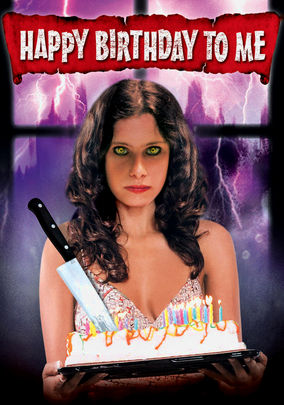
Happy Birthday to Me-1981

Happy Birthday to Me-1981

Director J. Lee Thompson

Starring Melissa Sue Anderson, Glenn Ford

Top 40 Horror Films #39

Scott’s Review #621
Reviewed March 4, 2017

Grade: A-

Happy Birthday to Me is a 1981 slasher film that I fondly remember scaring the shit out of me as a little kid, too young to be watching a film of this nature, but sneaking into my parents’ bedroom with my brother to catch it on HBO.

Certain that the film helped shape my passion for the horror genre, I hold a fondness for it- critics be damned.

My opinion is that the film is a small treasure in the land of 1980s slasher films, containing a neat whodunit and a grotesque ending.

Melissa Sue Anderson, desiring to break out of her nice television persona, thanks to the wholesome Little House on the Prairie, is cast in the lead role.

Happy Birthday to Me also earns merit, as it is directed by acclaimed British director J. Lee Thompson (Cape Fear).

Anderson carries the film quite well in a challenging part, and Glenn Ford co-stars as a Doctor.

Virginia Wainwright is a pretty and popular senior at exclusive Crawford Academy- a school for elite, rich kids. She is part of the “Top Ten”, the most popular and richest kids in the school. The ten friends meet nightly at the local pub.

One night, Bernadette, one of the top ten, is murdered by an assailant on her way to meet her friends.

This murder sets the tone as, one by one, the others are subsequently killed off, sending the school and local townspeople into a frenzy of panic.

To thicken the plot, Virginia was involved in a horrible car accident four years earlier, which killed her mother and caused Virginia to have only sparse memories of the accident.

This piece is key to the film’s mystery.

There are many comparisons I can make to slasher classics that heavily influenced Happy Birthday to Me, but the most prominent must be 1978’s Halloween.

The character of Virginia is very similar to Laurie Strode (Jamie Lee Curtis) in their somewhat virginal, good-girl characters, and both have almost identical hairstyles!

Also, Happy Birthday to Me successfully uses the killer’s point of view, as the camera frequently serves as the perspective of either the killer or someone lurking, spying on others.

The film also “looks” similar to Halloween.

The whodunit aspect is the most effective among the film’s qualities. There are a multitude of likely suspects, and the film does not shy away from this, purposely casting doubt on several characters- could it be the creepy Alfred, who carries around a pet mouse and creates a fake head of the murdered Bernadette?

Or the suave French student, Etienne, who snoops in Virginia’s bedroom and steals a pair of her panties? Finally, could it be Head Mistress, Mrs. Patterson, a harsh, no-nonsense woman harboring resentment for the snobbish elitism that exists at her school?

When the killer is finally revealed, a measure of pure shock and confusion will undoubtedly transpire- how can this be? But by the time the ultimate finale is played out, all will make sense.

The conclusion does disappoint slightly in the implausibility factor, and the original ending is much more logical and compelling than what was actually in the final cut- rumors have run rampant that the screenplay of the film was rewritten numerous times well into the production, never a good thing.

So, the motivations of the actual killer are quite weak, but the buildup is amazing.

Not to be outdone by the whodunit, the kills themselves are superlative: a shish kabob to the throat, falling gym weights, a scarf caught in the spokes of a bike, and the traditional fireplace poker are done in macabre and fantastic fashion.

We always see the killer’s gloved hands, and we are aware that the victim is friendly with the killer, so we continually try to deduce who it could be.

The gruesome “Birthday party” finale is gruesome and gleeful at the same time. Each murder victim is propped up around a dining room table, each with a party hat on and all in various forms of dismemberment or blood-soaked from their murder wounds.

It is a grim and hilarious reveal. The murderer parades out of the kitchen, wielding an enormous birthday cake, cheerily singing “Happy Birthday to Me”.

This is one great finale.

Happy Birthday to Me (1981) is a wonderful trip down memory lane and still holds up as a key, perhaps overlooked part of the slasher genre that should be rediscovered by fans and followers everywhere.
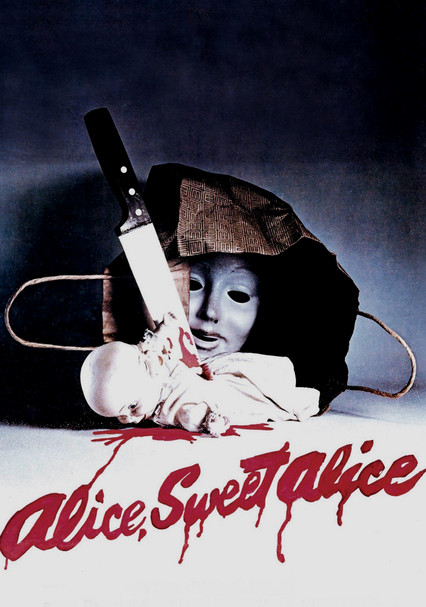
Alice, Sweet Alice-1977

Alice, Sweet Alice-1977

Director Alfred Sole

Starring Paula Sheppard, Linda Miller

Top 40 Horror Films #40

Scott’s Review #1,343

Reviewed February 12, 2023

Grade: A-

Originally titled ‘Communion’ and re-titled and re-released as Alice, Sweet Alice in 1977, the film can proudly tout it as the debut film of star Brooke Shields. Her role, while quite small, is essential to the story.

Any film that challenges, mocks, or showcases Catholicism, especially in the horror genre, has instant appeal to me. There is something so warped yet satisfying to me.

As The Exorcist did in 1973, Alice, Sweet Alice will leave Catholics and the otherwise religious squirming in their seats or scrambling for the ‘stop’ button on their remotes.

Director Alfred Sole, also a well-known production designer, was inspired by Alfred Hitchcock’s films and the 1973 masterpiece, Don’t Look Now. Does it ever show if one looks closely enough?

The story is sometimes muddled and confusing, to say nothing of implausible, but the overall tone and content are fascinating. The camera angles, production design, musical score, and overall style are exceptional, making the film a major success.

On her First Communion day, Karen (Brooke Shields) is viciously strangled and set afire in church after being stuffed in a wooden chest.

Her emotionally unstable and unattractive sister, Alice (Paula Sheppard), is immediately considered a suspect because of her jealousy and her possession of a translucent mask, Karen’s crucifix, and veil.

Alice is no saint, as she enjoys tormenting Karen and the obese landlord who lives in the apartment below her family’s.

Aunt Annie (Jane Lowry), a staunch catholic who hates Alice, is later stabbed on an apartment complex stairway by a childlike figure wearing a translucent mask and a yellow rain slicker. Annie insists her attacker was Alice.

In a subplot, the girls’ mother, Catherine, played by Linda Miller, embarks on a tender romance with her dashing ex-husband, now dating another woman, until he too is brutally murdered.

I was immediately struck and smitten by the haunting musical score, a clear homage to Hitchcock’s 1960 Psycho. The shrill violins and the palpable bass are familiar, bringing fond memories of that legendary masterpiece.

Instead of a direct copy, though, composer Stephen J. Lawrence superbly enhances the effects to fit a more modern-style horror film, and it works.

Mr. Hitchcock’s fascination with stairways is also mirrored many times, and he crafts many effective scenes using only shots of feet walking up or down the stairs.

And anytime a mask is used in a horror film, it’s scary.

In terms of the plot, while the events are compelling, they also don’t make much sense. It would be too predictable and unsatisfying if Alice were the killer (she isn’t). However, the terrific final sequence leaves room for a sequel as Alice maniacally studies a bloodied butcher knife.

However, there is a constant theme of hysterical religious judgment, punishment for sins, and sacrificing someone for the greater good. These align perfectly with the many hypocritical aspects of religion at a time when the catholic church was facing much criticism.

Characters like Aunt Annie and the wacky housekeeper, Mrs. Tredoni (Mildred Clinton), are played as over the top but work surprisingly well.

And it’s likely no accident that Sole cast the adorably handsome Rudolph Willrich as the much-sought-after Father Tom.

In 1977, Alice, Sweet Alice was quite timely and fits nicely with other 1970s horror films with a religious theme.

Paula Sheppard all but carries the film, though the supporting actors are all effective, too. Her facial expressions teeter between soft and angelic, and demonic and cagey. It’s an exceptional part of the film.

Alice, Sweet Alice (1977) is an underappreciated gem that needs to be dusted off and rediscovered by rabid horror fans seeking a superior watch.

Carousel-1956

Carousel-1956

Director Henry King

Starring Gordon MacRae, Shirley Jones

Scott’s Review #1,486

Reviewed July 27, 2025

Grade: A-

Following the success of Oklahoma! in 1955, Carousel (1956) is similarly based on the lauded Rodgers and Hammerstein stage musical. It is firmly nestled among the myriad musical productions that emerged in the 1940s, 1950s, and into the 1960s in cinema.

Darker in tone, the musical drama bears a strong resemblance to Oklahoma! It swaps the Midwest United States for Northeastern Maine. Clambakes and wattery harbors lend authenticity to the film.

Easily paired with Oklahoma! as a double feature, it even features the same stars—Gordon MacRae and Shirley Jones, who return to star in Carousel. As an aside, the filmmakers originally cast Frank Sinatra, who dropped out, so MacRae was a second choice.

As with the original stage production, the film features some of Rodgers and Hammerstein’s most famous songs, particularly ‘Carousel Waltz’ and the emotional ‘You’ll Never Walk Alone’.

It also features arguably the most serious storyline of all their musicals, incorporating domestic abuse into the fray.

The story follows the romance of Billy Bigelow (MacRae), a charming carousel barker, and Julie Jordan (Shirley Jones), a pretty blue-collar worker from a nearby mill in Boothbay Harbor, Maine.

When the attractive young couple abruptly and reactively gets married, they also both find themselves unemployed and broke, which puts a strain on their relationship.

When Billy finds out that Julie is pregnant, he resorts to extreme measures to get money, a decision that leads to tragedy.

Cleverly, the film is non-linear, as the first scene features Billy in what appears to be Purgatory (or the back door of Heaven), where he is told that he can return to Earth for one day to make amends.

We know that Billy has died after a tragic event, but we do not know the details.

To its credit, Carousel is not a cheery, bombastic musical fraught with over-the-top phoniness or too much glee. The characters are darker, which makes it feel unique to me.

Proof of this is evident in a comparison of MacRae’s and Jones’s characters in Oklahoma! to Carousel. While Laurey (Jones) is a respectable, virginal good girl, Julie plays with fire, assuredly spending time alone with Billy after being warned of the consequences.

Curly McLain (MacRae) is a good-natured cowboy who admires the beautiful morning while riding to see his wholesome crush, Laurey, whereas Billy is a rough-talking, macho brute.

Supporting characters like Carrie (Barbara Ruick), Jigger (Cameron Mitchell), and Cousin Nettie (Claramae Turner) are fantastic additions, especially Turner, as she brings down the house with ‘You’ll Never Walk Alone’.

Still, I yearned for a bit more substance to their characters. What makes them tick? Are they fulfilled?

A final highlight is the amazing fantasy musical song and dance number that appears towards the finale. As Billy’s teenage daughter, Louise (Susan Luckey), dances amongst her classmates, she is mocked for her father’s reputation and shortcomings.

She writhes around them in a deliciously choreographed sequence that builds tension and kickstarts the action.

Unlike Curly, I found Billy difficult to like, though the character is softened considerably by the end of the film. He’s honestly a dick through most of the story, hitting Julie, and plotting ways to find fortune at the expense of others.

To make matters worse, he also slaps his own daughter’s hand when he comes down from Purgatory to see her. Are we expected to like him?

Despite the two aforementioned powerful musical numbers, the other songs don’t carry through as much or are nearly as memorable.

For much of the running time, until the great build with Louise’s musical number, there is a slowness to the events. Whereas Oklahoma! has it all, something is missing from Carousel, and the pacing isn’t as fine-tuned.

Nonetheless, I adore the summery New England setting with the authentic location sequences and attention to detail. The darkness and edgy religious-themed trimmings combined with two homerun hitting musical numbers are enough to make me a fan of Carousel (1956).

Looking for Mr. Goodbar-1977

Looking for Mr. Goodbar-1977

Director Richard Brooks

Starring Diane Keaton, Tuesday Weld, Richard Gere

Scott’s Review #1,485

Reviewed July 25, 2025

Grade: A-

Diane Keaton won the Academy Award for Best Actress in 1977 for Annie Hall, an excellent film by Woody Allen, but as has happened in Oscar history, she won for the wrong role.

She delivers her best acting performance of her distinguished career in Looking for Mr. Goodbar (1977), a raw crime drama in which she plays Theresa, a liberated and carefree young schoolteacher living in a metropolitan area.

The film, directed by Richard Brooks (Cat on a Hot Tin Roof, 1967, and In Cold Blood, 1968), is based on Judith Rossner’s 1975 best-selling novel. The setting inexplicably shifts from New York City to San Francisco, but it feels exactly like the troubled urban metropolis of its late 1970s, crime-ridden period.

I nearly felt as if Theresa’s dingy, windowless apartment was a character in itself.

The musical soundtrack is a significant win, featuring disco anthems from the time, such as ‘Don’t Leave Me This Way’ by Thelma Houston and ‘Love Hangover’ by Diana Ross.

Film lovers familiar with Taxi Driver (1976) and Cruising (1980) (both set in New York City) will notice similarities and draw parallels.

Theresa (Diane Keaton) teaches deaf children during the day and cruises singles bars and discos at night. Despite being raised a devout catholic ‘good girl’, she favors quick nights of passion with random suitors, ignoring the advances of well-meaning but nerdy social worker James (William Atherton).

She pursues the likes of Tony (Richard Gere), whose threatening knife and swagger excite her. As the film progresses, Theresa becomes increasingly entangled in perilous encounters, putting her life in danger.

Despite a jarring shift in story direction towards the end of the film and the geographical change, I found more than enough to merit a superior rating, especially Keaton’s performance.

Keaton flawlessly carries the film as an unapologetic, progressive character. She lives life, enjoys life, and sees nothing wrong with her chosen lifestyle. Keaton is fearless, delivering a likable character we probably shouldn’t like.

She can be cutting, self-centered, and moody, but takes sheer delight in teaching deaf kids who have problems at home, almost fostering them as her own.

Richard Kiley and Priscilla Pointer play Theresa’s parents in rather one-note performances. They are devout Irish Catholics, but too much time is spent showcasing their traditional values.

Theresa’s sister, Katherine, played by Tuesday Weld, is more like Theresa but more needy, and clinging to any man she meets. The sisters are close, even living in the same building, and constantly have each other’s backs.

Looking for Mr. Goodbar perfectly depicts life in an inner city in the mid-1970s: booze, sex, parties, and drugs.

Rinse and repeat.

The male characters that Theresa interacts with are of different types. Her first fling is with her married professor, whom she fantasizes about living with. When this doesn’t work out, she has urges for more dangerous experiences.

Tony (Gere) is sexy, unreliable, and dangerous, and Theresa is titillated. It’s with him when she teeters over the brink.

The film transitions from a sexual thriller into a deadly final sequence, leaving my mouth hanging open with surprise. The ending will leave audiences on the edge of their seats and may not please those seeking a happily-ever-after story.

Is the audience supposed to learn a lesson? Does Theresa get what she deserves? How dare she live her life as she sees fit? These are questions well worth further discussion.

The introduction of Gary (Tom Berenger), a tortured gay man Theresa meets in a bar, comes so late in the film that there is barely time to get to know the character. But he doesn’t put the LGBTQ+ community in such a positive light.

Still, the gay men who yearn to be straight cannot be dismissed since this was commonplace when the story was created.

With a spot-on atmosphere filled with juicy late 1970s coolness and danger, and a brilliant starring turn by Diane Keaton, Looking for Mr. Goodbar (1977) has more than enough to warrant a watch and a follow-up chat.

M3GAN 2.0-2025

M3GAN 2.0-2025

Director Gerard Johnstone

Starring Allison Williams, Violet McGraw

Scott’s Review #1,484

Reviewed July 6, 2025

Grade: C+

Shifting from science fiction/horror to science fiction/action, M3GAN 2.0 (2025) peppers in enough humor and witty quips from its barbie-like central robotic doll named M3GAN (Amie Donald/Jenna Davis) to keep things entertaining.

I expected more horror elements, which are sorely missing to its detriment. This is peculiar since the slasher elements of the first installment are what made it campy fun.

The story ultimately lost me due to erratic storytelling, preposterous moments, and events that were difficult to follow. Throw in some over-the-top acting, and, at best, M3GAN 2.0 delivers a popcorn summer entertainment classification.

M3GAN (2023) is much superior.

The second chapter follows M3GAN being reluctantly rebuilt by its roboticist and creator, Gemma (Allison Williams), to combat a humanoid military robot named AMELIA (Ivanna Sakhno), which was built using M3GAN’s technology and is attempting an AI takeover.

But, is M3GAN being manipulated?

Writer and director Gerard Johnstone swaps the original’s horror software for a more action-leaning approach that doesn’t prove to be an upgrade. Fight sequences and a car chase overtake any creepy moments.

However, he wisely keeps and even increases the number of quips delivered by the fiendish robot, and some are laugh-out-loud delightful with saucy expletives thrown around for good measure.

M3GAN primarily engages in banter with Gemma, easily pointing out her shortcomings while remaining a loyal friend and protector to Cady (Violet McGraw).

These are the fun moments, like when M3GAN admits that Gemma is reasonably attractive enough to lure a man to bed. Her sarcastic and slightly robotic voice worked perfectly, so I longed for more of these scenes.

The character of M3GAN is the main attraction. More mature and with a cute bob-like hairstyle, she is older and wiser but just as sinister. She has presumably progressed from a young adult ‘friend’ to a grown woman capable of superior thought process and calculating strategy.

The writing and motivations of the characters are overcomplicated and confusing.

Four different sets of potential villains are thrown into the complex mix. Christian Bradley, a cybersecurity expert whom Gemma meets on her book tour, Alton Appleton, a corrupt tech billionaire, the U.S. Army, and AMELIA.

It’s challenging to keep track of who the good guys are or who the bad guys are, and this includes the allegiance of M3GAN.

An attempt to highlight the dangers of AI to government and technology is a timely and vital message, and is weakly referenced.

Rather than making it a central part of the film, it is merely glossed over without anything to make that message resonate with the audience.

The hokey plot-driven story and kung-fu-like action sequences unfortunately outshine the more satisfying one-liners delivered by M3GAN.

Much of the acting is either alarmingly cartoonish or altogether wooden, mainly on the part of the villains (former) or young actor McGraw, who makes Cady too pouty and brooding.

Williams, most known for Get Out (2017), adequately carries the film while being upstaged by a robot.

M3GAN 2.0 (2025) is a ho-hum affair that may result in the termination of the young franchise unless Johnstone wises up and reverts to more comedy and more horror in a potential M3GAN 3.0 effort.