Gremlins-1984

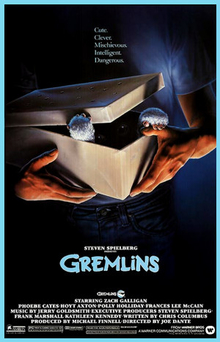
Gremlins-1984

Director Joe Dante

Starring Zach Galligan, Phoebe Cates

Scott’s Review #1,443
Reviewed September 28, 2024

Grade: B+

A mishmash of film genres such as black comedy, horror, and Christmas, Gremlins (1984) is one of the films responsible for the introduction of the new Motion Picture Association of America (MPAA) PG-13 rating in the mid-1980s.

Too soft for an adult R rating, but too scary for a PG rating, many films fit better in the PG-13 category.

The film features a cute, E.T. the Extra-Terrestrial (1982)- inspired creature named Gizmo. Since Steven Spielberg executive-produced Gremlins, there have been comparisons to the successful mega-box-office film.

But Gremlins is darker than E.T., especially when the spawn of Gizmo emerges in a fierce, aggressive manner and one dons a mohawk-style haircut. Many of the gremlins die, and a few humans are killed by the gremlins, giving it a scarier vibe.

This is thanks to director Joe Dante, who gives the film a 1950s B-movie look with a dark, campy tone.

A gadget salesman, Randall Peltzer (Hoyt Axton), is looking for a special Christmas gift for his son, Billy (Zach Galligan), and finds one at a store in Chinatown. The shopkeeper is reluctant to sell him the “mogwai” but does, and warns him never to expose him to bright light or water, or to feed him after midnight.

Naturally, when Randall returns to his home in the United States, all of this happens, and the result is a gang of gremlins that decide to tear up the town on Christmas Eve.

There are a couple of ways to view this film. The ‘message’ is a statement about the consumer culture that ran rampant in the 1980s. Wanting everything but not appreciating what you have is highlighted in the final scene.

The Chinese shopkeeper repossesses the “mogwai”, scolds the family for their negligence, and criticizes Western society for its carelessness with nature.

In a touching scene, Gizmo, having bonded with Billy, bids him goodbye. The touched shopkeeper concedes that Billy may be ready one day and, until then, Gizmo will be waiting.

Anyone with a pet will get a teary eye or two.

One can also view Gremlins as an entertaining popcorn flick with superior special effects and a fun story. The visual effects and the art direction are worth a pause. Impressive are the sequences in the town where the stores and homes are perfectly dressed for the holidays.

The Christmas lights, trees, snow, and other trimmings provide feelings of warmth and spirit.

Galligan and Phoebe Cates, who plays his love interest, Kate, have wonderful chemistry as a teen romance blossoms. This makes the audience more invested in their peril as they try to save the townspeople from doom.

Axton and Frances Mee McCain, who plays Billy’s mother, Lynn, are also rootable. They are believable as a lovely suburban couple who have a wacky side.

Corey Feldman and Judge Reinhold appear in small roles as a friend and Billy’s obnoxious boss, respectively. Neither role is developed or necessary, but familiar faces are always nice to see in the cinema.

Polly Holliday nearly steals the show as the dog-hating Ruby Deagle. In a clear nod to Mrs. Gulch in The Wizard of Oz (1939), she sneers and snickers in an ill-fated attempt to have Billy’s dog destroyed.

Delightfully, she gets a death scene where the gremlins terrorize her to death when her stair chair goes wonky and throws her out a window. Holliday is a hoot and must have had a ball playing the villain.

Other stock characters, like the disbelieving police force, are clichéd and only serve to hinder the main characters’ actions.

Gremlins (1984) is a darling film that holds up well. It’s mischievous without going full horror and can be enjoyed by the entire family on Christmas Eve. The quirky comedy elements and cool visuals make the film fun and impressive.
Police Academy-1984

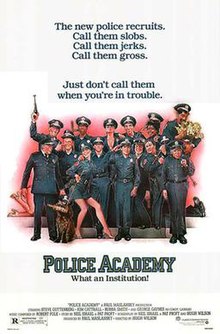
Police Academy-1984

Director Hugh Wilson

Starring Steve Guttenberg

Scott’s Review #1,442

Reviewed September 27, 2024

Grade: B+

Police Academy (1984) is a fun slice of nostalgia for me that oozes back memories of being a pre-pubescent boy, and it’s difficult to put my ‘critic’ hat on long enough to review the film adequately and impartially.

But I’ll try.

1980s cinema is filled with movies like Police Academy, featuring bumbling antics and situation comedy gags with little film integrity or artistic merit. The dimwitted and sex-crazed characters, usually male, go from one situation to another with the hopes of fun and sex.

The franchise relies on basic slapstick humor, typically grounded in simple characterization and physical comedy. As with many similar films, the theme centers on a group of underdogs struggling to prove themselves while various authority figures try to suppress them.

Thus, the audience adores and roots for them.

Yes, Police Academy is riddled with cliches, idiocy, and a disrespect for law enforcement, but only in the softest of ways. Filmmakers have no ill contempt and only intend to follow a well-used comedy formula to produce a hit.

Quite a hit, it spawned six sequels, culminating in 1994’s lame Police Academy: Mission to Moscow.

When the mayor of an unnamed crime-ridden city loosens the restrictions on entering the police academy to get more cops on the street, all manner of oddball characters enlist to join the force.

Among the cadets are sexy Carey Mahoney (Steve Guttenberg), hulking Moses Hightower (Bubba Smith), blonde Karen Thompson (Kim Cattrall), and sound effects-generating Larvell Jones (Michael Winslow), who all have to show initiative and courage when they are faced with tough situations out on patrol.

The law enforcement villains are Police Chief Henry Hurst (George R. Robinson) and Lieutenant Thaddeus Harris (G.W. Bailey), who scheme to make the training unbearable so the recruits will quit.

In predictable form, the good-looking Mahoney and Karen fall in love while the incompetent rookies manage to save the day and bust some thugs. They receive recognition for bravery and graduate from the academy.

Beneath the surface is the racial diversity of three prominent black characters who became popular staples of the franchise. There are a few ethnic slurs, but they’re used by villains who receive their comeuppance.

There are several LGBTQ+ situations, one of which involves two of the foils purposely being sent to a gay bar and dancing the night away with masculine leather men.

Later, Commandant Eric Lessard thinks Mahoney has provided him with fellatio (it’s a female prostitute), and thinks he sees Mahoney making out with a man.

The inclusion is a nice touch for the time, and it’s unclear whether the message is that the foils may be gay, that the situations are meant for laughs, or that being straight is better.

Nude scenes featuring female characters exist, and we do see male characters shirtless, but like many 1980s mainstream R-rated films, the females are nude, and the males are not.

An unfair double standard that has mercifully changed over the years.

A terrific and apt comparison is that the Police Academy (1984-1994) franchise is like the Friday the 13th (1980-2009) franchise. So many sequels follow a similar formula, so the audience knows what to expect and adores the redundancy.

I’ve seen both series numerous times and never get tired of them.

Police Academy (1984) is not high art, nor is it meant to be analyzed. For its pleasing entertainment and a chance to root for the underdog, the film is satisfying, provides a chuckle or two, and I won’t feel guilty about my enjoyment.

The First Omen-2024

The First Omen-2024

Director Arkasha Stevenson

Starring Nell Tiger Free, Ralph Ineson, Bill Nighy

Scott’s Review #1,441

Reviewed September 26, 2024

Grade: B

Having six and a half hours to kill on a late-night international flight to Europe, I eagerly desired some good horror to pass the time. What better way to while away the minutes than some religious treachery?

In truth, I accidentally thought The First Omen (2024) selection was the recent The Exorcist: Believer from 2023. Further, I thought the film was a solid ninety minutes, but I was wrong again. The running time is an unwieldy one hundred and nineteen minutes, a lifetime for a horror film.

So, The First Omen had much going against it before I was even ten seconds into the film.

While not a great film, primarily due to a corny and far-fetched story, The First Omen is memorable for its moments and the stylistic approach to camerawork. 

I love watching films by first-time directors partly because they may become the next Quentin Tarantino, Alfred Hitchcock, or Greta Gerwig. Sometimes a blueprint is served up for what’s to follow in said directors career.

Arkasha Stevenson must have studied films by Italian horror director Dario Argento, the devilish late 1960s horror classic Rosemary’s Baby, or both.

The film has a gothic look, and it was shot on location in Rome, providing authenticity. What better backdrop than the city the Roman Catholic Church is most associated with?

The costumes are excellent, specifically the clothes worn by the nuns. They represent the 1940s or the 1950s even though the film is set during the 1970s, and somehow this works.

For fans of the classic The Omen from 1976, The First Omen serves as a prequel with a couple of satisfying tie-ins to that great film. I can think of two examples incorporated simply because the filmmakers wanted to please moviegoers watching this film because of the original. 

There were sequels made in 1978, 1980, 1982, and 1985, but those must be forgotten entirely.

When a young American woman named Margaret (Nell Tiger Free) is sent to Rome to work at an orphanage before she begins a life of service to the church, she encounters a darkness that causes her to question her faith.

Along with the kindly Father Brennan (Ralph Ineson), she uncovers a terrifying conspiracy that hopes to bring about the birth of evil incarnate.

You see, Brennan explains that radicals within the church, desperate to regain power against the rise of secularism, seek to bring about the Antichrist to create fear and drive people back to the church, with a young orphan named Carlita (Nicole Sorace) intended to be his mother.

There is little need not to reveal that the Antichrist is Damien, the little boy adopted in The Omen (1976) who wreaks havoc.

The standout moments are pretty good. One day, Margaret spots Carlita showing a nun named Anjelica a drawing of a pregnant woman being restrained; moments later, Anjelica self-immolates and hangs herself after she proclaims, ‘It’s all for you.’

This moment is a fantastic ode to a similar scene in The Omen, and I nearly got goosebumps recalling that epic, frightening sequence.

There’s another where Margaret runs into Paolo, a man she may or may not have slept with, who tells her to “look for the mark” before being struck and cut in half by an oncoming truck.

The final climax, which mostly resembles Rosemary’s Baby, is so convoluted that I stopped trying to make sense of the story and instead appreciated the incredible visceral birthing scenes, which were controversial.

The film looks authentically like it’s from the 1970s, which is another win for Stevenson. It could easily be watched right before watching The Omen.

I’m intrigued by Stevenson’s direction and wonder what else she’ll do in the future.

The First Omen (2024) is a quality religious horror film sure to scare religious zealots and somewhat please fans. It’s not great, but it has enough going for it to deserve a watch.

A Quiet Place: Day One-2024

A Quiet Place: Day One-2024

Director Michael Sarnoski

Starring Lupita Nyong’o, Joseph Quinn, Djimon Hounsou

Scott’s Review #1,440

Reviewed September 24, 2024

Grade: B+

I was skeptical about watching A Quiet Place: Day One (2024) since the John Krasinski and Emily Blunt team do not appear (on screen anyway). And let’s be honest, the third in a horror film series is not usually a revelation and is more often than not a money grab.

Be that as it may, I thoroughly enjoyed the film, and Krasinski does serve as a producer who invests in quality over convention.

It’s a prequel to the surprise hit A Quiet Place (2018), which once again brought the horror genre credibility, so it more or less sets the stage for what’s to come later in the events.

The setting of New York City is great. The loud and bustling city complements the hearing-infused theme and counterbalances the necessity for quiet, as viewers already know.

Oscar winner Lupita Nyong’o, who is having excellent success in the horror genre after appearing in Jordan Peele’s Us (2019), stars alongside an adorable cat who is a hell of an actor.

Nyong’o plays a terminally ill cancer patient named Sam, living out her days in a hospice facility. Depressed, she yearns for a trip to the Big Apple to live again, remembering how she would accompany her pianist father for pizza and a concert as a child.

When she goes on a field trip to see a puppet show in Manhattan with her primary nurse, the shit hits the fan. Frightening creatures appear out of nowhere to attack and terrorize the city.

Casting Nyong’o is a wise move for credibility. She’s an Oscar-winning actor and a great talent. Since the film requires silence, the actors must use facial expressions and body language to reveal emotions, which Nyong’o does well.

Sam experiences shock, horror, and wonderment as she glimpses the monsters and realizes the wrath of terror they are on. Nyong’o is up to the task.

She pairs well with actor Joseph Quinn as Eric, whom we know little about except that he is kind. The pair slinks around the city, doing their best to avoid death by a monster, and their relationship is tender but not predictable.

In a standard film, they would escape and conquer their foes, or a tepid romance might be added, but Sam is dying and intends to save Eric and her darling cat by any means necessary.

As a cat lover, I was immediately captured by Frodo’s incorporation. Not only does it make sense for a terminally ill cancer patient to cling to a furry friend, but the scenes of Sam losing Frodo and finding him again had me in tears.

How many horror films have that effect?

Suspension of disbelief is required in certain scenes. There is no way a cat would passively agree to be cradled by its owner underwater, especially in a sewer or the Hudson River. But it’s fun to pretend.

Despite being a good movie, A Quiet Place: Day One has few surprises from a story perspective, and A Quiet Place (2018) is the best of the trio of films.

However, this film sets up the events in the others and has a better story angle than merely continuing where Part II left off.

In a nice nod, Djimon Hounsou reprises his role from Part II, so we know where the character originates, but he has little to do. Perhaps if there is another installment, it may center around him. 

The visual and special effects marvel and provide jumps and frights in the right places. Thunderous outbursts of mayhem balance the ‘quiet’ moments.

For a third installment, A Quiet Place: Day One (2024) keeps the story character-driven as we follow a day in Sam’s life and her journey. This is the key to the success of these John Krasinski-created films.

All of Us Strangers-2023

All of Us Strangers-2023

Director Andrew Haigh

Starring Andrew Scott, Paul Mescal, Claire Foy

Scott’s Review #1,439

Reviewed September 22, 2024

Grade: A

A moody, dark-lit experience, All of Us Strangers (2023) is a dreamy affair in all the best ways. It’s a bit of a ghost story combined with a love story and can be challenging to explain. 

Especially noteworthy are some elements like the lighting and mood which serve as enhancers. The lavish setting of London, England, and its surroundings are presented as lonely and depressing.

Loneliness is an encompassing description of the film summing up the character-driven story set mostly in an enormous yet almost vacant luxury high-rise apartment.

The vacant building is an effective backdrop to the main character’s experience.

We get inside his head and travel down a tunnel of self-reflection and acceptance just as he does. It’s unclear what is imagined or real, raising the stakes and catapulting the viewer into a world of questions.

The best pleasure comes after finishing the film and wondering how all the pieces come together or even if they do. I wasn’t sure what happened in the conclusion but the overall experience left me thinking. 

The British film follows a lonely screenwriter named Adam who works as a television writer. He develops an intimate relationship with his mysterious male neighbor while revisiting memories from the past involving his parents.

Andrew Haig directs the film and Andrew Scott plays the screenwriter from which the story is his vehicle. Paul Mescal plays his neighbor and love interest.

Haigh is best known for efforts like 45 Years (2015) and Lean on Pete (2017). Both are quiet films and character-driven. All of us Strangers is the best of the trio, though.

The film also has some teary moments of sweetness mostly shown through an LGBTQ+ lens but the film is not only for members or allies of the community but for anyone with a heart or craving something cerebral.

Viewers who have lost parents far too soon before feelings are expressed and only cherished memories remain will find All of Us Strangers to resonate mightily.

Specific to the LGBTQ+ community, what gay man wouldn’t want to travel thirty years into the future and have deep conversations with his parents about his lifestyle? Having missed those prominent years because of death. 

In the story, Adam’s parents died in a car accident when he was a child. Since he never ‘came out’ to them he travels to their house outside of London and imagines conversations with them separately and together. 

The best scenes are between Andrew Scott and Claire Foy who plays Adam’s mother. They are lengthy and poignant and brilliant acting by both are showcased. 

In an ideal fantasy, his mother would leap into Adam’s arms and champion his lifestyle becoming his most ardent supporter. Haig writes the scenes better than that as real-life situations might play out with conflict and misunderstandings.

The mother wants to understand and support but has hesitancies and ideas about a lifestyle different than Adam’s. The scenes become tense and complex not because of shouting but because of a deep struggle for understanding.

Not to be outdone by Foy’s performance in the unique relationship between father and son deliciously played by Jamie Bell. 

Adam has resented his father’s emotional distance for years never forgetting how he needed his father’s support as a child and never got it.

In a powerful scene, Adam and his father embrace. The embrace is one that Adam needed as a child.

The film is for everyone because why wouldn’t anyone want to visit their dead parents years later? Even if still alive there are things between parent and child never said or expressed. 

So many scenes are emotional, poignant, and meaningful in All of Us Strangers. 

The finale is trippy and made me recall David Lynch’s Mulholland Drive (1992) where what is real may not be and who we think a character’s life is all about may not be so.

Though wrapped in fantasy, All of Us Strangers (2023) is focused on grief through a deep emotional lens and uses superior acting to tell its story.

Independent Spirit Award Nominations: Best Film, Best Director-Andrew Haigh, Best Lead Performance-Andrew Scott

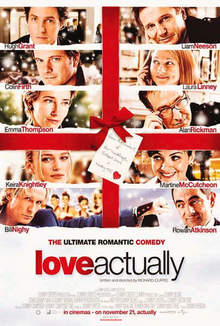
Love Actually-2003

Love Actually-2003

Director Richard Curtis

Starring Hugh Grant, Emma Thompson, Liam Neeson

Scott’s Review #1,438

Reviewed September 8, 2024

Grade: B

Love Actually (2003) is a British romantic comedy perfect for watching around the holidays, especially on Christmas Eve. Perhaps even on Valentine’s Day, the setting is tinsel-laden and filled with holiday merriment and sweetness.

It involves an ensemble cast of dozens but surprisingly not hard to follow. The myriad of stories had me naturally more invested in some than others, preferring the heavy drama to the silly side plots.

The film begins beautifully as a voice-over narrator sets the stage and message of love. He ruminates about pure and uncomplicated love of lovers, and friends, and points out that the messages from the 9/11 victims were messages of love and not hate.

The story then switches among the interconnecting “love stories” of many people.

The quick segment nearly left me in tears and to let the poignant message sink in.

I was pleasantly surprised to find nine stories some of which intersect with others. I am a fan of this type of storytelling but not all of them connect with others which might have made it too confusing or even better layered.

Some stories are not given a lot of exposure but the balance feels close to right.

I preferred the first half of Love Actually to the second. I had heard of the film and finally watched it twenty years later but anticipated more of a sappy romantic comedy than anything of substance, especially since the rom-com master Hugh Grant stars.

I immediately felt an emotional connection to stories like the United Kingdom Prime Minister (Grant) and his romantic connection with Natalie (Martine McCutcheon), a junior member of his household staff. This ‘boy meets a girl from the wrong side of tracks’ felt authentic and laden with possibilities.

Another win is the love story between Sarah (Laura Linney) and handsome creative director, Karl (Rodrigo Santoro). Their buildup and near tryst after a Christmas party had me in their corner, and rooting for the pair to overcome an obstacle involving Sarah’s dependent brother.

Finally, my favorite couple is writer Jamie (Colin Firth) and his Portuguese housekeeper, Aurélia (Lúcia Moniz). Their sweetness and innocence are gleeful and true and rooting for them to get together despite language barriers was easy. 

Richard Curtis, who directs and writes the screenplay, misses an opportunity when he creates an unfulfilling love triangle between newlyweds Juliet (Keira Knightley), Peter (Chiwetel Ejiofor), and best man Mike (Andrew Lincoln). Initially unclear if Mike is smitten with Juliet or Peter the traditional route is chosen instead of an LGBTQ+ presence.  

In one story, the horny British lad named Colin (Kris Marchall) unsuccessfully tries to woo British women and decides to go to America to get laid. Predictably, he meets one hot woman after another in the mid-west USA.

This story is hokey and could have been dropped altogether in favor of more screen time for the more interesting stories.

In the final act, I was disappointed when the film teeters too much towards cheesy with a tepid Christmas pageant where many stories come to a head.

This culminates with a silly chase throughout Heathrow Airport where one character jumps security and outwits inattentive airport personnel to catch his love interest before she leaves on a flight to New York.

Since 9/11 is mentioned in the beginning this tired plot device is surprising given the times of heightened terrorism and deserved respect for airport security.

Curtis rips off Paul Thomas Anderson’s Boogie Nights (1997) in the epilogue by using the same song, ‘God Only Knows’ by the Beach Boys, and the same wrap-up of what happens to the characters.

Despite the thievery, I did enjoy seeing what happens in my favorite stories.

Love Actually (2003) wobbles a bit by trying to have all nine stories pack a punch but the effort is nice and the message of love closes out the film.

We know happiness and Christmas miracles usually don’t pan out but it’s nice to escape and pretend they do.

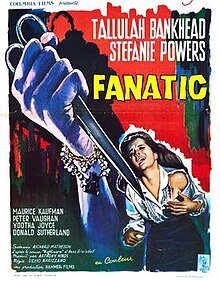
Die! Die! My Darling!-1965

Die! Die! My Darling! -1965

Director Silvio Narizzano

Starring Tallulah Bankhead, Stefanie Powers, Peter Vaughn

Scott’s Review #1,437

Reviewed September 2, 2024

Grade: B

Die! Die! My Darling! (1965) is a British horror film released under this name in the United States, but it was initially titled Fanatic in the United Kingdom. This was frequently done for marketing purposes.

The film follows a young woman, played by Stefanie Powers, who wanders into the clutches of an old wacko, played by legendary actress Tallulah Bankhead. The once-sultry actress is unrecognizable as an elderly, hobbling old crone who is a religious freak.

She blends nicely into the 1960s trend of a once sexy and acclaimed actress going the horror route sans glamour or makeup. Bette Davis did the same thing, most notably in 1962’s What Ever Happened to Baby Jane? who Bankhead’s character is similar to.

One could argue that Davis led the pack with heavyweights like Joan Crawford, Joan Fontaine, and Veronica Lake.

Patricia Carroll (Powers) plays an American woman who travels to London to marry her boyfriend, Alan (Maurice Kaufmann). While there, Patricia decides to visit Mrs. Trefoile (Bankhead), the mother of her deceased ex-fiancé, to pay her respects and chat with the woman before marrying Alan.

Upon arriving, however, Patricia discovers that Mrs. Trefoile’s grief over her son has transformed her into a lunatic, and the woman plans to ‘save’ Patricia by holding her prisoner and helping her see God’s light.

Mrs. Trefoile’s staff—the housekeeper, Anna (Yootha Joyce), the groundsman, Harry (Peter Vaughn), and the mentally challenged, Joseph (Donald Sutherland)—are along for the ride.

The film is a perfect late-night watch and should not be taken too seriously. Once Patricia is locked in the upstairs bedroom of the quaint English cottage, it’s no surprise that she will eventually escape.

The fun is watching her many attempts at freedom and the inevitable conclusion.

Director Silvio Narizzano provides genuine thrills and peril that would make Hitchcock proud. When Patricia crafts a makeshift rope by tying bed linens together to climb down the side of the house, I hold my breath, hoping she will make it as she carefully scales past two characters chatting near a window.

The comical element is how she cannot physically overpower the older woman or Anna. She is younger, more muscular than either, and has the will to survive.

But Die! Die! My Darling! It isn’t meant to be analyzed but merely enjoyed. Narizzano fulfills that request with a nice set design of the cottage interiors, superior acting by Bankhead and Powers mainly, and real moments of peril the audience can enjoy.

As a viewer, I felt emotionally invested in the characters and couldn’t wait for Patricia to escape and Mrs. Trefoile to give her desserts.

I mostly enjoyed Patricia’s determination and battle with the wicked older woman. Some characters might have cowered to her demands, but Patricia remained strong in what was undoubtedly an effort to provide for 1960s feminism.

This counterbalances nicely with Mrs. Trefoile’s old-fashioned religious fanatism. It’s the old versus the new, especially when Patricia admits she’s not into religion.

Bankhead is the highlight, and I could only imagine Davis playing the role instead. Bankhead plays the part magnificently, and accurate glamour shots of Bankhead appear to have been used to show a younger Mrs. Trefoile, an actress.

The film is a cat-and-mouse affair and begins with a quick graphic of a cat chasing a mouse. Fans familiar with Hammer Horror Productions can rest assured that the cheap but effective sets are fully displayed.

A creak here and there and battered couches and walls only enhance the experience.

Die! Die! My Darling! (1965) is recommended for horror fans or Bankhead fans who want to see her stripped down, only three years before she died at age sixty-six.