May December-2023

May December-2023

Director Todd Haynes

Starring Natalie Portman, Julianne Moore, Charles Melton

Scott’s Review #1,412
Reviewed December 13, 2023

Grade: A-

Throughout May-December (2023) there exists a quiet gloominess and a sense of foreboding dread during nearly every scene that as a viewer I could not shake. The unsettling nature is what makes the film so fascinating to watch.

Making it even more peculiar is the feeling seeps through a mirage of cheeriness, small-town humility, and the Southern politeness of Savannah, Georgia, United States amongst a lofty helping of cakes, parties, and sunshine.

All is not as it seems.

As a fan of director Todd Haynes and his brilliant films Far From Heaven (2002) and Carol (2015), I had an idea of his style and tone from the get-go.

As excellent as May-December is I was left wanting perhaps one more potato chip than I was offered.  I was slightly unsatisfied only because I had Haynes’s other films as a comparison and May-December is not quite on par with those masterpieces despite being exceptionally well made.

But we can’t always expect a classic like Led Zeppelin IV.

Twenty years after their notorious tabloid romance gripped the nation, Gracie Atherton-Yu (Julianne Moore) and her husband Joe (Charles Melton) who is twenty-three years her junior are happily preparing for their twins to graduate from high school.

When Hollywood actress Elizabeth Berry (Natalie Portman) arrives in town to study the family to better understand Gracie and prepare for the role the family dynamics crack under the pressure of the spotlight.

Joe, in particular, who never got a chance to deal with his feelings and emotions as a teenager, begins to face the reality of having grown-up children. At the age of thirty-six, he confronts the rest of his life.

Meanwhile, Elizabeth and Gracie study each other, and the similarities and differences between the two women begin to surface causing friction.

Drama develops between Elizabeth, Gracie, Joe, and various family members as long-buried emotions and new scandals erupt in the small town.

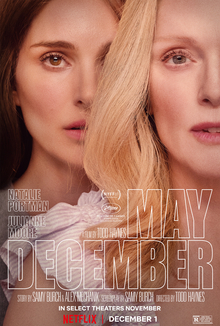
I felt snippets of Persona, a 1966 avante-garde psychological thriller by Ingmar Bergman, and even the theatrical posters of the two women looking into the camera and facing side by side are identical in both films.

There’s also a teasing Single White Female (1992) similarity to a lesser degree.

The point is that May-December produces a haunting merging of two female characters in a creepy way.

Identity and obsession are also explored.

Portman and Moore play against and with each other deliciously. It’s not so much a rivalry but an obsession. Portman’s Elizabeth refers while speaking to a class of aspiring actors about becoming a character and we know she means Gracie.

When Gracie helps put Elizabeth’s makeup on just the right way resembling her more and more they look at the camera and see themselves in a mirror. It’s a haunting realization that both women are neurotic and have issues.

Does Gracie want to become Elizabeth as much as Elizabeth wants to become Gracie? Is it real or pretend because of the film?

At different points, I felt sympathy for both characters but at other times I didn’t. Elizabeth seems kind, then not so kind, then dismissive, then demanding.

Gracie seems kind, then neurotic, then sympathetic, then catty. Did she give her daughter’s scales as a graduation present? Did she intentionally point out her daughter’s unflattering arms?

Portman and Moore are successful at portraying these emotions in the subtlest of ways making the characters complex and tough to figure out.

The standout is Melton though. As Joe, the actor made me wonder how astonishingly quick the teenager had to grow up. He never had a childhood and is subsequently childlike, unable to make himself be heard until he broils over with rage.

Melton is on the map as an up-and-coming actor.

At the end of the film, when Elizabeth heads off to the airport I was left disappointed. I wanted more and felt there was more to uncover. What’s to become of Joe and Gracie? Could the three be friends if Elizabeth lived in the town?

What Haynes does so well is create tension even when there is none on the surface. The guttural feelings I was left with made May-December (2023) a quiet and powerful experience.

Oscar Nominations: Best Original Screenplay

Independent Spirit Awards Nominations: 1 win-Best Film, Best Director-Todd Haynes, Best Lead Performance-Natalie Portman, Best Supporting Performance-Charles Melton, Best First Screenplay (won)

Maestro-2023

Maestro-2023

Director Bradley Cooper

Starring Bradley Cooper, Carey Mulligan

Scott’s Review #1,411

Reviewed December 3, 2023

Grade: A

Brilliance personified defines Maestro (2023), a film directed by and starring Bradley Cooper. As if that isn’t enough Cooper co-wrote the screenplay with Josh Singer and co-produced the project with Martin Scorcese and Steven Spielberg.

With riches such as these players involved equates to adequate muscle to make the film a necessary watch brimming with creativity and good storytelling.

There is no disappointment whatsoever in the buildup. Maestro expresses powerful acting, creative direction, and a musical score encompassing the works of the man being examined, Bernstein.

At the conclusion, I found myself feeling like I’d been hit by a Mack truck. The epic portrayal of one family’s love for one another was overwhelming.

Combined with the art appreciation left me astounded with culture and further knowledge of the composer.

The story is not as much of a straightforward biography as one might imagine though when the film begins in the 1940s the famous composer is just on the cusp of his first big break. By sheer luck, he is asked to fill in for an ailing conductor, Bruno Walter, one evening.

But at its core Maestro is a torrential and fearless love story chronicling the lifelong relationship between Leonard Bernstein (Bradley Cooper) and Felicia Montealegre Cohn Bernstein (Carey Mulligan) who was a well-known theater actress.

They meet at a party and fall madly in love spending most of their time together. The intrigue is that Leonard is gay and quite openly so before he meets Felicia and becomes famous.

His boyfriend is David Oppenheim, played by Matt Bomer.

This sat well with me and I was impressed by their openness well before the LGBT movement. Unfortunately, we see little of David or Bomer after the early days and Leonard becomes enamored with several young aspiring composers. He then took to doing lines of cocaine into the 1970s and 1980s.

What the film does well is reveal that Felicia is aware of Leonard’s sexuality and loves him despite his appetite for men. This is not always easy for her. They share a love that is stoic and unadulterated and they become one in their bond making it unbreakable.

Maestro gets very dark in the later stages when Felicia is diagnosed with terminal cancer but this gives Cooper and Mulligan a chance to shine, and dazzle the audience with mesmerizing acting performances.

It’s tough to showcase one because both are so good.

Cooper has given the best performance of his career.

Enveloping himself into the role so much that it’s staggering how he gets the mannerisms of Bernstein.  The composer’s energetic style of expressive body movements and gestures which he was noted for as a conductor are done to perfection by Cooper.

Mulligan doesn’t play the wife role. She has her own story and makes the audience empathize with Felicia’s struggles to deal with her husband’s sexuality especially when rumors come to light affecting her children.

Mulligan gives a genuineness and heart to Felicia’s battle with cancer.

Cooper’s direction is excellent. The first part is shot in black and white giving an artistic, old Hollywood-style feel making the cigarette smoking look glamorous and sophisticated. The lush art direction merges into blurry shadows and angular lighting that fits the mood.

The color enhances the 1960s, 1970s, and 1980s time as the characters age. The hairstyles and outfits gleam with sophisticated New York style and the Bernstein’s Long Island home is palatial.

Ironically, the darkest parts of the film are the most vivid and colorful.

Finally, the musical score features legendary Bernstein pieces that give truth to the production not only reminding viewers how talented he was but the choices made enhance each scene where a number appears.

I smiled when a number from West Side Story, perhaps his best-known work was featured.

A knock-out scene of Leonard conducting at a cathedral is lengthy and dramatic culminating with Felecia looking on from the side of the church. At this moment, I knew that the couple were true soulmates.

Maestro (2023) is an exceptional piece of filmmaking that easily secures Bradley Cooper his place in cinema history both in front of and behind the camera.

Oscar Nominations: Best Picture, Best Actor-Bradley Cooper, Best Actress-Carey Mulligan, Best Original Screenplay, Best Cinematography, Best Sound, Best Makeup and Hairstyling