Die Hard-1988

Die Hard-1988

Director John McTiernan

Starring Bruce Willis

Scott’s Review #1,458
Reviewed December 28, 2024

Grade: B+

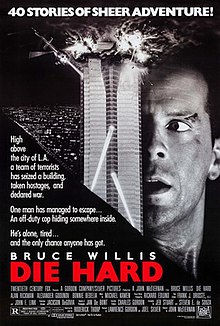
Die Hard (1988) is one of the best action films of the late 1980s and 1990s. Because of its success and mainstream appeal, it spawned dozens of copycat films.

It features hunky Hollywood star Bruce Willis in his breakout role, propelling him to a box-office stronghold that lasted for many years.

He would later appear in more cerebral offerings like Pulp Fiction (1994) and The Sixth Sense (1999), but Die Hard put him on the map.

Is it a Christmas film, or is it not? It can be debated.

Depending on one’s socioeconomic leanings, Die Hard can be seen as a film that puts the working-class Joe in the driver’s seat and makes yuppies or corporate types look like incompetent fools.

The film, watched decades after its making, is guilty of stereotypes and clichés. It is riddled with nearly every action film standard one-liner intended to evoke laughter, which now seems silly and contrived.

Hokey? Yes, but it’s also fun and a chance to watch the muscular, sweaty Willis run bare-chested for most of the run.

Like Friday the 13th (1980), the film produced several sequels, all subpar to the original.

New York City policeman John McClane (Willis) is visiting his estranged wife (Bonnie Bedelia) in Los Angeles on Christmas Eve. He joins her at a posh holiday party in the headquarters of the Japanese-owned business she works for.

The festivities are quickly interrupted by a group of terrorists led by the crazed but calm Hans Gruber (Alan Rickman), who take over the exclusive high-rise and everyone in it.

McClane realizes that he must save the day.

John McTiernan, who directs, knows his way around the action genre, and Die Hard is easily his best. Other notable works include Predator (1987) and The Hunt for Red October (1990), so he also knows how to create an action star.

The season, the setting, and the villain are other high points of Die Hard.

The perfect setup is a glossy high-rise in downtown Los Angeles at a glitzy corporate party on Christmas Eve. Drizzling with possibilities, McTiernan adds the German terrorists for good measure and a slice of necessary Americana, a fixture of the 1980s ‘USA good, Europe bad’ mentality.

Naturally, McClane is a good old-fashioned American boy. While he initially wants his successful wife, Holly (Bonnie Bedelia), to be a traditional homemaker, he realizes she’s good at her job as a corporate officer.

But the traditional and conservative mindset still shines through.

In a stroke of genius and authenticity, the real Fox Plaza in Century City was used for the skyscraper rather than an ineffectual mock set. This adds a lot to the enjoyment, and glimpses of The Towering Inferno (1974) crossed my mind.

In standard fashion, the feds, detectives, television reporters, and police officers are primarily incompetent, except for McClane. This adds to the earlier notion that the working-class guy is the movie’s hero.

Actor Paul Gleason, well-known for a similar curmudgeonly role in 1985’s The Breakfast Club, bears much of the brunt. As he callously shouts at police officer Powell (Reginald VelJohnson), he also frets at the mayor’s reaction to the handling of the situation with repeated ‘the mayor will have my ass’ remarks.

Interestingly, Powell, who bonds over the radio with McClane, is the only character to receive a competence award. The relationship between the two male cops is warm, respectful, and a high point.

The other well-written character is the main villain, Hans. Played deliciously by Rickman, he’s a baddie for the ages, cold and calm, and his deadly tumble from the top of the enormous building is satisfying to patient fans.

Die Hard (1988) centers on a good hero cop besting the bad guys from Germany, with a definitive pro-American theme popular at the time.

While the terrible 1980s hairstyles, clothes, and cheesy dialogue do not hold up well, the action is, and the film can surprisingly be watched repeatedly.

Oscar Nominations: Best Film Editing, Best Visual Effects, Best Sound Effects Editing, Best Sound
A Complete Unknown-2024

A Complete Unknown-2024

Director James Mangold

Starring Timothée Chalamet, Edward Norton, Elle Fanning

Scott’s Review #1,457

Reviewed December 27, 2024

Grade: A-

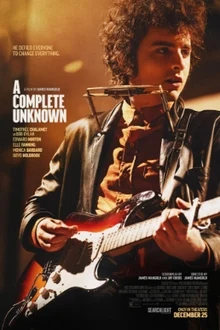
James Mangold, who directs the Bob Dylan biopic A Complete Unknown (2024), celebrates the folk singer as a humanitarian and champions Dylan’s dedication and confidence in his art.

Mangold is well known for directing other musical biopics, such as Walk the Line (2005), which focused on the lives and careers of Johnny Cash and June Carter Cash. He even incorporates Johnny as a prominent character in Dylan’s film, so there is a correlation between the two films.

With A Complete Unknown, Mangold focuses only on 1961-1965 rather than a decades-long approach beginning with the events in New York in 1961.

Set against a blossoming and vibrant music scene and a decade of tumultuous cultural upheaval, an enigmatic nineteen-year-old from Minnesota arrives with his guitar and revolutionary talent, destined to change the course of American music.

He crosses paths with folk greats and his idols, Woody Guthrie, Pete Seeger, and Joan Baez, and finds a niche within their Greenwich Village circle.

Like them, he is sympathetic to humanity and runs in the same circles as the Civil Rights movement and other humanitarian efforts.

Based on Elijah Wald’s 2015 book, Dylan Goes Electric! The film follows Dylan from his earliest folk music success to the momentous controversy over his use of electric instruments at the 1965 Newport Folk Festival.

Timothée Chalamet is exceptionally well cast. The actor, able to play waifish twinks, a fantasy chocolate maker, or a drug addict, is just as believable as Bob Dylan. His speech pattern is adjusted, and his vocals are convincing as he immerses himself in the folk world. 

He also plays guitar and harmonica frequently during the film.

The best scenes are when Chalamet performs in a dingy open mic club or on the festival stage. The actor performed a mind-blowing forty Dylan songs, so the film was showcased on the music.

The art and set design are pretty marvelous. The plumes of smoke in bars and the cloudy, smoky settings feel true to the 1960s when everyone regularly lit a cigarette or two.

A poet, Dylan knows and loves his craft and doesn’t waver in his notion of shaking up the folk world with an electric guitar, and Chalamet successfully replicates this.

Interestingly, Mangold doesn’t explore the singer’s family life or upbringing but instead focuses on the uproarious switch from acoustic to electric guitar and the stir it caused.

While not a womanizer, he does carry on an affair with Baez (Monica Barbaro) and dates Sylvie Russo (Elle Fanning) during this time. Russo (changed from Suze Rotolo at Dylan’s request) is a fascinating character since she reportedly influenced Dylan’s work during that period.

The focus is on creating the singer’s famous music rather than any demons or drama he may have faced.

In retrospect, this is a wise move by Mangold, and while the pacing of the film is relatively slow, the focus is crystal clear, and the 1960s revolution is front and center mixed with Dylan’s art.

The film feels fresh and authentic with the knowledge that Bob Dylan gave his approval stamp and served as an advisor or consultant to the finished piece. Since he had a hand in the overall product, there was a feeling of satisfaction knowing that the singer-songwriter was involved.

There are no blowup fights over jealousy, dramatic pieces about unfair songwriting credits, or other backstabbing trials and tribulations. Instead, the film does a great job of reaffirming that Bob Dylan is one of the greatest songwriters ever.

A Complete Unknown (2024) is a pleasing film, and I happily hummed ‘Like a Rolling Stone’ and ‘Blowin’ in the Wind’ on the way home from the theater.

I still am.

Oscar Nominations: Best Picture, Best Director-James Mangold, Best Actor-Timothée Chalamet, Best Supporting Actor-Ed Norton, Best Supporting Actress-Monica Barbaro, Best Adapted Screenplay, Best Costume Design, Best Sound

Gladiator II-2024

Gladiator II-2024

Director Ridley Scott

Starring Paul Mescal, Pedro Pascal, Denzel Washington

Scott’s Review #1,456

Reviewed December 21, 2024

Grade: B+

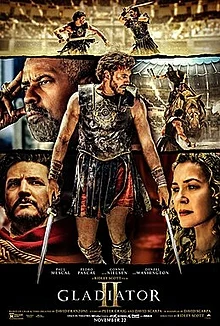
Ridley Scott, who directed Gladiator (2000), returns to the fold to direct Gladiator II almost twenty-five years later. Both are epic proportions and center on the barbaric yet luscious Ancient Roman Era.

It’s the type of film best seen in the theater on a large screen with loud surround sound. It’s bloodier than the first Gladiator.

Scott wisely incorporates snippets of the original’s ending to familiarize the audience with the events and ties a significant character to characters from the first film, both dead and alive.

The great thing about Scott directing both films is that despite the long gap between them, they feel very much aligned and have a similar tone.

When the film begins, we are told that Rome is nearly ruinous and led by tyrants. The peacefulness after Maximus’s (Russell Crowe in Gladiator) death is sadly gone.

Rome is now ruled by corrupt twin emperors, Geta (Joseph Quinn) and Caracalla (Fred Hechinger). They are barbaric and evil and use scare tactics to keep the masses in line.

We meet Lucius (Paul Mescal) when the emperors of Rome steal his home and kill his wife. He has unrelenting rage in his heart, and it’s revealed that he is the rightful heir to Rome and witnessed his father’s (Maximus) death at the hands of his uncle as a young boy.

With the empire’s future at stake, he looks to the past to find the strength and honor needed to return the glory of Rome to its people.

The fact that Lucius is the rightful heir and that his mother, Lucilla (Connie Nielsen), is still alive and now remarried to General Acacius (Pedro Pascal) provides immediate rooting value.

Combined with the viciousness of the current regime, we want the good guys to beat the bad guys. The bloody battles and the machismo nature of the story make it a muscular vehicle sure to appeal to a male audience.

It’s that type of film.

However, there is much to see visually to titillate one’s loins. Mescal looks chiseled and cut in his gladiator attire, sweatily and bloodily fighting others to the death. His hunky nature and dreamy blue eyes only make the character a sure crowd-pleaser.

Mescal also looks enough like Crowe to make the heritage believable.

Pascal and Denzel Washington are terrific in supporting roles. Washington, as Macrinus, a motivated leader intent on having the throne for himself, is bisexual, though this is hardly explored other than one line of dialogue.

A rumored kiss between Macrinus and another male character was reportedly scrapped, and shame on the powers that be for that. Too much for mainstream audiences?

The central LGBTQ+ presence is saved for the more unhinged twin ruler in a more stereotypical form.

There is little unpredictability since we know from the start that Lucius will conquer the tyranny and save the Roman people from further chaos.

But, the violent matches between gladiators and vicious beasts and one another are entertaining to watch and enthralling in their violence.

The visuals of a mock Roman Colosseum and palatial dining areas are well constructed and look real enough to transport us to the Roman Era.

Politically, the twins are compared to present-day tyrannical rulers in office and a rogue’s gallery of appointed officials. Although it can be argued that the twins are somewhat played for laughs, the fact that dictators like this rule is scary.

Gladiator (2000) packs more emotional punch than Gladiator II (2024), but watching them in parallel would be fun. From a story perspective, they link well and have the same look and feel.

Oscar Nominations: Best Costume Design

Emilia Pérez-2024

Emilia Pérez-2024

Director Jacques Audiard

Starring Karla Sofía Gascón, Zoe Saldaña, Selena Gomez

Scott’s Review #1,455

Reviewed December 15, 2024

Grade: A

Emilia Pérez (2024) is a brilliantly unique film that uses musical numbers to tell the riveting story of a transgender Mexican crime lord, her transition from male to female, and her difficult separation from her family.

Jacques Audiard, most known for A Prophet (2009) and Rust and Bone (2012), directs this unique and brave film.

Boldly featuring transgender actress Karla Sofía Gascón in the title role, the film showcases her talents and a needed burst of transgender representation in cinema.

The film also defies genres and expectations. Is it a crime thriller? A musical? An LGBTQ+ film? It’s a bit of each with an operatic spin.

On paper, it might seem jarring to watch a film about a Mexican drug cartel set against musical numbers, but I was immediately captured.

Emilia’s character is a feared cartel leader who enlists a lawyer, Rita (Zoe Saldañato), to help her disappear and achieve her dream of becoming a woman while whisking her clueless wife Jessi (Selena Gomez) and children off to snowy Switzerland.

While officially French, Emilia Pérez feels Latin since it is set mainly in Mexico, and most of the film is in Spanish.

The film follows several women’s journeys in Mexico through liberating song, dance, and bold visuals, each pursuing their happiness. Emilia is center stage, and Rita, Jessi, and Emilia’s later love interest, Epifanía (Adriana Paz), also have their own stories, giving it an excellent ensemble feel.

Rita is an unappreciated lawyer stuck in a dead-end job, Jessi wants to move on from her presumed-to-be dead husband, and Epifanía intends to move on from her abusive husband.

Audiard makes it clear that the women cannot escape the drug cartel world even though they’d like to. Emilia even champions a movement to identify the victims of cartel-related deaths, attempting to give back to others with her new life.

Emilia Perez is a significant victory because it’s so different, and that word kept returning to me. Rather than a straightforward transgender story, it mixes many other genres and creative song and dance numbers.

Could Broadway be in its future?

Each musical number is excellent, but two themes resonate most and support the story best.

When Emilia, now pretending to be her children’s long-lost aunt, puts her son to bed, he confesses he still recognizes her scent (“Papá”). She quietly weeps, knowing he will never see the truth.

The other theme is merged into three musical numbers. After meeting with doctors in Bangkok (“La vaginoplasty”) and Tel Aviv (“Lady”), Rita finds a surgeon who agrees to perform the procedure on Emilia after hearing Manitas’ recollections of gender dysphoria during childhood (“Deseo”).

The numbers explain the transition procedure in graphic detail while reminding the audience of the powerful emotional toll the transition takes on a person.

The film’s final chapter is an energetic and classic crime thriller with a major reveal of the truth to a significant character. A deadly car chase scene culminates in a fiery explosion and a reminder that rarely can anyone leave the drug cartel circuit alive.

The release of Emilia Perez in the year 2024, when there is current United States legislation to limit or exterminate transgender rights altogether, is a powerful reminder of why it’s essential to showcase a film like this.

Fortunately, the film’s slew of year-end award nominations has increased viewership and, thus, awareness of this critical topic.

Oscar Nominations: 2 wins-Best Picture, Best Director-Jacques Audiard, Best Actress-Karla Sofía Gascón, Best Supporting Actress-Zoe Saldaña (won), Best Adapted Screenplay, Best Film Editing, Best Cinematography, Best Original Score, Best Original Song-“El Mal,” (won) “Mi Camino,” Best Makeup and Hairstyling, Best Sound, Best International Film

Austin Powers: The Spy Who Shagged Me-1999

Austin Powers: The Spy Who Shagged Me-1999

Director Jay Roach

Starring Mike Meyers, Heather Graham, Michael York

Scott’s Review #1,454

Reviewed December 7, 2024

Grade: C

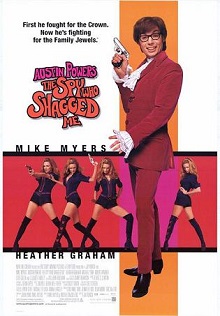
The silly comedy franchise Austin Powers, which gripped the nation in the late 1990s, never tickled me pink like it did so many others. International Man of Mystery debuted in 1997 and provided a smirk or two, but the follow-up ran out of gas by using more or less the same schtick as the first in the series.

I’ll never forget people mimicking taglines like ‘Yeah, baby’ to delightful laughter during this time, which I found more irritating than humorous.

Mike Meyers is talented and gives his all in the title role and two others. He infuses his natural comic talents into ridiculous, over-the-top, loud characters. He also does triple duty and portrays the main villain and henchman.

He deserves props for solid performances with mediocre writing.

Poor Heather Graham, excellent as ‘roller girl’ in Paul Thomas Anderson’s brilliant Boogie Nights (1997), is reduced to a scantily clad love interest. Besides being eye candy, her character has little worth to offer, undoubtedly frustrating to the then-rising star.

The film isn’t a total failure since the visuals and makeup are to be admired. Colorful sets and groovy designs replicate the 1960s in zany design, making watching the film better than listening to it.

It also serves as a modest treat for James Bond fans since the satire and parodies give credence.

Jay Roach, the director, must have advised his actors to perform as outrageously as possible, especially Robert Wagner, Rob Lowe, and Mindy Sterling, and Meyers does so on his own.

Blessedly, the running time is one hour and thirty-five minutes.

In the second installment, British super spy Austin Powers (Meyers) must return to 1969, as arch-nemesis Dr. Evil (Meyers) has ventured back to that year and successfully stolen Austin’s “mojo,” set up a powerful laser and aimed it at Earth.

With the help of gorgeous agent Felicity Shagwell (Graham), the newly single Austin must now contend not only with Dr. Evil but also Evil’s vicious, pint-size attack clone, Mini-Me (Verne Troya).

The point of the franchise is to spoof the legendary James Bond series while incorporating a Swinging London, free-love vibe, which on paper sounds good. However, the situations play more like sketch comedy or Saturday Night Live setups than a flowing screenplay.

Even the title greedily borrows the title of the 1977 The Spy Who Loved Me Bond film.

As with many comedy or romantic comedy films, screenwriters Mike Meyers and Michael McCullers desperately incorporate bathroom humor and countless sly sex sequences for laughs.

Also, keeping with a popular theme of comedy films, celebrity cameos run rampant. Jerry Springer, Willie Nelson, Woody Harrelson, and others appear as themselves.

I like the Bond references and themes the best, but the jokes mostly don’t work.

To its credit, Austin Powers: The Spy Who Shagged Me (1999) is not as bad as its follow-up, Goldmember (2002), but the gags fall flat most of the way.

Oscar Nominations: Best Makeup

Wicked: Part I-2024

Wicked: Part I-2024

Director Jon M. Chu

Starring Cynthia Erivo, Ariana Grande-Butera, Jonathan Bailey

Scott’s Review #1,453

Reviewed December 1, 2024

Grade: A

The extravagant Broadway musical Wicked (2024) is brought to the silver screen with beautiful results. It overtook the nation in hefty box office returns, and many donned witch hats for the event. The production has enough substance to justify the craze.

It is the first of a two-part film adaptation of the stage musical of the same name. The film is loosely based on Gregory Maguire’s 1995 novel, which is based on L. Frank Baum’s 1900 novel The Wonderful Wizard of Oz, its sequels, and its 1939 film adaptation.

Part II will emerge in late 2025.

Powerhouse Cynthia Erivo leads the charge as Elphaba, a young woman misunderstood because of her unusual green skin who has yet to discover her true power. When conceived, Elphaba’s mother and her secret beau drank a mysterious potion assumed responsible for her nature.

Elphaba is noticed by Madame Morrible (Michelle Yeoh), the Dean of Sorcerer Studies, and welcomed at Shiz University. Her disabled younger sister Nessarose (Marissa Bode) is a new student there.

Ariana Grande plays Glinda, a privileged and ambitious young woman who is jealous of yet enamored with Elphaba and yearns to discover her talent and powers.

Elphaba and Glinda forge an unlikely but powerful friendship. After encountering The Wonderful Wizard of Oz, their friendship reaches a crossroads, and their lives take very different paths.

The film begins with Glinda (the Good Witch of the North) recounting their relationship as Elphaba (or The Wicked Witch of the West) has just died to much celebration.

Whether viewers are familiar with the novels, the 1939 film, or the stage version, the rich history is well-combined.

The colorful sets and visuals are marvelous, with luminous greens encompassing the shimmering Emerald City. The Shiz University is more pastel with muted blue and pink colors.

Aside from the story, there is so much to look at visually. Be sure to glimpse background activity during dancing or celebration scenes to notice even more particulars.

Hints of what’s to come (the Cowardly Lion, a broomstick) also can be noticed.

The second half is the better portion when the action takes off and gets to a darker place. The colors are also darker than in the first half.

Watching the monkeys start to transition and grow wings painfully is a bit scary, especially for younger children.

The side story of animals losing their rights and being caged in the beginning, when they speak and even teach at a university, is complex to watch and represents the current state of the United States.

Director Jon M. Chu and screenwriters Winnie Holzman and Dana Fox wisely replace humans with animals as they remind audiences of groups of people (immigrants, the LGBTQ+ community) targeted by hate.

Sadly, as the Wizard of Oz and Madame Morrible remind Elphaba, the world needs another. ‘ The parallels between animals and humans are readily apparent.

Perhaps to combat the hate, Chu includes gay actors Jonathan Bailey and Bowen Yang in prominent roles.

Chu, most notable for Crazy Rich Asians (2018), delivers a stunning product filled with glamour, bravura, and necessary female empowerment.

The dynamic between Erivo and Grande-Butera is strong, making their rivalry/friendship believable and layered. Erivo gets the showier, albeit in a less attractive role, but she powerfully uses her voice to her advantage.

‘I’m Not That Girl’ and ‘Defying Gravity’ have quickly become favorites.

Wicked: Part I (2024) is an intriguing and spectacular production that raises critical societal questions. Whether you marvel at the visuals or explore gender and repression more deeply, the film has something for everyone.

Oscar Nominations: 2 wins-Best Picture, Best Actress-Cynthia Erivo, Best Supporting Actress-Ariana Grande, Best Film Editing, Best Production Design (won), Best Costume Design (won), Best Original Score, Best Sound, Best Makeup and Hairstyling, Best Visual Effects