Tag Archives: Rowan Atkinson

Four Weddings and a Funeral-1994

Four Weddings and a Funeral-1994

Director Mike Newell

Starring Hugh Grant, Andie MacDowell

Scott’s Review #1,444

Reviewed October 8, 2024

Grade: A-

Four Weddings and a Funeral (1994) is a surprisingly fresh and delightful romantic comedy and one of the better offerings of the 1990s. It is likely an inspiration for Love, Actually, from 2003, which I have seen recently, and they would be paired well together.

Both are British or set in the London area and have an English sophistication often lacking in American rom-coms.

The key to Four Weddings and a Funeral’s success is the writing. Storylines about real life emerge and relatable, awkward, and flawed characters grace the page. Lovelorn audience members who may have lost love or suffered from loneliness may relate most.

This is a huge win for a genre that often plays it safe or revels in predictability. Crisp writing goes a long way.

The main couple are played by Hugh Grant and Andie MacDowell and made them household names plummeting them to a successful decade in similar films, especially Grant.

Lovable Englishman Charles (Grant) and his group of friends seem to be unlucky in love. They frequently gather at parties or weddings never finding what they truly want, linking them together for life.

When Charles meets a beautiful American named Carrie (Andie MacDowell) at a wedding, he thinks his luck may have changed. But, after one magical night, Carrie, deemed ‘slutty’ returns to the States, ending what might have been a wonderful long-term relationship.

As Charles and Carrie’s paths continue to cross usually at someone’s wedding and one funeral, Charles believes they are meant to be together, even if their timing always seems to be off.

Grant shines in his role despite believing his performance was hideous, at least before the film received many accolades. Mike Newell, the director, provided conflicting direction making it hard for Grant to play the role in a particular way.

His stuttering and confusion, though, are what makes his character so endearing.

MacDowell is good too. It’s not clear why she doesn’t drop everything right away and date Charles or why she chooses an older Scottish guy to marry but the story-dictated situations only make the characters shine brighter.

Once the first wedding occurred I found myself hooked. I couldn’t wait to find out what three nuptials would be forthcoming and who the funeral was for.

Could it be a main character or even Charles or Carrie?

That makes Four Weddings and a Funeral compelling especially as the supporting characters are fleshed out.

We get to know Fiona (Kristin Scott Thomas), a bitchy friend who seems to judge everyone she meets. Her snobbery is slowly replaced with vulnerability when it’s revealed that she has always loved Charles.

Other characters like Tom (James Fleet) and Scarlett (Charlotte Coleman) are comic relief while a same-sex couple, Gareth and Matthew (Simon Callow and John Hannah), and Charles’s deaf brother David (David Bower) are part of the group with no judgments about their sexuality or disability.

In 1994 this was a searing victory and a feeling of inclusion is apparent.

The icing on the cake is a spectacular soap opera moment when a bride and groom are about to take their vows only for one party to admit their love for another character. Hysterics, a meltdown, and good old-fashioned drama commence and make the scene satisfying.

I didn’t expect to enjoy Four Weddings and a Funeral (1994) as much as I did. Audiences agreed and the film was rewarded with two surprising Oscar nominations.

Oscar Nominations: Best Picture, Best Original Screenplay

Love Actually-2003

Love Actually-2003

Director Richard Curtis

Starring Hugh Grant, Emma Thompson, Liam Neeson

Scott’s Review #1,438

Reviewed September 8, 2024

Grade: B

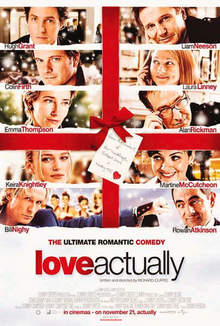
Love Actually (2003) is a British romantic comedy perfect for watching around the holidays, especially on Christmas Eve. Perhaps even on Valentine’s Day, the setting is tinsel-laden and filled with holiday merriment and sweetness.

It involves an ensemble cast of dozens but surprisingly not hard to follow. The myriad of stories had me naturally more invested in some than others, preferring the heavy drama to the silly side plots.

The film begins beautifully as a voice-over narrator sets the stage and message of love. He ruminates about pure and uncomplicated love of lovers, and friends, and points out that the messages from the 9/11 victims were messages of love and not hate.

The story then switches among the interconnecting “love stories” of many people.

The quick segment nearly left me in tears and to let the poignant message sink in.

I was pleasantly surprised to find nine stories some of which intersect with others. I am a fan of this type of storytelling but not all of them connect with others which might have made it too confusing or even better layered.

Some stories are not given a lot of exposure but the balance feels close to right.

I preferred the first half of Love Actually to the second. I had heard of the film and finally watched it twenty years later but anticipated more of a sappy romantic comedy than anything of substance, especially since the rom-com master Hugh Grant stars.

I immediately felt an emotional connection to stories like the United Kingdom Prime Minister (Grant) and his romantic connection with Natalie (Martine McCutcheon), a junior member of his household staff. This ‘boy meets a girl from the wrong side of tracks’ felt authentic and laden with possibilities.

Another win is the love story between Sarah (Laura Linney) and handsome creative director, Karl (Rodrigo Santoro). Their buildup and near tryst after a Christmas party had me in their corner, and rooting for the pair to overcome an obstacle involving Sarah’s dependent brother.

Finally, my favorite couple is writer Jamie (Colin Firth) and his Portuguese housekeeper, Aurélia (Lúcia Moniz). Their sweetness and innocence are gleeful and true and rooting for them to get together despite language barriers was easy. 

Richard Curtis, who directs and writes the screenplay, misses an opportunity when he creates an unfulfilling love triangle between newlyweds Juliet (Keira Knightley), Peter (Chiwetel Ejiofor), and best man Mike (Andrew Lincoln). Initially unclear if Mike is smitten with Juliet or Peter the traditional route is chosen instead of an LGBTQ+ presence.  

In one story, the horny British lad named Colin (Kris Marchall) unsuccessfully tries to woo British women and decides to go to America to get laid. Predictably, he meets one hot woman after another in the mid-west USA.

This story is hokey and could have been dropped altogether in favor of more screen time for the more interesting stories.

In the final act, I was disappointed when the film teeters too much towards cheesy with a tepid Christmas pageant where many stories come to a head.

This culminates with a silly chase throughout Heathrow Airport where one character jumps security and outwits inattentive airport personnel to catch his love interest before she leaves on a flight to New York.

Since 9/11 is mentioned in the beginning this tired plot device is surprising given the times of heightened terrorism and deserved respect for airport security.

Curtis rips off Paul Thomas Anderson’s Boogie Nights (1997) in the epilogue by using the same song, ‘God Only Knows’ by the Beach Boys, and the same wrap-up of what happens to the characters.

Despite the thievery, I did enjoy seeing what happens in my favorite stories.

Love Actually (2003) wobbles a bit by trying to have all nine stories pack a punch but the effort is nice and the message of love closes out the film.

We know happiness and Christmas miracles usually don’t pan out but it’s nice to escape and pretend they do.

Wonka-2023

Wonka-2023

Director Paul King

Starring Timothée Chalamet, Calah Lane, Olivia Colman

Scott’s Review #1,414 

Reviewed January 3, 2024

Grade: B+

Wonka (2023) is only the third live-action film based on Roald Dahl’s iconic 1964 novel Charlie and the Chocolate Factory, following Willy Wonka & the Chocolate Factory (1971) and Charlie and the Chocolate Factory (2005).

The latter was an inadequate and unnecessarily dark film starring Johnny Depp that threatened to ruin the trademark fantasy of the original.

Fortunately, director Paul King mostly known for directing the Paddington films opts for a warm and even gooey experience that does perfect justice to the original starring Gene Wilder with many connections to that film, especially costumes, characters, and locale.

It’s saccharine sweet but not sickeningly sweet instead feeling both fresh and genuine.

The wonderful and familiar featured song ‘Pure Imagination’ appears instantly as the film begins which does wonders to capture and captivate the nostalgic audience—mixed with other new gems like ‘A World of Your Own’ hooks newer and younger viewers.

The effort works well as a kindly old friend dusted off the shelf for a new waltz across the dance floor and a dizzying chocolate delight crowd-pleaser is the result of Wonka.

Wonka is released in December amid the sugary Christmas holiday season. A marketing win what parents could refuse a delicious trip to the cinema?

The wondrous story of how the world’s greatest inventor, magician, and chocolate maker became the beloved Willy Wonka (Timothée Chalamet) we know today begins with the young actor brazenly wearing a similar garb as Wilder did in the 1971 effort.

I adore this feat and pointed display because it makes crystal clear the attempt to leverage history instead of upheaval.

Chalamet is perfectly cast as Willy in large part because he resembles Wilder with his wiry build and waifish face. There exists a kindness and trustworthiness that transfers well from the big screen to the audience member.

Throughout the film, there is light peril that Wonka faces like a crooked debt owed to the even more crooked Mrs. Scrubitt’s (Olivia Colman) boardinghouse or the vengeful competitor Arthur Slugworth (Paterson Joseph) but it’s nothing he can’t handle with a grin and shrug of the shoulders.

His feathers are not ruffled easily because he believes in the magic of chocolate. In a dear flashback scene featuring his mother, played by Sally Hawkins, she inspires him to always believe in himself and be a good person.

This is at the heart of the film.

Along for the ride are new friends orphan Noodle (Calah Lane), Abacus Crunch (Jim Carter), and others trapped within Scrubbit’s and henchman Bleacher, played by Tom Davis.

There’s even a connection with the fan favorite Oompa-Loompa’s led by Lofty (Hugh Grant) who becomes a close ally in the end. As historical viewers will know the pair reunites in business.

Despite all these terrific additions the main attraction is the chocolate naturally. Highlights are a lavish chocolate attempted drowning, a chocolate store, and more than enough chocolate colorful flowers to whet one’s appetite.

The film is weird and zany without being too far out there and retains its touchy-feely approach.

Wonka (2023) successfully builds a multi-generational bridge between audiences with a powerful human connection. Grandparents, parents, and children alike can all see the film together with a common love of chocolate and magic.

The dangers are light-hearted and the filmmakers keep age-appropriate sensibilities and the result is family-friendly material with a kindhearted approach.

We all need this sometimes.

The Witches-1990

The Witches-1990

Director Nicolas Roeg

Starring Angelica Huston, Mai Zetterling 

Scott’s Review #483

20282991

Reviewed September 20, 2016

Grade: B-

The Witches (1990) is a G-rated family film with a slightly dark tone, handled softly, as it is targeted at children. However, it is a film that adults may love too.

I found the film entertaining, with impressive special effects and a dazzling comedic performance by Angelica Huston. Still, ultimately, The Witches has a silly quality, though admittedly not trite, that does not quite make it a success in my book.

The film is based on a Roald Dahl children’s book, with a child as the central character, similar to other Dahl novels that were adapted into films such as James and the Giant Peach and Charlie and the Chocolate Factory.

I cannot help but wonder whether my mediocre rating of The Witches is due to not having read the novel, even though I have read the other aforementioned novels in his collection.

Our hero in the story is Luke- a kindly, innocent young boy living in Norway with his parents and grandmother, Helga. When his folks are tragically killed, his grandmother takes him to London to begin a new life for themselves.

When Helga falls ill, they stay at a seaside resort where they stumble upon a convention of witches disguised as the Royal Society for the Prevention of Cruelty to Children.

Luke and his plump friend Bruno fall victim to the witch’s plot to turn children into mice. The witch group is led by the Grand High Witch (Huston), whom the other witches fawn over with grandiose praise.

Huston is fantastic as she overacts the part she plays- this is not a bad thing, but it makes the role quite fun and energetic.

When she transforms from a glamorous woman to a shriveled monster, the transformation is interesting to watch and an impressive part of the film.

Furthermore, the way Luke and Bruno interact as mice is also cute and a positive aspect of the film.

I enjoyed the aspect that, if watched closely, reveals that numerous witches are men wearing female wigs. This successfully gives the witches a grotesque, obviously mannish quality and emits a chuckle of pleasure at the same time.

Still, there is something slightly childish or juvenile about the offering, while the film appears dark on the surface. The subject is played for laughs rather than going full steam ahead as a dark film.

Undoubtedly, this is due to the target audience that the film is going for. For instance, the hotel manager’s affair with a hotel maid seems slightly unnecessary.

The Witches (1990) is a decent offering due to respect for the creative aspects that it elicits- I just felt the story might have been done a bit more seriously.

Additionally, the ending feels slightly forced and abrupt- a Hollywood-intended ending perhaps?