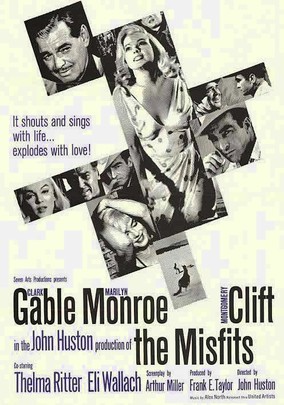
The Misfits-1961

The Misfits-1961

Director John Huston

Starring Marilyn Monroe, Clark Gable, Montgomery Clift

Scott’s Review #389
60000725

Reviewed March 27, 2016

Grade: B+

A dark film about loneliness, insecurity, and the need for friendship, The Misfits (1961) stars several of the era’s great legends in a film that I found both sad and disturbing.

Tragically, two stars would soon be gone from this world shortly after the film was made- Clark Gable and Marilyn Monroe.  This was the final film for each.

The film, shot in black and white,  has a bleak feel and represents the onset of darker decades in the film (the 1960s and 1970s). Primarily starring in light, feel-good films, The Misfits is a complete departure for Monroe.

The film is well-written and character-driven, which appeals to me, but cruelty to animals is a lot to take.

Set in Reno, Nevada, Roslyn has arrived from out of town for a quickie divorce. She is staying with Isabelle (Thelma Ritter), who frequently assists women needing divorces, lending as their witness in court.

After the divorce is final, they go to a local watering hole to celebrate life, where they meet an aging cowboy, Gay (Gable), and his tow-truck friend, Guido. They all agree to go to Guido’s house in the desert to party. When they arrive, they learn that Guido’s wife has recently died.

From this point, Gay and Roslyn become a couple and grow vegetables at Guido’s house, attempting to begin an everyday life. Later, the group decides to round up Mustangs and hire a rodeo hand, Perce (Montgomery Clift), to help.

This leads to conflict as Gay intends to sell the horses as dog food. A subplot of a love triangle between Gay, Roslyn, and Perce emerges.

The Misfits is a rugged watch. From a story perspective, it is cynical and sometimes heartbreaking. Each of the principal characters is severely damaged and pained.

We learn that Gay has two estranged children. When he runs into them at a bar, he excitedly wants to introduce them to Roslyn, but they have left before he can.

In a drunken stupor (and a sad scene), he pathetically calls out for them to return, causing a stir. Perce’s father has died, and his mother left a changed woman- his stepfather selfishly takes their ranch for himself, despite Perce’s father wanting it to go to Perce.

Alcohol abuse is prevalent throughout the film- obviously, the characters drown their sorrows to escape or avoid the pain that they feel.

The opening credits are unique and feature puzzle pieces. This symbolizes the group’s isolation and desire to find each other and fit in. They are all misfits who come together for some sense of companionship.

This is a unique aspect of the film, and director John Huston deserves the credit for immediately setting the tone for clever viewers.

The acting in The Misfits is outstanding, and I would argue that Monroe and Gable’s performances are the best in their respective careers. They both chartered very dark territory in the lonely and damaged characters they portrayed.

Thelma Ritter adds sardonic humor but inexplicably vanishes from the film about halfway through- never to return or be mentioned again.

I would have liked to have seen much more of Isabelle and more depth to her character. Why was she a misfit? She mentions loving all cowboys, so we might assume she has had her share of damaged relationships with men. More clarity might have been interesting.

The final portion is difficult to match. Ann’s interminable scene involves Gay and Perce savagely rounding up the horses and roping them down overnight—the length of the scene and the the horses’s struggles to escape will tug at one’s heartstrings.

Knowing that animals, until quite recently, were not treated well on film sets leaves me twice as unsettled.

Dark stuff.

A film fraught with difficulties (Monroe and writer Arthur Miller’s marriage breakup, Monroe’s and Huston’s substance abuse issues), and a dark subject matter, make The Misfits an intriguing experience.

Having watched the film twice, I appreciate it more with each viewing and think it contains memorable qualities worth exploring.

As the years have passed, The Misfits (1961) has become more appreciated, like a fine wine- I am realizing why.
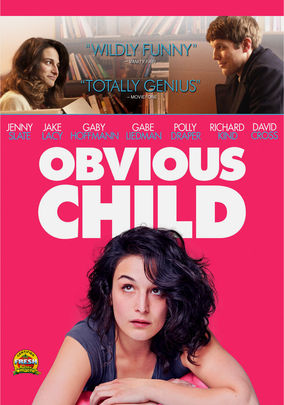
Obvious Child-2014

Obvious Child-2014

Director Gillian Robespierre

Starring Jenny Slate

Scott’s Review #387

70301275

Reviewed March 22, 2016

Grade: C+

Obvious Child is a 2014 independent comedy/drama nominated for a couple of independent spirit awards, that has mixed results.

It works on some levels but has an irritating underbelly and some unneeded components that ultimately give it a thumbs down.

The major success is star Jenny Slate, a real-life Brooklyn stand-up comic with immeasurable comic timing, who will hopefully become a rising star.

Slate starred in a 2009 short film of the same name before said film graduated to a full-length feature.

Slate stars as a twenty-eight-year-old Brooklyn-ite, who moonlights as a stand-up comic in a dingy bar while working in a desolate bookstore that is soon closing.

Conversely, her parents are successful- her mother is a famed professor. When she is unceremoniously dumped by her steady, she takes up with a handsome young man for a one-night stand filled with fun.

Predictably, she winds up pregnant and forges ahead with a plan to abort their child.

The abortion story is quite interesting since there is never a doubt about what will happen. Unlike films that make abortion the main focus of conflict, Obvious Child wisely does not- every character supports, and even encourages her to have the procedure, including her mother and best friend.

Having been written and directed by women, this is intentional and a way of empowering women, which is one of the high points. If one is on the fence about the topic of abortion or is a pro-life stance, this film may be very tough to watch as its slant is made crystal clear.

Slate is the other high point of the film.

She exudes confidence and comic range. Jewish and slightly awkward looking, she is not the leading-lady type and this arguably makes her wit and sarcastic language all the more comical. She is a natural in the comedy department and hope she will go far.

Two slight props for me worth mentioning are the wonderful mention of the classic film Gone with the Wind (1939) and the setting of Brooklyn. This was a great nod to film history and the setting gave Obvious Child an authentic New York City feel.

On the other hand, an utter annoyance about Obvious Child is the shameless and constant use of blatant and off-putting bathroom humor- not just once or twice, but numerous times.

How is this necessary to the plot? I can’t say, but surmise that it was deemed necessary by the filmmakers to show that females can give as good as males can.

Almost saying, “men can make poop jokes, why can’t women”? Why this is necessary for any film is beyond me and it gives Obvious Child a crass, ugly feel.

The film also has an unrealistic quality to it. Max is portrayed as prince charming. He can do no wrong, supports Donna in any decision she makes, is enamored by her sole being, and loves her unconditionally after only a one-night stand.

This would not happen in real life.

The fact that Donna is Jewish and quirky and Max is Christian and straight-laced is not explored. What conflicts would they undoubtedly face? Why were his parents not featured?

Highly uneven, with a great premise and an interesting slant on a still-controversial social issue, Obvious Child (2014) succeeds in the story department but fails in its uncalled-for use of potty humor to elicit cheap laughs.

Independent Spirit Award Nominations: Best Female Lead-Jenny Slate, Best First Feature

Spy-2015

Spy-2015

Director Paul Feig

Starring Melissa McCarthy, Jason Statham

Scott’s Review #386

80027379

Reviewed March 20, 2016

Grade: C+

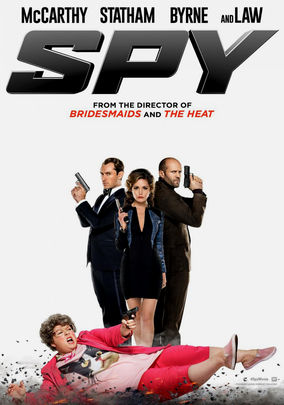
Spy is a 2015 comedy spy spoof starring funny lady Melissa McCarthy as a loser desk CIA analyst suddenly thrown into the field and assigned to rescue a missing agent with whom she is also in love.

Carrying the film in every way, McCarthy is funny and adds to an otherwise formulaic, by-numbers, comedy.

As, admittedly, the “action-comedy” genre is not my favorite, I have seen much worse than Spy, and the premise is quite nice, but the second half of the film sinks into the ridiculous and is very loud and overly long.

McCarthy plays Susan Cooper, a frumpy forty-year-old woman with a decent job as a CIA analyst (she tracks the field agents’ cameras and warns them of impending peril), an important job, but is deemed dispensable and a loser by the higher-ups at her job, with more important duties.

She is single, overweight, and lonely, pining after her sophisticated partner Bradley Fine (Jude Law), a field agent and stylish James Bond-type.  After a mishap with Bradley thought dead, Susan goes undercover in France, Rome, and Budapest to solve the case since she will be unnoticed.

Spy is a film with a star that completely carries the film.  Being a big fan of McCarthy’s and enjoying her performance in whatever she appears in (comedy or drama), this film needs her charisma and comic timing.

Spy contains a few laugh-out-loud moments, especially when McCarthy is forced to take on the persona of one loser after another- a divorcee with multiple cats and a wardrobe to cringe over-throw in a 1980s perm and got a great SNL-type moment.

The film itself reminds me of a long SNL skit. When McCarthy delivers her one-liners they connect and amuse.

An apparent homage to spy films and James Bond films, Spy seems closer to an Austin Powers film as it goes for more silliness, but not quite as over the top.

Still, the European locales offered added elements of Bond films pleasantly. McCarthy as an apparent female James Bond is also cute.

A noticeable negative is the unnecessary two-hour running time. With a genre of this nature, a ninety to one-hundred-minute running time is all that is necessary, and any more than that the jokes wane, become redundant, and usually go into the ridiculous.

Another problem with Spy is the supporting characters. A well-known cast including Rose Byrne, Allison Janney, Jason Statham,  and Bobby Cannavale, each of these actors are cast in cartoon-like, one-note roles.

Cannavale and Byrne are the villains (Sergio and Rayna) in the plot and they play their roles in a one-dimensional way,  as evil as possible, but perhaps also over-acting the parts.

This could be the fault of the director or simply what is accepted in the genre that this is. Janney-  as the tough-as-nails CIA director and Statham as the dumb, temperamental, field agent also overplay their roles.

Why are all of these characters loud, unpleasant, insulting, or all of the above? The answer is it might allow better comedy to have caricatures instead of characters, but that is a debate for another time.

On the other hand, Miranda Hart as McCarthy’s sidekick Nancy, a very tall, awkward woman, and Susan’s best friend is great and shares equally in the comic success that McCarthy brings.

Their chemistry is evident and a recommended second pairing would be worth exploring. Unlike the other characters, I felt myself rooting for her and wished her a love interest, though the 50 Cent’s romantic introduction was strange.

The plot is more or less trivial and unimportant in a film like this. Rationally speaking, almost everything that transpires would never happen in real life, but alas, this is the movie, so one must suspend disbelief big time.

Spy is escapist fare to the max.

A hot mess if not for the wit and comic timing that McCarthy brings, Spy (2015) has an interesting premise but doesn’t deliver anything more than the silly formula that has existed for decades in the film comedy world.

I finished the film with mixed emotions.

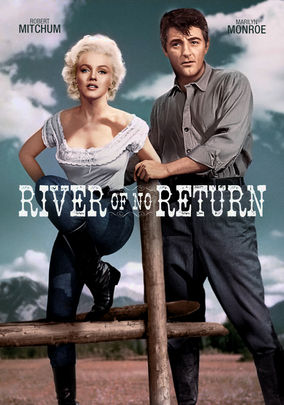
River of No Return-1954

River of No Return-1954

Director Otto Preminger

Starring Robert Mitchum, Marilyn Monroe

Scott’s Review #385

60022672

Reviewed March 15, 2016

Grade: B-

A departure in genre and character from the iconic Marilyn Monroe, most notable for playing “bubble gum” roles, in the 1954 film River of No Return, she plays a dance hall singer living in 1875 northwestern United States.

The film is in the Western genre and features gorgeous scenery, some authentic and some staged. The look of the film is a great selling point for me, as is Monroe’s performance and appeal.

However, the story has significant negatives, mainly that it is not very compelling or engaging, not to mention existing plot holes.

The crux of the story is as follows- A widower, Matt Calder (Robert Mitchum), arrives in a tent city in pursuit of his ten-year-old son, Mark, left in the care of Kay (Monroe), while the man who delivered the boy to the town has taken off for the hills.

What follows is a mishmash of the storyline involving Matt, Mark, and Kay being chased by Indians, a love triangle between Kay, Matt, and Kay’s fiancé Harry, and the father/son reconciliation between Matt and Mark.

The story is not the strong point of the film. Nevertheless, it is undoubtedly where the high drama exists.  Despite being characterized as a Western, a stark contrast to most Marilyn Monroe films, it appears a soft Western with a romantic slant.

There are some kills, to be sure, with vicious wild animals, guns, and knives prevalent, giving it an outdoorsy, naturalistic feel.

The film lacks a streamlined direction and does not know where it’s headed. Is it intended to be an all-out Western, a romance, or some hybrid? Why does the story ultimately not work?

I sensed a snippet of chemistry between Mitchum and Monroe, though they were hardly Clark Gable and Vivian Leigh. One could argue that Matt does not treat Kay very well, and, surprisingly, Matt is portrayed as the hero in River of No Return.

Close to the middle of the film, while camping along the river, he attempts to rape Kay, where she struggles and ultimately submits. Then, almost as quickly, this fact is forgotten, and the story forages forward as a love story. Huh?

The film almost seems spliced together from a story perspective and is not compelling or memorable.

As an aside, and upon some research, River of No Return was riddled with problems and setbacks amid shooting, most notably drama due to Monroe’s needed on-set acting coach who conflicted with director Otto Preminger and star Robert Mitchum’s heavy drinking.

Then, there was Monroe’s broken ankle and numerous weather issues. Publicly, Monroe later stated that River of No Return was her least favorite film that she appeared in. Let’s say that the gods were not with this film.

River of No Return is undoubtedly an uneven film with a lackluster story and odd chemistry among the characters, which has a marginal appeal to me, mainly due to the talents of Monroe, who carries the weight of an otherwise lackluster and forgettable film.

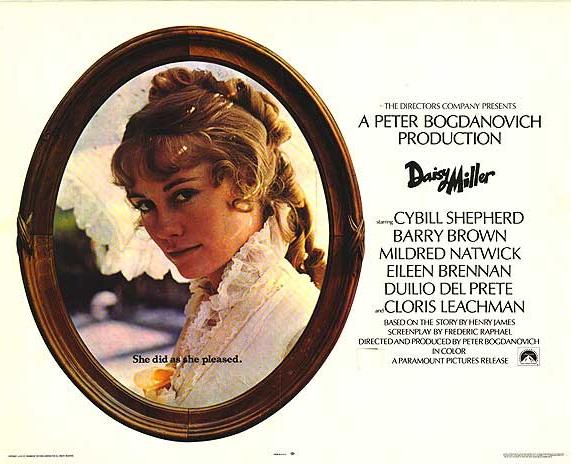
Daisy Miller-1974

Daisy Miller-1974

Director Peter Bogdanovich

Starring Cybill Shepard, Cloris Leachman 

Scott’s Review #383

DaisyMillerPoster

Reviewed March 6, 2016

Grade: B

Daisy Miller is a largely forgotten 1974 film based on a Henry James novella of the same name, directed by Peter Bogdanovich and starring then-girlfriend Cybill Sheperd in the title role.

I admire the film in certain aspects, but ultimately rank the film as good, but not spectacular. I pondered the film afterward and had a feeling that something was missing from it.

The story, set in the late 1800s, tells of a wealthy upstate New York family, led by the naïve Daisy Miller (Sheperd), visiting Europe in the hopes of becoming more cultured and worldly, but instead, are largely met with defiance and snobbery from European sophisticates. Daisy attempts to find love with her numerous potential suitors.

The film is largely shot in Switzerland and Italy.

The romantic story between Daisy and upper-class Frederick Winterbourne is the focal point. Daisy, a chatterbox and flirtatious, captures Winterbourne’s fancy and he gradually woos her but is conflicted by social norms and her innocent involvement with other men, most notably dashing Italian Giovanelli.

This leads to conflict. I noticed some chemistry between Daisy and Winterbourne.

Bogdanovich, who only directed a handful of films, including the masterpiece The Last Picture Show (1971), uses several great actors in both films.

In addition to Sheperd, Cloris Leachman, and Eileen Brennan appear in supporting roles. Leachman as Daisy’s equally chatty and naïve mother, and Brennan as the vicious socialite Mrs. Parker.

Brennan, in particular, shines. Outstanding at playing snobs and unique character roles, this was right up Brennan’s alley and she almost steals the show.

I adored the cinematography and the costumes featured in the production and thought both were the film’s main strengths.

The clothing that the characters were dressed in is both gorgeous and believable for the period. The backdrop during the hotel garden scene is exquisite and picturesque as the lake, sky, and mountain are all in full view adding a unique viewing experience.

I also found the subject of cultural class distinctions quite interesting. The Millers are rich but uneducated and unlikable- they live in Schenectady and are considered far beneath the clever, intelligent figures of Europe.

They do not measure up and they lack the same breeding and class as many of the characters.

Adding to this is the fact that the Millers never really seemed all that interested in being in Europe, almost taking the opportunity for granted, so I was never completely captured by the Millers or found them particularly sympathetic as a group.

Given that she is the focus, I found the character of Daisy Miller a bit unlikable and this could be due to the casting of Sheperd. Daisy’s endless rants, largely about herself, teetered on annoying to say nothing of her irritant little brother.

Sure, Daisy is sweet and kindhearted, but there is something that did not compel me about her. She was a less charismatic, northern version of Scarlett O’Hara.

I kept wondering if other actresses might have brought more to the character and given her more muscle. Was this role a showcase for Sheperd because of her relationship with Bogdanovich?

The conclusion of the film surprised me and features a downcast ending that I did not expect given the sunny mood of the rest of the film, and this is to Bogdanovich’s credit.

He certainly did not make a mainstream film and I admire that.

Daisy Miller (1974) is a mixed bag for me. I give my admiration for some aspects, but the story and the casting could have used a bit of altering.

Oscar Nominations: Best Costume Design

The New Girlfriend-2015

The New Girlfriend-2015

Director Francois Ozon

Starring Romain Duris, Anais Demoustier

Scott’s Review #382

80017300

Reviewed March 5, 2016

Grade: B

The New Girlfriend (2015) is a French, and lighter, version of The Danish Girl, a similarly themed film also released in 2015.

The story involves gender identification confusion among the central character, though the time in The Danish Girl is the 1920s, The New Girl is set in present times.

The film begins with a brief montage of the lives of two best friends,  Laura and  Claire, inseparable as children, young adults, and even as married women.

Sadly, we learn that Laura has recently died of a terminal illness and this is where the film begins. Claire embarks on a unique friendship with Laura’s husband David when she catches him wearing female clothing and acting as a “mommy” to his infant daughter.

They form a bond and Claire agrees to harbor David’s secret and even accompany him in public as he slowly takes on the persona of “Virginia”.

I found the film quite compelling throughout most of the running time as we see David’s burning desire to dress as a woman and feel like a woman.

We mostly see the bond develop between Claire and David, who sometimes is Virginia, and other times David. Claire is happily married to her successful, handsome, husband Gilles and the three individuals are friends. They share dinners, tennis matches, and evenings consuming wine.

Gilles is unaware of David’s secret and begins to fear an affair between his wife and friend. Likewise, during moments, Claire imagines David and Gilles beginning a torrid affair.

Interestingly, the film does not go full steam ahead with the love triangle between Claire/Gilles/David (Virginia), a wise choice. That would have made the film more typical and perhaps even one-note.

Rather, the point is struggles by David to feel like a woman and how his friends support him. When he kisses Claire and snuggles with her, it is not sexual, it is to feel close to another woman.

This makes the film more character-driven.

As with many foreign-language films, The New Girlfriend is liberal with nudity, male and female. When nudity is featured in American films typically it is gratuitously or sexually.

This film is French, so the nudity is tasteful and even beautiful. When Claire is topless it is more expressive as the mystique of the female body than in a showing of a chesty woman, which Claire is not.

The ending slightly disappointed me. The idyllic, fairy tale way it wrapped was romanticized and unrealistic. I would have liked to have seen more of David/Virginia’s struggles and how his in-laws might have wrestled with their granddaughter being raised by a single man dressing as a woman.

Another flaw was the lack of explanation as to whether David, as a male, desired and yearned biologically to become a woman or if he was satisfied to dress up and publicly look like a woman.

The film chose not to go this route and undoubtedly would have made the film darker, containing a much deeper story.

Instead, The New Girlfriend (2015) was light, fun, and wholesome in its overall story.