Category Archives: Independent Comedy

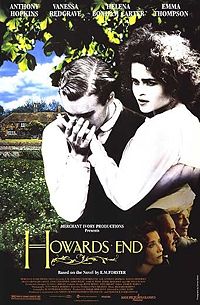
Howards End-1992

Howards End-1992

Director James Ivory

Starring Anthony Hopkins, Emma Thompson, Helena Bonham Carter

Top 250 Films #79

Scott’s Review #702

Reviewed December 1, 2017

Grade: A-

Howards End is my favorite film adaptation of E.M. Forster’s novel, which was also adapted into a film during the 1980s (1985’s A Room with a View and 1987’s Maurice are the other two notable works).

The novels were written during the early 1900s and set during the same period, focusing on class relations in 20th-century England.

The film is lovely and picturesque, telling an interesting story about romance and drama between the haves and have-nots during this period.

The film was a success and received heaps of Academy Award nominations in 1993.

Margaret Schlegel (Emma Thompson), an upper-middle-class intellectual, part of London’s bourgeoisie, befriends wealthy and sophisticated, yet shockingly conservative Ruth Wilcox (Vanessa Redgrave).

The two women strike up a powerful friendship, which results in her beloved country home being left to Margaret when an ailing Mrs. Wilcox dies.

To complicate matters, Margaret falls in love with a businessman (and husband of Ruth), Henry (Anthony Hopkins), while Margaret’s sister Helen, briefly becomes engaged to Paul Wilcox, Henry’s son.

The two families’ lives further intersect when they wind up as neighbors in London and the true owner of the beloved “Howards End” is questioned.

Added to the mix are several other characters of various social backgrounds, having connections to the families.

The writing in Howard’s End is rich and emotional as each character is perfectly fleshed out this includes the supporting as well as the lead characters.

Thompson and Hopkins, both sensational actors, have tremendous chemistry together, and unsurprising was Thompson’s win for Best Actress during this competitive year. She carries the film seamlessly with her upper-middle-class ideals- not conservatively rich, but far from working-class- she epitomizes poise grace, and empathy for those less fortunate than she.

Hopkins, on the other hand, is calculating and confident, yet charismatic and sexy as an old-school, controlling businessman.

Somehow, these two characters complement each other exceptionally well despite their varied backgrounds

The role of Helen may very well be Helena Bonham Carter’s finest. Not being an enormous fan of the actress-overrated and too brooding in my opinion enjoys portraying an interesting character in Helen.

Lovelorn and earnest, yet somewhat oblivious, she develops a delicious romance with the young clerk, Leonard Bast, my favorite character in the film. Living with Jacky, a woman of dubious origins, he is the ultimate nice guy and sadly winds up down on his luck after heeding terrible business advice.

Bast, thanks in large part to actor Samuel West, who instills an innocent, good guy quality in his character, deserves major props.

The cinematography featured in Howards End is beautiful with extravagant outdoor scenes- the lavish gardens of Howards End- just ravishing and wonderful.

Kudos too to the art direction, set design, and costume department for making the film look so enchanting.

There is something so appealing about the look of this film and director, James Ivory, undoubtedly deserves praise for pulling it all together into a suave picture. Whether the scene calls for sun or rain, tranquil or bustling, every scene looks great.

If I were to knock any points from this fine film it would be at two hours and twenty-two minutes, Howards End does drag ever so slightly, and many scenes involve the characters merely having chats with each other, without much action.

But this criticism is small potatoes when compared to the exceptional writing and well-nuanced character development displayed throughout the piece.

Admittedly, and perhaps shamefully, I have not read any of the Forster novels, but Howards End appears to be the film that is most successfully adapted, gleaming with textured finesse, grace, and style.

With the film’s finest actors along for the experience, and intricate, fine story-telling, Howards End (1992) is a film well worth watching.

Oscar Nominations: 3 wins-Best Picture, Best Director-James Ivory, Best Actress-Emma Thompson (won), Best Supporting Actress-Vanessa Redgrave, Best Screenplay Based on Material Previously Produced or Published (won), Best Original Score, Best Art Direction (won), Best Cinematography, Best Costume Design

Independent Spirit Award Nominations: Best International Film

Diary of a Mad Housewife-1970

Diary of a Mad Housewife-1970

Director Frank Perry

Starring Carrie Snodgress, Frank Langella

Top 250 Films #86

Scott’s Review #189

MPW-36461

Reviewed November 5, 2014

Grade: A

The film version of Diary of a Mad Housewife, based on the best-selling novel by Sue Kaufman, is a tremendous, unique story of one woman’s frustration with her irritating life.

A superb Carrie Snodgrass stars as a haggard, insecure, yet affluent housewife named Tina Balser, who lives in New York City, surrounded by an unpleasant family.

The family is led by Tina’s verbally abusive and neurotic husband Jonathan- a successful attorney, played flawlessly and rather comedically by Richard Benjamin, and her two brattish daughters Sylvie and Liz.

Bored, Tina decides to embark on an affair with crude artist George Prager, wonderfully played by Frank Langella. She teeters on the edge of an emotional breakdown throughout the film and trudges through life depressed and disappointed with all aspects of her life except for her affair with George.

George, however, is a womanizer and openly has other conquests besides Tina.

The brilliant idea of the film is that the story is told strictly from Tina’s point of view. All of the action centers on her character, which makes the film so interesting.

On the surface, one might argue she has everything- she is intelligent, well-educated, and affluent. A stay-at-home mother, she is treated like a servant by her husband Jonathan, as he constantly berates her appearance and criticizes her activities- she is always doing something incorrectly.

The film though is not a downer. It is a dry, satirical comedy that reminds me very much of a Woody Allen film. Tina is depressed, yes, but she goes through life with a realistic, almost chin-up, outlook. Her marriage to Jonathan is loveless yet why doesn’t she leave him?

Her affair with George is sexually satisfying, but she has no intention of pursuing anything further with him, nor does he want to. Tina dotes over her husband- planning dinner parties, sending Christmas cards, and various other wife duties.

I’m not sure that the film’s true intent is to show Tina as either a strictly sympathetic character or as completely downtrodden- the film is not a moral tale nor is it a schmaltzy, woman victimized and will rise against the world’s generic drama- it is witty and filled with black humor.

Despite her unkind husband, I found myself envying Tina’s life, in a way, and I think the film expects that of the viewer. I never got the impression that Tina was suicidal in any way.

It’s not that type of film.

Instead, she has wealth, and she goes to fancy restaurants, but she also has a very needy husband- he does not abuse her in a physical sense, nor is she reduced to tears by his outbursts.

She gets annoyed and merely accepts that this is the way life is and gets by with the assistance of an occasional swig of alcohol while doing dishes or preparing dinner, or when the dog has “an accident” on the living room rug and Tina’s kids cannot wait to tattle on her.

She is a sophisticated woman, trapped in an unhappy yet financially secure relationship.

Diary of a Mad Housewife is an interesting character study for all women to view and perhaps even slyly wink at.  Many women would champion Tina. She is a likable, sarcastic, cool chick. Audiences will find themselves drawn to her and even falling in love with her before long- I know I did.

Without the talents of Carrie Snodgrass, who completely carries this film, it would not be the wonder that it is. A wonderful satire, the film is not as wry or satirical as the novel, but how many films are?

The novel delves more into detail and the role of the Balser’s maid is barely mentioned in the film, yet plays a larger role in the Kaufman novel.

I loved the portrayal of Jonathan by Richard Benjamin who must receive some honor for the most annoying character ever in the film when he repeatedly screams for his wife by bellowing “teeeenaaaaa!”, or initiating sex by asking “Would you like a little roll in dee hay?”, one wants to choke him.

The way Tina’s daughters whine “mudder” instead of “mother” is comically brilliant. And her simmering hatred of all of them is dark hysteria.

Diary of a Mad Housewife is a genius and should not be forgotten.

Oscar Nominations: Best Actress-Carrie Snodgress

The Breakfast Club-1985

The Breakfast Club-1985

Director John Hughes

Starring Judd Nelson, Molly Ringwald

Top 250 Films #131

Scott’s Review #755

Reviewed May 8, 2018

Grade: A

The Breakfast Club (1985) is one of the most beloved films of the 1980s and perfectly captures being a teenager during this time.

Containing both innocence and authenticity rarely found in films targeted at younger audiences (and there were plenty in the 1980s), the film is timeless and holds up exceptionally well, still feeling fresh.

Director John Hughes avoids cliches and creates genuine truth in cinema. The theme song, “(Don’t You) Forget About Me” is nearly impossible to hear without associating it with this film.

The storyline is uncomplicated; five high school students (Bender, Claire, Andy, Brian, and Allison) of differing social classes gather one Saturday morning in the high school library for a day of detention.

Each student appears to know the others, but only peripherally, having little in common.

Assistant Principal Vernon (Paul Gleason) assigns them to complete a thousand-word essay by the end of the day. The group engages in mischievous antics, and squabbles, and discusses their respective roles and troubles in life throughout the day.

The film looks and feels like a small independent feature rather than a big-budget offering, which is of enormous praise. The cast is very small- only the aforementioned six principles and two minor characters.

The setting is almost entirely inside the walls of a suburban high school with only a few exterior shots to speak of. Mainly what succeeds is that the characters interact with rich dialogue, good texture, and underlying insecurities that make the screenplay bristle with genuine angst.

It is tough to pinpoint who the lead characters would be, but arguably Claire and Bender (Molly Ringwald and Judd Nelson) are the pair expected to unite as a couple, as they do in the conclusion- this is predictable yet sweet.

Unexpectedly, however, the film pairs Andy and Allison (Emilio Estevez and Allie Sheedy). Both couples are complete opposites, Claire and Bender even despise each other throughout most of the film but realize their mutual attraction.

Careful not to weigh down the film with too much heavy drama, Hughes, who also wrote and produced the work, peppers in some comedic moments.

Gleason is the easy foil as the sole authority figure, a bit too dedicated to his job of humiliating and disciplining the students, but he does get his due humorously.

Either on-screen or off-screen, no adult figures are written in a positive light giving The Breakfast Club a complete teenage perspective.

But the main appeal goes to the teenagers and the message that Hughes successfully relays- that of the misunderstood young adult. Each character is unhappy in some way and feels put into a category or defined by the individual cliques they each belong to- whether they want to or not.

Hughes makes the film a treasure in terms of relating to the characters- everyone remembers high school and the insecurities wrestled with while attempting to get good grades and obtain acceptance.

Hughes brings these aspects to life with his slice-of-life tale.

Even if every character is not immediately recognized by the viewers themselves, each is empathetic nonetheless. When Andy reveals his father’s criticisms or Bender painfully recounts his father’s physical abuse, we feel for them, suddenly seeing the strong athlete or the burnout from our high school days in an entirely new way.

Mousy Allison gets a makeover from Claire and suddenly shines like a new dime- finally not being ignored. Brian’s overbearing parent’s pressures are almost too much for him to bear.

After the film, we are left to wonder what will happen on Monday morning during homeroom. Will the group continue their new friendships (or more) or simply return to the normalcy of their respective peer groups?

Hughes wisely does not satisfy our piqued curiosity but rather leaves it to our imagination.

The Breakfast Club (1985) holds appeal for the masses without feeling cliched or put upon- only feeling insightful and inspired to accept others we may have preconceived notions about.

Pink Flamingos-1972

Pink Flamingos-1972

Director John Waters

Starring Divine, Edith Massey

Top 250 Films #165

Scott’s Review #359

70032618

Reviewed January 9, 2016

Grade: A

One of the true, and best, late-night gross-out films of all time, Pink Flamingos (1972) breaks down barriers I never thought possible to do in film and contains one of the most vomit-inducing scenes to ever grace the movies.

The film is certainly one of a kind and will only be appreciated by a certain type of film-goer. Pink Flamingos is raw, entertaining, and must be seen to be believed.

Outrageous in every way and shot documentary style, the film has weird close-ups and amateurish camera angles, only adding to the fun.

I love the film.

In what director John Waters famously dubbed the “Trash Trilogy”, along with similar films Desperate Living and Female Trouble, Pink Flamingos has the dubious honor of being the best of the three.

Waters stalwart, Divine, plays Babs Johnson, an underground criminal who lives a meager existence in a trailer along with her mentally challenged son Crackers, and her bizarre, egg-obsessed mother, Edie (Massey). They are joined by Babs’s companion, Cotton.

In an attempt to win the “Filthiest Person Alive” contest and usurp Babs from achieving this distinction. the Marbles (Mink Stole and David Lochary) set out to destroy her career.

Pink Flamingos is complete and utter over-the-top fare, but I have fallen in love with the film over the years.

Let’s just say it is a type of film that is an acquired taste, and one will eventually revel in the madness or be disgusted with its bad taste.

Waters, a truly creative,  breaks new ground in filthy behavior. On a budget of no more than $10,000, it is more than impressive how he pulled this off successfully.

The antics that Babs and the Marbles engage in are downright crude, but the extreme nature of the fun is exactly what is to love about the film. Hysterical is the character of Babs’s mother Edie.

Confined to a crib and constantly inquiring about the Egg Man, she is obsessed with eggs and wants to eat nothing else. She eventually marries the Egg Man. The character is entertaining beyond belief.

The Marbles run a clinic in which they sell stolen babies to lesbian couples for cash.  When they send Babs a box of human excrement and a card that says “fatso”, the war between the two sides is on.

The highlight of the film is the main sequence in which Babs holds a birthday party. A male contortionist flexes his anus in rhythm to the song “Surfin’ Bird”, which may be the only film featuring an anus.

How Waters got away with some of this stuff is mind-blowing.

The most disturbing scene occurs at the very end when Babs watches a dog do “its business” on the street and proceeds to pick up the excrement and eat it, revealing to the audience a toothy (and brown) smile.

Reportedly Divine did this act. As the film ends, Babs truly is “The Filthiest Person Alive”.

Thanks to the genius of John Waters and Divine and the superlative supporting cast, Pink Flamingos (1972) is a reminder that creativity and unique humor do not have to conform to a specific style or follow a road map.

Waters takes any film criteria and throws it right out the window, instead of creating a masterpiece in warped fun and disgust.

Female Trouble-1974

Female Trouble-1974

Director John Waters

Starring Divine

Top 250 Films #168

Scott’s Review #146

70032612

Reviewed August 4, 2014

Grade: A

Female Trouble (1974) is a deliciously naughty treat by famous Independent film legend, John Waters.

Not exactly family-friendly, it is a gem for those desiring more left-of-center fare with depravity and gross-out fun mixed in for good measure.

Water’s theme of the film is “crime is beauty” and the film is dedicated to Manson family member, Charles “Tex” Watson.

Meant for adult, late-night viewing, the film tells the story of female delinquent Dawn Davenport, who angrily leaves home one Christmas morning after not receiving her desired cha-cha heels as a Christmas present.

Her parents, religious freaks, disown her and she is left to fend for herself on the streets of Baltimore.

The film then tells of her life story of giving birth and subsequently falling into a life of crime in the 1960s.  Her friends Chicklet and Concetta are in tow as they work various jobs and embark on a career of theft.

Female Trouble stars Waters regulars Divine, Mink Stole, Edith Massey, Cookie Mueller, and others.

Interestingly, Divine plays a dual role- Dawn Davenport (in drag, of course) and also the father of her bratty child- Earl Peterson. Dawn and Earl have a less-than-romantic interlude on a dirty mattress on the side of the road when he picks her up hitchhiking, which results in the birth of Taffy.

Also featured is the hilarious feud between Dawn and her love interest’s (Gator) Aunt Ida, as the women engage in tactics such as acid throwing and chopping off of limbs as they constantly exact revenge on each other.

Favorite scenes include Dawn’s maniacal nightclub act in which she does her rendition of acrobatics and then begins firing a gun into the crowd. Another is of Dawn’s dinner party with Donald and Donna Dasher- serving a meal consisting of spaghetti and chips, Taffy’s tirade hilariously ruins the evening.

This film is not for the prudish, squeamish, or uptight crowd, but a ball for all open-minded, dirty fun-seekers. The film contains one over-the-top, hilarious scene after another.

The line “just cuz you got them big udders don’t make you somethin’ special” is a Waters classic.

Female Trouble is one of a series of outrageous, cult-classics featuring the legendary camp star, Divine.

Not meant to be overanalyzed or some might say, analyzed at all, Female Trouble (1974) is unabashedly trashy and makes no apologies for its outrageousness.

Desperate Living-1977

Desperate Living-1977

Director John Waters

Starring Mink Stole, Liz Renay

Top 250 Films #225

Scott’s Review #534

60027260

Reviewed December 4, 2016

Grade: B

Desperate Living (1977) will not be everyone’s cup of tea. It is a raunchy, late-night comedy, similar to other John Waters-directed cult classics.

This one, however, suffers from the absence of Waters staple, Divine, who did not appear due to scheduling conflicts.

For this glaring omission, Desperate Living is not the greatest of the Waters films, but it is a fun experience all the same.

The film has choruses of political satire, specifically fascism, and overthrowing the government.

Mink Stole (Peggy Gravel) takes on the lead role as a crazed, mentally unhinged, neurotic woman on the lam with her maid, Grizelda, after they accidentally cause the death of Peggy’s husband.

Peggy has been in and out of mental hospitals and is clearly off her rocker as she yells at neighbors about communism.

After an encounter with a lewd police officer, the duo is banished to Mortville, a town filled with outcasts and social deviants. They align with others in the town to overthrow the tyrannical Queen Carlotta, played by Waters fixture Edith Massey.

Carlotta plots to spread rabies throughout the community and is at war with her daughter, Princess Coo Coo.

The issue with Desperate Living is the absence of Divine, originally set to play Mole McHenry, a self-loathing female wrestler, determined to receive a sex change operation.

One imagines the Divine in this important role, which was played by Susan Lowe, a capable star, but no Divine. With Divine in the part, the hilarious possibilities are endless.

Mink Stole carries the movie well, but traditionally being a supporting player in Waters’s films, is not quite the star the film needs to be a true success.

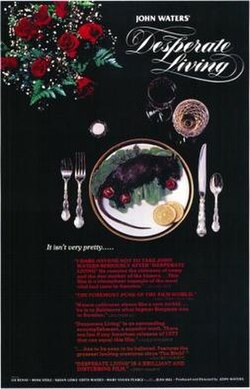
This is not to say that the film is a dud- it is entertaining and will please most Waters fans. It contains gross-out moments and vulgarity from the very first scene- as the opening credits roll, we see a roasted rat, daintily displayed on good china, on an eloquent dinner table, presumably to be served.

Later, Carlotta meets her fate by being roasted, pig style, on a spit with an apple in her mouth. Another character is executed by being shot in the anus. The offensive moments never end!

There also exists a quite controversial scene that I am surprised made the final cut. Peggy, already in a frazzled state due to a neighbor boy accidentally shooting out her bedroom window, is shocked to find another boy playing “doctor” with a little girl in her downstairs basement.

Both children are completely naked, leaving not much to the imagination. This scene is tough to watch as one wonders what the child actors thought of all of this.

I have never viewed another scene quite like this in film.

Otherwise, Desperate Living is filled with cartoon-like characters, lots of sexually deviant leather men, grizzled men with facial hair, and other odd-looking characters, making up the community of Mortville.

Water’s set creations for the exterior scenes of the town are great using mainly cardboard and rubbish he found throughout Baltimore where the film was shot, the sets show a bleak yet colorful underworld.

Desperate Living (1977) is a raunchy good time with over-the-top acting, trash-filled moments, and laugh-out-loud fun.

The lack of any Divine makes it not the first offering to watch from the Waters collection. Pink Flamingos (1972) and Female Trouble (1974) would take that honor.

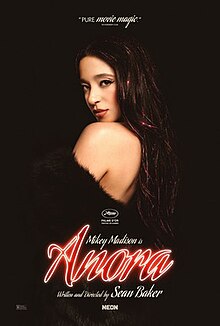
Anora-2024

Anora-2024

Director Sean Baker

Starring Mikey Madison, Mark Eidelstein, Yura Borisov

Top 250 Films #243

Scott’s Review #1,450

Reviewed November 3, 2024

Grade: A

Anora (2024) is one of the boldest films I’ve seen in some time and is my favorite Sean Baker film so far. Tangerine (2015) and The Florida Project (2017) are also great works.

Those planning to see the film should do homework and learn what Baker films are about. He frequently directs independent feature films about the lives of marginalized people, especially immigrants and sex workers.

Baker’s films are dirty, dark, and outrageous.

Because Anora has received awards buzz and is classified as a romantic comedy, the audience at my showing seemed slightly overwhelmed by its raw nature. While there are comedic moments, they are shrouded in darkness, and I don’t think my audience quite knew how to respond.

Some cover art captured the main couple, played by Mickey Madison and Mark Eidelstein, happily dancing and depicted them with the caption ‘a modern day Cinderella story’. This is misleading to the gritty nature of the story.

Madison plays Ani (Anora), an exotic dancer and part-time sex worker at a swanky Manhattan strip club. She lives in a Russian section of Brooklyn. Her life takes an unexpected turn when she meets and impulsively marries Vanya (Mark Eidelstein), the childlike son of a Russian billionaire.

When Vanya’s godfather and parents catch wind of the union, they send their henchmen to annul the marriage, setting off a wild chase through the streets of New York. Vanya flees the scene, and the others must find him.

Madison is brilliant. Known for a small role as Susan Atkins in Quentin Tarantino’s Once Upon a Time in Hollywood (2019) and a role in one version of Scream (2022), the young actress comes on as gangbusters.

Her character is tricky. We only know she lives with her older sister, and their mother lives in Florida with her boyfriend. Presumably, her father is absent, and she has had to find work to support herself. She is brassy, savvy, and intelligent. Most importantly, the audience roots for her.

Madison has an aura surrounding her, and she believably plays loving and hysterical with ease. Ani wants love but is also intelligent enough to know love doesn’t come easy and has a price. Madison channels each emotion with seeming ease.

Baker has become a favorite director of mine. He also writes, produces, and edits most of his projects. Although his films are not easy to watch, that’s what I like about them.

His films take marginalized or dismissed groups and provide representation.

Another standout is Russian actor Yura Borisov. Since Ani is the only character worth rooting for, Borisov’s character, Igor, slowly becomes a fan favorite. Assumed to be a henchman, he begins to care for Ani and strive to do the right thing amid chaos.

Borisov provides Igor with warmth and kindness in a world of chaos. I yearned to know more about the character. How did he get to be where he is? Did he need to escape Russia any way he could?

It’s hard to like the other characters, and I wouldn’t say I enjoyed quite a few, especially the wealthier ones. I yearned to leap across the aisles and smack Vanya, his mother, and one stripper who is Ani’s rival.

This caused me to react viscerally to the film and think about my emotions after it ended. Anyone who appreciates good cinema knows that the longer you think about it, the better it is.

Towards the end, Baker incorporates satisfying moments of Ani standing up for herself, especially against Vanya and his mother. This only reaffirmed the passion of her character. Even in despair, Ani remains tough and refuses to be mistreated by anyone.

My favorite sequence is at the end, during a January snowstorm in Brooklyn. A tender moment occurs between Ani and Igor where the writing, cinematography, and camera angles are beautiful.

Anora (2024) is recommended for fans of Baker’s work. He successfully and carefully weaves an emotional and raw tale of adventure, romance, desperation, and the haves versus the have-nots.

Oscar Nominations: 5 wins-Best Picture (won), Best Director-Sean Baker (won), Best Actress-Mikey Madison (won), Best Supporting Actor-Yura Borisov, Best Original Screenplay (won), Best Film Editing (won)

Independent Spirit Award Nominations: 3 wins-Best Feature-(won), Best Director-Sean Baker-(won), Best Lead Performance-Mikey Madison-(won), Best Supporting Performance-Yura Borisov, Karren Karagulian

Butt Boy-2020

Butt Boy-2020

Director Tyler Cornack

Starring Tyler Cornack, Tyler Rice

Scott’s Review #1,483

Reviewed June 28, 2025

Grade: B+

Despite the title, Butt Boy (2020) is not a film intended for adult entertainment during a seedy escapade to a cheap motel.

It’s better than that.

It’s a wacky, darkly humorous comedy played straight, without relying on easy gags.

With an experimental feel and co-written, directed by, and starring newcomer Tyler Cornack, it conveys a sense of creative freedom and an expressive nature.

To its resounding credit, Butt Boy is an independent film and hardly a studio production, where it undoubtedly would have been made more mainstream if not for the titillating title.

The film is a spinoff from a Tiny Cinema comedy sketch.

I am surprised I am awarding it a ‘B+’ rating because early on I wasn’t as enamored with it as I was when the credits rolled and I was able to ‘digest it’, pun intended.

The story doesn’t make complete sense, and has a fantasy edge where it’s not always clear what is happening or why.

Chip Gutchell (Cornack) is an IT specialist and married father trapped in a loveless marriage with his wife, Anne (Shelby Dash), who may be cheating on him.

He develops a compulsive behavior after a routine rectal exam, where anything he inserts into his anus provides intense pleasure and then mysteriously disappears. This fetish consists of objects, animals, and people.

Detective Fox (Tyler Rice) loves work and alcohol. After going to AA, his sponsor, Chip, becomes the main suspect in his investigation of a missing kid.

Fox also starts to believe that people are disappearing up Chip’s butt.

The audience immediately relates to Chip. He works in a sterile office with colleagues who engage in enthusiastic work chants to celebrate successes. He counts the minutes until the work day ends.

His home life is no better with a distant wife who chats on the phone and goes out with the girls. It’s revealed that Chip got her pregnant, causing them to forge a life of doldrums.

The story goes off course after Chip discovers the pleasures of anal stimulation. He kidnaps a baby, a young kid, and his dog to shove them up his butt where they are trapped inside his intestines.

Why he needs the stimulation to be a living being instead of an object is never revealed.

Bizarre sequences of Chip farting and inevitably having an explosion of diarrhea thus making his victims escape his anus covered in fecal material make no sense.

Nonetheless, I slowly became absorbed by Butt Boy mostly because it’s an idea in cinema that has never been done before. The film’s tone is awe-inspiring in its serious nature, opting not to rely on cheap laughs or easy comic points.

Deeper subjects like compulsion, addiction, and career emptiness are easy to correlate to the central premise.

I found myself intrigued by the character of Detective Russell Fox as well. Rice seems like a good actor and a poor man’s Christian Bale, with his slicked-back hair.

A revelation later in the film about Fox connects the dots better regarding his story and character motivations.

Butt Boy was recommended by John Waters, a left-of-center film director most known for gross-out indies like Pink Flamingos (1972) and Female Trouble (1974). I trust his warped appreciation for film implicitly.

The mood is comparable to that of other film gems, such as Under the Skin (2013) and Nightbitch (2024). The finale is reminiscent of The Substance (2024) in its absurdity even though Butt Boy was made several years prior.

I’m curious about Cornack and whether Butt Boy (2020) is a one-off novelty idea or if there’s more to come from his distinguished creative mind.

Time will tell.

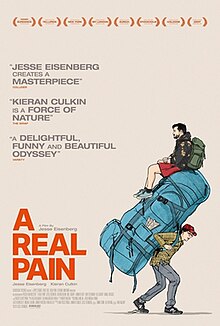
A Real Pain-2024

A Real Pain-2024

Director Jesse Eisenberg

Starring Jesse Eisenberg, Kieran Culkin, Jennifer Grey

Scott’s Review #1,452

Reviewed November 25, 2024

Grade: A-

A Real Pain (2024) is a well-written film about life’s emotions, experiences, joys, and pains. It wonderfully mixes comedy with drama, not one genre or the other but a pot of delicious flavors forming a potent concoction.

Jesse Eisenberg produces, writes, directs, and acts in his creation, making it his own. Kieran Culkin is a revelation as a troubled young man plagued by depression and ravaged by passion.

Emma Stone co-produces.

David (Eisenberg) and Benji (Culkin) play New York Jewish cousins with seemingly minor in common who reunite for a tour through Poland to honor their beloved grandmother.

David, a reserved and pragmatic father and husband, contrasts sharply with Benji, a free-spirited and eccentric drifter. Their personalities clash as Benji criticizes David for losing his former passion and spontaneity, while David struggles with Benji’s unfiltered outbursts and lack of direction.

In Poland, the pair meets up with a Holocaust tour group that each shares a link to the Holocaust history.

Emotional honesty among the group members and tour guide occurs during their week-long trip as brutal truths and past tensions surface.

A Real Pain is a character study with flawless writing. Eisenberg delivers an effort reminiscent of a Woody Allen film with punchy moments, neurotic characters, and cheeky humor.

Benji and David, more like brothers than cousins, admire and resent each other. Benji wishes he had what David does- a stable job, a wife and child, and peace of mind. David resents the way Benji lights up a room with his passion, quickly becoming center stage while David is forced to lurk in his shadow.

Together, the film belongs to Eisenberg and Culkin as their dazzling chemistry emulates from the screen.

From the first scene, we sense David’s frustration. He rushes to the chaotic airport, hurriedly leaving voicemails for Benji. But the carefree Benji has been at the airport for hours and dismisses David at every measure.

David is a nice guy who selflessly gives Benji the window seat and first dibs on the shower. But he secretly feels bullied by Benji’s selfishness.

David realizes that people always fall for Benji and give him a pass, which frustrates him. He essentially mocks and calls the tour group assholes but somehow is deemed ‘real’ or ‘honest.’

Benji is tough to like, but Culkin’s wounded blue eyes allow the audience to realize he is hurting and suffering from deep pain.

My only knock is why the tour guide, who is mocked and criticized by Benji, ultimately thanks him for his brutal honesty and more or less snubs David.

Compared to the otherwise honest writing, this scene feels forced and unrealistic.

Eisenberg flawlessly delivers a performance that showcases his range of emotions. Sufferingly patient, he explodes during a dinner scene, letting his emotions spill onto the table.

Eisenberg and Culkin’s great acting is showcased, especially during the scenes where they let their emotions rip. Their best scene together is atop a hotel, where they smoke pot and old wounds furiously come to the surface.

Besides the acting, Eisenberg, the screenwriter, immerses the audience in the importance of Holocaust history.

It’s not for the faint of heart. Powerful scenes of the tour group walking through  Majdanek concentration camp are hard to watch, with the knowledge that thousands were exterminated.

Led by a scene-stealing turn from Culkin and a bevy of creative talents by Eisenberg, A Real Pain (2024) is a powerfully funny, emotionally resonant dramedy that finds him playing to his strengths on either side of the camera.

Oscar Nominations: 1 win-Best Supporting Actor-Kieran Culkin (won), Best Original Screenplay

Independent Spirit Award Nominations: 2 wins-Best Supporting Performance-Kieran Culkin (won), Best Screenplay (won)

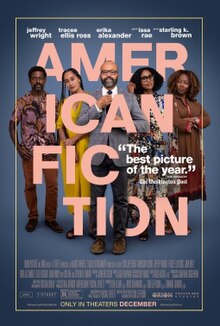
American Fiction-2023

American Fiction-2023

Director Cord Jefferson

Starring Jeffrey Wright, Issa Rae, Sterling K. Brown

Scott’s Review #1,421

Reviewed February 11, 2024

Grade: A

American Fiction (2023) is an intelligently written expose of black culture and a poignant family drama mixed as one. Cord Jefferson makes his feature directorial debut with the satirical comedy-drama which he also wrote.

The film explores how perceptions of black people, mostly by white people but even amongst themselves, are categorized into neat little boxes.

Usually, the negative stereotypes are assumptions of bad grammar, poverty, and hardships in ghetto situations.

While some may be sympathetic these beliefs are either conscious or subconscious and they are propelled by the media. In the case of the film, through literary works.

Are white people intimidated by intelligent black people, the film questions. How do the intelligent black people feel about themselves?

American Fiction is a witty, smart, funny, and poignant film that will make you laugh as often as it makes you think about the perspectives offered.

Jefferson brilliantly offers up both an education and powerfully drawn black characters. In the middle is a sentimental family storyline that had me enraptured by almost all the characters.

The writer/director bases his film on the 2001 novel Erasure by Percival Everett. Thelonious “Monk” Ellison (Jeffrey Wright) is a highly intelligent African-American upper-class writer and professor living in Los Angeles.

He is a frustrated novelist-professor who doesn’t make much money or sales from his serious works.

Needing money after moving back to Massachusets on a leave of absence, he decides to write an outlandish satire of stereotypical “black” books, only for it to succeed by mistakenly thought of as serious literature and published to both high sales and critical praise.

He struggles with keeping his alter ego a secret while questioning the lack of intelligence with people assumed to be the liberal elite and the general public.

Wright is great and leads the charge of a dynamic cast. He makes his characters believable and their motivations clear while still showing Monk’s conflict. Monk has lived a privileged life with education, social status, and success.

His experience as a black man is different than other black men and he is smart enough to know this while still wrestling with his feelings.

Wright is dynamic at showing many emotions.

To make the film even better, the supporting characters are delightful with their own stories, making me fall in love with them. Special call-outs are for Sterling K. Brown and Erika Alexander who plays Monk’s brother and girlfriend, respectively.

Brown as Cliff is a successful surgeon but lives a conflicted life as a newly ‘out’ middle-aged gay man. He dabbles in drugs and promiscuous behavior but all he wants is approval by his family.

Alexander is a successful public defender and neighbor of the Ellison’s going through a divorce. She relates to Monk while challenging him on his bullshit and is a richly carved character.

Also, Leslie Uggams Monk’s mother suffering from Alzheimer’s disease, Ellison’s housekeeper Lorraine (Myra Lucretia Taylor), and Issa Rae as Sintara Golden are weaved into the canvas seamlessly and with purpose.

The film’s ending left me scratching my head and caught me off guard. While clever, it made me wonder if what I had just seen was reality or fantasy. Providing three different endings as adapted film options it’s tough to know which if any actually happened but maybe that’s the point.

I left the movie theater having laughed out loud, thought, and been entertained.

American Fiction (2023) made me feel like I had seen something relevant that would help me understand people better and give me insight into what other people feel.

Oscar Nominations: 1 win-Best Picture, Best Actor-Jeffrey Wright, Best Supporting Actor-Sterling K. Brown, Best Adapted Screenplay (won), Best Original Score

Independent Spirit Awards Nominations: 2 wins-Best Film, Best Lead Performance-Jeffrey Wright (won), Best Supporting Performance-Erika Alexander Sterling K. Brown, Best Screenplay (won)

Triangle of Sadness-2022

Triangle of Sadness-2022

Director Ruben Östlund

Starring Harris Dickinson, Charlbi Dean, Woody Harrelson

Scott’s Review #1,374

Reviewed July 2, 2023

Grade: A

When I realized the director of Triangle of Sadness (2022) had directed Force Majeure (2014) and The Square (2017), I became very interested in seeing it.

I’m not sure I ultimately ‘got’ The Square, but Force Majeure was a thought-provoking slice of cinematic brilliance that I still think about from time to time.

Sure, Triangle of Sadness was rewarded with three Academy Award nominations, which it deserved. Still, Ruben Östlund has a knack for challenging his audience to think outside the box, both cinematically and otherwise, with a robust examination of social classes.

He crafts a subject matter about class systems and the haves and have-nots that has been explored in film many times before. But, in Triangle of Sadness, it feels fresh and fraught with many different possible directions.

The wicked dark comedy explores political talking points such as capitalism, communism, and socialism, and challenges conventional ways of thinking.

It’s on par with the popular HBO series The White Lotus, but on steroids.

I cannot recommend the film more highly, primarily geared toward those seeking expressive and deeply textured films with some meaning.

Despite the dreary title, it’s far from a dour experience. There are quite a few laugh-out-loud moments, especially in scenes featuring severe vomiting amid seasickness.

The rich and famous embark on a luxury cruise with fine dining and servants galore. But after a devastating storm leaves several passengers and staff stranded together on a deserted island, the power exchange begins to shift, and the social hierarchy is turned upside down.

Events mainly surround a celebrity model couple, Carl (Harris Dickinson) and Yaya (Charlbi Dean), who are invited on the luxury cruise for promotional purposes. Yaya is a social media influencer.

They are joined by a Russian oligarch, Dimitry, and his wife, Vera, as well as an elderly couple, Clementine and Winston, who have made their fortune manufacturing grenades and other weapons. Therese, a wheelchair user only capable of speaking a single phrase in German following a stroke, and Jarmo, a lonely tech millionaire who flirts with Yaya.

Besides possibly Therese, there is no a sympathetic rich character to be found.

The yacht staff are more sympathetic, although we don’t get to know all the characters very well.

Highlights include the head of staff, Paula, who demands that the staff obey the guests without question, Abigail, a cleaning woman, and the yacht’s captain, Thomas Smith (Woody Harrelson), who spends his time drunk in his cabin and despises the absurdity of the guests’ wealth.

The main events on the ship take a while to get to, and the film is divided into chapters. Part 1: Carl and Yaya, Part 2: The Yacht, and Part 3: The Island.

I realized after the fact that the point of the slow build is to show the dynamic between Carl and Yaya, the main characters. Both models and living life based on their looks, they are wildly insecure, bickering over money and gender roles.

While not likable nor complete assholes either, enjoyable is a chance to get a fleshed-out perspective on where they are coming from.

My adoration for the film largely stems from not knowing what is going to happen but knowing that at some point the shit is going to hit the fan.

The setup is perfect, especially the put-upon staff. While they are not abused, the relationship is clear. The passengers are in a position of power; the staff is not.

This will soon change.

Late in the game, I unexpectedly found myself rooting for a minor character who takes center stage in the last chapter, turning events upside down.

Comparisons can also be found in the recent Best Picture winner Parasite (2019) and classic international films such as Swept Away (1974) and L’Avventura (1960).

These are all brilliant films, and my hunch is that Triangle of Sadness (2022) will hold up well, perhaps achieving even greater acclaim as the years go by.

Oscar Nominations: Best Picture, Best Director-Ruben Östlund, Best Original Screenplay

Everything Everywhere All at Once-2022

Everything Everywhere All at Once-2022

Director Daniel Scheinert, Daniel Kwan (Daniels)

Starring Michelle Yeoh, Ke Huy Kwan, Stephanie Hsu

Scott’s Review #1,337

Reviewed January 26, 2023

Grade: A

Released in March 2022, Everything Everywhere All at Once is a film that built momentum throughout the year, resulting in an astonishing eleven Academy Award nominations.

Traditionally, films vying for awards season attention and subsequent praise and honors are released in the fourth quarter, while earlier releases are relegated to the discount racks.

But Everything Everywhere All at Once breaks the mold thanks to being a visionary, absurd comedy that demands the appreciation it has received.

As of this writing, it is the highest-grossing film released by A24, a champion of independent and quality cinema.

Evelyn Wang (Michelle Yeoh) plays a flustered and bedraggled immigrant mother who runs a laundromat along with her goofy husband Waymond (Ke Huy Kwan).

They reside in the laundromat with Evelyn’s irritable father, Gong Gong (James Hong), and daughter Joy (Stephanie Hsu), who is gay.

In trouble with an IRS inspector, Deirdre (Jamie Lee Curtis), Evelyn is contacted from a parallel universe and told that only she could save the world. She must quickly learn to channel her newfound powers and fight through the timelines of the multiverse to save her home, her family, and herself.

Everything Everywhere All at Once is not conventional and is admittedly a complete mess, meant in the finest of ways.

It takes the cinematic formula and tips it on its ass, but intelligently incorporates heartfelt scenes and gripping performances so that the viewer falls in love with the characters before knowing what’s hit them.

I semi-cried when I heard the film was an action mix with science fiction and superhero multiverses, none of which are my genre of choice. The film goes beyond that with a sensory overload, a warped onslaught of colorful wackiness that includes hot dog fingers, butt plugs, and a drag performance.

You can’t make this up, kids.

Michelle Yeoh kicks ass (literally!) and gets the role of a lifetime. At sixty years old, she has played a Bond girl in Tomorrow Never Dies (1997) and a rich bitch Mom in Crazy Rich Asians (2018), decent roles, but nothing like Evelyn.

Directors, the Daniels, show through Evelyn’s character how her life has disappointed her. Never appreciated by her father and living in a state of doldrums, she becomes an angry and frustrated young woman, but eventually develops into a person who enjoys the small moments of human connection in her life.

We can all learn from Evelyn.

What a treat to see Jamie Lee Curtis chew up the scenery playing Deirdre. Displaying her gut, wearing a bizarre grey wig, she plays part IRS agent, part lesbian lover, depending on which universe she inhabits, and is a hoot.

Ke Huy Kwan is famous as the child actor from Indiana Jones and the Temple of Doom in 1984, and not much since. He somersaults back into the acting spotlight in the role of Evelyn’s kind husband.

Finally, Stephanie Hsu is a gem as Stephanie, who wants to be loved by her mother. The actor has a bright future ahead of her.

These actors get to play four or five different characters, showcasing their acting chops.

Stylistically, the film is off the wall. Dizzying special effects and absurd editing bombard the viewer with ‘stuff’ that can be analyzed from a technical perspective for weeks.

But at the end of the film, you will shed a tear or two at the emotion that sneaks up from behind in the most wonderful way. Quiet scenes between the noisy ones show humanity and love for one another.

Everything Everywhere All at Once (2022) has reaffirmed my appreciation of film and the creativity and beauty that can be mastered.

Oscar Nominations: 7 wins-Best Picture (won), Best Director-Daniel Kwan and Daniel Scheinert (won), Best Actress-Michelle Yeoh (won), Best Supporting Actor-Ke Huy Kwan (won), Best Supporting Actress-Stephanie Hsu, Jamie Lee Curtis (won), Best Original Screenplay (won), Best Original Score, Best Original Song-“This is a Life”, Best Costume Design, Best Editing (won)

Independent Spirit Award Nominations: 6 wins-Best Feature (won), Best Director-Daniel Kwan and Daniel Scheinert (won), Best Lead Performance-Michelle Yeoh (won), Best Supporting Performance-Ke Huy Kwan (won), Jamie Lee Curtis, Best Breakthrough Performance-Stephanie Hsu (won), Best Screenplay (won), Best Editing (won)

Zola-2021

Zola-2021

Director Janicza Bravo

Starring Taylour Paige, Riley Keough, Colman Domingo

Scott’s Review #1,290

Reviewed August 16, 2022

Grade: A-

I’ve said this before when speaking about cinema, but it bears repeating. I treasure the independent film genre and the creativity it allows. Usually, it’s a small group or sometimes even only one person with a vision and the ability to bring it to the big screen.

Budgets are almost always tight, but that’s a good thing. Remember how 1978’s Halloween was made on a shoestring budget and took over the world?

Zola (2021) is an outstanding example of the freedom allowed in independent filmmaking.

The film is not for everyone, and I think it knows this. Marketed as a black comedy, it’s a blend of drama, humor, and a dark story that can be difficult to watch at times.

Comic moments are contained within, but sometimes it’s unclear whether we are supposed to laugh or cringe.

I was enthralled by the film, not only for its compelling story but also for its instances of visual magnificence, such as the dazzling opening shot of lead character Zola (Taylour Paige) in multiple forms of bubbles and sparkles, surrounded by quick editing shots.

She boldly asks the audience, “Y’all wanna hear a story about why me and this bitch here fell out? It’s long but full of suspense.”

From the moment the first line is uttered, we know we are in for something sassy, salty, and dangerous.

Gorgeous and technically superior cinematography mixed with sex, drugs, and foul language would resurface throughout the film.

The story is loosely based on a viral Twitter thread from 2015 by Aziah “Zola” King and the resulting Rolling Stone article “Zola Tells All: The Real Story Behind the Greatest Stripper Saga Ever Tweeted” by David Kushner.

Eventually, portions of the tale would prove to be embellished.

Zola (Paige) is a Detroit waitress who strikes up a new friendship with a customer, Stefani (Riley Keough), who convinces her to join a road trip weekend of dancing and partying in Florida.

What at first seems like a fun trip quickly turns into a deadly journey involving a pimp, Stefani’s clueless boyfriend, some Tampa gangsters, and other unexpected adventures.

Director Janicza Bravo, a New York University graduate, is someone to watch out for. Zola is her first full-length feature and reminds me quite a bit of Tangerine (2015) and American Honey (2016), two superior independent films.

At other times, the film contains a sprinkling of the underappreciated 2019 film Hustlers starring Jennifer Lopez.

Bravo is not afraid to delve into the down-and-dirty lives of characters that most people would quickly dismiss or avoid altogether. Stories about strippers, prostitutes, and pimps can be a tough sell.

The sex work industry is not always pretty.

Zola contains the raunchiest scene I have ever seen. As Zola and Stefani sit on the toilet, going to the bathroom, the camera pans from overhead, revealing not only their naked bums but also the waste excreted into the toilet.

The setting of Florida, where much of the action takes place, hits home to me, as I recall several boozy vacations in various parts of the state. A somber gloominess enshrouds the characters as they traverse an otherwise bright and sunny landscape.

I love the detail and mixture of pretty and poisonous, but I was left knowing very little about the personal lives of the characters. I wanted to know how Zola and Stefani ended up where they did.

Considering the subject matter, Bravo thankfully doesn’t make the film violent or abusive. Instead, she peppers the dark comedy and over-the-top turns with her characters, especially the pimp (Domingo) and Stefani.

When Zola (2021) ends, I am left with an unsettling feeling of uncertainty and a lack of conclusion that I wish were different. Still, the creativity and the ability to create desperate characters willing to do anything to make some cash is fascinating.

Independent Spirit Award Nominations: 1 win-Best Film, Best Director-Janicza Bravo, Best Female Lead-Taylour Paige (won), Best Supporting Male-Colman Domingo, Best Screenplay, Best Cinematography, Best Editing

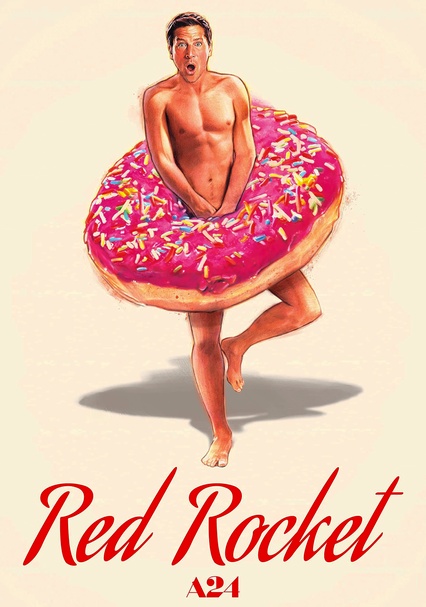
Red Rocket-2021

Red Rocket-2021

Director Sean Baker

Starring Simon Rex, Suzanna Son

Scott’s Review #1,277

Reviewed July 15, 2022

Grade: A-

Sean Baker has become a director I am intrigued by. Firmly planted in the independent circuit, recent films like Tangerine (2015) and The Florida Project (2017) offer a slice-of-life look at troubled or otherwise forgotten or discarded groups of people.

His works are fascinating and humanistic, admittedly skewing darker or daring avenues like the transgender community, the homeless, or, in the case of Red Rocket (2021), a former male porn star.

And while his characters may not always be likable, they are complex, requiring exploration and consideration.

There are also enough butts, boobs, and fornicating to remind us what the subject matter at hand is.

Baker has an incredible way of providing depth to the people considered dregs of society and a voice with a story to tell. He treats them like human beings, oftentimes using real people who are non-actors in pivotal roles.

This elevates the authenticity and realism to new heights, successfully getting his audience to empathize with the characters and see them as living beings with fears, thoughts, and emotions.

Mikey Saber (Simon Rex) is a charismatic con man and washed-up porn star who returns to rural southeast Texas to shack up with his depressed and estranged wife, Lexi (Bree Elrod).

He plots his triumphant return to Los Angeles and the porn industry after meeting a teenager named Strawberry (Suzanna Son) who works at the local donut shop. They connect and plot ways to escape their depressing small-town existence and enter the adult film world.

Like other Baker films, the city of Los Angeles is portrayed as a place of grandeur, where the characters’ lives are expected to improve. Mikey and Strawberry feel their destiny lies outside of the daily doldrums of their surroundings, and they are convinced their lives will change.

Red Rocket is a film about longing for a better life and being frustrated with the present. That’s a message many audiences can connect with.

Even though Rex and Son are successful with their lead roles, it’s the supporting characters who I found even more interesting. I liked Mikey and Strawberry, but never loved them together. What interested me was Mikey’s relationships with other characters.

Lexi and her mother are fascinating characters. It’s mentioned that before Mikey returned to town, Lexi would meet men on Craigslist to pay the rent. Along with her mother, Lil (Brenda Deiss), who smokes pot to ease some health pain, they exist in a dilapidated house.

Their neighbors, a black family, sell drugs to make ends meet and appear to do alright for themselves, respected around town.

I love how there is small-town harmony and the neighbors seem fond of each other, united with pleasantries. There’s a sense of having one’s back, and there is no mention of racism.

I adore these surface characters and long to know more about their stories. Of course, since Mikey and Strawberry are the core characters, there is not enough time to go into much detail.

Baker provides political overtones about American life that are both noticeable and depressing. News clips of former President Donald Trump boasting and pandering to his blue-collar base are included in various scenes.

A ‘Make America Great’ fixture covers the side of a building.

These points are oxymorons of what the characters’ lives are and always will be. They are poor and stuck, clinging to a false hope instilled in them by a crooked salesman turned politician who promised to make their lives great.

It’s heartbreaking and scary in its realism, and Baker makes his point clear without having to hammer it over the heads of the audience.

Red Rocket (2021) makes it a solid trifecta for Baker and his earlier works. With a sometimes brutal depiction of small-town life in poverty, he shows there is always hope and heart despite the many obstacles that many people continue to face.

Independent Spirit Award Nominations: 1 win-Best Male Lead-Simon Rex (won), Best Supporting Female-Suzanna Son

Young Adult-2011

Young Adult-2011

Director Jason Reitman 

Starring Charlize Theron, Patrick Wilson, Patton Oswalt

Scott’s Review #1,267

Reviewed June 17, 2022

Grade: A-

I am a big fan of Jason Reitman films.

Though classified as comedies, they lack the qualities I most dislike in many mainstream comedies: slapstick, formulaic, gag setups, and potty jokes, that feel completely staged and redundant.

Instead, he incorporates wry, sardonic humor, cynicism, and intelligence into his films that enhance the writing and make the characters’ motivations clear.

Most of his characters are damaged and unhappy, suffering from inner conflict or instability, but the result is witty humor providing laughs to those able to think outside the box and immerse themselves into the character’s heads.

Thanks to a brilliant screenplay by Diablo Cody the thoughts and conflicts of a female character take center stage.

Reitman’s best films are Juno (2007), Up in the Air (2009), and Young Adult (2011) right up there with the others providing a darker tone than especially Juno contained.

Along with Reitman and Cody is a terrific performance by Charlize Theron who rightfully should have received an Oscar nomination. This is tough to achieve with a comedy performance and she had to settle for a Golden Globe nomination instead.

Just looking at the movie poster for Young Adult reveals a lot about her character. With an annoyed and flabbergasted look, wearing pajamas, she immediately gives off the vibe of being slovenly, fed up, and looking for a fight.

Theron is great at playing take-no-prisoners, tough characters with a bit of edge and a no-bullshit attitude.

Mavis Gary (Theron) is a successful but frustrated writer of teen literature who realizes that her high school sweetheart Buddy Slade (Patrick Wilson) has just become a father with his wife Beth (Elizabeth Reaser).

Mavis decides to return to her small hometown and cause trouble.

She feels her life is getting away from her and she’d love to steal Buddy away from Beth and ride off into the sunset for presumed happiness. She also knows that life usually doesn’t work this way.

Mavis forms an unusual bond with a former classmate Matt (Patton Oswalt), who has also found it difficult to move past high school.

The two connect in the unlikeliest of ways since they didn’t exactly travel in the same circles during high school. Matt has his own powerful story since he was gay-bashed causing him to be permanently disabled.

Matt and Mavis are both relatable characters to most of the audience. Who hasn’t ruminated over their past life in high school? For some high schools are glorious years filled with memories of pep rallies, parties, and graduation.

For others, the mere thought conjures up memories of insecurity, moodiness, and awkward experiences. There can also be some of both for most people.

Mavis, Matt, and Buddy have each not closed out their high school chapters in different ways so the fun is seeing the feelings of each character come to the surface shrouded in conflict. With Matt and Mavis turning to all-night drinking binges eases their pain.

The best scene that showcases Mavis’s anger and Theron’s exceptional acting skills occurs at an outdoor party in celebration of naming Buddy’s daughter.

As the entire town is gathered on the front lawn Beth spills punch on Mavis’s dress causing Mavis to fly into a rage, insulting Beth, and finally confessing that she was once pregnant with Buddy’s child but had a miscarriage.

The hateful Mavis, the hurt Beth, and the embarrassment of the townspeople are on full display. The scene is wonderful and shows the cohesive value of the events to the rest of the story.

Reitman brings complexity to his characters in Young Adult (2011) and proves that dark comedy, especially character-driven, provides emotional power amid the laughs.

I love that the ending is ambiguous rather than wrapped up in a nice bow like too many comedies.

Thanks to wonderful acting, insightful writing, and wise direction, the film is well-remembered and undoubtedly a source of inspiration for upcoming comedy writers and directors.

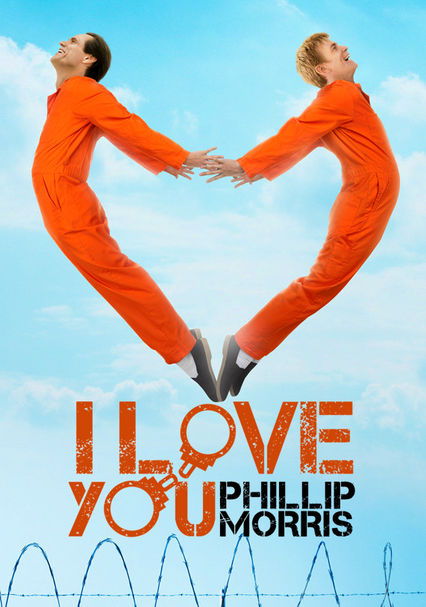
I Love You Phillip Morris-2009

I Love You Phillip Morris-2009

Director John Requa, Glenn Ficarra

Starring Jim Carey, Ewan McGregor

Scott’s Review #1,235

Reviewed March 5, 2022

Grade: A-

Easily the most daring and arguably the best film role of Jim Carey’s career, I Love You Phillip Morris (2009) is a delightful romantic comedy featuring same-sex characters in the central roles.

At the risk of being too fluffy, there is a sardonic and wry wittiness that I fell in love with.

Those criticizing the film as ‘gay porn’ are silly since there is hardly a sex scene to be critical of or anything more than would appear in a traditional male/female romantic comedy.

Prudes wouldn’t see a film as I Love You Phillip Morris anyway.

It is based on the 1980s and 1990s real-life story of Texas con artist, impostor, and multiple prison fugitive Steven Jay Russell who was clever beyond belief and successful at outwitting his opponents.

I Love You, Phillip Morris, is the directorial debut by John Requa and Glenn Ficarra who received a nomination from the Writers Guild of America Award for Best Adapted Screenplay.

Steven Russell  (Carrey) becomes a cop, gets married, and starts a family, but after a terrible car accident, he vows to be true to himself. Thus far in his life, he has played by the rules and done what is expected of him and because of the crash, he pivots to an emotional bloodletting.

The key irony is that Steven is telling the audience his story from his deathbed so most of the activity is in the past. This is the hook because it made me wonder how and why he died. But is there a twist?

He comes out of the closet, moves to Florida, and finances a luxurious lifestyle with bad checks and credit cards. Arrested and now in prison, Steven meets Phillip (Ewan McGregor), a mild-mannered inmate who becomes the love of his life.

Determined to build a beautiful life with his partner, Steven embarks on another crime spree.

The film caters to the LGBTQ+ audience but has a crossover appeal so that all audiences can enjoy it. This is in large part thanks to the screenwriters and whoever had Carey and McGregor in mind for the film.

Too often films centering around gay characters are deemed second fiddle and not profitable but with bigger stars, the audiences will come.

I Love You Phillip Morris is an independent film that builds momentum when the message is that big stars are comfortable in gay roles, something Heath Ledger and Jake Gyllenhaal taught us a few years earlier in Brokeback Mountain (2005).

Jim Carey, fabulous in The Mask from 1994, and having his share of hits and misses over the years, is perfect in the role of Steven. It’s the most interesting role he has portrayed since he gets to provide his usual physical humor in a role that matters.

LGBTQ+ audiences see a character who makes them laugh without the typical gay stereotypes.

Straight audiences will see a character whose sexual identity doesn’t matter to them.

Props go to McGregor as well who makes a perfect counterpart for Carey as the calm, cool, and collected ‘straight man’. The film could not have worked without him.

He meshes so well with Carey that the audience instantly roots for Steven and Phillip to ride off into the sunset despite being criminals.

The stereotypes are limited but the subject matter of AIDS, especially given the time in which the film is set, is given notice. This is a win and Requa and Ficarra are very careful not to teeter too close to the edge of doom and gloom while respecting the disease.

At its core, I Love You Phillip Morris (2009) is a romantic comedy, and the trials and tribulations of Steven and Phillip are told. I immediately fell in love with them and viewers will too.

It’s a film that feels fresh and alive with the exploration of character richness that is not easy to come by.

Election-1999

Election-1999

Director Alexander Payne

Starring Reese Witherspoon, Matthew Broderick

Scott’s Review #1,225

Reviewed January 30, 2022

Grade: A

Election is a 1999 black comedy film directed by Alexander Payne. He co-wrote the screenplay with Jim Taylor, and it’s based on Tom Perrotta’s 1998 novel of the same name.

Anyone film fan who knows Payne’s work can attest that they are noted for their dark humor and satirical depictions of contemporary American society. His best is About Schmidt (2002), Sideways (2004), and Nebraska (2013).

And Election ranks among his finest works.

The subject matter at hand this time out is politics and education with the familiar Payne setting of Omaha, Nebraska. Right smack in the middle of the American Heartland.

Only his second film, Election stars Reese Witherspoon in her breakthrough role that built momentum toward her becoming a superstar. She is utterly fantastic and this would rank as one of her best roles, if not the best.

And, no, that is not a slight against her iconic portrayal of Elle Woods in Legally Blonde (2001), which I love, but Tracy Flick gets my vote.

The film itself is a masterpiece and has become a cult classic. Payne takes a subject matter, a rivalry between a teacher and student, still considered somewhat taboo. He takes into question authority and tomfoolery and then spins everything around.

Jim McAllister (Matthew Broderick), is a straight-and-narrow, well-liked high school government teacher who notices that successful student Tracy Flick (Witherspoon) uses unethical tactics and manipulation to get exactly what she wants.

Since Jim believes that Tracy has ruined his friend’s marriage he already despises the girl. Though, could he also be in love with her?

When Tracy decides to run for school president, Jim feels that she will be a horrible influence on the student body. He convinces Paul (Chris Klein), a dull but popular student-athlete, to run against Tracy.

When she becomes aware of Jim’s secret involvement in the race, a bitter feud develops between teacher and student as they try to outsmart the other.

The writing in Election is brilliant. The audience may see Jim or Tracy as the villain or perhaps both. They resort to drastic machinations to get their way. Tracy wants to win at all costs while Jim becomes obsessed with ensuring that Tracy does not win.

I love the high school setting and the normal goodie two-shoes Jim resorting to ballot cheating and affairs to best his rival. Tracy is no better as she manipulates and conspires to win the election.

I also worry that the viewers who should see this film either won’t or won’t get the message that Payne is sending.

The editing is flawless and the quick cuts that allow each character a chance to narrate and share their perspective is a major win. We see each motivation and understand what makes each character tick-especially Jim and Tracy.

The acting is wonderful and enough praise cannot be reaped upon Witherspoon and Broderick for their sick and twisted performances. They each radiate desperation and dark comedy and delightful is the perkiness and drive that Witherspoon gives Tracy.

When she bakes cupcakes in the hopes of bribing her classmates for votes, this counterbalances Broderick’s angry and grizzled Jim. He is at war with a student and goes for the jugular instead of being the role model a teacher should be.

It’s delightfully fun though many high school teachers may not appreciate the deviousness.

There’s also a cool LGBTQ+ inclusion which is a positive.

I’d venture to compare Election to American Beauty (1999), made the same year and with a similar tone. Cynical and witty, they both question morality and ethics, especially with the sugar coating of a high school or small-town Americana.

Satire never looked finer in both films.

Made in 1999, how dubious the realization is that Election continues to have relevance as time goes by.

In the current state of United States politics where lying, cheating, and a blatant refusal to accept election results unless one side is the victor is running rampant, and shockingly tolerated by some, Payne’s message has never been more powerful.

Oscar Nominations: Best Adapted Screenplay

Independent Spirit Award Nominations: 3 wins-Best Feature (won), Best Direction-Alexander Payne (won), Best Screenplay (won), Best Female Lead-Reese Witherspoon, Best Debut Performance-Jessica Campbell

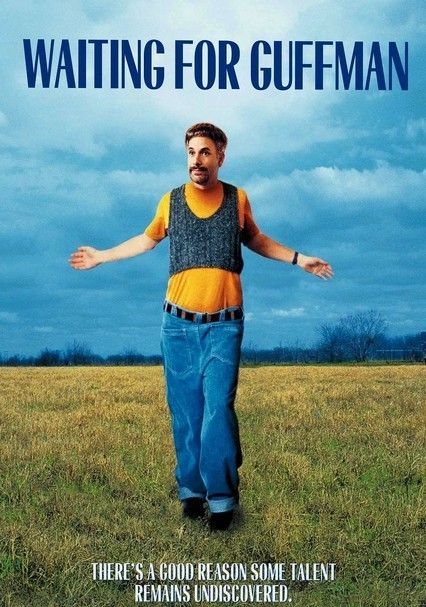
Waiting for Guffman-1996

Waiting for Guffman-1996

Director Christopher Guest

Starring Christopher Guest, Eugene Levy, Catherine O’Hara

Scott’s Review #1,145

Reviewed May 24, 2021

Grade: B+

Somehow mocking local community theater troupes with questionable talent couldn’t be funnier with the right premise and an outstanding cast.

The added fun of midwestern traditions like barbeques good manners and spot-on imitations put on display for humor works well.

They should be celebrated and appreciated in Waiting for Guffman (1996).

The hysterical Best in Show (2000) is probably my favorite Christopher Guest film but Waiting for Guffman is a hoot and hollering good time.

The ‘B+’ rating comes largely because Guffman is an opening act to the fab Best in Show. They can easily be watched back to back and perhaps should for further cherishing.

When the town of Blaine, Missouri approaches its sesquicentennial, the residents decide to celebrate by performing a musical revue called “Red, White, and Blaine.”

Flamboyant director Corky St. Clair (Christopher Guest) is determined to return to Broadway success by casting untalented but passionate individuals to perform.

Eugene Levy, Fred Willard, and Catherine O’Hara play the main cast members.

When Corky reveals that influential theater agent Mort Guffman will attend the opening, the cast is convinced that they will be rewarded with accolades and appearances on the Broadway stage if they perform successfully.

They become titillated, flustered, and manic as the pressure of opening night approaches.

I daresay, some folks from the midwest United States or those faithful to the local theater may not enjoy Wating for Guffman but I sure did. Most of the characters are written as buffoons and lacking any talent.

The hysterics come because they think that they possess what they lack.

The aforementioned Guest, Levy, Willard, and O’Hara work so well together they are the reason Waiting for Guffman is so damned funny! The comic timing between the actors is flawless and timed perfectly.

Levy and O’Hara appeared together in the Canadian television sketch comedy series SCTV in the 1970s and 1980s before hitting the jackpot with the television series Schitt’s Creek in later years so a fun thing to do is watch them in whatever they appear in together.

They are that good!

There abound many stereotypes in Waiting for Guffman since Corky is written as a walking gay stereotype with mascara and flamboyancy. The irony is that he reportedly has a wife who is never seen so the audience can draw their conclusions.

Given the casting and the director, Christopher Guest takes on acting and directing duties, the experience is largely improvisational and witty result.

Guest treats his actors, and himself, to famous Director Robert Altman’s mantra of letting his actors release and act on their terms, presumably knowing the characters better than anyone else.

The tactic works. Too often comedies are stagey and situations forced in an attempt to make the viewer laugh because he or she thinks they are supposed to laugh.

My favorite characters unsurprisingly are Ron and Sheila Albertson (Willard and O’Hara) as travel agents/amateur performers. They are zany and unpredictable and their antics cannot be superseded by anyone else.

Recommended mostly for the artistic and the improv comedy crowd. The spoofs are all over the place and fans of documentaries and talent shows can appreciate the gags.

Waiting for Guffman (1996) targets an intelligent audience craving fresh and original comedy. Being a cinema fan largely immersed in drama and horror, I was won over nonetheless.

The only drawback is the film pales in comparison to the brilliant Best in Show (2000) with largely the same cast and tone, but still should be watched.

Promising Young Woman-2020

Promising Young Woman-2020

Director Emerald Fennell

Starring Carey Mulligan, Bo Burnham

Scott’s Review #1,132

Reviewed April 13, 2021

Grade: A

Emerald Fennell, making her film directorial debut, kicks her viewers in the ass with significant help from star Carey Mulligan, with Promising Young Woman (2020).

The actress gives the best performance of her career.

The film is a sexy and haunting experience, mixing black comedy and witty dialogue with an important and timely subject matter- the abuse and victimization of young women by men.

Both men and women can be held responsible, as Fennell makes abundantly clear. Predators often have a share of people who choose to “look the other way” and thereby enable.

This is a constant theme throughout the film involving many characters who are called out for their passivity.

Fennell makes this point during two of the film’s most compelling scenes, calling out a high-powered dean and attorney for their betrayals. The scenes are so powerful that I wanted the characters to suffer as much as the revenge seeker does.

There is also a wackiness in the pacing and dialogue that reminds me quite a bit of the 1999 masterpiece, American Beauty.

The film is depravity, bizarreness, and brilliance all rolled into one. I felt this film in my bones.

Almost every scene is a treat in the mysterious and unexpected, and the film features peculiar characters and creative musical score renditions, and includes a scene and music from the underappreciated masterpiece The Night of the Hunter (1955). Fennell knows her classic cinema.

Mulligan stars as a woman named Cassie who seeks to avenge the death of her best friend, who was a victim of rape when they were in medical school, and their young lives had potential, and such possibility lay ahead of them.

Cleverly, we never see her friend, named Nina Fisher, but she is of vital importance and nearly a central character herself despite her absence.

Everyone said Cassie was a “promising young woman” until a mysterious event abruptly derailed her future. But now, at thirty and still living at home, her parents suggest, via a giant suitcase for her birthday, that it may be time for her to move on.

Cassie is tough to figure out since she’s wickedly clever, sometimes wisecracking, and tantalizingly cunning, and she’s living a secret double life by night. She goes to nightclubs looking drop-dead gorgeous and lures men to her rescue, pretending to be inebriated.

What happens when they go back to their pad is shocking, dark, and justified. The men will never see this coming.

Before the presumption is that Cassie is nothing more than a bad-ass, her intentions are not only admirable, but she has a heart and desires love. Promising Young Woman is a dark character study.

Besides the powerful story, Promising Young Woman is riddled with interesting cinematic techniques. Cassie’s parents lounge in their afternoon, watching The Night of the Hunter, a dark fairy tale for adults.

Later, a haunting version of Britney Spears “I’m a Slave 4 U”, complete with a string arrangement, is featured most uniquely.

All the supporting players add pizzazz and strength, some in odd or unclear ways, until certain revelations bubble to the surface.

Jennifer Coolidge as Cassie’s strange mother, Bo Burnham as the smitten Ryan Cooper, and Alison Brie as Cassie’s college friend Madison McPhee are the best examples.

Bo and Madison have the most to hide, but will they or won’t they face Cassie’s wrath? Not much is worse than a woman scorned.

But the main draw is Mulligan. Startlingly good, with an astonishingly powerful, deeply layered performance by her. She showcases a remarkable acting range, effortlessly shifting from brash to darkly humorous and, at times, emotionally vulnerable in her best performance to date.

Two scenes stand out to me.

The first is a delicious scene between Cassie and the female dean of her school, played by Connie Britton. At first dismissive and annoyed by Cassie’s accusations, Dean Elizabeth Walker finally takes notice when she believes that Cassie had kidnapped her teenage daughter and left her with a group of drunken frat boys. What comes around goes around!

The second is the finale wedding scene, interestingly not featuring Cassie other than by text messages. As the happy young couple says their vows a parade of police cars ruins the moment and the audience cheers victory. It’s a satisfying moment.

The screenplay is original, fresh, and timely. In the “Me Too” movement, the timing is vital and makes the subject matter relevant. Fennell wrote the screenplay- is there anything she can’t do?

Promising Young Woman (2020) is an exceptional film. It’s a controversial revenge film, but it’s so much more. Taking a powerful subject matter and examining the hypocrisy of men and women is telling and eye-opening.

That is why this film is critical to see and brings awareness to a situation that society still too often deems as okay.

Oscar Nominations: 1 win-Best Picture, Best Director-Emerald Fennell, Best Actress-Carey Mulligan, Best Original Screenplay (won), Best Film Editing

Independent Spirit Award Nominations: 2 wins-Best Director-Emerald Fennell, Best Female Lead- Carey Mulligan (won), Best Screenplay (won)

Year of the Dog-2007

Year of the Dog-2007

Director Mike White

Starring Molly Shannon, John C. Reilly

Scott’s Review #1,131

Reviewed April 9, 2021

Grade: B-

Comedienne, Molly Shannon stars in Year of the Dog (2007), a quirky independent film that can be classified as a hybrid of the comedy and drama genres.

It’s peculiar, sometimes being very creative and nuanced while other times feeling generic and clichéd. Somehow it’s not predictable either- a plus.

It’s not the cute, sentimental film the premise might lead one to believe and at times it’s downright dark and depressing.

A story centering around dogs seems pretty cool but it usually conjures up a pitifully dreary family-style affair with a husband, wife, two cookie-cutter kids (a boy and girl naturally), and some story and drama involving the family pet. And, of course, a happy ending.

Thankfully, Year of the Dog bears little resemblance to that type of film.

While it could have been more cohesive and less messy, the film deals with pet death in the most interesting ways and the effort is there. While it’s not a downer it’s not cheery either.

After her beloved beagle, Pencil dies unexpectedly when she lets it stay outside all night, an administrative assistant named Peggy (Shannon) strives to find ways to fill the void in her life while blaming herself for his death.

She becomes lonely and despondent, finally bringing in treats for her co-workers and fussing over other people’s kids. An ill-advised love affair with a gun fanatic (John C. Reilly) leads to more misery causing Peggy to go off the deep end and change her life completely.

Shannon, unsurprisingly, is the best part of the film, though she doesn’t quite cut it as the lead. She is cast perfectly as the odd-ball secretary with no life outside of her pet dog, but isn’t she better as the interesting sidekick?

It’s tough to imagine another actress being as believable in the part and her comic timing is on fire. The dramatic parts are a bit of a stretch and I like her in comedic situations better.

The supporting characters are where Year of the Dog lacks. None of them are very interesting.

Laura Dern and Regina King are reduced to caricature types as the loyal best friend, Layla, and the cold sister-in-law, Bret, respectively. Layla is only interested in finding romance for lonely Peggy while Bret barely notices Peggy’s suffering.

Yawn!

Characters like these occur so often in stock comedies that I can hardly keep count. Talents like Dern and King deserve better than one-note characters.

Reilly, as the intended love interest, has no chemistry with Shannon and it’s obvious from the start that Al is written as the foil and opposite in every way from Peggy.

It’s just another standard cliché screaming from a mile away. Peggy dates Newt (Peter Sarsgaard) but the romance isn’t there either.

Where the film gets both interesting and lost, is when Peggy becomes an animal rights activist. It sets up Year of the Dog as a message film which never really works.

Peggy ruins furs, attempts to show children a slaughterhouse, and spontaneously adopts fifteen dogs because another injured dog dies.

It just doesn’t flow together with the comedy stuff. Especially when the ending takes Peggy in yet another direction.

It’s like the filmmakers decided to try and roll things up in a neat little bow but instead have a sloppily wrapped present with a nice bow on it.

Director, Mike White, also a producer and writer, creates a great concept but Year of the Dog (2007) hardly lights the world on fire.  The finale is too sentimental and too many cliches surface as the action plays out. Shannon is the only interesting character and the supporting players are stock written.

White also penned School of Rock (2003) which is a better film.

Tadpole-2002

Tadpole-2002

Director Gary Winick

Starring Sigourney Weaver, Aaron Stanford, John Ritter

Scott’s Review #1,125

Reviewed March 23, 2021

Grade: B

Tadpole (2002) is an enjoyable coming-of-age effort that carefully, or too carefully, toes the line between being cute and exploring some morally questionable material.

The film gets away with the naughty subject matter because there exists a wholesomeness that lands somewhere between fresh and a commodity.

It’s a fun romp but nothing memorable either, borrowing from better films.

Aaron Stanford, the lead actor, makes the film better than it might have been and seamlessly matches wits and comic timing with heavyweight actors like Sigourney Weaver, John Ritter, and Bebe Neuwirth. He is charming just like his character and carries the film.

As Oscar Grubman (what a name!) he is compassionate and sophisticated, reciting Voltaire and speaking fluent French.

When he arrives home for Thanksgiving weekend it is revealed that he has a major crush on his stepmother, Eve (Weaver). She and Oscar’s father, Stanley (Ritter) share a ritzy Manhattan apartment and entertain a girl they think would be perfect for Oscar but he only has eyes for Eve and rebuffs the poor girl.

Despondent at not having a chance with his stepmom but desiring her, Oscar visits a local bar and runs into Eve’s best friend, Diane (Neuwirth). He gets drunk and she takes him home winding up in bed together! Oscar is filled with remorse.

Oscar’s and Diane’s tryst is the caveat for the rest of the antics of the film. Oscar is terrified that Diane will tell his father and Eve especially as she is on the guestlist for dinner the next night!  An amusing game of footsie under the table ensues between Oscar and Diane.

Diane is a Mrs. Robinson-type character to Oscar’s Benjamin if we want to draw comparisons to The Graduate (1967) and how could we not? Eve is like Elaine, Mrs. Robinson’s daughter.

Unsuspecting and slightly naive. It’s fun to reminisce about the classic film that director Gary Winick borrows from.

Speaking of Winick, he has a knack for creating coming-of-age stories featuring teenage characters with light angst and he commonly releases independent films. My hunch is that if Tadpole was a big-budget mainstream affair even more concessions might have been made for the brewing May/December romance.

The “dinner scene” is the best part of Tadpole and provides good physical comedy and a hilarious setup. It’s a stretch in plausibility and borrows from many slapstick comedies but somehow the scene works well and stands out.

The subject matter of a woman three times the age of Oscar is not as harsh as it sounds and is largely played for laughs and misunderstandings. This is where the film misses the mark and stays firmly in the safe lane.

Imagine the juicy possibilities that would occur if Eve reciprocated Oscar’s advances. Now that is an interesting concept!

I shudder to think that if Oscar were a fifteen-year-old girl and Eve a forty-something-year-old man this film would never have been made.

The double standard gnawed at me.

The ending is wholesome and predictable making the film satisfying for the character yet limiting for the viewer. Oscar more or less “snaps out of it” and realizes that girls his age are okay after all.

I half-wondered if the film would be revealed to have all been Oscar’s dream.

The cougar-esque subject matter provides light entertainment never daring to go as far as it could have, or should have. In the end, we understand a young, pubescent boy’s dreams and desires and may fondly recall when we were his age and all the troublesome sexual feelings that bubbled under the surface.

Tadpole (2002) is a watchable independent comedy providing enough to digest thanks to the worthy actors among its cast.

Saint Ralph-2004

Saint Ralph-2004

Director Michael McGowan

Starring Adam Butcher, Campbell Scott

Scott’s Review #1,118

Reviewed March 3, 2021

Grade: C

Saint Ralph (2004) is an indie drama that is overly sentimental with too many added standard plot points.  This makes the film ho-hum and extremely cliched. It feels like the attempt was to create a major studio film in independent clothes but without the grit afforded most indies.

There are plenty of ordinary setups and by the numbers, follow-through over anything different or fresh.

The film is too charming and safe for my tastes and is too feel-good. Maybe there are just too many similar types of movies made that it doesn’t stand out very well.

And since it’s an indie shouldn’t it strive for more edginess?

The message is meant to inspire and in a way it does but that only goes so far.

Saint Ralph is a story of a young man triumphing over insurmountable odds- wonderful but unrealistic. The religious elements of faith, miracles, and the Catholic high school are lost on me but some may champion those elements better.

I did enjoy the 1950s time-period and its share of decade trimmings and set pieces yet too often they feel stagey and any authenticity doesn’t feel fresh. Rather, like actors clad in period clothing.

The lead kid who plays Ralph (Adam Butcher) isn’t impressive enough though Campbell Scott who plays a priest with more wisdom than he probably should have is the best thing about Saint Ralph.

If I’m being harsh it’s unintentional but Saint Ralph is a film I’ve forgotten about a day or so after seeing it. I like a film that sticks with me and makes me think about and Saint Ralph just ain’t it.

It’s classified as a tear-jerker and I didn’t shed one.

Ralph is a troubled kid. His father has died in World War II and his mother lies ill in a coma. He smokes and masturbates resulting in adult intervention by way of strict Father Fitzpatrick (Gordon Pinsent) and kindly Father Hibbert (Campbell Scott).

He is encouraged to run in the upcoming Boston Marathon and he trains mightily with the right encouragement.

He feels if he trains hard and wins the marathon his mother will be granted a miracle by God, wake up from her coma, and live happily ever after. I won’t spoil the ending but the conclusion will satisfy pious audiences.

I embrace films that feature a character championing certain hardships and Saint Ralph does contain a youthful innocence and earnestness that holds some appeal. I felt myself rooting for him to overcome his problems. No kid deserves those hardships.

The weakness is that I felt manipulated. Since the intention was to root for Ralph it was clear what direction the film was going in and the predictability was at an all-time high.

The training sequences are reminiscent of any sports film. Think of a young Rocky Balboa training for an upcoming fight. And the saccharine ending is riddled with predictability.

Saint Ralph (2004) will ruffle no feathers and only appeal to mainstream audiences seeking safe cinema. Most people will not remember it very well.

Booksmart-2019

Booksmart-2019

Director Olivia Wilde

Starring Beanie Feldstein, Kaitlyn Dever

Scott’s Review #1,113

Reviewed February 17, 2021

Grade: A-

I usually avoid teenage coming-of-age comedies, or more to the point, being not of that demographic, they are not usually even on my radar.

The only reason I saw Booksmart (2019) is for the Independent Spirit Award it won and the Golden Globe nomination it achieved. Still, I was skeptical of what the appeal of two female teenage bookworms who decide to become party animals would have on me.

Boy, was I wrong? The film is a fabulous and fast-paced experience that I enjoyed immensely.

Director Olivia Wilde, in her very first effort, delivers the goods, believe it or not. She takes a genre told to death and knocks it on its keister, offering a fresh and creative spin on a tried-and-true formula that feels anything but formulaic.

There is diversity, inclusiveness, and heart for miles without the feeling that these add-ons were done intentionally for a modern spin.

Before I get carried away too much Wilde carefully keeps the standard moments of teenage angst, rejection, breakups, and makeups, and there are one or two of the commonplace high school “types”- loner, jock, weirdo, etc. but evident is a strong LGBTQ+ stronghold including one of the leading female characters. Booksmart sure feels authentic to me.

Molly (Beanie Feldstein) and Amy are forever friends.

The girls study, they giggle, they hang out, and they share their problems, both sexual and otherwise, with each other. The kicker is that Molly is straight and Amy is gay. Amy is happily “out” and nobody gives a damn.

Her parents, played in small but juicy parts by Will Forte and Lisa Kudrow, are hilarious and progressive in their approach to understanding a gay child. They incorrectly assume that Molly and Amy are a couple, which the girls use to their advantage.

Anyway, Amy and Molly are intelligent and look forward to graduation day and attending great schools. Once they realize that their fellow students who, in their minds, slack off and party, are also going off to Ivy League schools, they panic.

They realize they have wasted four years studying and decide to finally let their hair down the night before graduation, intent on attending a popular boy’s (and Molly’s crush) party.

The situations the duo get themselves into are clever and witty, and the most fun in the film. Feldstein and Dever have exceptional chemistry, and I bought them as best friends from the moment of their first scene.

When they have a knock-down, drag-out argument towards the end of the film, it’s acting at its finest, which made me feel proud.

I admire young talent with great acting chops and pride in their craft, and Feldstein and Dever both have it.

Wilde peppers much of the film with hip and trendy pop songs that surprisingly enhance rather than detract from the viewer’s enjoyment. The lyrics match the specific events of the particular scene.

The romanticism is pivotal as the crushes Molly and Amy have are not necessarily who they wind up with at the end of the film, which naturally culminates on graduation day. I love how their ceremony includes no parents.

The creativity within Booksmart is admirable.

When Molly and Amy trip on a hallucinogen, they accidentally imagine they are Barbie dolls. The scene is laden with hilarity as they bend, twist, and turn. Later, Molly imagines a dance with Nick amid a colorful, slow-motion sequence that is beautiful, while Amy has an awkward, unexpected sexual experience with a mean girl.

Booksmart (2019) is quite R-rated, almost shockingly so, which is not a negative. It’s a positive. Too many films of this ilk try to soften how teenagers speak and the feelings they have, which are usually sexual.

It’s raunchy and not for the younger teen set, but mature audiences will reminisce about their high school days.

Independent Spirit Award Nominations: 1 win-Best First Feature (won)

Calendar Girls-2003

Calendar Girls-2003

Director Nigel Cole

Starring Helen Mirren, Julie Walters, Penelope Wilton

Scott’s Review #1,090

Reviewed December 11, 2020

Grade: B+

A clever female version of The Full Monty (1997), the middle-aged bordering on senior citizen characters, nudity comparisons notwithstanding, Calendar Girls (2003) has standard similarities.

The film is a light-hearted affair, charming and fun with positive and inspiring messages about friendship and helping with cancer research.

How can a film like this not bring a smile to the viewer’s face? It did to mine.

That said, it’s hardly high drama or material that requires much thought or dissection. I’d wager to say you only need to see it once. There lies a situational or clichéd theme as the women face the standard and guessable awkward moments, but the film entertains in style.

Calendar Girls is based on a true story adding merit, appreciation, and an endearing quality. It’s a feel-good film if there ever was one which is just fine in this case.

The film was a box-office smash, and why not? It’s a comically robust experience.

A likable group of “women of a certain age” conspire to launch a calendar, bearing their best assets for all to see. Before this sounds too scandalous or corny, the ladies do it for a good cause and not for any titillating pleasure.

The women are British and, while attractive, are average-looking gals with womanly figures. These tidbits lead to humorous and embarrassing situations as some of the women are more modest than others, especially parallel to the conservative and crusty town they live in.

This leads to shocks among the prudish townspeople.

Chris (Helen Mirren) and Annie (Julie Walters) are best friends. When Annie’s husband dies of leukemia, they conjure up the idea of creating a nude calendar, where women pose while doing traditional duties like baking and knitting. The proceeds will go to research for the deadly disease.

Unexpectedly, Chris and Annie, along with others from the Women’s Institute in which they are members, achieved worldwide success even invited to Los Angeles to appear on television’s The Tonight Show with Jay Leno.

The women clash due to their success and differing lifestyle directions, before reconciling and deciding that their ordinary lives aren’t so bad. They happily resume their nice lives away from the spotlight.

The comparisons to The Full Monty (1997) must be mentioned because they are obvious. Whereas the men in The Full Monty strip on stage, the women prefer more modesty, nestled behind calendars for safety, but both groups hail from the English countryside and are regular folk.

Since nudity is the word of the day, both groups possess average bodies and champion worthy causes. Like it or not, this setup produces giggles.

The “calendar girls” are a relatable group that is a marketing genius and allows the film to achieve much merit. Who would care if a bunch of supermodels posed nude while baking cookies?

No, the everywoman factor is sky-high, allowing the film to be appreciated and savored.

Because Mirren and Walters, two respected British actresses appear in Calendar Girls, there is an added respectability.

After all, would either choose a project less than credible? The obvious answer is they make the film better than it might have been. Penelope Wilton does too.

There is a classiness the ladies bring so that we can sink into our theater seats and revel in the good-natured comedy, assuring ourselves we are seeing something of quality too.

Calendar Girls (2003) is so like The Full Monty that they ought to be watched back to back. Perhaps a naughty night in, with a bottle of wine and some cheese, ready to embark on delights and jolly laughs.

After Hours-1985

After Hours-1985

Director Martin Scorsese

Starring Griffin Dunne, Rosanna Arquette

Scott’s Review #1,069

Reviewed October 9, 2020

Grade: A-

After Hours (1985) is a gem of a film.

When thoughts of director Martin Scorsese are conjured, Taxi Driver (1976), Raging Bull (1980), or Goodfellas (1993) are films that immediately spring to mind.

Scorsese’s decision to create a pared-down independent film was met with enormous success and accolades for the very first Best Feature indie film victory and Best Director honors.

The experience is a black comedy set within the gritty and unpredictable underbelly of Soho-New York City in the 1980s.

Mixing comedy with satire, Scorsese leapfrogs from similar content in The King of Comedy (1983) to this film made only two years later.

Any fan of New York City will cheer with joy at the authenticity achieved since the film was shot on location there. The Big Apple in the 1980s was a notoriously violent cesspool so the genuine setting and the use of dark streets and alleys is an immeasurable treat and adds much zest to this unusual film.

A nice guy, Paul Hackett (Griffin Dunne), works hard as a computer data entry worker by day and shares an encounter with a quirky young woman named Marcy Franklin (Rosanna Arquette) in a Manhattan coffee shop.

After she gives him her number and leaves, he is unable to stop thinking about her and embarks on a late-night adventure to go and see her at her apartment.

The night does not end how he thinks it will. Not by a long shot, as he spends the rest of the long night meeting various women and other strange characters as he traverses around the city attempting to get back home. He has lost his money and is broke.

The great aspects of After Hours are its bizarre characters and the cinematography that offers a tantalizing view of downtown Manhattan. The film is atmospheric and zany in its gloomy and steamy side streets and odd locales sprinkled with color.

A dingy bar, a sophisticated artist’s apartment, and a man sculpture that follows Paul everywhere are usurped by the film’s strangest and most interesting set, Club Berlin, an “after-hours” club inhabited by punks who want to shave Paul’s head into a mohawk.

I enjoyed this film as a sort of “A Day in the Life of Paul” adventure story, albeit a gothic one. The film concludes wonderfully as the sun begins to rise just as the film ends and thus Paul’s wild night finally ends.

I was chomping at the bit with the thought of what a new morning would bring and the possibilities of reuniting with any of the women he encountered the night before, either dead or alive.

Particularly charming to me while watching After Hours, the decade of decadence well into the past, are the relics once commonplace in everyday life. A phone booth, the traditional yellow cabs, and desktop personal computers are heavily featured.

These items, relevant when the film was made, now seem like throwback niceties that make the film endearing and like a glimpse into someone’s time capsule.

I did not pick up on much authentic romance between Paul or any of the female characters- Marcy, June, Gail (Catherine O’Hara), or Julie (Teri Garr), but maybe that’s the point. While one winds up dead, not one, but two of them pursue him, and not in a good way.

The film is mystical, weird, and energetic. The inclusion of Cheech & Chong only adds to the revelry.

Sadly, underappreciated and too often forgotten, After Hours (1985) is a Scorsese treat worth dusting off now and then. The birth of the Independent Spirit Awards has a lot to owe to this film for grabbing top honors and the admiration works both ways.

For a glimpse at the creative genius that is Martin Scorsese, this film gets an enormous recommendation.

Independent Spirit Award Nominations: 2 wins-Best Feature (won), Best Director-Martin Scorsese (won), Best Female Lead-Rosanna Arquette, Best Screenplay, Best Cinematography