Category Archives: Hag Horror

Berserk! -1968

Berserk! -1968

Director Jim O’Connolly

Starring Joan Crawford

Scott’s Review #1,534
Reviewed May 25, 2026

Grade: B

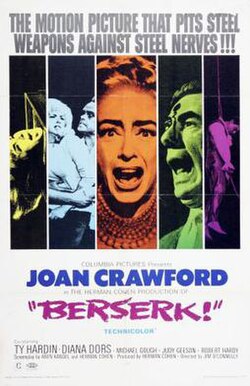
Joan Crawford, legendary Hollywood screen star, appears in Berserk! (1968), a British horror-thriller vehicle that was one of her last roles.

Trog (1970) was her final film role.

She portrays Monica Rivers, a ringmistress of a traveling circus in the London area. Monica is no-nonsense and man-hungry, known to bed some of the talent as she confidently hunts her prey.

As the co-owner of the circus, Monica is always preoccupied with filling seats and making money, a bottom-line gal.

Following the suspicious ‘accidental’ death of a tightrope walker, Rivers is pleased to see her profits increase because of the drama. She soon hires handsome Frank Hawkins (Ty Hardin) to replace him.

But when performers start to meet gruesome deaths, it becomes apparent that a killer is on the loose. Monica must juggle pesky detectives lurking around with accusations that she may be the killer.

While I enjoyed the film, which serves as a compelling whodunit first and foremost, not to mention Crawford’s appeal, it is only moderately above mediocre.

As expected, Crawford leads the charge and gives the project her best effort. Deliciously callous and self-serving, the role of Monica is one Crawford can sink her teeth into as unsympathetic as she is.

Her many outfits are glamorous, especially given the circus setting, and her cigarette smoking, nearly a trademark, makes her look powerful.

An aging star, her romantic pairing with Hardin, young and muscular, is borderline silly since she could easily be his grandmother. Weirdly, in a couple of scenes with him, Crawford looks much older and more ragged than in other scenes, while Hardin is bare-chested and buff.

There is little chemistry between the two.

The whodunit works well, as a myriad of suspects have both the cause and the motivation for the killings.

Monica, Frank, performer Matilda (Diana Dors), and others are suspects.

A colorful yet dark circus setting is wonderful in any horror film. The peculiar yet stereotypical characters, such as the strongman, the bearded lady, and others, are incorporated, as are scenes of characters following one another or lurking in the shadows.

The mostly nighttime scenes work well.

The final reveal of the killer is startling and surprising, which greatly improves the film. There is satisfaction when a viewer is genuinely surprised by a whodunit rather than having guessed the killer from the start.

However, the killer’s motivations are lackluster and hard to believe. The sequence is also very rushed and wrapped within five minutes of screentime.

Rather than systematically kill victims off one by one, the killer might have had a sit-down conversation over tea to flesh out the issues that are the motivation for the murders.

Another perplexity is Crawford’s lack of a British accent. Having grown up in England and with the circus in her family for 50 years, Monica wouldn’t be American.

While a real circus was used for the myriad scenes involving elephants, dog performers, and others, director Jim O’Connell overdoes it to the detriment of the action.

The scenes are cute, but they slow down the plot.

Berserk! (1968) is a watchable effort largely due to Crawford’s stunning screen presence and a solid whodunit. It is hardly on her greatest-hits film reel, but it is not disastrous either.

What Ever Happened to Baby Jane?-1962

What Ever Happened to Baby Jane? -1962

Director Robert Aldrich

Starring Bette Davis, Joan Crawford

Top 250 Films #68

Top 40 Horror Films #16

Scott’s Review #193

70048556

Reviewed November 14, 2014

Grade: A

Baby Jane kicked off a trend, prominent throughout the 1960s, of aging Hollywood actresses starring in horror films (interestingly, Bette Davis and Joan Crawford each did two—the others being Dead Ringer and Strait-Jacket), with varying degrees of success.

What Ever Happened to Baby Jane (1962), directed by Robert Aldrich, stars Davis and Crawford as, ironically enough, two aging Hollywood actresses, Jane and Blanche Hudson.

Jane (Davis), a child star in the 1920s nicknamed Baby Jane, with an adorable signature song, “I’ve Written a Letter to Daddy,” has long since faded from the spotlight but continues to dress in her Baby Jane costume, consisting of a little girl dress with hair in curls and ribbons.

Blanche, however, achieved success as an adult in the 1930s until a tragic accident left her wheelchair-bound and subsequently ruined her career. She then became a popular film star, much more popular than Jane.

Blanche and Jane now while away the years in a crumbling mansion in Los Angeles. Blanche is entirely dependent on her unbalanced sister for care. Jane is resentful of Blanche’s success and popularity and plans to relaunch her career in her once-famous alter ego.

The film has macabre comedic elements but never veers too far over the edge into camp or foolishness. It is also a very psychological film, as Jane mentally abuses Blanche and plays mind games with her to gain the upper hand.

Davis had a ball with this role, as her appearance alone is frightful – a grown woman of a certain age in blonde curls, pancake makeup, and a baby doll dress – she looks hideous!

What Ever Happened to Baby Jane reminds me quite a bit of Billy Wilder’s masterpiece Sunset Boulevard in several ways. For example, both feature successful stars of years past with delusions of returning to their former fame, both feature older women who are more than a bit unbalanced, and both films are set in sunny Los Angeles.

Two of the film’s supporting actors are well cast, adding significantly to the film, and deserve recognition. Victor Buono, later made famous for his role of King Tut in the popular late 1960s television series Batman, is highly effective as the opportunist sloth, Edwin Flagg, who aids Jane in her comeback attempt.

Maidie Norman as the Hudson sisters’ black housekeeper, Elvira, loyal to Blanche but never a fan of Jane’s, slowly becomes wise to Jane’s sinister plot and does a fantastic acting job when she stands up to the manipulative sister- for 1962, a black maid verbally assaulting a white woman employer was still somewhat taboo and kudos to the film for bravely going there is a highly effective scene.

The fact that Davis and Crawford famously despised each other in real life gives the audience an edge in scenes where the two women physically and verbally clash.

The film features wonderfully quotable dialogue. “We got rats in the cellar,” Jane utters matter-of-factly as she serves Blanche a cooked rat on a bed of lettuce for lunch one day, and cackles fiendishly when she hears Blanche scream in disgust.

One aspect of the film that has taken me three viewings to become aware of and that I love is the musical score throughout the film- it features multiple and creepy versions of Jane’s signature song, “I’ve Written a Letter to Daddy,” with varying tempos.

This film must use suspension of disbelief. Why does Blanche not pound and scream at her bedroom window to alert the neighbor of trouble instead of casually tossing a note out the window?

Blanche struggles to descend the steps by sliding down them and then cannot slide across the floor to escape the mansion, which is silly. The film is so gripping that I happily overlook these errors and instead enjoy the suspenseful film, which features two actresses, rivals both on and off-screen, that make this film a bit too realistic —a realism that makes for delightful film-watching.

Oscar Nominations: 1 win-Best Actress-Bette Davis, Best Supporting Actor-Victor Buono, Best Sound, Best Cinematography, Black-and-White, Best Costume Design, Black-and-White (won)