Bus Stop-1956

Bus Stop-1956

Director Joshua Logan

Starring Marilyn Monroe, Don Murray

Scott’s Review #400

60004539

Reviewed April 30, 2016

Grade: C

Bus Stop is a 1956 film starring Marilyn Monroe that, while surprisingly ranking as one of her best roles, is one of her worst films in my opinion and, at present times, feels dated, chauvinistic, and diminishing to women.

Perhaps perceived as romantic and cute in 1956, times have changed, and the film no longer has the charm it undoubtedly must have had decades ago.

The film is based on a play by William Inge and, remarkably, is Monroe’s first full-fledged dramatic performance. She plays a nightclub performer named Cherie or mispronounced “cherry” by her love interest, Beau, an immature, naïve, socially inept cowboy, unfamiliar with women, and looking for his “angel”.

He is accompanied by his friend and father figure, Virgil.

Together, they travel by bus for a rodeo from Montana to Phoenix, Arizona. Once Beau meets Cherie, he conquers and marries her despite her resistance to his pursuits.

As a fan of Monroe’s more familiar works- Gentlemen Prefer Blondes (1953) and How To Marry A Millionaire (1953), it is nice to see her in a dramatic role, giving her some nice range and meatier material to tackle.

In 1956, she still looked marvelous, and the sexy nightclub outfit she wore while prancing around in the film worked well.

While Monroe will never be accused of being the most excellent actress in the world, her performance in this film is to be praised. She expresses some lovely emotions. Unfortunately, the character is poorly written, but Monroe gives it the old college try.

Another positive aspect of the film is that of the supporting cast.

Bus stop owner Grace (Betty Field), who has a suggested affair with the bus driver (Robert Bray), is a delight and nearly steals the show! I found their limited screen time and limited romance more interesting and fraught with more potential than the main couple (Beau and Cherie).

Eileen Heckert is acceptable as Vera, Cherie’s waitress and confidante, though she is given little to do.

My favorite scene is at Grace’s Bus Stop as the group is stranded during a sudden winter storm. Beau and the bus driver engage in a bare-knuckles fight outdoors in the driving snow while the rest look on. The bus driver is tired of Beau’s obnoxiousness and intends to teach him a lesson.

Despite being on a sound stage, the scene is authentic, and the snow and gusts add to the animal-like, masculine scene.

Otherwise, the film is not kind to women and, in some parts, is downright sexist. When Cherie, clearly rebuffing Beau’s advances, attempts to board a bus out of town (and alone), Beau decides to lasso her to prevent her from leaving.

In the next scene, Cherie obediently sits beside Beau on another bus to Phoenix to marry him.  It is suggested that she finally gives in, temporarily, to his advances.

This film would never be made today.

The character of Beau is not well crafted. Dumb, lower class, and bordering on abusive to Cherie, I am perplexed as to why the audience should root for this character to obtain Cherie and ride off happily into the sunset- I certainly did not.

I would have preferred a pairing of Cherie and Virgil, who are older, sensible, and kind.

Dated, sexist, and poorly written characters, Bus Stop (1956) is not Monroe’s best film, but it allows an audience to see her in a dramatic role that is worth a viewing.

Oscar Nominations: Best Supporting Actor-Don Murray

Bridge of Spies-2015

Bridge of Spies-2015

Director Steven Spielberg

Starring Tom Hanks, Mark Rylance

Scott’s Review #399

80050060

Reviewed April 28, 2016

Grade: B+

Tom Hanks teams with Stephen Spielberg once again in another A-list Hollywood film.

Like Saving Private Ryan (1998), Bridge of Spies (2015) is in the historical vein. This time, the Cold War is featured; the film begins in 1957.

The camera work, the artwork, and the set decorations are second to none as the film looks and feels authentic.

As interesting as the overall result is—it felt like I was watching a well-made film—there was also something missing, which did not make it truly riveting, and that is why it received a B+ rating.

With Spielberg and Hanks on board, one will get a quality film.

Hanks portrays James B. Donovan, a Brooklyn attorney specializing in insurance law, but a wiz at negotiation and experienced with the Nuremberg trials.

He is assigned to defend suspected spy Rudolf Abel (Mark Rylance) in what is assumed to be an open-and-shut case, his guilt is considered a given.

Abel has been arrested by the FBI and is thought to be a Russian spy. They are willing to release him on the condition that he reveal Soviet contacts, but he refuses.

Meanwhile, an American pilot, Frances Powers, is captured in Soviet territory and taken hostage. To make matters more complicated, an American graduate student, Pryor, is trapped behind the Berlin Wall in East Germany and not allowed by the Germans to leave.

The pressure is on Donovan to defend Abel in the United States but to make a deal to return the three men to their respective countries.

Hanks, a great actor, is his typical stoic, capable self, and his portrayal reminds me of his role in Captain Phillips (2013), calm, well-mannered- a clear yet quiet leader.

The role is not flashy compared to other legendary Hanks roles (Forrest Gump-1994, Philadelphia-1993). The film centers around Hanks and caters to his acting style. His character is always at the forefront.

Hanks never gives a bad performance and I admire him in almost anything.

Let’s discuss the role and the portrayal by Mark Rylance in his Oscar-winning role.

Giving a very subdued, nuanced performance, he is good and low-key in what could have been an energetic, over-the-top performance if written that way, but I am not sure I would have handed him the golden statuette over a few of the other nominees in the 2015 Supporting Actor category.

This isn’t a criticism, but I am unsure if he warrants an Academy Award.

Bridge of Spies is very detail-oriented and every set piece- from late 1950s cars, clothing, hairstyles, and home furnishings is spot on.

The film was expensive to produce and no expense seems to have been spared.

The film travels from Brooklyn to the Soviet Union, to Germany, and gives off a patriotic, Americana flare, which is true to life in the given time. There was such a sense of country and community.

Nothing makes this more apparent than the distasteful glares coldness and hatred displayed by many characters towards Donovan.

To counteract this, when Donovan is ultimately more the hero, he is revered and celebrated.

As great as the film looks, there is something slightly disconnecting about it. I was left wanting more from a story perspective and feeling slightly disengaged throughout parts of it. I was never riveted or blown away despite realizing I was watching a well-made film.

This can happen if the story is less compelling than the way the film looks as with Bridge of Spies.

After I finished watching I felt that I did not need to see the film again, in contrast to truly great films where one can watch over again.

A slight mention is that Bridge of Spies is a “guy’s film”. Amy Ryan, a great actress, does all she can with the only real female role in the film in that of Donovan’s dutiful, supportive wife, a role written one-dimensionally hundreds of times.

It is a shame her character is not fleshed out. The typical worried scenes or fretting for her husband to return home to his family are purely reactionary and do not further the plot.

In this sense, the film deserves criticism for being too traditional.

Bridge of Spies is a good effort but not a tremendous film. It is the type of film I liked but did not love.

Perhaps, the names Spielberg and Hanks on the marquee had me expecting more.

Oscar Nominations: 1 win-Best Picture, Best Supporting Actor-Mark Rylance (won), Best Original Screenplay, Best Original Score, Best Sound Mixing, Best Production Design

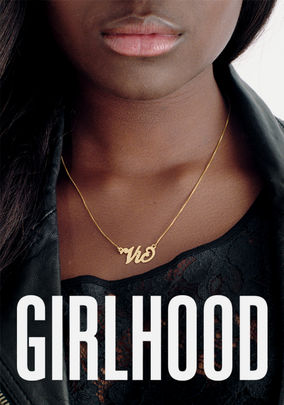
Girlhood-2015

Girlhood-2015

Director Céline Sciamma

Starring Karidja Touré, Assa Sylla

Scott’s Review #398

80013602

Reviewed April 24, 2016

Grade: B

Girlhood (2015) is a coming-of-age foreign language, French drama that tells the story of a sixteen-year-old French girl, living in a poor area (the projects) just outside Paris.

She faces numerous conflicts and tough decisions on how to live her life. School, gangs, and romance are the main issues she tackles, as well as troubled home life.

Wisely, the film uses a female director, Céline Sciamma, which lends some authenticity to the largely female issues discussed. For all its good intentions and some interesting nuances, the film suffers from a lack of grit and has a safe feel making it less compelling than it could have been.

I felt I was watching a glossy film rather than any harsh reality.

Still, worth the effort.

Marieme is a tall, gorgeous teenager living near Paris. She struggles academically and is rejected from attending high school, instead of being sent on a vocational track to be able to find a job.

Her mother works long hours as an office cleaner, and Marieme’s abusive brother is in charge of the household. Marieme also has two younger sisters.

Upset to learn she will not be attending high school, she is approached by a gang of girls, led by Lady, who asks her to go to the city with them.

She agrees to join their gang when she realizes that her brother’s best friend, Ismael, whom she has a crush on, is friendly with the other girls. Marieme and the girls begin to while away the days by stealing, fighting, and terrorizing anyone in their path.

Partying in hotels, they make the rounds. Marieme must ultimately decide if this is the life she wants.

What I found most interesting about the film is its use of an all-black cast. Sciamma (who ironically is white) felt that the female black population in Paris is underrepresented.

This is accurate and scores point with me. I love the camaraderie among the girls. They always have each other’s backs and when Marieme fights a rival girl to defend the recently beaten Lady, there is a sense of sisterhood that is appealing and is at the heart of the film.

Friendship, loyalty, and bonding are explored.

Also worth noting is that most of the cast are either unknown actors or non-actors picked off the streets to appear in the film. To this effect, the acting is surprisingly good for most novice or non-actors.

The romance between Marieme and Ismael is another strong point. They share an undeniable attraction but are forced to spend time in secret. Marieme’s brother appears to run a gang of all boys and forbids anyone from being with his sister.

The scenes shared between Marieme and Ismael are tender, sweet, and believable. They have a rooting factor.

The positives are also the negatives to Girlhood. The film lacks real grit or dirt and the friendship and romantic elements are also played safely.

Everything is glossy and bright.

For example, two fight scenes occur, one with Lady and a rival girl, and one with Marieme and the rival girl. A group of spectators gathers in a circle egging the girls on. They are in a hot, deserted parking lot.

The scenes could have been brutal, bloody, and fierce. Instead, they are short, lack blood or bruising, and feel safe. When Marieme pulls out a knife, it is intended to cut the rival girl’s bra, not to stab her. This seems unrealistic and not how things would play out in an urban gang situation.

And on a nitpicky level, why was the mother absent from the family life? Sure she had a night job, but the film presented her as being all but out of the picture. She tried to help Marieme get a job working with her, so why so much turmoil due to her busy schedule?

Also, the silly scene of the girls playing miniature golf added nothing to the plot and should have been dropped.

Girlhood (2015) is a nice, albeit sweet, coming-of-age, female gang story, that might have been more intense, but the decision was to make a soft film rather than a harsh one.

An effort that mainly focuses on bonding, friendship, and life choices over the realistic brutality it could have dealt with.

Independent Spirit Award Nominations: Best International Film

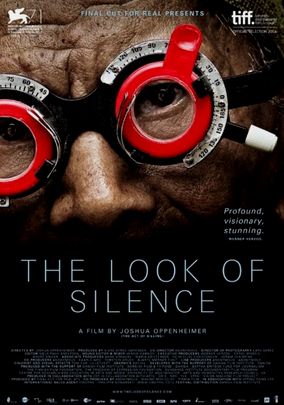
The Look of Silence-2015

The Look of Silence-2015

Director Joshua Oppenheimer

Scott’s Review #396

80016401

Reviewed April 18, 2016

Grade: B+

An extremely grim and depressing 2015 documentary, The Look of Silence is a companion piece to 2013’s The Act of Killing.

Both focus on the brutal Indonesian genocide of 1965-1966, in which an estimated one million people were exterminated.

The documentary tells of the effects on one of the families who survived, who now must co-exist in the same village as the killers, who remain unpunished because of government corruption.

They are still in power.

The documentary is cleverly put together as the central figure watches what appears to be outtakes of the related The Act of Killing on television, and the story is manipulated so that some of the killers do not realize they are being filmed for the purposes they are.

The main point of view of the film comes from a middle-aged Indonesian man, peacefully living with his wife and daughter, as well as tending to his very elderly parents, the father is a torture victim and quite frail, who appears to suffer from dementia.

The father is rail-thin and the mother cares for him. Their life is tough. For protection,  throughout the documentary, the middle-aged man is unidentified.

Through conversation with his mother, we learn that his brother (their son) was one of the  “communists” or leftists, who were led to the nearby Snake River, tortured, and eventually murdered and thrown into the river.

The mother reveals that by some miracle, the middle-aged man was conceived shortly after his brother was killed, thereby saving the parents from suicide because of their grief.

The middle-aged man, under the guise of fitting patients with eyeglasses, goes from murderer to murderer (all still alive, very old, and living in the town) and politely quizzes them on their involvement in the Indonesian Massacre.

It is unknown whether the middle-aged man is, in fact, a Doctor, or if it is merely a ruse. Interspersed throughout, the interview clips of the murderers on television proudly describing their feats, are shown.

The Look of Silence is a true downer but shockingly realistic, sad, painful, and eye-opening.

Unlike many documentaries, we are not shown repeated clips of the events of the 1960’s- the story stays in the here and now.

The audience uses their imagination to create what they think happened. Powerful stuff. In the videos of the killers, they describe in brutal detail how they killed their victims and it is quite sickening to watch.

Two men proudly reminisce of the chopping off of a woman’s breast, comparing the ruined flesh to an open coconut,  or slicing off a man’s penis. Others tell of drinking the blood of the victims.

Painful to realize is that this is not some horror film, but a real-life event.

Quite dumbfounding to me was that little or no remorse was shown when the middle-aged man questioned the killers in the present time. Some shrugged their involvement off, some got hostile, and some denied their involvement.

Some, now quite feeble, were accompanied by younger family members unaware of their father’s or grandfather’s past doings.

Some appeared quite upset.

The documentary is not filled with spliced-together archives or flashy lights or graphics. It is slow-paced and plodding. Some may find it too slow.

The title, The Look of Silence is rather perplexing and makes little sense to the subject of the documentary so I am not sure why it has the title that it does. But that is merely an aside.

As much as citizens of the United States complain and stress about the political state of affairs or financial matters, we have it quite good, and viewing this painful documentary is a reminder of that.

The Look of Silence (2015) displays the evil of human beings in the recent past. They show no remorse. In a world filled with ISIS, the documentary is a scary reminder that something like this can easily happen again.

This is a sad and morbid reality and this film will stick with you for some time.

Oscar Nominations: Best Documentary-Feature

Independent Spirit Award Nominations: 1 win-Best Documentary Feature (won)

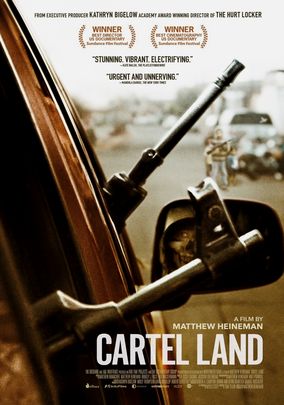
Cartel Land-2015

Cartel Land-2015

Director Matthew Heineman

Scott’s Review #395

80039606

Reviewed April 17, 2016

Grade: B

Cartel Land is a 2015 documentary film about the Mexican drug war, specifically focusing on vigilante groups in both Mexico and the United States.

These groups attempt to combat and thwart drug cartels by using their illegal efforts. Brutal and ugly, the documentary paints a dark picture of the drug trafficking problem and the hopelessness of the situation.

Interestingly, the hot-button issue of illegal immigration is not explored.

The great thing about documentaries, in general, is their truthfulness and ability to open one’s eyes to a situation in which one may not be aware or have limited knowledge.

Most people know there is a drug problem in the United States, but Cartel Land successfully educates the viewer on the complexity of the issue.

Various perspectives are explored throughout the documentary: the Arizona Border Recon, led by militant figure, Tim “Nailer” Foley, and the Autodefansas, led by Dr. Jose Mireles, are the vigilante groups in the U.S. and Mexico, respectively.

A third perspective, in that of one of the cartel members, the particular gentleman featured, cooks and transports the crystal meth across the Mexican border.

Additionally, some individuals feel that the police and government are responsible for solving the issues and should be left in their hands.

The documentary does not endorse one particular opinion but paints a controversial picture of the situation’s reality and presents both sides objectively. However, the majority of the screen time is dedicated to the Autodefansas story.

One of the most thought-provoking parts of the documentary, and what initially engaged me in it, is at the very beginning of the story.

Told from the perspective of one of the cartel members who is interviewed with the backdrop of a nighttime scene, where he cooks the meth he will then deliver, is poignant.

Since he transports drugs, he is perceived as a monster.

He admits he causes people’s deaths, destruction, violence, etc. He then explains that the cartel members come from poverty- what else are they going to do to make this much money? Or make a living at all? It is an opportunity- who would give that up?

This made me think of how complex a problem drug smuggling is and it also laid the groundwork for the viewer to realize that the cartel members may not be the only ones who are bad or crooked.

What is the definition of right and wrong? On whose terms?

The primary members featured are Dr. Mireles and another member of Autodefansas, Papa Smurf. They started Autodefansas to combat the corrupt Mexican police and government that allows the drug cartel to exist, presumably for profit.

Their group of vigilantes brandishes militant guns to “protect their town” and the inhabitants. An assassination attempt occurs when someone tries to crash Mireles’s plane- he goes into hiding.

But we also learn that Mireles is a womanizer, a cheat, and cannot be trusted. Is he making deals for profit on his own? Papa Smurf is in cahoots with the police. Is cash being exchanged?

The Arizona vigilante story is interesting to hear from Foley’s perspective. I observed the group to be uneducated, poor, angry, and filled with racist hatred. This is scary to think that some Americans feel the way they do and it made me sympathize with them the least and the drug cartel a bit more.

One vigilante compared different races to being like two pit bulls in a cage- separated things are fine, but released from those cages the animals will kill each other. He had no concept of two races being able to live happily amongst each other.

Parts of Cartel Land are quite gruesome and descriptive.

In one scene we see a teary mother from the town of Michoacán, who the Autodefansas protect, describe how an entire family of innocent farmworkers, including a newborn, were murdered by being hurled against rocks until they died.

They were the victims of a revenge scheme enacted against their boss. One pities her and we see the funeral for the newborn take place amid screams of despair from surviving family members. We also see decapitated heads and murdered individuals.

It is chilling to think that this goes on in today’s world.

The cinematography is splendid and countless scenes of the Mexican and Arizona landscape are prominently featured. Miles and miles of spacious, mountainous areas are shown, and the use of night vision cameras allows a feeling of being right there with the patrol groups.

The main takeaway from Cartel Land is the subject of corruption.

Throughout each story the lines are blurry. Who is corrupt? Who should we sympathize with? Who are the good guys? Who are the bad guys? The facts are shaded in gray and we know there are no good groups or bad groups.

This documentary teaches the audience that there is a major problem with the drug cartel across Mexico and the United States that has existed for years and will continue to exist for years to come.

A lesson learned.

Oscar Nominations: Best Documentary-Feature

Miller’s Crossing-1990

Miller’s Crossing-1990

Director Joel Coen

Starring Ethan Coen, Gabriel Byrne

Scott’s Review #394

60028099

Reviewed April 13, 2016

Grade: B+

Containing a mixture of The Godfather Part III, Goodfellas, and The Grifters- ironically all released in 1990- Miller’s Crossing is an old-fashioned gangster film made fresh thanks to the direction of Joel Coen.

He brings a quirky edge to the film, throwing in a blend of film noir, black humor, and edgy characters that make the film storyline feel fresh and alive in the present.

It has a definite late-1980s-era cinematic look (not a compliment).

I could immediately tell which decade it was made. Miller’s Crossing begins slowly, but during the second act, it gains steam and is the best part of the film.

The film is set somewhere in New York during the 1920s Prohibition period- it is assumed New York City, but this is never stated.

The general story involves Tom Reagan, a handsome Irish gangster and right-hand man of Leo O’Bannon (Albert Finney), who becomes involved in conflict with Leo, his lover Verna (Marcia Gay Harden), and her brother Bernie (John Turturro), who is wanted dead by rival Italian mobster, Johnny Caspar.

Johnny’s right-hand man, “Dane,” comes into play, as does another gangster, Mink, played by Steve Buscemi. Tom changes allegiances and plays one mob boss against the other as a web of deceit, tested loyalty, and murder ensues.

As the first half concluded, I was not completely sold on the film.

How many times have I seen a gangster film with all the stereotypical elements, the tough-guy shtick, and the contrivances?

I was afraid I was watching a retread of similar films.

I wondered what the point of the film was- the relationship between Tom and Leo’s struggle for power and control. A triangle between Tom, Verna, and Leo?

I noticed little chemistry among them and could not help but wonder whether a female presence was required in the film, though not all that necessary.

Regardless, I was quickly bored with Verna’s character.

But then the elements of the film began to come together, and some rather left-of-center nuances emerged, leaving me even more engrossed.

A homosexual triangle (seldom seen in traditional, crime/mob films) took shape between Mink, Dane, and Bernie. All vicious killers had no stereotypes often seen in the film, which is refreshing.

Dane was arguably the most brutal of all the characters, and the bloodletting was plenty. I found this reveal completely refreshing, not to mention unexpected.

However, the intricacies of the triangle were left unexplored. They bedded each other.

A pivotal scene set in the woods (Miller’s Crossing) is as gorgeous as it is character-driven. Tom must choose between killing Bernie and proving his loyalty to the mobsters awaiting, or secretly letting him live, faking his death, all in the name of his love for Verna.

But will his decision come back to haunt him?  Is Tom, at his core, a good man or a bad man?

The calm of the forest mixed with the brutality of the film is perfect. I was reminded of the 1970 Italian masterpiece The Conformist while viewing this beautiful scene—Tom’s conflict between good and evil and his earlier premonition of a tumbling hat come into play.

His character conflict reminded me of Michael Corleone in The Godfather films.

Look quickly, and you will see Frances McDormand, soon to be a fixture in Coen films, as a slinky, well-dressed secretary. We are reminded of great things to come by this then-unknown talent.

A nice thing that I always look forward to in Coen films is the quirky, weird, fun, minor characters, and Miller’s Crossing is no different- Johnny Caspar’s overweight wife and son, an Augustus Gloop from Willy Wonka and the Chocolate Factory lookalike, give comedy to the potentially too dark film.

From Bryan to Tic-Tac to the fat lady with the purse, all offer amusing and meaningful turns that lend the film a richness and an unusual cast of characters.

Miller’s Crossing (1990) proves to be a nice little film once it picks up steam, and the intertwining of stories and characters, with a touch of classic film noir, makes for a refreshing take on an age-old genre.

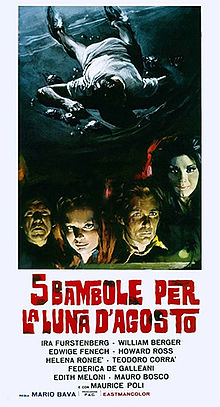
Five Dolls For An August Moon-1970

Five Dolls For An August Moon-1970

Director Mario Bava

Starring William Berger, Ira von Fürstenberg

Scott’s Review #393

5-bambole-poster

Reviewed April 9, 2016

Grade: B-

Five Dolls For An August Moon is a 1970 Italian horror film by horror maestro Mario Bava, a well-regarded director of the genre.

Being relatively a novice to his films, but knowing his name, I expected a bit more from the movie than I was treated to.

From a critic’s consensus, Five Dolls For An August Moon is not considered to be one of his better films- not even close. I found some positive elements in the film, but ultimately, it did not come together cohesively or compellingly.

The dubbing from Italian to English is poor, and I would have preferred more authenticity in the original Italian.

Containing a fascinating and mysterious premise, a group of gorgeous people gathers on a sunny, remote desert island- somewhere off the coast of the Mediterranean Sea.

Owned by wealthy industrialist George Stark, the weekend is intended for socializing, fun, and relaxation.

It appears to be summer(hence the title), and the vacationers exude sexuality and a sense of good style. The beach house is lavish and sophisticated, and it is suggested that all are brilliant, or at least, riding on the coattails of those who are.

One of the guests is famed chemist Professor Gerry Farrell (William Berger), who has recently developed a revolutionary formula, and it is quickly revealed that all the guests are industrialists eager to buy it from him at any price.

Incensed, Farrell refuses to budge and, suddenly, one by one, the guests are killed off in typical gruesome horror fashion.

I am a sucker for a good whodunit, and Five Dolls For An August Moon appears to be in Agatha Christie’s- And Then There Were None style of intrigue, but this aspect of the film proves to be the most trivial and uninteresting as the plot moves along.

The character’s motives were unclear (yes, I get they all wanted the secret formula). Still, the absolute necessity of having it, besides, presumably, money, which they all appeared to have plenty of already, was dull.

The ending of the film and the “big reveal”, while clever, was also overly complicated for this type of film.

The film, for its time (1970), was very provocative in its look and style, and that impresses. Featuring a groovy, psychedelic soundtrack, bright, trendy clothing, and a sunset, the film challenges the tried-and-true horror elements, especially those of foreign horror (darkness, rain, fog, gloom), which makes it work from a cinematic perspective.

One cannot help but watch this film and think of director Russ Meyer as a heavy influence. The casting of good-looking Italian actors, both male and female- the females busty and gorgeous- the men stylish and cool, reminiscent of Myer male actors, is noteworthy.

Interestingly, another glaring example of how other countries’ progressive sexual viewpoints contrast with the more conservative United States is that many of the couples on the island are involved sexually with other people on the island, including a lesbian romance, which was highly unusual to show in 1970.

These shenanigans give Five Dolls For An August Moon a more creative, suave, and sexual intrigue.

A highly effective, and creepy, aspect of the film is the keeping of the corpses in a freezer with plastic bags over the victim’s heads- meat locker style.

Eyes bulging, with the clear bags giving a ghastly view, I immediately thought of the still-to-come masterpiece, Black Christmas (1974), and how this film might have been influenced by a similar scene of a victim wrapped in plastic with a gruesome facial expression.

This is good horror stuff.

Five Dolls For An August Moon (1970) is not a great film, but it does have some edgy elements, a cool look, and, thanks to great direction from Mario Bava, influences some movies to come.

A decent horror flick and a worthwhile investment for fans of Italian horror- Bava is a heavy hitter and, next to Dario Argento, is the master of Italian horror films.

A Decade Under The Influence-2003

A Decade Under the Influence-2003

Director Ted Demme, Richard LaGravenese

Starring Francis Ford Coppola, William Friedkin

Scott’s Review #392

60027599

Reviewed April 5, 2016

Grade: B+

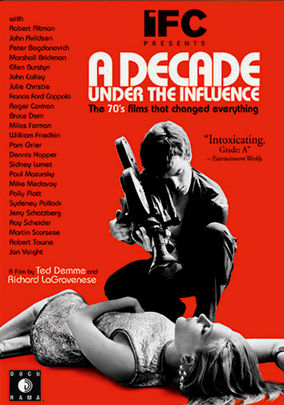
Produced by the cable network Independent Film Channel (IFC), A Decade Under The Influence explores the decade of 1970s film, a decade that was arguably the most creative and liberating to filmmakers and audiences alike.

A period in film defined by the directors securing creative freedom instead of the studios, where artists instead of corporations finally ruled the roost. A Decade Under The Influence gives us an overview of the era.

Despite some conspicuous omissions, I enjoyed this informative piece a great deal.

The documentary is divided into numerous segments including sections on women in film, the transition into a different period in Hollywood, and the subsequent close of the decade.

The interviews are plentiful including a who’s who of stars: Martin Scorsese, Ellen Burstyn, Clint Eastwood, Robert Altman, Julie Christie, Francis Ford Coppola, and numerous other influential directors, actors, and filmmakers.

Each individual describes his or her perspective on 1970s cinema, and personal anecdotes of experiences or challenges are shared.

Ellen Burstyn, for example, describes how the success of The Exorcist afforded her a plethora of other film offers, but all of the roles were of prostitutes, dutiful wives, or women in peril.

She needed roles more stimulating than those so she chose to star in Alice Doesn’t Live Here Anymore, which was a much better-written role. What I found a bit sad is how there are still limited, layered roles for women in Hollywood to this day unless one goes the independent film route, which this documentary touts as a savior.

Francis Ford Coppola relays how The Godfather was never expected to be a success, but rather, how he was chosen to direct the film merely because he worked for cheap and was Italian-American.

How ironic that the film became such a monumental success and influential to film making as a whole for generations to come.

The documentary, at times, seems like an overview of the decade, with many clips of classic 1970s cinema interspersed with the talking points.

Despite being three hours in length, I still felt that there was so much more than the documentary could have explored. Not surprisingly, the stars granting interviews were granted heavy screen time for their films.

The documentary was fine, but could have delved much deeper- I could see a multiple-disc set totally of ten or more hours dedicated to the decade.

One conspicuous omission was Robert Altman’s Nashville, arguably, the best film of the decade. While it was briefly mentioned, and a still frame of a scene from it did appear, I felt that it warranted more dissection and discussion.

This was more surprising given that Altman was interviewed for the documentary.

Another miss was Halloween or any mention of John Carpenter films. Halloween influenced many horror films to come and The Exorcist received heaps of coverage, undoubtedly because star Burstyn and director William Friedkin appear at length throughout the production.

Additionally, in the horror genre, Black Christmas (a highly influential horror film) was not mentioned at all.

A celebration of my favorite decade of cinema, A Decade Under the Influence is a documentary that is a basic must-see for fans of 1970s cinema, or film students perhaps immersing themselves into the world of great film for the first time.

Kiss Me Deadly-1955

Kiss Me Deadly-1955

Director Robert Aldrich

Starring Ralph Meeker, Cloris Leachman

Scott’s Review #391

60020642

Reviewed April 2, 2016

Grade: A-

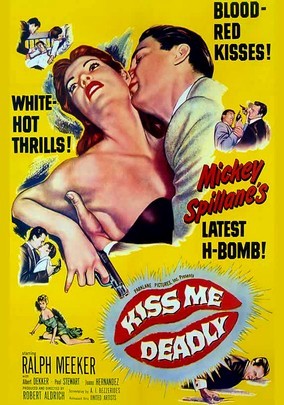
Kiss Me Deadly is a 1955 noir drama that influenced many subsequent films. After years of keeping it on my “to see” list, I finally got around to viewing this influential gem and now realize its power.

At times, it is confusing and perplexing and requires additional watching. I rate it an A——; however, I can see its grade rising to a solid A upon subsequent viewings.

Still, Kiss Me Deadly has much respect from me as a lover and appreciator of a good film.

The mysterious plot goes like this: Mike Hammer (played by Ralph Meeker) is a stern Los Angeles private eye. One evening, driving along a lonely country road, he picks up a hitchhiker, Christina (Cloris Leachman’s film debut), who is clad only in a trench coat.

He quickly realizes she has escaped from a mental institution but is compelled by her desperation.  When thugs catch up to them, this sets off events as Mike spends his days investigating the strange turn of events.

The plot twists and turns in innumerable ways and becomes complex but fascinating. A peculiar glowing box, which everybody seems to want, comes into play.

Wonderfully directed by Robert Aldrich, Kiss Me Deadly features unique and creative uses of lighting, camera angles, and moody shadows to significant effect, and this is one of the first aspects I noticed.

Shot in highly effective black and white, allowing Kiss Me Deadly a murky, suspicious look- as if danger and doom might be around every corner.

Meeker and Maxine Cooper as Velda, Mike’s secretary/lover, make a nice pair, as they are good-looking, but a rather B-movie type couple, in contrast, to say, Cary Grant and Eva Marie Saint, two gorgeous upper echelon Hollywood stars of the day.

Casting those stars might have changed the tone of the film.  Meeker and Cooper bring, perhaps, a blue-collar look to the film. Nevertheless, the chemistry works.

An interpretive film, Kiss Me Deadly undoubtedly influenced later film noir classics such as Chinatown (1974), L.A. Confidential (1997), and Pulp Fiction (1994), as well as science-fiction films and, arguably, Raiders of the Lost Ark (1981).

The list could go on as Kiss Me Deadly crosses into numerous genres.

The ending is highly complex, spooky, and downright weird. It is one of the craziest endings I have ever experienced.

Once the mysterious box is opened, the film becomes a strange Twilight Zone episode with screeching sounds. The explosion is open to complete interpretation and changes the dynamic. I had the enormous fortune to view the alternate ending not released in theaters.

Mike and Velda’s fates were vastly different from one end to another. My preference was the alternate ending. Sometimes, the studios play things too safe.

What does it all mean? Nuclear weapons, the apocalypse, the Cold War, glowing boxes, and detective work are many elements in one film.

A conversation about Kiss Me Deadly (1955) could be enjoyed, as it speaks volumes about the film’s high quality.

I look forward to seeing this revolutionary film again for further appreciation.

Hello, My Name Is Doris-2016

Hello, My Name Is Doris-2016

Director Michael Showalter

Starring Sally Field, Max Greenfield

Scott’s Review #390

80050896

Reviewed April 1, 2016

Grade: B

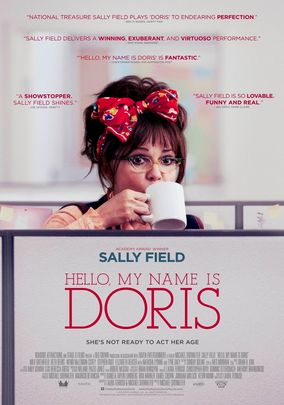
Sally Field shines in Hello, My Name Is Doris (2016), a sweet-natured indie romantic comedy that tells of a lonely Staten Island woman and her mostly fantasy-laden relationship with her colleague, a much younger, hunky man (Max Greenfield).

The film is somewhat predictable but sweet and honest and works well. It hardly reinvents the wheel, but it is a lovely character-oriented story about a woman’s reawakening from a dull life.

This is refreshing in a world of retreads and superhero flicks.

Doris Miller meanders through life at her crappy data entry job at an Advertising Agency in mid-town Manhattan. Having worked in the same role for decades, she is overlooked and more or less invisible to colleagues.

She is the “weird old lady” or the “wallflower” who goes unnoticed. Her personal life is a dud. She lives with her recently deceased mother, who is a hoarder and severely marginalized. She has no dating possibilities.

One day, on the elevator heading to the office, a kind young man named John Fremont innocently pays attention to her, and she becomes enamored with him.

Later, she is stunned to realize that John is the new Art Director at her job.

Her crush escalates as she and John become friends, and a series of misunderstandings ensue, with the added conflict of her friends thinking she is living in a fantasy world, worried she will wind up hurt.

Sally Field carries this film in every way. It is nice to see her in a lead role again, which, sadly, is a rarity these days for a seventy-year-old actress.

She convincingly plays quirky, shy, and awkward and has one melt-down scene that is a powerful testament to her continued acting ability.

The character of Doris slowly blossoms and becomes rich with zest. We discover she is much more than meets the eye, and these moments in the film are wonderful to experience, thanks to Field’s charisma.

My favorite scenes involve the lovely bond between Doris and the thirteen-year-old granddaughter of her best pal, Roz, played by Tyne Daly.

Despite the age difference, the granddaughter views her as a peer, giving daring dating advice to the inept Doris. This leads to a nice portion of the plot and some funny moments.

One unique aspect of Hello, My Name Is Doris is that it is not a film about a May-December romance between a man and a woman—at least, I did not see it that way. Instead, it is about a woman who finally decides to live regardless of age.

I felt her stifled and smothered by her brother and sister-in-law, who clearly did not understand that she hoarded “stuff” in her home to cope with her loneliness, and to be surrounded by things that gave her comfort helped her deal.

Granted, Doris clinging to one broken wooden ski from the Dark Ages was amusing in its cuteness.

Tyne Daly, who can recite the phone book, is worth a considerable note from an acting standpoint. I’d be happy to do that. She is one of those natural, confident, engaging, real actresses, and her scenes with Field glistened with raw talent and emotion.

Perhaps a female buddy movie with Field and Daly?

The remainder of the supporting characters are capable but not spectacular. They are somewhat clichéd and one-note.

For example, Doris’s colleagues view her as invisible with the classic office jokes, especially the female boss thrown into the film- possessing a hard-as-nails personality and coldness.

I have seen these characters time after time in comedy films.

Supporting actors from Orange is the New Black (2013-2019) and Mad Men (2007-2015) are featured as a couple of the colleagues.

Indie, fun, and with a freshness made in large part by Sally Field, Hello, My Name Is Doris (2016) is an innocent comedy with a romantic edge and some nice laughs.

It is far from a masterpiece but a good-natured escape, which is refreshing, especially for the middle-aged or senior crowd craving a non-stereotypical female character.

Independent Spirit Award Nominations: 1 win-Piaget Producers Award (won)