Into the Woods-2014

Into the Woods-2014

Director Rob Marshall

Starring Emily Blunt, Meryl Streep

Scott’s Review #241

70305948

Reviewed May 8, 2015

Grade: B

Based on the stage production of the same name, Into the Woods (2014) is a feature-length Disney film that incorporates several different fairy tales into the main story.

The film is a fantasy musical with numerous songs performed by the cast, featuring a large ensemble of seasoned actors.

The classic fairy tales are modern versions of Little Red Riding Hood, Rapunzel, Jack and the Beanstalk, and Cinderella.

The action mainly revolves around a baker and his wife (James Cordon and Emily Blunt) who are sad and lonely because they cannot conceive a child due to a long-ago curse put upon the baker’s family by a witch- played by Meryl Streep.

Circumstances surrounding the baker’s father caused the once beautiful witch to be turned ugly. The witch offers a bargain to the baker and his wife- if they bring her four items (a white cow, a red cape, yellow hair, and a gold slipper) for a special potion, she will lift the curse, enabling them to conceive a child and live happily ever after.

This prompts the couple into the dark forest to obtain the requested items. From this point, the couple intersects with other characters from the fairy tales as they all question various aspects of their lives.

There are subsequent stories- the witch is Rapunzel’s adoptive mother and keeps her locked in a tower to prevent her from being hurt by the world.

Cinderella (Anna Kendrick) escapes her taunting stepsisters and attends a ball only to flee when noticed by the handsome prince (Chris Pine).

Jack attempts to sell beans to provide food for his mother- and Little Red Riding Hood brings sweets to her Grandmother but is confronted by the Big, Bad, Wolf (Johnny Depp), a strange Woman Giant is stomping through the forest searching for Jack.

All these stories revolve around the baker and his wife’s efforts to retrieve the witch’s requests.

The production and art direction in the film is great. I love the dark, gloomy forest, which translates so well on the screen and gives the magical effect of a mysterious, secret forest.

I enjoyed the songs quite a bit- especially the catchy “Into the Woods”. However, some of the songs are quite one-dimensional and bland and not discernible from each other, let alone memorable.

The duet of the Prince’s, “Agony” is silly and useless to the plot, with gyrations, and dance moves.

Meryl Streep- dynamic in anything she appears in again steals the show as the vile witch turns beautiful at the end. She has a fantastic solo number mid-story, entitled “Stay with Me”.

One drawback I found with the film is, at times it drags a bit and I was not sold on the casting of Anna Kendrick as Cinderella.  Something about her performance was lacking, perhaps she was not as sympathetic or convincing as another actress might have been.

Also, I would have enjoyed seeing Johnny Depp as the Wolf be more prominently featured and a larger role for the Woman Giant. As integral as she is to the plot, it was tough to get a clear glimpse of her face let alone anything more substantial.

An entertaining feast of fairy tales immersed in one film, Into the Woods (2014) has some compelling moments but lost opportunities that bring it far from the reaches of a masterpiece level.

A solid film, but not a great film.

Oscar Nominations: Best Supporting Actress-Meryl Streep, Best Production Design, Best Costume Design
Carrie-1952

Carrie-1952

Director William Wyler

Starring Jennifer Jones, Laurence Olivier

Scott’s Review #240

60011689

Reviewed May 3, 2015

Grade: B

Carrie, not to be confused with the 1976 horror classic Brian DePalma, is a 1952 drama starring Laurence Olivier and Jennifer Jones—two big Hollywood stars of the time.

Shot in black and white, the film tells the story of a self-titled ingénue (Jones) from a Midwest upbringing who travels to Chicago to make her fortune.

Attempting to launch her career, Carrie becomes immersed in a love triangle with Olivier, who is unhappily married and runs a restaurant with salesman Charles Drouet, played by Eddie Albert.

Directed by William Wyler, the film has a melancholy tone as one of the characters sinks into a world of despair.

The highlight of this film is Laurence Olivier’s excellent performance as George Hurstwood, who goes from being a successful restaurant manager with an affluent existence to a poverty-stricken, lonely, and broken older man.

Olivier is so effortless and believable in his performance, as he always was.

However, I felt that Jennifer Jones was miscast. While attractive, yes, I did not think that every man would lust after her on sight alone, as was needed for the character of Carrie. Her acting, while okay, is not on the level of either Albert or especially Olivier, with whom she shares much screen time.

Perhaps Vivian Leigh, Teresa Wright, or Kim Novak might have been wiser choices.

The story itself is compelling and engaging. Here we have a woman- at the turn of the twentieth century- forging ahead to make it on her own- almost unthinkable for a woman, taking menial jobs as a sewing worker in a factory to scrape by.

Carrie resists the urge to become a rich husband-seeking gal and believes in marriage and true love. That is why she is devastated when she learns that George is married.

Will true love win out for them? This seems to be the central aspect of the film.

Behind-the-scenes issues may have contributed to the problems that appear onscreen. Wyler reportedly did not want to cast Jones, Olivier did not like Jones, Olivier was injured during much of the filming, and the film’s ending was changed to provide a “happier” ending.

Initially, George was to commit suicide, which might have successfully made the film more shocking and heartbreaking.

Containing beautiful costumes and interesting cinematography, Carrie has positives but might have been much better than the final product ended up being, but for poor casting and real-life dramas that hurt the film.

Oscar Nominations: Best Art Direction, Black-and-White, Best Costume Design, Black-and-White

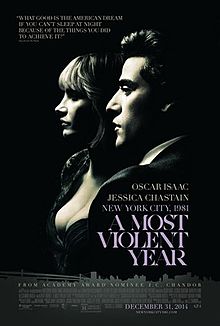
A Most Violent Year-2014

A Most Violent Year-2014

Director J.C. Chandor

Starring Oscar Isaac, Jessica Chastain

Scott’s Review #239

_A_Most_Violent_Year__Theatrical_Poster

Reviewed May 1, 2015

Grade: B

Set in New York City, throughout the notoriously violent year of 1981 and influenced, at least in part, by The Godfather (1972) A Most Violent Year (2014) is similar in texture to the elite HBO series The Sopranos (1999-2007).

A Most Violent Year is an attempt at weaving a tale of a “good guy” mixed up with the mafia and attempting to remain upstanding throughout the adversity and corruption he encounters.

Oscar Isaac and Jessica Chastain portray Abel and Anna Morales, who owned Standard Oil, an upstart business they are attempting to launch.

Due to the violent nature of the times, several trucks are hijacked, resulting in robberies and severe beatings. In desperate need of funds to expand their business and stay ahead of competitors, Abel and Anna are forced to take out loans, leading them into a world where crime and violence run rampant.

They are under investigation for apparent price fixing and tax evasion activity by the Assistant District Attorney.

The main theme is the conflict and guilt that Abel feels towards violence and the constant temptation to join the ranks of the crime world to protect his business ventures.

Abel faces pressure from Anna, who has mob ties (her father is an influential mafia boss known around town) and is all for fighting fire with fire. Abel refuses and is determined to lead a straight and narrow life.

When circumstances spin out of control, his morals are questioned.

A Most Violent Year is an interesting film yet I think I was expecting a bit more than I was given.

For starters, it is not in the same league as the mafia works of art. It is tough to put my finger on what the issue is but something is missing from the film making it lack a compelling edge.

The plot moves slowly, for sure, but the film is successful as the character study that it is, however, I was left wanting more depth to the characters and a broader vision of the film itself.

I did not find myself truly vested in either the character of Abel or Anna.

Chastain received praise for her performance, which I found adequate, but hardly a marvel. Nominated for several awards, but deemed “snubbed” for not receiving an Oscar nomination, I find this untrue.

Her performance is not brilliant and Oscar Isaac’s is superior.

This is not to say that I did not enjoy the film overall. It takes some risks, has a rich character complexity, is shot very well, and looks great. It has a smooth look and I completely bought the 1981 time period, rather than it appearing to be dressed up for the era.

There is an authenticity to it.

A mob film not on the level of The Godfather or Goodfellas (1990), A Most Violent Year is a decent contribution to the crime-thriller era. It just does not live up to the critical acclaim heaped upon it.

Independent Spirit Award Nominations: Best Supporting Female-Jessica Chastain, Best Screenplay, Best Editing