Tag Archives: Jack Elam

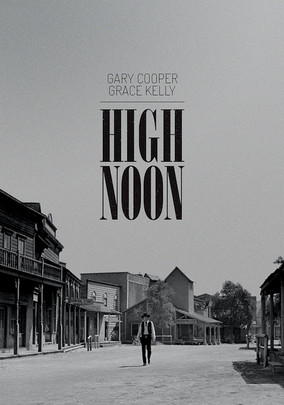
High Noon-1952

High Noon-1952

Director Fred Zinneman

Starring Gary Cooper, Grace Kelly

Top 250 Films #150

Scott’s Review #638
Reviewed April 28, 2017

Grade: A

Billed as a standard Western but much more complex than a film as traditional, basic Western, High Noon accomplished what no other Western did in 1952- adding complexities from different genres, such as suspense and drama, to a film form.

Additionally, High Noon challenged typical Western themes, such as male-driven fights and chases, in favor of a moral and emotional approach, and oh, is the film ever character-driven.

The results are astounding, and to understand and appreciate all its elements, the film should be studied in film school.

High Noon heartily breaks the mold. It was released when mainstream Western was quite popular in the film, adding enormous risk, and the results paid off in spades.

Marshal Will Kane (Gary Cooper) has just wed his beloved bride, Amy (Grace Kelly), in a small ceremony in a tiny town in New Mexico. He plans to turn over his badge and retire to the prairie land with his new wife.

Suddenly, the town receives word that a dastardly villain, Frank Miller, whom Kane once sent away, has been released from a Texas prison and plans to exact revenge on Kane.

Miller is to arrive on the noon train as his three accomplices await his arrival, much to the chagrin of the rest of the town, who become panicked with each passing moment.

The film begins at approximately ten-thirty in the morning and ends shortly after Noon.

High Noon has subtle political themes and clear examples of McCarthyism. However, some dispute this McCarthyism was a campaign launched by Senator Joseph McCarthy, which ended up blacklisting many artists suspected of communism.

The central theme is how people become frightened and blame the attack on one another because of this fear. Our main protagonist (Kane) faces the dire feat of facing four angry gunmen, with revenge on their minds, alone, as an entire town of people chooses not to get involved.

Brilliant is that High Noon more or less takes place in real-time. The inclusion of clocks in the film, and specifically of pendulums swaying back and forth, creates a defined level of tension as character after character nervously glances at the time, knowing full well that with each passing minute, they inch closer and closer to a fantastic and deadly showdown- much blood will be shed.

Cooper, old enough to be Kelly’s grandfather, is noticeable if one chooses to be nitpicky, but the couple works well together, and I bought the happily wedded couple as genuine.

I adore the character of Helen Ramirez, played by actress Katy Jurado. A Mexican character, Ramirez is a prominent businesswoman in the small town, owning a saloon. She is empowered and confident, a character to admire regardless of gender.

A strong female character of Mexican heritage in a 1952 film was relatively uncommon, considering the film is set in the Wild West.

Equally impressive and completely backward for the time, the events of Amy coming to the rescue of Kane, instead of the standard, gender-specific, “man rescues woman,” challenge the norm. Further groundbreaking is that Amy is written as a Quaker woman, not the traditional Christian woman, nor is she skittish or silly.

Western stereotypes are entirely turned upside down, which is arguably way ahead of its time.

Eerie yet highly effective is the use of a “theme song” either sung or in another form (musical score or background music) throughout the film—the song is “Do Not Forsake Me, My Darling,” which became a hit for Texas Ritter.

It is worth mentioning that the success of this added “theme song” encouraged subsequent Westerners to add similar songs to their films.

Challenging the standard in many ways, High Noon sets the bar very high in its thoughtfulness, message, and conflict.

The film exemplifies people who take the world and turn it upside down with fantastic and inspiring results.

Oscar Nominations: 4 wins-Best Motion Picture, Best Director-Fred Zinnemann, Best Actor-Gary Cooper (won), Best Screenplay, Best Scoring of a Dramatic or Comedy Picture (won), Best Song-“The Ballad of High Noon (“Do Not Forsake Me, O My Darlin”)” (won), Best Film Editing (won)

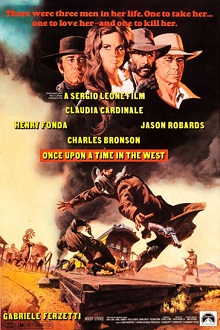
Once Upon a Time in the West-1968

Once Upon a Time in the West-1968

Director Sergio Leone

Starring Henry Fonda, Claudia Cardinale

Top 250 Films #187

Scott’s Review #886

Reviewed April 17, 2019

Grade: A

At one time dismissed as either frivolous or cartoon-like, the derogatory genre classification “spaghetti western” was originally played for laughs or featured a comical slant, often with bad lip-syncing.

Many of these films have aged tremendously well, though, and are now more widely appreciated and have become a part of the cinematic canon.

Once Upon a Time in the West (1968) is a lesson in camp art that marinates like a fine steak, drizzling with texture and a good atmosphere across a sprawling two-hour-and-forty-six-minute landscape.

In a great sequence, the film begins with a mysterious harmonica-playing gunman (Charles Bronson), dubbed “Harmonica” for reasons eventually revealed, shooting three men sent to kill him.

Meanwhile, to get his hands on prized railroad land in Sweetwater, disabled railroad baron Morton (Gabriele Ferzetti) hires killers, led by blue-eyed baddie Frank (Henry Fonda), who murders property owner Brett McBain (Frank Wolff) and his family.

The film immediately exudes intensity, with a severe revenge theme.

The story develops further, with romance mixed in a Western style, as McBain’s newly arrived bride, Jill (Claudia Cardinale), inherits the land instead.

Jill is a former prostitute who catches the eye of most of the men she encounters. Both outlaws, Cheyenne (Jason Robards) and Harmonica, take it upon themselves to look after Jill and thwart Frank’s plans to seize her land.

With standard Western flair, they are both attracted to Jill and yearn for her affection while also feeling protective of her.

Not professing to be enamored with the Western genre- the stereotypical Cowboys and Indians and token damsel in distress have their limitations- Once Upon a Time in the West is a feast for the eyes and the ears with cinematography on par with Lawrence of Arabia (1963) and a killer musical score.

While the story may have a traditional backbone, the nuances are astounding. The sweeping mountains of the western United States are heavily featured, and the tension-infused music sets up every thrilling scene with gusto and foreboding.

Hot on the heels of another similarly themed masterpiece, The Good, The Bad, and The Ugly (1966), Leone delivers the goods at every turn, most notably setting up each scene with sizzling elements that emit a clear sense of danger.

The audience knows trouble is about to transpire, but not exactly when the shit will hit the fan. The family death scene is paced astoundingly well as the family merrily goes about preparing a delicious summer meal, unaware that destruction is around the corner.

Sure, the cast is a mix of American and Italian actors with varying degrees of accents, not exactly mirroring the Wild West.

Yes, Jill wears heavy mascara and a hairstyle straight out of the 1960s, and one character has brightly dyed red hair, but these intricacies give the film character rather than turn the production into a disheveled mess.

Forever known for heroic or everyman roles, Fonda plays against type, cast as the central, sadistic villain, and the result is superlative.

Leone’s ability to cast a legendary star in a production with little expectation is quite a feat, and Fonda seems to revel in role-playing him both dangerously and straight.

With his piercing blue eyes and a gaze sure to make children run away in terror, his brutal villainy is fully realized only at the film’s conclusion.

Dozens of iconic comparisons to Quentin Tarantino’s modern directing style can be drawn. The director undoubtedly watched and studied this film repeatedly, as numerous qualities of it mirror his own movies.

Viewers will delight in drawing these comparisons, including a harmonica reference, a revenge story, and the climactic reveal at the end of the film, presented as a flashback that pulls all the pieces together.

Once Upon a Time in the West (1968) is a quality film that has finally gotten its due. Tremendous and compelling storytelling is combined with flavorful qualities and a dusty atmosphere.

The film is the sum of its parts, and while it was initially underappreciated, it has finally risen to the rank of a high-quality masterpiece.

Influencing many great directors, including Martin Scorsese, George Lucas, and Tarantino, is quite a testament to its staying power.

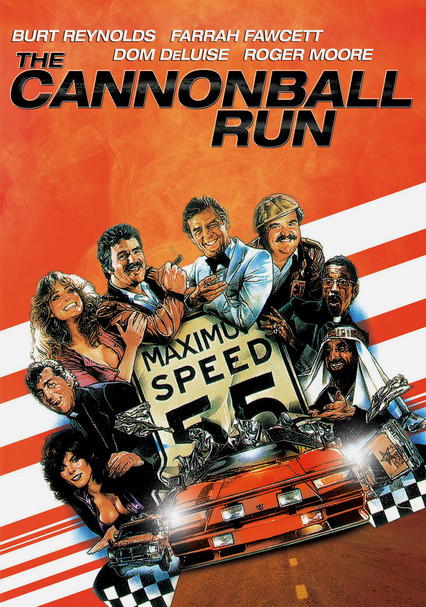
The Cannonball Run-1981

The Cannonball Run-1981

Director Hal Needham

Starring Burt Reynolds, Roger Moore, Farrah Fawcett

Scott’s Review #1,204

Reviewed December 4, 2021

Grade: B-

The Cannonball Run (1981) is someone’s idea of collecting big film and television stars of the time and throwing them into a film with a pointless plot about cross-country road racing.

Truth be told, it’s a pretty bad film.

But it’s a fun way to spend 90 minutes seeing a multitude of celebrities in both cameos and leading roles. Otherwise, The Cannonball Run should be skipped.

Taking a glance at the list of players, we have Burt Reynolds, Farrah Fawcett, Roger Moore, Sammy Davis Jr., Dom DeLuise, Peter Fonda, Dean Martin, Jamie Farr, Jackie Chan, Bert Convy, and Terry Bradshaw.

Hopefully, the actors had a good time making the film.

The acting is not stellar, and one wonders if many of the cast phoned it in or even read much of the script. The out-takes look like everyone was having one grand old time.  And whether some were even sober during the shooting is debatable.

The film is loosely based on the 1979 running of an actual cross-country outlaw road race in the United States, beginning in Connecticut and ending in California.

It was one of 1981’s most successful films at the box office, which is a scary realization. It was followed by two forgettable sequels- Cannonball Run II (1984) and Speed Zone (1989).

Feeling very thrown together, director Hal Needham is most known for collaborations with Burt Reynolds involving cars and car chases, so the plot, if one wants to call it that, is right up his alley.

Race teams gather in Connecticut to start a cross-country car race. One at a time, teams drive up to the starters’ stand, punch a time card to record their departure time, and then take off.

The reward for the winner is one million dollars. A representative of the “Safety Enforcement Unit” tries to stop the race due to its environmental impact and safety concerns.

Various teams are shown either evading law enforcement, most of which deal with talking their way out of a possible ticket, or concocting crazy schemes to outmaneuver their opponents.

The winner of the race is rather unimportant.

It’s all silly and not to be taken seriously. There are plenty of stereotypes, like Jamie Farr’s Middle-Eastern wealthy sheik driving a Rolls-Royce and the inevitable scantily clad females in tight wear.

Despite The Cannonball Run being riddled with enough negative aspects to make me hate the film, it’s kind of fun.

The bevy of different vehicles, like an ambulance, an Aston Martin DB5 (driven by Moore’s James Bond, imitating the character, of course), a Ferrari, and a Chevrolet Malibu, are all entertaining.

There is no character development, nor are there any characters with any depth, so the only reason to see the film is for the speedy cars and the competition.

And to see which celebrity will appear next.

A slapstick film that makes even the similarly penned Smokey and the Bandit (1977) seem like high art, The Cannonball Run (1981) is a must-see only for genre fans or those who are willing to watch and perhaps even be entertained by any movie.

I haven’t seen the film in eons, but I can imagine it’s a film only meant for its time and now would feel incredibly dated.

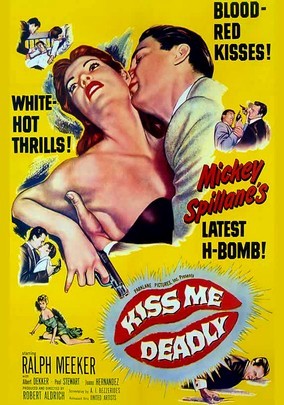
Kiss Me Deadly-1955

Kiss Me Deadly-1955

Director Robert Aldrich

Starring Ralph Meeker, Cloris Leachman

Scott’s Review #391

60020642

Reviewed April 2, 2016

Grade: A-

Kiss Me Deadly is a 1955 noir drama that influenced many subsequent films. After years of keeping it on my “to see” list, I finally got around to viewing this influential gem and now realize its power.

At times, it is confusing and perplexing and requires additional watching. I rate it an A——; however, I can see its grade rising to a solid A upon subsequent viewings.

Still, Kiss Me Deadly has much respect from me as a lover and appreciator of a good film.

The mysterious plot goes like this: Mike Hammer (played by Ralph Meeker) is a stern Los Angeles private eye. One evening, driving along a lonely country road, he picks up a hitchhiker, Christina (Cloris Leachman’s film debut), who is clad only in a trench coat.

He quickly realizes she has escaped from a mental institution but is compelled by her desperation.  When thugs catch up to them, this sets off events as Mike spends his days investigating the strange turn of events.

The plot twists and turns in innumerable ways and becomes complex but fascinating. A peculiar glowing box, which everybody seems to want, comes into play.

Wonderfully directed by Robert Aldrich, Kiss Me Deadly features unique and creative uses of lighting, camera angles, and moody shadows to significant effect, and this is one of the first aspects I noticed.

Shot in highly effective black and white, allowing Kiss Me Deadly a murky, suspicious look- as if danger and doom might be around every corner.

Meeker and Maxine Cooper as Velda, Mike’s secretary/lover, make a nice pair, as they are good-looking, but a rather B-movie type couple, in contrast, to say, Cary Grant and Eva Marie Saint, two gorgeous upper echelon Hollywood stars of the day.

Casting those stars might have changed the tone of the film.  Meeker and Cooper bring, perhaps, a blue-collar look to the film. Nevertheless, the chemistry works.

An interpretive film, Kiss Me Deadly undoubtedly influenced later film noir classics such as Chinatown (1974), L.A. Confidential (1997), and Pulp Fiction (1994), as well as science-fiction films and, arguably, Raiders of the Lost Ark (1981).

The list could go on as Kiss Me Deadly crosses into numerous genres.

The ending is highly complex, spooky, and downright weird. It is one of the craziest endings I have ever experienced.

Once the mysterious box is opened, the film becomes a strange Twilight Zone episode with screeching sounds. The explosion is open to complete interpretation and changes the dynamic. I had the enormous fortune to view the alternate ending not released in theaters.

Mike and Velda’s fates were vastly different from one end to another. My preference was the alternate ending. Sometimes, the studios play things too safe.

What does it all mean? Nuclear weapons, the apocalypse, the Cold War, glowing boxes, and detective work are many elements in one film.

A conversation about Kiss Me Deadly (1955) could be enjoyed, as it speaks volumes about the film’s high quality.

I look forward to seeing this revolutionary film again for further appreciation.