Tag Archives: J. E. Freeman

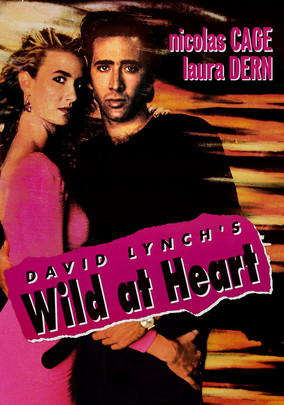
Wild at Heart-1990

Wild at Heart-1990

Director David Lynch

Starring Nicolas Cage, Laura Dern

Scott’s Review #1,230
Reviewed February 19, 2022

Grade: B+

David Lynch has created some weird films. Blue Velvet (1986) and Mulholland Drive (1992) are masterpieces that skew the odd and peculiar facets of human behavior.

But Wild at Heart (1990) takes the cake as the strangest in the lot.

Fascinatingly unhinged yet hard to understand, it’s got the Lynch handprint from start to finish, but only a warm-up act compared to those other films.

Somehow, the film is classified as a comedy. It’s got to be one of the darkest of dark comedies.

Anyone who is not a Lynch fan will not appreciate or get this film- I am a Lynch fan, and I’m not sure I even got it.

I do appreciate it, though.

It’s also the best role of Diane Ladd’s career in which she plays a fiendish, witchy mama. The graceful actress belts a home run in her storied performance.

An event during the opening sequence sets the tone for the rest of the film. Sailor Ripley (Nicolas Cage) serves prison time for a self-defense killing and reunites with his girlfriend Lula Fortune (Laura Dern) when he is released.

Lula’s mother, Marietta (Diane Ladd), is desperate to keep them apart and hires a hitman to kill Sailor. But those are only the start of his troubles when he and Bobby Peru, played by Willem Dafoe, an old buddy who’s also out to get Sailor, try to rob a store.

When Sailor lands in jail again, he may be destined never to reunite with Lula.

Wild at Heart is a love story about Sailor and Lula and the many obstacles they must overcome to live happily ever after.

Cage and Dern are terrific, though I fantasized while watching how nice it would have been to see Kyle MacLachlan in the role of Sailor.

A Blue Velvet reunion would have been splendid since his chemistry with Dern in that film was top-notch. Nonetheless, I enjoyed watching Cage and Dern as the romantic leads.

The many references to The Wizard of Oz are delightful, such as when an image of Marietta flying through the air on a haggard broomstick appears, just like the Wicked Witch of the West.

When Lula desperately clicks her red heels three times to no avail, we strangely wonder where the home she wants to return to is.

The film is one of those that is hard to take seriously or focus on the plot too much.

This is evidenced by the inclusion of Twin Peaks (1990-1991; 2017) alumni Sheryl Lee, Sherilyn Fenn, and Grace Zabriskie. They play The Good Witch, Girl in Accident, and Juana Durango, respectively.

Each character is indescribable in their strangeness.

The nuttiness continues with bizarre turns from Crispin Glover and Harry Dean Stanton.

Interesting that Wild at Heart was released the same year as Twin Peaks. The inclusion of a seedy bar named One-Eyed Jacks, which appears in both productions, is about all that is comparable between the two productions. The main events in Wild at Heart are in Texas and Washington for Twin Peaks.

Aside from the storylines, the best part of Wild at Heart is the cinematography. Enough dark, dusty highway sequences emerge, using glowing, moody lighting and foreboding cracks and crevices, in other visceral scenes.

Cigarette smoking has never looked as sexy or dangerous as it does in this film.

Despite admirable, perfectly Lynch-y elements in Wild at Heart (1990), the film is just too far over the top for me to fall in love with.

I’ll pull out my copies of Blue Velvet (1986) and Mulholland Drive (1992) any day before Wild at Heart.

Oscar Nominations: Best Supporting Actress-Diane Ladd

Independent Spirit Award Nominations: 1 win-Best Supporting Male-Willem Dafoe, Best Cinematography (won)

Miller’s Crossing-1990

Miller’s Crossing-1990

Director Joel Coen

Starring Ethan Coen, Gabriel Byrne

Scott’s Review #394

60028099

Reviewed April 13, 2016

Grade: B+

Containing a mixture of The Godfather Part III, Goodfellas, and The Grifters- ironically all released in 1990- Miller’s Crossing is an old-fashioned gangster film made fresh thanks to the direction of Joel Coen.

He brings a quirky edge to the film, throwing in a blend of film noir, black humor, and edgy characters that make the film storyline feel fresh and alive in the present.

It has a definite late-1980s-era cinematic look (not a compliment).

I could immediately tell which decade it was made. Miller’s Crossing begins slowly, but during the second act, it gains steam and is the best part of the film.

The film is set somewhere in New York during the 1920s Prohibition period- it is assumed New York City, but this is never stated.

The general story involves Tom Reagan, a handsome Irish gangster and right-hand man of Leo O’Bannon (Albert Finney), who becomes involved in conflict with Leo, his lover Verna (Marcia Gay Harden), and her brother Bernie (John Turturro), who is wanted dead by rival Italian mobster, Johnny Caspar.

Johnny’s right-hand man, “Dane,” comes into play, as does another gangster, Mink, played by Steve Buscemi. Tom changes allegiances and plays one mob boss against the other as a web of deceit, tested loyalty, and murder ensues.

As the first half concluded, I was not completely sold on the film.

How many times have I seen a gangster film with all the stereotypical elements, the tough-guy shtick, and the contrivances?

I was afraid I was watching a retread of similar films.

I wondered what the point of the film was- the relationship between Tom and Leo’s struggle for power and control. A triangle between Tom, Verna, and Leo?

I noticed little chemistry among them and could not help but wonder whether a female presence was required in the film, though not all that necessary.

Regardless, I was quickly bored with Verna’s character.

But then the elements of the film began to come together, and some rather left-of-center nuances emerged, leaving me even more engrossed.

A homosexual triangle (seldom seen in traditional, crime/mob films) took shape between Mink, Dane, and Bernie. All vicious killers had no stereotypes often seen in the film, which is refreshing.

Dane was arguably the most brutal of all the characters, and the bloodletting was plenty. I found this reveal completely refreshing, not to mention unexpected.

However, the intricacies of the triangle were left unexplored. They bedded each other.

A pivotal scene set in the woods (Miller’s Crossing) is as gorgeous as it is character-driven. Tom must choose between killing Bernie and proving his loyalty to the mobsters awaiting, or secretly letting him live, faking his death, all in the name of his love for Verna.

But will his decision come back to haunt him?  Is Tom, at his core, a good man or a bad man?

The calm of the forest mixed with the brutality of the film is perfect. I was reminded of the 1970 Italian masterpiece The Conformist while viewing this beautiful scene—Tom’s conflict between good and evil and his earlier premonition of a tumbling hat come into play.

His character conflict reminded me of Michael Corleone in The Godfather films.

Look quickly, and you will see Frances McDormand, soon to be a fixture in Coen films, as a slinky, well-dressed secretary. We are reminded of great things to come by this then-unknown talent.

A nice thing that I always look forward to in Coen films is the quirky, weird, fun, minor characters, and Miller’s Crossing is no different- Johnny Caspar’s overweight wife and son, an Augustus Gloop from Willy Wonka and the Chocolate Factory lookalike, give comedy to the potentially too dark film.

From Bryan to Tic-Tac to the fat lady with the purse, all offer amusing and meaningful turns that lend the film a richness and an unusual cast of characters.

Miller’s Crossing (1990) proves to be a nice little film once it picks up steam, and the intertwining of stories and characters, with a touch of classic film noir, makes for a refreshing take on an age-old genre.