Category Archives: Psychological Horror

Rosemary’s Baby-1968

Rosemary’s Baby-1968

Director Roman Polanski

Starring Mia Farrow, John Cassavetes

Top 250 Films #14

Top 40 Horror Films #4

Scott’s Review #9

60002403

Reviewed June 17, 2014

Grade: A

Rosemary’s Baby (1968) is not only a great film, it’s a masterpiece. Easily one of my favorites in the horror genre, it’s also towards the top of the list of my all-time favorite films.

The beauty of this film lies in its power of suggestion and subtleties. It lacks the blood, gore, or standard horror frights one might expect.

It doesn’t need them.

The audience senses something is amiss through clues provided throughout the film. The closed-off room in the young couple’s apartment, the sweet, but a bit odd, elderly neighbors, a strange suicide, a mysterious, horrid-smelling, good luck charm. Rosemary’s due date (June 6, 1966- “666”).

The strange, dreamlike conception scene is intense and surreal. Her husband- claiming Rosemary passed out from too much alcohol- begins to become a suspicious man following the incident, but we are confused by his involvement- what are the neighbors up to, we wonder? Are they sinister or simply innocent meddlers?

In a sinister scene, Rosemary gnaws on bloody raw meat, catches her reflection in the glass, and is horrified by her behavior.

Mia Farrow is excellent as the waifish, pregnant Rosemary, who loses weight, rather than gains it.

The film also has a couple of real-life eerie occurrences: the building setting (The Dakota) is where John Lennon was shot and killed, and Director Roman Polanski’s wife, Sharon Tate, in a cameo, was murdered shortly after filming by Charles Manson.

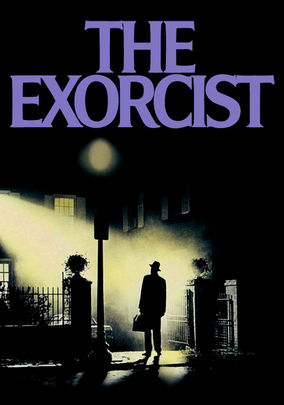
Rosemary’s Baby shares a similar theme with other devilish/demon films, such as The Exorcist (1973) and The Omen (1976).

This is a film that must be seen by everyone and only shines brighter with each subsequent viewing.

Oscar Nominations: 1 win-Best Supporting Actress-Ruth Gordon (won), Best Screenplay Based on Material from Another Medium

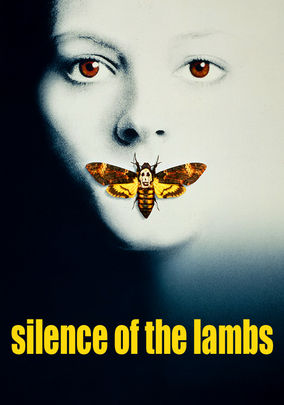
The Silence of the Lambs-1991

The Silence of the Lambs-1991

Director Jonathan Demme

Starring Anthony Hopkins, Jodie Foster

Top 250 Films #64

Top 40 Horror Films #15

Scott’s Review #320

14546747

Reviewed January 3, 2016

Grade: A

The Silence of the Lambs (1991) has the honorary achievement of being one of only three films to win the top five Oscar statuettes, having been awarded Best Picture, Best Director (Jonathan Demme), Best Adapted Screenplay, Best Actor (Anthony Hopkins), and Best Actress (Jodie Foster) at the 1991 Oscar ceremonies.

This is no small feat, especially considering the film was released in March (not an Oscar-happy month) and is a horror film.

These elements speak volumes about the level of mastery in The Silence of the Lambs, and the film holds up incredibly well as the years go by.

The film was a sleeper hit at the time of its release and gradually built momentum throughout the year, becoming a phenomenon and a classic forever.

The film is adapted from the novel of the same name by Thomas Harris and, despite being a horror film, contains little gore.

The film stars Foster as Clarice Starling, an FBI trainee, sent by her superiors to interview the infamous Hannibal Lecter.

Hannibal, “The Cannibal”, is a highly intelligent former psychiatrist who has been banished to a maximum security insane asylum after having been found guilty of killing and eating his victims.

The FBI hopes that Hannibal will aid them in a current case involving “Buffalo Bill”, a serial killer who skins his female victims.

Hannibal and Clarice embark on an intense and strange relationship in which he gets under her skin and questions her unhappy childhood in exchange for information about “Buffalo Bill”.

This relationship leaves Clarice vulnerable, though the pair develops a strong connection. As Hannibal makes increasingly demanding demands in exchange for information, he eventually escapes from custody in a chilling, bizarre escape.

The psychological elements and the intense relationship between Hannibal and Clarice are of monumental importance, and Hopkins and Foster share an amazing chemistry.

Hopkins gives a top-notch and downright creepy performance as the cannibalistic killer. His mannerisms are stiff and calculating, his tone of voice monotone, and he embodies his character, making him a legendary and recognizable presence in film history.

Two memorable lines he utters are: “I do wish we could chat longer, but I am having an old friend for dinner,” and “I ate his liver with some fava beans and a nice Chianti.”

The character of “Buffalo Bill” is as terrifying as Hannibal Lecter.

Portrayed by Ted Levine, the character is maniacal, sexually confused, and otherwise downtrodden. A tailor, he aspires to make a full “woman suit” from his victim’s skin. His current hostage, a Senator’s daughter, is kept confined in an old well and terrorized by Bill’s antics.

His famous line, “It puts the lotion on, or it gets the hose again,” still terrifies me.

Highly influential, imitated for years to come, and featuring multiple lines and characters permanently etched into film history, The Silence of the Lambs (1991) is a classic not soon forgotten.

The film was followed by multiple sequels, none of which come close to the power and psychological complexities of the original.

Oscar Nominations: 5 wins-Best Picture (won), Best Director-Jonathan Demme (won), Best Actor-Anthony Hopkins (won), Best Actress-Jodie Foster (won), Best Screenplay Based on Material Previously Produced or Published (won), Best Sound, Best Film Editing

What Ever Happened to Baby Jane?-1962

What Ever Happened to Baby Jane? -1962

Director Robert Aldrich

Starring Bette Davis, Joan Crawford

Top 250 Films #68

Top 40 Horror Films #16

Scott’s Review #193

70048556

Reviewed November 14, 2014

Grade: A

Baby Jane kicked off a trend, prominent throughout the 1960s, of aging Hollywood actresses starring in horror films (interestingly, Bette Davis and Joan Crawford each did two—the others being Dead Ringer and Strait-Jacket), with varying degrees of success.

What Ever Happened to Baby Jane (1962), directed by Robert Aldrich, stars Davis and Crawford as, ironically enough, two aging Hollywood actresses, Jane and Blanche Hudson.

Jane (Davis), a child star in the 1920s nicknamed Baby Jane, with an adorable signature song, “I’ve Written a Letter to Daddy,” has long since faded from the spotlight but continues to dress in her Baby Jane costume, consisting of a little girl dress with hair in curls and ribbons.

Blanche, however, achieved success as an adult in the 1930s until a tragic accident left her wheelchair-bound and subsequently ruined her career.

She then became a popular film star, much more popular than Jane.

Blanche and Jane now while away the years in a crumbling mansion in Los Angeles. Blanche is entirely dependent on her unbalanced sister for care.

Jane is resentful of Blanche’s success and popularity and plans to relaunch her career in her once-famous alter ego.

The film has macabre comedic elements but never veers too far over the edge into camp or foolishness. It is also a very psychological film, as Jane mentally abuses Blanche and plays mind games with her to gain the upper hand.

Davis had a ball with this role, as her appearance alone is frightful – a grown woman of a certain age in blonde curls, pancake makeup, and a baby doll dress – she looks hideous!

What Ever Happened to Baby Jane reminds me quite a bit of Billy Wilder’s masterpiece Sunset Boulevard in several ways.

For example, both feature successful stars of years past with delusions of returning to their former fame, both feature older women who are more than a bit unbalanced, and both films are set in sunny Los Angeles.

Two of the film’s supporting actors are well cast, adding significantly to the film, and deserve recognition.

Victor Buono, later made famous for his role of King Tut in the popular late 1960s television series Batman, is highly effective as the opportunist sloth, Edwin Flagg, who aids Jane in her comeback attempt.

Maidie Norman as the Hudson sisters’ black housekeeper, Elvira, loyal to Blanche but never a fan of Jane’s, slowly becomes wise to Jane’s sinister plot and does a fantastic acting job when she stands up to the manipulative sister.

For 1962, a black maid verbally assaulting a white woman employer was still somewhat taboo, and kudos to the film for bravely going there; it is a highly effective scene.

The fact that Davis and Crawford famously despised each other in real life gives the audience an edge in scenes where the two women physically and verbally clash.

The film features wonderfully quotable dialogue. “We got rats in the cellar,” Jane utters matter-of-factly as she serves Blanche a cooked rat on a bed of lettuce for lunch one day, and cackles fiendishly when she hears Blanche scream in disgust.

One aspect of the film that has taken me three viewings to become aware of and that I love is the musical score throughout the film- it features multiple and creepy versions of Jane’s signature song, “I’ve Written a Letter to Daddy,” with varying tempos.

This film must use suspension of disbelief. Why does Blanche not pound and scream at her bedroom window to alert the neighbor of trouble instead of casually tossing a note out the window?

Blanche struggles to descend the steps by sliding down them and then cannot slide across the floor to escape the mansion, which is silly.

The film is so gripping that I happily overlook these errors and instead enjoy the suspenseful film, which features two actresses, rivals both on and off-screen, that make this film a bit too realistic —a realism that makes for delightful film-watching.

Oscar Nominations: 1 win-Best Actress-Bette Davis, Best Supporting Actor-Victor Buono, Best Sound, Best Cinematography, Black-and-White, Best Costume Design, Black-and-White (won)

Golden Globe Nominations: Best Performance by an Actress in a Motion Picture-Drama-Bette Davis, Best Performance by an Actor in a Supporting Role in any Motion Picture-Victor Buono

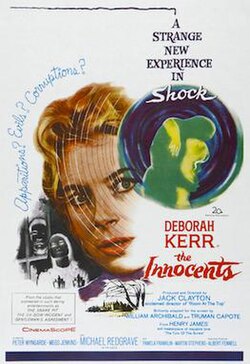
The Innocents-1961

The Innocents-1961

Director Jack Clayton

Starring Deborah Kerr

Top 250 Films #94

Top 40 Horror Films #17

Scott’s Review #639

Reviewed April 29, 2017

Grade: A

The Innocents is a 1961 British psychological horror film that tells a ghost story, based on the novella “The Turn of the Screw” by Henry James.

Although it is a horror film, it contains few traditional elements, such as contrived frights, jumps, and blood.

Instead, the film succeeds by using lighting and magnificent cinematography by Freddie Francis.

And, of course, fantastic storytelling and direction from Jack Clayton.

Deborah Kerr gives an excellent turn as a beleaguered governess hired by a wealthy bachelor (Michael Redgrave) to tend to his young niece and nephew, Flora and Miles.

The setting is a lavish yet creepy mansion located outside London. As the Uncle goes away to India on business, Miss Giddens, with no previous experience, is left to tend to Flora and Miles, who both begin acting strangely.

To complicate matters, Miss Giddens sees sinister ghosts lurking around the property. The ghosts are former household servants who have passed away, of whom Miss Giddens has never met.

Miss Giddens is assisted only by the kindly housekeeper, Mrs. Grose (Megs Jenkins), who tells her about the servants’ tragic deaths.

The Innocents, shot in black and white, uses sound to its advantage. This, combined with the interesting camera angles and focus shots—mainly of the ghosts Miss Giddens sees—makes the film unique and scary.

When Miss Giddens hears strange voices, she becomes convinced that Miles and Flora are playing tricks on her, engaging in games. The whispers’ sounds are haunting and do wonders for the effects, chilling the viewer as the film progresses.

Is Miss Giddens imagining the voices and visions, or is this an actual reality? Could the children be sinister and playing a vicious prank on her? Could Mrs. Grose be evil?

Nobody else within the household sees or hears anything amiss- or admits to it.

Kerr, a treasured actress, plays the part with emotional facial expressions and genuine fear, so much so that she wins the audience over as we side with and empathize with her character.

Still, is she a woman on the verge of a mental breakdown? Does she have past mental problems?

Like the uncle, we know nothing of her past, only that she claims to be the daughter of a minister. How, then, does she have stylish, expensive clothes? Could she only be pretending to be a governess? Has she run away from her past?

The Turn of the Screw is a true ghost story, but The Innocents is a bit different —it relies, successfully, on being more of a character-driven story.

As Miss Giddens becomes convinced that the servants’ spirits have possessed both children, she makes it her mission to rescue them from the spirits. We have an ominous feeling that events will not end well, and they do not.

Several scenes will frighten the viewer, as Miss Giddens sees a haggard ghost (the female servant) standing quietly in the distance by a lake while Flora dances chirpily; the image of the distant ghost is eerie and well shot.

The film draws comparisons to the classic Hitchcock film Rebecca (1940). Each is set in a large mansion and features complex villains portrayed as deceased.

Also, the main character’s sanity is in question.

With a compelling story and the nuts and bolts that deliver clever effects and a chilling conclusion, the film succeeds as an excellent, intelligent horror film.

With great acting all around, including fantastic performances by child actors, The Innocents (1961) scares the daylights out of any horror fan and uses exterior and interior scenes to make the film an all-around marvel.

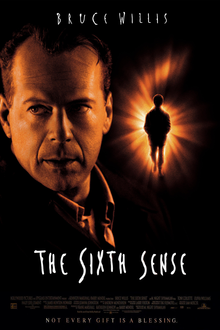
The Sixth Sense-1999

The Sixth Sense-1999

Director M. Night Shyamalan

Starring Bruce Willis, Haley Joel Osment

Top 250 Films #106

Top 40 Horror Films #20

Scott’s Review #182

Reviewed October 8, 2014

Grade: A

The Sixth Sense is a psychological thriller/horror film directed by M. Night Shyamalan, released in 1999, about ghosts, and was an incredible box-office and critical success at the time of its release, making the line “I see dead people” universally imitated.

Bruce Willis stars as Dr. Malcolm Crowe, a successful and admired child psychologist who lives a perfect life with his wife, Anna, in Philadelphia.

Enjoying a romantic night at home, Malcolm and Anna are interrupted by a deranged former patient, played by an unrecognizable Donnie Wahlberg.

Malcolm is shot by the patient, who also shoots himself, and the story picks up a year later as Malcolm takes an interest in Cole, a troubled 9-year-old boy, played by Haley Joel Osment.

Cole is a peculiar boy- an outcast taunted at school- who can see the dead.

He’s worried about his overworked mother, Lynn, who Toni Collette plays.

Meanwhile, Malcolm and Anna appear to be experiencing marital problems and lack meaningful communication with each other.

Anna begins to be pursued by a new beau, much to Malcolm’s chagrin. Malcolm and Cole develop a special bond as Malcolm convinces Cole to speak to and help the ghosts that he sees rather than be terrified of them.

As the plot slowly unfolds, Cole helps a recently deceased girl named Kyra Collins, who is around his age. Kyra gives Cole a videotape that reveals she was murdered and proves who killed her.

The subsequent scene is my favorite- there is a haunting quality to it, and the camera follows the events interestingly, slowly, and sedately.

The setting is a service at Kyra’s house, where family and friends gather to pay respects and support Kyra’s parents. Malcolm and Cole arrive and present Kyra’s father with the plain videotape.

The entire scene is powerful in its simplicity, yet it carries great emotional weight. It is slow, but devastating in its climax and reveals. Small nuances are revealed- why is Kyra’s mother wearing bright red when the other guests are all wearing black? Will Kyra’s younger sister be the next victim?

Superlative filmmaking.

A scene involving Cole’s teacher is riveting: sensing aspects of his teacher’s past, Cole realizes his teacher had a stuttering problem as a child.

When his teacher is condescending towards Cole, the young boy explodes with rage and begins a chant of “tuttering Stanley,” which reduces the teacher to childhood traumas.

Yet another powerful scene involves Cole and his mother sitting in a car caught in traffic- Cole admits the truth of his skill of seeing dead people to her and introduces an emotional story to her as proof.

This is a scene where Toni Collette shines brightly.

Well over a decade since The Sixth Sense was released, most people know the twist and the subsequent surprise ending, and it is such a joy to go back, see the manipulations in the story and in individual scenes, add them up, and revel in the clever way Shyamalan puts them together.

The Sixth Sense is not dated and is quite fresh, holding up tremendously well, and I still get chills during the big reveal all these years later.

But beyond this pleasure, the film is beautifully written. Somewhere between horror and psychological thriller, it successfully tells a ghost story with interesting characters and jumps-out-of-your-seat thrills that are not contrived or predictable in the traditional horror-film way.

From an acting perspective, Bruce Willis is amazing and under-appreciated as Malcolm- he is calm, cool, and collected. His performance is quite understated as the inquisitive and pensive psychologist.

More praise should have been reaped for Willis.

Haley Joel Osment gives an astounding performance of a lifetime- he emits an image to the audience of being strange yet sympathetic, and he relays his very frightening fear of the ghosts so well that the pain and conflict he endures are evident on his face.

Toni Collette is effective as the scared, concerned, haggard mother. Collette and Osment were rewarded with Academy Award nominations- sadly, Willis was not.

Shyamalan was subsequently ridiculed for his later films (The Village, 2001, and Unbreakable, 2001) – perhaps the manipulation and trickery from The Sixth Sense angered some people.

The Sixth Sense (1999) is a film that remains with you for days, weeks, even years, and can be revisited and rediscovered for an intelligent, chilling good time.

Oscar Nominations: Best Picture, Best Director-M. Night Shyamalan, Best Supporting Actor-Haley Joel Osment, Best Supporting Actress-Toni Collette, Best Screenplay Written Directly for the Screen, Best Film Editing

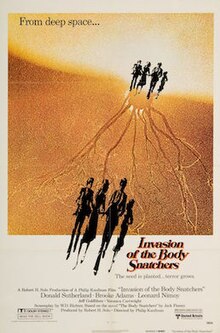
Invasion of the Body Snatchers-1978

Invasion of the Body Snatchers-1978

Director Philip Kaufman

Starring Donald Sutherland, Brooke Adams, Veronica Cartwright

Top 250 Films #217

Top 40 Horror Films #31

Scott’s Review #1,434

Reviewed July 22, 2024

Grade: A-

Even though this film is a remake and remakes are usually not as good as the original, I am partial to the 1978 version of Invasion of the Body Snatchers versus the 1956 release.

This might even be one of the best remakes ever.

The 1950s version has a campy science-fiction element popular in the decade, featuring frightening, otherworldly elements like The Day the Earth Stood Still (1951) or Invaders from Mars (1953), which were meant to promote the idea of invaders taking over Earth.

This was enough to scare the bejesus out of middle America, USA, and their white picket fence-encased neighborhoods.

The 1970s version eschews camp in favor of a straight-ahead sci-fi/horror hybrid. A glamorous, artistic approach oozes from the 1970s and from various exterior sequences in San Francisco, making it superior to the original.

It’s a more polished and mainstream-ready product that works better for this film.

By far the best scene is the final scene between a perfectly cast Donald Sutherland and Veronica Cartwright, which left chills going up and down my spine.

I won’t spoil the fun, but suffice it to say that the actor’s facial expressions make the scene exceptional, especially when paired with the creepy sound effects.

Director Philip Kaufman also toys with his audience when he teeters ambiguously between his leading ladies. Is Cartright the ‘final girl’ or is it Brooke Adams? In parallel to Hitchcock’s Psycho (1960), the lead may not be who you assume it to be.

Matthew Bennell (Donald Sutherland) is a health inspector who assumes that when his friend and colleague Elizabeth (Brooke Adams) complains of her husband’s strange mood, it’s a cheating husband or an exaggerated concern.

He begins to worry, however, as more people report similar observations about their loved one’s strange behavior.

His concern is confirmed when writer Jack Bellicec (Jeff Goldblum) and his wife (Veronica Cartwright) discover a mutated corpse that creates a citywide epidemic in which humans are replaced by alien doubles devoid of humanity or emotion.

The casting is first-rate, especially because Sutherland is front and center. The actor does wonders with his bulging blue eyes and a spacey demeanor. This works well in a film where we wonder whether his character is ‘one of them’.

He’s also a good actor and easily carries the film along with Adams and Cartright.

Kaufman peppers the film with eerie atmospheric elements like the mysterious parasitic alien race scurrying to harvest before their planet dies, and small seed pods amid hallucinogenic pink flowers.

The success is mainly due to the audience being left uncertain about whether to hate the aliens or feel sorry for them. Since they are ambiguous, this leaves confusion and, therefore, a sense of empathy.

Speaking of the exterior sequences, a great one takes place on the streets of San Francisco, where a hysterical man warns Elizabeth and Matthew of danger as a mob pursues him. He is then killed in a hit-and-run, surrounded by emotionless onlookers.

Eagle-eyed viewers will spot Kevin McCarthy, the leading man in the 1950s film, and director Don Siegel.

When this scene plays, it is eerie and underscores that the small group of friends must stick together against a mob of clones.

Wisely, Kaufman assures readers that the story does not play for laughs or appear over-the-top or silly. The gritty camera angles, superior makeup crew, and wonderfully practical sound effects confirm that he is making a film to be remembered.

Taking what the 1950s version created but only scratched the surface of the potential during a cinematically safe decade, the 1978 Invasion of the Body Snatchers has muscle and compels from start to finish.

Years later, it still holds up wonderfully well alongside similar stylistic and popular horror films such as Jaws (1975), Carrie (1976), Dawn of the Dead (1978), and Halloween (1978).

On a larger level, it also confirms the 1970s as the greatest decade for horror films.

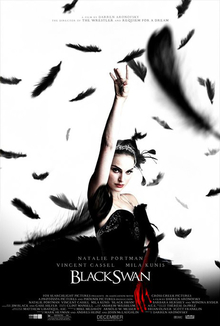
Black Swan-2010

Black Swan-2010

Director Darren Aronofsky

Starring Natalie Portman

Top 250 Films #221

Scott’s Review #735

Reviewed March 22, 2018

Grade: A

Darren Aronofsky, the director famous for the psychological and bizarre, most notably 2000’s Requiem for a Dream, 20008’s The Wrestler, and 2017’s mother!, can easily add 2010’s Black Swan to this category.

He weaves an unsettling tale involving the world of ballet centered around the Tchaikovsky work Swan Lake.

The film is dark, eerie, perverse, and utterly mind-blowing in its creativity- in short, Black Swan is a masterpiece.

The film reaped several Academy Award nominations, including a win for Natalie Portman as Best Actress.

In the competitive New York City ballet company, art director, Thomas Leroy (Vincent Cassel), is preparing to open the season with the compelling and complex, Swan Lake.

Deemed “too old,” star ballerina Beth McIntyre (Winona Ryder) is forced into retirement, much to her chagrin, allowing others to audition for the coveted lead role.

Aspiring talent, Nina Sayers (Portman), gives a flawless audition as the White Swan but lacks the depth to succeed as the Black Swan.

Despite this point, Nina wins the role and slowly becomes psychotic as she begins to embody the Black Swan in her quest for perfection.

Center stage, Portman embodies her character with mystique as we never know if she is living her dual role or if someone is messing with her.

As strange events begin to occur, Nina is insecure and on edge throughout- as she desperately wants to give testament to White Swan/Black Swan, she does not feel confident in the skin of Black Swan. She eventually teeters toward the edge of insanity.

Deserving the Oscar statuette she won, Portman delivers the best role of her career.

Black Swan would not have been the success that it was without the talents of the three most prominent supporting characters- Cassel, Mila Kunis (at the time unknown), as Lily/Black Swan, and legendary talent Barbara Hershey as Nina’s supportive yet haggard mother, Erica.

Just as Nina grows both suspicious of and distrustful of each of these characters’ motivations, so does the audience.

Is Lily a trusted friend? What does Nina know of her? Is Cassel’s Thomas manipulating Nina for a great performance or does he have sexual designs on her?

Is Erica a loyal confidante, a jealous bitch, vengeful about her stalled career?

The final scene of the film is a masterpiece in itself and perfectly wraps up the film in a perplexing, grotesque style.

As the big night finally arrives and doubt is cast on whether or not Nina will perform successfully, the entire scene is a riveting, climactic experience.

One will never forget the final shot of Nina, gushing with blood, and a grimace caked in stage makeup, as she professes a perfect performance to her musical director and castmates.

With this scene, we are left wondering whether she will ever recover from this performance.

The fabulous musical score is haunting and effective, and each piece is perfectly placed within the appropriate scene.

The heavy use of violins gives the soundtrack a frightening, almost horrific screeching quality, and the Chemical Brothers’ electronic songs, importantly used during Nina and Lily’s wild night out clubbing, are tremendously effective.

The 1948 masterpiece The Red Shoes, directed by the controversial Michael Powell, must have influenced Aronofsky.

Both contain similar subject matters of ballet and dancing on the edge of sanity; I can hardly think of two better films to serve as companion pieces, watched in tandem, than these two timeless greats.

Darren Aronofsky, along with a perfectly cast company with stellar, bombastic actors, and a classical music score by the great Tchaikovsky, with electronic elements mixed in, delivers a piece that works in spades.

2010’s chilling Black Swan is a modern-day classic that will be discussed as much as it is remembered as an incredibly important film.

Oscar Nominations: 1 win-Best Picture, Best Director-Darren Aronofsky, Best Actress-Natalie Portman (won), Best Cinematography, Best Film Editing

Independent Spirit Award Nominations: 4 wins-Best Feature (won), Best Director-Darren Aronofsky (won), Best Female Lead-Natalie Portman (won), Best Cinematography (won)

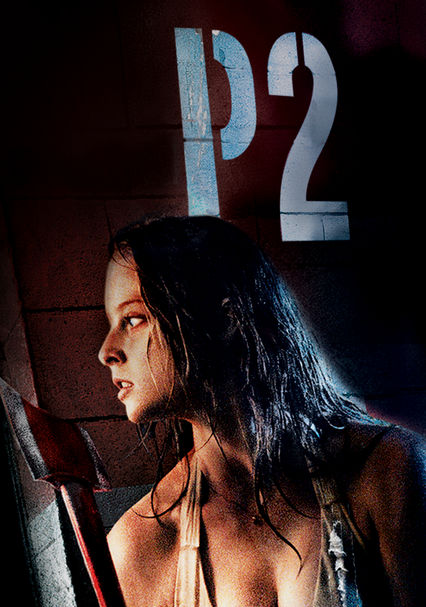
P2-2007

P2-2007

Director Franck Khalfoun

Starring Rachel Nichols, Wes Bentley

Scott’s Review #1,106 

Reviewed January 29, 2021

Grade: B

Franck Khalfoun, a French filmmaker known for the horror genre, makes his directorial debut with P2 (2007).

As a horror buff, I thought the film had a great premise, which made me immediately want to see it. Unfortunately, while the film has its moments of intrigue and plenty of gore, the climax ultimately disappoints, and it turns run-of-the-mill.

Like many of its modern horror brethren, there is little that separates it from other similar films.

It’s fine Saturday night viewing fare, but quite predictable.

Films set during the Christmas holiday, especially in festive New York City, always enrapture me, so P2 gets a leg up.

The film doesn’t utilize the holiday very well, save for a smattering of decorations within an office building, some snow, and one creepy holiday song.

Set on Christmas Eve, the plot follows a young businesswoman named Angela (Rachel Nichols) who becomes trapped in an underground parking garage in midtown Manhattan.

She is pursued by a psychopathic, unhinged security guard (Wes Bentley), who is obsessed with her.

Bentley, known for his terrific role in American Beauty (1999), is the main reason to see this film. He plays creepy and obsessed very well and is a great villain.

His piercing blue eyes are intense and frightening, and his obsession with Elvis Presley and his dog is revealed. He is disturbed, though, for no apparent reason, which is not positive to any character development.

Why is he crazy?

When Thomas plays Elvis Presley’s “Blue Christmas” over the intercom, it’s a festive and delightfully morbid highlight.

I desired to know what makes Thomas tick and why he hunts Angela. Has he been watching her for months, or does he see an opportunity on this particular night and go for the gusto?

The plot reveals a bit of both, which is unsatisfying because there is no payoff.

Does he knock out and kidnap Angela because she rebuffs his advances, or would he have done this anyway if she had agreed to dinner?

He is in love with her, but why? It’s not that she isn’t a catch. She is pretty and a successful businesswoman with a good head on her shoulders. Does she reject him because she gets a bad vibe or because he’s a security guard?

I wanted more backstory for both main characters, but once she is chained to a table, it hardly matters. He’s gone too far off the deep, especially after it’s revealed he has killed others. Thomas’s motivations are not satisfying.

Nichols, a novice actress, is very good at her role. She carries the film and is in a state of peril most of the time. But she neither overacts nor plays the victim.

There is a nice balance between the terror and the task of figuring out what steps to take to save her life and flee the madman.

P2 has a female-empowerment vibe, but Angela does appear in skimpy clothing, thus reflecting the standard state of undress required of their female stars, a formula many horror films stick to.

Angela is smart, quick-thinking, and strong. She tries to outsmart her capturer, and more often than not, she does, and she is victorious in the end.

Surprise!

I noticed multiple nods to the Saw (2004-present) franchise since this series introduced and embraced the torture-horror genre.

Many horror films use this technique to shock and startle viewers rather than offering clever writing or stories. The use of videotape appears in P2, which borrows heavily from Saw.

P2 (2007) is a fine effort and will satisfy horror fans. It may tread into familiar territory and back itself into a corner with limited story possibilities.

Still, I did look over my shoulder a couple of times after viewing the film when I was in my building’s parking garage.

Ironically, I was on level P2.

Maybe the film did leave an impression after all?

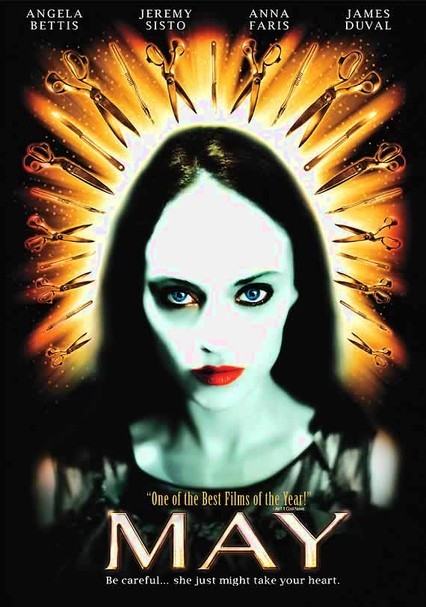
May-2003

May-2003

Director Lucky McKee

Starring Angela Bettis

Scott’s Review #985

Reviewed January 30, 2020

Grade: B+

May (2003) is a macabre and twisted psychological horror film and the directorial debut of Lucky McKee.

Though not a box-office success, the film has become a cult favorite and is a feast for lovers of the deprived and tormented.

The wicked fun is to watch the main character, already troubled at the start of the film, dissolve into complete and utter madness.

The acting and the mood are exceptionally crafted.

Growing up with a lazy eye, leaving her scarred with never-ending insecurity, May Canady (Angela Bettis) is a twenty-eight-year-old woman who has suffered from a troubled childhood.

Having always had trouble making friends, she finally befriends a lesbian colleague, Polly (Anna Faris), and a handsome mechanic, Adam (Jeremy Sisto).

Before long, she spoils the friendship when her oddities brim to the surface. May descends into utter madness and decides to build a new friend using human body parts.

Will bits and pieces of her friends be used in the creation?

Bettis is a goldmine in the central role, providing a healthy dose of sympathy and creepiness.

Many film characters have been outright disturbing in cinematic history, but May is wounded and victimized, so we, as viewers, want to see her win out for once.

All May wants is a friend, and, especially with Adam, we root for her to find true love.

May is like a combination of Carrie and Frankenstein.

Adam, while handsome, is also weird, and a good match for May. He introduces her to a bizarre movie in which two characters embark on a romantic picnic and then eat each other. Adam reveals that he created the film for a college project.

This impresses May- finally, she has a soulmate! She quickly ruins the moment by biting his lip, turning him off, and destroying her mounting confidence.

McKee is successful at making the film flow with precision and good pacing. Many rookie directors seem overwhelmed by a major motion picture undertaking, perhaps feeling more comfortable with short films.

McKee proves he knows his stuff with an elegant and icy atmosphere that is just perfect for this type of film.

May is a quick one hour and thirty-three minutes, which is all that is needed to make its mark.

The final thirty minutes are the best part as the shit hits the fan in a big way. McKee’s choice to use Halloween night as the backdrop is both obvious and ingenious.

May is not only ignored by Adam, but also learns that he has a new girlfriend. To add insult to injury, Polly also finds love with their new girlfriend, Ambrosia.

May feels isolated and finally snaps when her cat ignores her. She goes on a rampage and hacks up not only her friends but also her eye.

May is a clever and atmospheric horror/thriller film with bursts of creativity and a well-flowing narrative. McKee may not always be original and borrows heavily from other genre films, but he creates a solid blueprint for what his talents may lead to.

The film leaves the viewer unnerved and aghast, but isn’t that the point of a good horror film?

May (2003) could disappear over time, but it provides a worthy dedication to the horror genre.

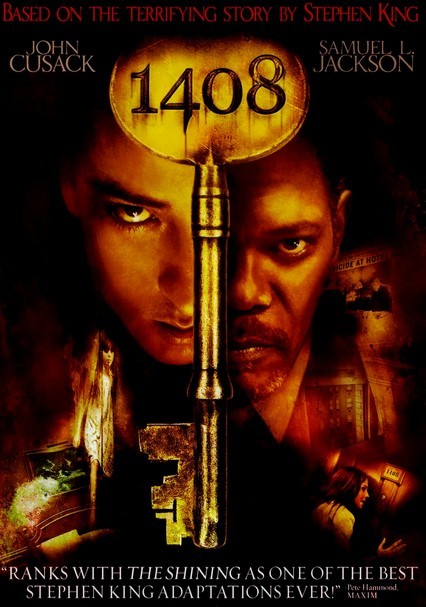
1408-2007

1408-2007

Director Mikael Hafstrom

Starring John Cusack, Samuel L. Jackson

Scott’s Review #983

Reviewed January 23, 2020

Grade: C+

A bundle of film adaptations of Stephen King novels has been born over the years.

1408 (2007) is one of many, and while suspenseful, the project might have been better served as a quick fifty-minute episodic television event rather than a big-screen effort.

The content seems displaced and disjointed, stretched too thin.

Nonetheless, big stars like John Cusack and Samuel L. Jackson provide some stamina to a film that slowly teeters into nonsense and a confusing conclusion.

Based on Stephen King’s 1999 short story of the same name, the film follows Mike Enslin (Cusack), an author who investigates allegedly haunted houses, and rents the titular room 1408 at the Dolphin, a New York City hotel, to see what all the fuss is about.

Although skeptical of the paranormal, he soon finds he cannot leave the room as bizarre events unfold.

The hotel manager, Gerald Owen (Jackson) attempts to convince Mike not to inhabit the notorious room, and intriguing is why?

The film is most successful when it focuses on the atmospheric and tense moments. The lighting and camera techniques evoke a closed-in, claustrophobic aura because the set is mostly a hotel room.

The use of psychological tension works better than a slice-’em, dice-’em approach.

During Mike’s examination of his room, the clock radio suddenly starts playing “We’ve Only Just Begun”, a hit song by The Carpenters. Mike assumes that Olin is pulling a prank to scare him.

At 8:07, the song plays again, and the clock’s digital display changes to a countdown starting from “60:00.”

This is creepy, and the viewer is intrigued by what will happen next.

The window slams down and wounds Mike’s hand. He begins to see ghosts of the room’s past victims, followed by flashbacks of his dead daughter Katie and his sick father.

This catapults Mike into terror, and he attempts to escape the room, fearing for his life.

He fails to escape, and the room appears to hold him prisoner until his wife, Lily (Mary McCormack), comes to the rescue.

What does Olin have to do with the events? Is Lily sinister or benevolent?

When Mike is out of the hotel room, the film falls apart. Containing too many weird circumstances to make much sense- a surfing event on the beach, a Molotov cocktail, a fire alarm, and a return to the hotel room- spins the viewer in too many directions as a hallucinogenic experience is created.

Before long, the viewer will stop caring. I know I did. On paper, these oddities sound intriguing, but they did not translate well to the screen.

Hafstrom directs the activity adequately and uses actors viewers are familiar with, which adds to its credibility.

With fewer talents or unknowns, the film might have felt low-budget or independent, and I think it, while not great, needs these actors to lend professionalism.

The star is naturally Cusack, who enjoys the most screen time as a man who only believes what his eyes and ears tell him, and not the silliness of spirits and ghosts.

The actor possesses an offbeat look, which adds to the film.

From a storyline perspective, 1408 never really catches fire. The film is neither pitiful nor a great adaptation of a Stephen King novel. The novel is hardly a household name, which does the film a few favors.

The result is fair to middling, with a promising first half followed by a dour second. 1408 (2007) will be forgotten five years after its release.

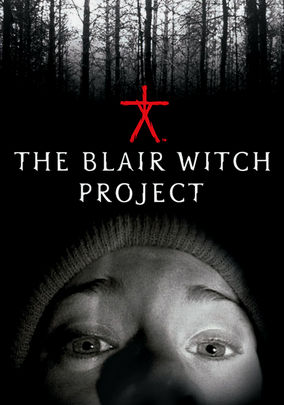
The Blair Witch Project-1999

The Blair Witch Project-1999

Director Daniel Myrick, Eduardo Sanchez

Starring Heather Donahue, Joshua Leonard, Michael Williams

Scott’s Review #761

Reviewed May 22, 2018

Grade: A

When a horror film “scares the viewer to death,” then that film has superseded what it has intended to do, since horror films are a dime a dozen these days.

Fondly remembering sitting in a crowded and very dark movie theater to see The Blair Witch Project (1999), I was left both mesmerized and clutching my seat for dear life.

This film had an enormous impact on me.

The film wisely uses hand-held cameras (black-and-white 16mm film) and Hi-8 video, manipulating the audience into using their imaginations and leading to terrifying results, making it one of the scariest horror films of the 1990s.

Sometimes what you don’t see is much more frightening than what is seen on screen.

In 1994, three college-aged amateur filmmakers (Heather, Michael, and Joshua) decided to hike to Burkittsville, Maryland, to film a documentary about a legend known as the “Blair Witch”.

The witch is reportedly responsible for mysterious deaths and disappearances over the past two hundred years. They interview, wander, and joke around with each other as a sense of dread begins to develop.

According to the film, the trio themselves disappear, but a year later, their equipment is found fully intact, and the film footage can be viewed.

The 1999 film is professed to be the footage left behind by the group.

Throughout the film, we watch the individuals conduct interviews with the townspeople and eventually get lost in the woods at nightfall, forced to stay the night as a mysterious entity terrorizes them.

Numerous creepy noises and rustlings scare the group.

In retrospect, with more insight and knowledge about the film, it may be easy for critics to dismiss The Blair Witch Project as either a hoax or a complete manipulation, but in 1999, audiences flocked to the theaters in droves as word of mouth spread.

I saw the film twice on the big screen and was frightened equally with each viewing. More importantly, with the onset of the reality television craze, the film was clever in capitalizing on this trend, so it is to be championed.

Timing is everything!

In the film genre, The Blair Witch Project used buzz and word of mouth to elicit interest before the film was even released- and then the craze began.

The film was highly influential to subsequent releases that also chose to utilize camcorders as their method of storytelling- think 2007’s Paranormal Activity and 2008’s Cloverfield.

The Blair Witch Project is similar in tone to older masterpieces such as 1974’s The Texas Chainsaw Massacre and 1968’s Night of the Living Dead- independent releases made on a shoestring budget that became enormously successful.

As with these films, the camerawork was crucial to achieving the necessary realism.

What makes The Blair Witch Project enormously authentic is the tricks used not only on the audience but also on the cast. Reportedly, the film was almost entirely improvised, including dialogue and situations that the characters faced.

The actors began to feel as if the events they were supposed to act out were happening- their map disappeared, and noises were created to frighten them.

This clever approach to Method acting elicited the perfect responses from all involved- especially as they got colder, hungrier, and more desperate.

My concern is how well 1999’s The Blair Witch Project will hold up over the years. Phenomenally effective and tremendously profitable at the time, the film has inspired dozens of imitations since its release.

So much so that it makes the original idea seem dated.

One thing remains true- the film gave the horror genre a much-needed breath of fresh air and influenced many films to come.

Independent Spirit Award Nominations: 1 win-Best First Feature (Under $500,000) (won)

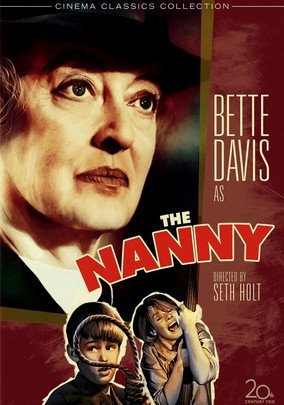
The Nanny-1965

The Nanny-1965

Director Seth Holt

Starring Bette Davis

Scott’s Review #256

70089620

Reviewed July 11, 2015

Grade: B

The Nanny is a 1965 Hammer productions thriller starring legendary film icon Bette Davis as a mysterious nanny caring for a ten-year-old boy named Joey.

Joey has recently been released from a mental institution and returned home to resume everyday life, but has he been “cured”?

There is obvious tension between Joey and Nanny, but the audience doesn’t know what that tension is precisely. Why do they dislike each other? Why is Joey afraid of her?

As the plot unfolds, the suspense and tensions thicken as various events occur and Joey’s parents and Aunt Pen are further fleshed out. Past events are revisited, and the story becomes thrilling.

At one point, long before Joey’s return home, his younger sister has drowned, and the circumstances are vague. It has devastated the family, including Nanny. Joey has been blamed for her death, though he insists that Nanny is the culprit.

Nobody except the neighbor girl believes Joey, and the audience wonders who to believe and who to root for: Joey or Nanny. Davis, like Nanny, brings a warmness to her character, but is she sincere? Is it an act? Is Joey a sweet boy or maniacal?

These questions race through the audience’s minds as the film progresses. When Virginia, the mother, eats tainted food, the obvious conclusion is that the Nanny poisoned it since she prepared it. But why? Did she do this?

As the plot is slowly explained, there are a few chills, though the ending is not too surprising.

Any film starring Bette Davis is a treasure, though admittedly, it is not her finest work. Still, her finest work is challenging to match.

The Nanny is a good film, though not great. It is shot in black and white, which is a nice touch for a thriller.

The main reason to watch Davis’s performance is that it is always mesmerizing. Traditionally playing gruff, mean, or bitchy parts (especially in her later years), The Nanny allows Davis to play a sympathetic role.

She is seemingly sweet, proper, well-organized, and a perfect nanny on paper.

The role of Virginia, played by Wendy Craig, is a bit too neurotic and slightly over-acted. She is rather one-note as the fretting mother worried about her son. The character of the father is also a bit one-dimensional.

The Nanny is more of a classic thriller from the 1960s that is often lumped together with some of Bette Davis’s other films around the same period (Dead Ringer-1964, Hush, Hush, Sweet Charlotte-1964, and Whatever Happened to Baby Jane? -1966), and are in large part superior to The Nanny. As a stand-alone, it is a decent film.