Category Archives: 90’s Horror

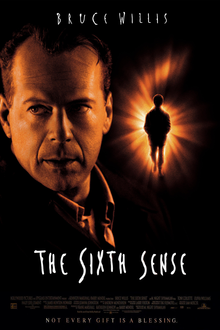
The Sixth Sense-1999

The Sixth Sense-1999

Director M. Night Shyamalan

Starring Bruce Willis, Haley Joel Osment

Top 250 Films #106

Top 40 Horror Films #20

Scott’s Review #182
Reviewed October 8, 2014

Grade: A

The Sixth Sense is a psychological thriller/horror film directed by M. Night Shyamalan, released in 1999, about ghosts, and was an incredible box-office and critical success at the time of its release, making the line “I see dead people” universally imitated.

Bruce Willis stars as Dr. Malcolm Crowe, a successful and admired child psychologist who lives a perfect life with his wife, Anna, in Philadelphia.

Enjoying a romantic night at home, Malcolm and Anna are interrupted by a deranged former patient, played by an unrecognizable Donnie Wahlberg.

Malcolm is shot by the patient, who also shoots himself, and the story picks up a year later as Malcolm takes an interest in Cole, a troubled 9-year-old boy, played by Haley Joel Osment.

Cole is a peculiar boy- an outcast taunted at school- who can see the dead.

He’s worried about his overworked mother, Lynn, who Toni Collette plays.

Meanwhile, Malcolm and Anna appear to be experiencing marital problems and lack meaningful communication with each other.

Anna begins to be pursued by a new beau, much to Malcolm’s chagrin. Malcolm and Cole develop a special bond as Malcolm convinces Cole to speak to and help the ghosts that he sees rather than be terrified of them.

As the plot slowly unfolds, Cole helps a recently deceased girl named Kyra Collins, who is around his age. Kyra gives Cole a videotape that reveals she was murdered and proves who killed her.

The subsequent scene is my favorite- there is a haunting quality to it, and the camera follows the events interestingly, slowly, and sedately.

The setting is a service at Kyra’s house, where family and friends gather to pay respects and support Kyra’s parents. Malcolm and Cole arrive and present Kyra’s father with the plain videotape.

The entire scene is powerful in its simplicity, yet it carries great emotional weight. It is slow, but devastating in its climax and reveals. Small nuances are revealed- why is Kyra’s mother wearing bright red when the other guests are all wearing black? Will Kyra’s younger sister be the next victim?

Superlative filmmaking.

A scene involving Cole’s teacher is riveting: sensing aspects of his teacher’s past, Cole realizes his teacher had a stuttering problem as a child.

When his teacher is condescending towards Cole, the young boy explodes with rage and begins a chant of “tuttering Stanley,” which reduces the teacher to childhood traumas.

Yet another powerful scene involves Cole and his mother sitting in a car caught in traffic- Cole admits the truth of his skill of seeing dead people to her and introduces an emotional story to her as proof.

This is a scene where Toni Collette shines brightly.

Well over a decade since The Sixth Sense was released, most people know the twist and the subsequent surprise ending, and it is such a joy to go back, see the manipulations in the story and in individual scenes, add them up, and revel in the clever way Shyamalan puts them together.

The Sixth Sense is not dated and is quite fresh, holding up tremendously well, and I still get chills during the big reveal all these years later.

But beyond this pleasure, the film is beautifully written. Somewhere between horror and psychological thriller, it successfully tells a ghost story with interesting characters and jumps-out-of-your-seat thrills that are not contrived or predictable in the traditional horror-film way.

From an acting perspective, Bruce Willis is amazing and under-appreciated as Malcolm- he is calm, cool, and collected. His performance is quite understated as the inquisitive and pensive psychologist.

More praise should have been reaped for Willis.

Haley Joel Osment gives an astounding performance of a lifetime- he emits an image to the audience of being strange yet sympathetic, and he relays his very frightening fear of the ghosts so well that the pain and conflict he endures are evident on his face.

Toni Collette is effective as the scared, concerned, haggard mother. Collette and Osment were rewarded with Academy Award nominations- sadly, Willis was not.

Shyamalan was subsequently ridiculed for his later films (The Village, 2001, and Unbreakable, 2001) – perhaps the manipulation and trickery from The Sixth Sense angered some people.

The Sixth Sense (1999) is a film that remains with you for days, weeks, even years, and can be revisited and rediscovered for an intelligent, chilling good time.

Oscar Nominations: Best Picture, Best Director-M. Night Shyamalan, Best Supporting Actor-Haley Joel Osment, Best Supporting Actress-Toni Collette, Best Screenplay Written Directly for the Screen, Best Film Editing
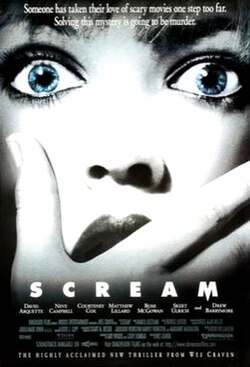
Scream-1996

Scream-1996

Director Wes Craven

Starring  Neve Campbell

Top 250 Films #161

Top 40 Horror Films #25

Scott’s Review #710

Reviewed January 5, 2018

Grade: A-

Wes Craven’s 1996 film Scream is a film that greatly helped bring the horror genre back into relevance after a long drought in the late 1980s and early 1990s, when horror films suffered from both oversaturation and clichéd messes.

Thanks to Scream, creativity and plot twists and turns returned to the forefront of good horror films, and a clever film was born.

Fast-forward to 2018, and the film does suffer a bit from a dated 1990s look, but it is still great fun to watch and a treat for all classic horror buffs, with references to classic greats galore.

The film is sectioned off nicely and gets underway quickly (in the best sequence of the film) as Casey Becker (Drew Barrymore) receives a flirtatious phone call from a man asking her to name her favorite horror film while making popcorn.

The friendly game quickly turns vicious as the caller threatens to kill her boyfriend should she answer a question incorrectly.

In a clever twist (think 1960s Psycho!) Casey and her boyfriend meet deadly fates as the opening credits roll.

Given Barrymore’s huge star in 1996, this twist was all the more shocking and attention-grabbing.

The remainder of the film centers around Sidney Prescott (Neve Campbell), a popular California high school student, as she is pursued by an attacker known only as “Ghostface”, who dons a creepy costume and terrorizes victims via phone calls.

The small town, led by police officer Dewey Riley (David Arquette) and bitchy newswoman Gale Weathers (Courteney Cox), is determined to unmask the killer and understand their motivations.

Sidney’s boyfriend, Billy (Skeet Ulrich), and other friends are along for the ride as a possible connected sub-plot involving Sidney’s deceased mother is introduced.

A romance between Dewey and Gale is also broached.

Scream is an enormous treat for fans of the horror genre, with numerous references (and film clips!) to classics such as 1978’s Halloween throughout.

Other references to Friday the 13th, Prom Night, and A Nightmare on Elm Street appear during the film.

Writer Kevin Williamson, a horror enthusiast, must have had a ball writing the screenplay that would become Scream.

In 1996, the mega-success of the film not only jump-started the entire genre but also introduced younger fans of Scream to classics from their parents’ generation, sparking their interest in the films.

Classic horror films are not only referenced during the film but also explained, mostly by the supporting character of Jamie, the nerdy kid who works at the video store and adores horror films.

A sequence in which he explains several “rules” of the horror genre is superlative, creative, and just great fun. He tells the teenagers at a party that anyone who drinks, has sex, or says “I will be right back” is doomed to suffer a violent fate.

This clever writing makes Scream enormous fun to watch.

The climax of Scream is quite surprising in itself, and the “great reveal” of the murderer (s) is also intelligent writing and quite the surprise.

Several red herrings are produced along the way, casting suspicion on other characters who may or may not be the killers.

A small gripe of the writing is the motivations of the murderers- when the explanation is given for their killing spree, the reasoning is a bit convoluted and hard to fathom, but this is horror. Suspension of disbelief is always a necessity.

Scream is best remembered for giving the horror genre a good, hard kick in the seat of the pants and shaking up the elements a bit while preserving the core ideals of a good slasher film (suspense, a whodunit, and good, solid kills).

Scream (1996) was followed by several sequels, some of which achieved greater success than others.

In 2018, the film may not be quite as fresh as it once was, but it is still a solid watch and memorable for relaunching a genre.

The Faculty-1998

The Faculty-1998

**Updated Review- Original Review in 2017**

Director Robert Rodriguez

Starring Josh Hartnett, Jordanna Brewster, Clea Duvall

Scott’s Review #1,227

Reviewed February 5, 2022

Grade: B

The Faculty (1998) was released during the late 1990s horror film renaissance.

Wisely, it cast film veterans who enhanced its merit, along with young rising stars who were bankable at the box office.

The film was only a moderate success but has become a cult classic over the years.

With a teacher/student dynamic that incorporates all the standard clichés that go with it, it mixes classic horror with a direct ode to Invasion of the Body Snatchers. It is enjoyable, though hardly worthy of regular viewings.

Instead, it can be part of a 1990s nostalgia night or taken out as an opening act for the comparison film Scream (1996), a similar vehicle also released by Dimension Films. The sunny yet somber high school setting is nearly identical in both films.

The Faculty is a sheer delight for teenage audiences or even twenty-somethings who can relate to the idea of their teachers being otherworldly or some such alien beings.

Stars Josh Hartnett, who had just jumped into the horror circle with Halloween H2O: 20 Years Later (1998), along with attractive, similarly aged Jordanna Brewster and Elijah Wood, lead the pack.

Piper Laurie, Robert Patrick, and Bebe Neuwirth appear in supporting roles as part of the faculty.

The setting is midwestern Ohio, where the students at Harrington High find Principal Drake (Neuwirth) and her gang of teachers a bit odd. Wacky under the best of circumstances, suddenly they become controlled by a parasite and attempt to infect the students one by one.

Cheerleader Delilah (Jordana Brewster), football player Stan (Shawn Hatosy), drug dealer Zeke (Hartnett), and new girl Marybeth (Laura Harris) team up with other classmates to fight back against the invaders.

But is one of the students the ringleader and in control of the faculty?

The horror standardizing one by one is intelligently mixed up in The Faculty. Rather than a maniac brandishing a hatchet and chopping the students to bits, they are instead infected by more subtle means.

The fun is finding out who will become an alien next and enjoying the staff’s weird behavior.

And who hasn’t imagined one of their teachers writhing around in a sports car, coquettishly toying with the hunky high school football players?

Yes, there are some plot holes to contend with and some stale attempts to pair the teens romantically. Predictably, the standard jock, cheerleader, nerd, and outcast stereotypes abound, as well as perceptions of what a school nurse, math teacher, and drama teacher look and sound like.

For good measure, one of the faculty (Salma Hayek) is ‘hot’.

There is much fun in the film and perhaps some truth, and that’s what director Robert Rodriguez showcases throughout. He doesn’t take himself or his characters too seriously, as inside jokes and role interplay in high school make for a playful, light experience.

Rodriguez is the best friend and frequent collaborator of filmmaker Quentin Tarantino, but The Faculty holds no Tarantino influence whatsoever.

My favorite line may be when Casey says to snooty Delilah Profitt, “You’re pretty cool when you’re not being a bitch”.

The film isn’t really about students versus teachers or the faculty getting their comeuppance. The target audience is the teen crowd, and they will have a marvelous time experiencing The Faculty.

Times may change, but the same teenage angst is shared across generations. The film is a good outlet for that.

Any fan of Invasion of the Body Snatchers, either the 1950s version or the 1970s remake, will notice some familiar territory.

The pods become fish, and the explanation of taking over planet Earth because another planet is dying is intentionally (hopefully!) silly with a science-fiction edge.

The film ends happily ever after, which is satisfying for the level of seriousness one must take while watching.

Borrowing heavily from other horror films near and dear to it, The Faculty (1998) carves out enough originality in the science fiction genre to warrant some props.

It’s not a measured success, but it evenly distributes pacing and entertainment.

And the big stars add a nice touch.

I Know What You Did Last Summer-1997

I Know What You Did Last Summer 1997

Director Jim Gillespie

Starring Jennifer Love Hewitt, Ryan Phillippe, Sarah Michelle Gellar

Scott’s Review #1,182

Reviewed September 29, 2021

Grade: B+

Capitalizing on the wild success of the mid-1990s horror resurgence led by Wes Craven’s Scream (1996), I Know What You Did Last Summer (1997) was a popular low-budget popcorn hit.

The year 1997 was like 1979 or 1980 when the slasher craze (part Deux) was still fresh and intriguing.

The film is fun with superior direction and a dark ambiance that works quite well for the genre.

A slew of other imitators would follow this release, including the tepid I Still Know What You Did Last Summer in 1998, but the first one is formulaic entertainment done well.

It wisely cast youthful stars of the day, chomping at the bit to be the killer’s next victim.

One hot July 4th night in the small coastal town of Southport, North Carolina, a group of four teenagers runs over a fisherman and dumps his body in the water, vowing never to speak of the incident again.

Some members of the group feel little remorse, while others are racked with guilt.

The four principals are Julie (Jennifer Love Hewitt), Barry (Ryan Phillippe), Helen (Sarah Michelle Gellar), and Ray (Freddie Prinze Jr.).

Predictably, one year later, Julie receives a frightening letter, and the group reconvenes. They fret and worry that they have been seen or, worse, that they will be exposed. The letter states, ‘I Know What You Did Last Summer.’

Someone begins to follow them, especially Julie, clad in a fisherman’s gear and wielding a meat hook.

In a way, he is a combination of other horror villains like Jason, Freddy, and Michael Myers, but we know neither his identity nor his motivation.

Does he want money or blood?

One of the groups incorrectly pursues who they think is the killer and is unceremoniously run down and terrorized. The bloodletting only continues as other townspeople become involved in the events, some amid a local Independence Day parade.

There are some obvious inclusions to the story to make sure audiences are aware they are watching a slasher flick and a teen-targeted genre flick.

This is no wonder since the screenwriter, Kevin Williamson, was best known for teen-themed writing for television’s Dawson’s Creek.

I Know What You Did Last Summer borrows from so many 1980’s slasher-flicks like Terror Train (1980), Prom Night (1980), and My Bloody Valentine (1981) that it’s a given that Williamson and director Jim Gillespie spent weekends shacked up with popcorn and sodas while watching these films for reference material.

The killer is masked. This is to make damned sure we know that we are watching a whodunit and that at the finale the killer will be exposed- think the big reveal in every Scooby-Doo episode.

Could the killer be one of the teens themselves?

Julie is immediately the ‘final girl’ simply because she feels the most guilt and is the most pursued, perhaps for that very reason.

Other necessities like the asshole jock (Phillippe), the mean girl (Bridgette Wilson), and the red herring are added on like clockwork.

We know that Julie will be the one to survive.

Still, the premise is quite compelling and immediately hooked me. I also knew that I was being manipulated, but I did not care. I couldn’t wait to find out who the killer was.

The final sequence, which ensures a sequel, is delicious and an obvious ode to Brian De Palma’s films.

A year later, in 1998, Julie is in college in Boston. As she enters the shower, she notices the words “I still know” written in the steam on the shower door.

Moments later, a dark figure crashes through it as Julie screams!

I Know What You Did Last Summer (1997) is straight-up, by-the-numbers mainstream horror, but the familiarity doesn’t detract from the enjoyment. You know what is right around the bend, and you can’t wait to get there.

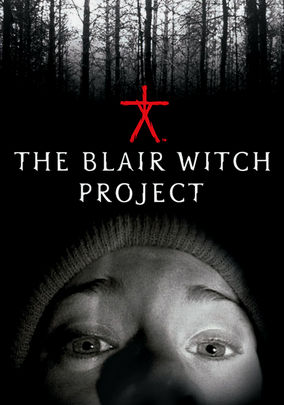
The Blair Witch Project-1999

The Blair Witch Project-1999

Director Daniel Myrick, Eduardo Sanchez

Starring Heather Donahue, Joshua Leonard, Michael Williams

Scott’s Review #761

Reviewed May 22, 2018

Grade: A

When a horror film “scares the viewer to death,” then that film has superseded what it has intended to do, since horror films are a dime a dozen these days.

Fondly remembering sitting in a crowded and very dark movie theater to see The Blair Witch Project (1999), I was left both mesmerized and clutching my seat for dear life.

This film had an enormous impact on me.

The film wisely uses hand-held cameras (black-and-white 16mm film) and Hi-8 video, manipulating the audience into using their imaginations and leading to terrifying results, making it one of the scariest horror films of the 1990s.

Sometimes what you don’t see is much more frightening than what is seen on screen.

In 1994, three college-aged amateur filmmakers (Heather, Michael, and Joshua) decided to hike to Burkittsville, Maryland, to film a documentary about a legend known as the “Blair Witch”.

The witch is reportedly responsible for mysterious deaths and disappearances over the past two hundred years. They interview, wander, and joke around with each other as a sense of dread begins to develop.

According to the film, the trio themselves disappear, but a year later, their equipment is found fully intact, and the film footage can be viewed.

The 1999 film is professed to be the footage left behind by the group.

Throughout the film, we watch the individuals conduct interviews with the townspeople and eventually get lost in the woods at nightfall, forced to stay the night as a mysterious entity terrorizes them.

Numerous creepy noises and rustlings scare the group.

In retrospect, with more insight and knowledge about the film, it may be easy for critics to dismiss The Blair Witch Project as either a hoax or a complete manipulation, but in 1999, audiences flocked to the theaters in droves as word of mouth spread.

I saw the film twice on the big screen and was frightened equally with each viewing. More importantly, with the onset of the reality television craze, the film was clever in capitalizing on this trend, so it is to be championed.

Timing is everything!

In the film genre, The Blair Witch Project used buzz and word of mouth to elicit interest before the film was even released- and then the craze began.

The film was highly influential to subsequent releases that also chose to utilize camcorders as their method of storytelling- think 2007’s Paranormal Activity and 2008’s Cloverfield.

The Blair Witch Project is similar in tone to older masterpieces such as 1974’s The Texas Chainsaw Massacre and 1968’s Night of the Living Dead- independent releases made on a shoestring budget that became enormously successful.

As with these films, the camerawork was crucial to achieving the necessary realism.

What makes The Blair Witch Project enormously authentic is the tricks used not only on the audience but also on the cast. Reportedly, the film was almost entirely improvised, including dialogue and situations that the characters faced.

The actors began to feel as if the events they were supposed to act out were happening- their map disappeared, and noises were created to frighten them.

This clever approach to Method acting elicited the perfect responses from all involved- especially as they got colder, hungrier, and more desperate.

My concern is how well 1999’s The Blair Witch Project will hold up over the years. Phenomenally effective and tremendously profitable at the time, the film has inspired dozens of imitations since its release.

So much so that it makes the original idea seem dated.

One thing remains true- the film gave the horror genre a much-needed breath of fresh air and influenced many films to come.

Independent Spirit Award Nominations: 1 win-Best First Feature (Under $500,000) (won)

Bride of Chucky-1998

Bride of Chucky-1998

Director Ronny Yu

Starring Jennifer Tilly, Brad Dourif

Scott’s Review #680

Reviewed September 11, 2017

Grade: D+

Bride of Chucky (1998) is the fourth installment in the famed late 1980s Child’s Play franchise. The late 1980s were not the best time for the horror genre in general, but the film was quite the highlight in a slew of duds.

By this time in the series (1998), the child/victim of the doll premise is dropped in favor of dark humor; the series immerses itself more into the horror-comedy arena.

A treat is the inclusion of a fantastic hard rock soundtrack led by Rob Zombie’s classic “Living Dead Girl,” which adds some points to the film’s final grade; it would have been more dismal without it.

The film is not great, and I find perverse pleasure in reviewing poor films. However, Bride of Chucky does have its place- as a late Saturday night viewing choice amid strong cocktails, it contains a certain charm.

Not to be taken seriously, the placement of a love interest for Chucky gives the film macabre romantic humor.

Still, the film suffers from lackluster acting and quickly turns into drivel by the time the credits finally roll.

The action picks up from where Child’s Play 3 leaves off, and the appearance of Chucky is now weathered and stitched, giving the doll a more gruesome and maniacal look- this works given the elimination of a child lead character.

Left for evidence in a police compound, Chucky is stolen by Tiffany Valentine, played by Jennifer Tilly.

The girlfriend of a deceased serial killer, Tiffany, is convinced that the spirit of her boyfriend exists within Chucky, and she is determined to bring him back to life using a voodoo ritual.

When the act finally works, Chucky and Tiffany reunite, but shortly afterward, Tiffany is also turned into a doll, and the duo sets out on a killing spree.

The best aspect of the film is the camaraderie between Tilly and actor Brad Dourif, who voices Chucky. The duo has a light, comic banter that is fun to watch, as well as fantastic chemistry.

Granted, the actors only voice the dolls for a small part of the film, but their back-and-forth works well.

This is what makes Bride of Chucky tongue-in-cheek- let’s face it, with talking dolls as your main characters, director Ronny Yu wisely avoids making the killings too grisly or heavy-handed, but rather, frequently uses quips and one-liners throughout the film.

As Chucky and Tiffany slice and dice their way to Hackensack, New Jersey, their motivations are to embody a neighborhood boy, Jesse, and his girlfriend Jade, played by a young Katherine Heigl.

Along the trek, the foursome faces ludicrous obstacles, including a brief introduction of a con artist couple who meet their doom when flying shards of glass cut them after stealing Jesse’s money.

The side story of Jade’s overprotective police-chief uncle, played by a miscast John Ritter, does not work at all. His schemes to plant marijuana in Jesse’s van are little more than plot-driven machinations to advance the thin plot.

The characters of Jesse and Jade are trivial and secondary, and Heigl’s acting is particularly garish, to say nothing of the lack of any chemistry between Heigl and actor Nick Stabile.

Heigl seems to wear a pout throughout the entire film. But, not to worry, these characters are as meaningless as all the others.

The gimmick ending, surely meant to “spawn” yet another sequel, is as interesting as it is grotesque, and a small highlight in a poor film.

Bride of Chucky (1998) provides a nice lineage in the franchise’s history, a killer musical score, and decent chemistry among the leads, but it also suffers a similar fate to many horror films, especially sequels: poor acting, a silly tone, and no character development.

The Faculty-1998

The Faculty-1998

Director Robert Rodriguez

Starring Josh Hartnett, Piper Laurie, Salma Hayek

Scott’s Review #648

Reviewed June 4, 2017

Grade: B

Having watched The Faculty, a  teenage horror/science fiction flick,  at the time of release in 1998 (now almost twenty years ago!), I fondly remember sitting in the movie theater watching this soon-to-be cult classic take hold of its audience.

Despite some now-dated (in 2017) special effects, the story holds up well, and what a treat to see some “stars of tomorrow” mixed in with some venerable veterans, take center stage.

The Faculty stirs up a strange hybrid of classic films (Invasion of the Body Snatchers, Alien, and The Breakfast Club) to create a fun and gory horror film.

The action takes place in a small town said to be somewhere in Ohio, though the film is shot in Texas. A football town and home to the Hornets, sports are central to Herrington High School- both to students and faculty.

It becomes immediately evident that some of the staff are not “right” after two of the teachers stab Principal Valerie Drake (Bebe Neuwirth) with a pencil and scissors and flee with no emotions late one night after a faculty meeting.

Later, student Casey Connors (Elijah Wood) confesses to his group of friends that he believes aliens are controlling the teachers.

Naturally, they are skeptical until strange events among the staff begin to take shape once the students watch the staff’s activities closely.

The film then turns into a clever whodunit as one student after another is revealed to be infected and therefore an alien.

A highlight of The Faculty is its stellar casting- there is the younger set of actors, who share great chemistry- Josh Hartnett (Zeke), Wood (Casey), Jordana Brewster (Delilah), Clea Duvall (Stokes), Laura Harris (Marybeth), and Shawn Hatosy (Stan) all make up the troupe of characters thrown together due to unlikely circumstances to figure out the big mystery- who amongst the staff is an alien and where they come from?

All of the students are from different social classes, which makes their antics unique: Zeke, the rebel; Stan, the jock; Stokes, the “weirdo”; and Casey, the nerd. In this way, the film reminds me of The Breakfast Club, a mid-1980s “coming of age” high school film.

Additionally, the staff comprises some of the best in the business- stalwart Piper Laurie appears as the drama teacher, luscious Salma Hayek as the sexy school nurse, comic Jon Stewart as the science teacher, and rugged Robert Patrick as Coach Willis.

What a treat for film fans to watch a film such as The Faculty to see a bevy of popular film and television stars amongst the cast.

Director Robert Rodriguez, best known for creative left-of-center work such as Machete (2010) and Sin City (2005), and for being a frequent collaborator with Quentin Tarantino on his edgy collection of films, helms a rather mainstream piece in The Faculty.

The film is targeted at your typical mainstream audience, with the right blend of clever quirks.

Delicious is an ode to the classic science fiction film Invasion of the Body Snatchers (1956 and 1978), only set in a suburban high school. Clever still is the revelation of the teachers as the robotic “pod people” or aliens from outer space.

This cute reference, in 1998, and still today, is an innocent knock on authority figures as the high school kids slowly get their comeuppance against some of the staff.

There comes a point in the film when nearly everyone is an alien, and it runs out of gas. However, the final scene is wonderfully constructed as the film ends as just another day in the life of a small-town high school- life goes on, and all is well.

The Faculty (1998) is a treat to watch in present times as a “trip down memory lane experience.

Halloween: H2O-1998

Halloween: H2O-1998

Director Steve Miner

Starring Jamie Lee Curtis, Josh Hartnett

Scott’s Review #504

16915002

Reviewed October 30, 2016

Grade: B

Halloween: H2O is the seventh installment of the Halloween franchise, though it is only associated, story-wise, with Halloween and Halloween II.

Made in 1998, the film capitalized on the twentieth anniversary of the original classic horror film.

To measure up to that masterpiece would be impossible, but the film is not bad on its own merits, and it offers nice nods to the past, making for a franchise pleaser.

Jamie Lee Curtis returns to the role that made her famous.

Before we are even reintroduced to Curtis’s character, we are treated to a nostalgic scene involving chain-smoking Nurse Marion Chambers (Nancy Stephens) from parts I and II.

Michael Myers vandalizes her house as he steals a file she has kept on Laurie Strode.

How nice to see this character back in the fray- though her screen time is limited. She is pivotal to the kick-off of the new story.

Laurie (Curtis) has faked her death and is now living life anew in California- running a prep school as its headmistress. Her son John (Josh Hartnett) attends the school, and her boyfriend Will (Adam Arkin) teaches there.

John’s girlfriend Molly (Michelle Williams), a poetic security guard (LL Cool J), and a dizzy secretary, Mrs. Watson (Janet Leigh), round out the cast.

For the past twenty years, Laurie has been troubled by the notion of Michael Myers returning to kill her, and her fears come to fruition. The film has an interesting slant- no longer is Laurie the victim, cowering in cars and corners.

Now, she is intent on exacting her revenge on Michael- her brother.

She wants this long chapter in her life to finally close.

What nods to history does this film contain! And that is the best part of it. Otherwise, without the history, it would be a run-of-the-mill slasher film.

Besides the obvious Michael/Laurie connection, what a treat to see Jamie Lee Curtis’s real-life mother (and original scream queen herself), Janet Leigh.

Furthermore, her character’s car is the exact make and model, and the same license plate, from the 1960s Psycho, in which she starred- a brilliant treat for horror and classic film fans.

The film also uses some impressive stylistic choices- the use of mirrors and reflections is used successfully, as well as events occurring in the background- seen by the audience, but not by the other characters, are well used.

Halloween: H2O features several young, up-and-coming stars who would go on to become big stars (Hartnett, Williams, and a very young Joseph Gordon-Levitt).

Who knew these talents got their start in one of the greatest horror franchises?

Let’s be clear- Halloween: H2O (1998) is not a masterpiece- far from it. The horror clichés run rampant- the silly, supporting characters (friends of John and Molly’s), eager to drink and party and meant for comic relief, in addition to the LL Cool J character.

These characters are stock types.

Predictably, we more than once think that Michael Myers is finally dead- only to resurface, perfectly timed to the plot.

The inevitable standoff between Laurie and Michael Myers is well done and a satisfying conclusion to a fantastic franchise. Laurie gets her revenge while Myers dramatically gets his just desserts.