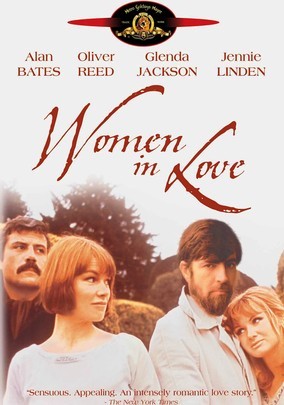
Women in Love-1969
UPDATED REVIEW
Director Ken Russell
Starring Glenda Jackson, Oliver Reed
Top 250 Films #54
Scott’s Review #766

Reviewed June 2, 2018
Grade: A
Women in Love (1969) is a British romantic drama film that stands out as truly one of a kind. The film is quite cerebral and requires a bit of thought, which will undoubtedly lead to good conversation with film connoisseurs everywhere after a viewing.
The four central characters are complex and flawed, and they dramatically intersect in each other’s lives, making the film a “thinking man’s” feast.
The film is adapted from a popular D.H. Lawrence novel of the same name.
Set in 1920 in the Midlands of central England, sisters Ursula (Jennie Linden) and Gudrun (Glenda Jackson) attend the wedding of an acquaintance, Laura Crich.
The Crich family is enormously wealthy and owns a large share of the mining town.
During the ceremony, Gudrun and Ursula fantasize about Gerald Crich (Oliver Platt) and Rupert Birkin (Alan Bates), respectively.
When the foursome cross paths again at Rupert’s pretentious girlfriend’s party, attraction and conflict arise.
The film is described as “character-driven,” but it doesn’t do it justice. Each of the four principal characters is richly written with intelligence and gusto.
All of them are flawed or insecure in some way, and the sexual attraction between Gerald and Rupert share a sexual attraction for each other is another nuance explored throughout the film.
Rupert is confident and outspoken about his bisexuality- extremely rare for a 1969 film. In this way, Women in Love is ahead of its time.
The significant themes in Women in Love are commitment and love, and how each character handles them, sometimes embracing them and sometimes running away from them.
Gudrun and Gerald are in love with each other, as are Rupert and Ursula, but only one couple reaches any bliss.
The characters feel a bevy of emotions, making happiness almost impossible, and they feel doomed to failure from the start.
This is an example of Larry Kramer’s tremendous writing and of bringing the characters to the big screen in a memorable way.
Jackson’s Gudrun and Bates’s Rupert are my favorite characters because they seem to have a bit more depth and feel like standouts. Gudrun appears to have love-hate feelings toward Gerald and is often downright cruel to him.
As they vacation in the Swiss Alps, Gudrun purposely and inexplicably flirts with a gay artist, leaving Gerald extremely jealous, which results in tragedy.
Counterbalancing Gudrun’s anger, Rupert showers in fun and zest for life, happily bisexual and thinking nothing of it, enjoying his sexually charged affections for both men and women.
The supporting characters, specifically snobbish Hermione and mentally unstable Christianna Crich, are examples of perfect casting.
Eleanor Bron plays Hermione as mocking and teetering on the edge of unhinged. As she psychologically bullies poor Ursula, even though it’s clear Rupert prefers the more innocent woman, Hermione becomes frightened.
Actress Catherine Willmer takes Christianna to a new level of creepy. Already appearing psychotic, when her daughter tragically drowns, the woman goes over the edge, unleashing vicious dogs on any visitors to her estate.
Both actresses give unforgettable performances.
Women in Love contains a scene that may very well be the most homo-erotic scene in film history. As Rupert and Gerald decide to partake in a Japanese-style wrestling match one evening, they strip completely naked and grapple in front of a roaring fire.
In this lengthy sequence, both front and rear nudity are provided, leaving nothing to the imagination. When Rupert suggests they swear eternal love for each other, Gerald cannot commit to the emotional union.
One wonders if this outstanding scene influenced 2007’s Eastern Promises.
1969’s Women in Love is a fantastic film with terrific acting all around.
Taking romantic drama to an entirely different level and setting a new standard for cinematic complexity, Ken Russell’s work is peppered with nuance, making it rich with great storytelling and character development.
The fact that one couple ends in bliss and the other in tragedy is sheer excellence.
Oscar Nominations: 1 win-Best Director-Ken Russell, Best Actress-Glenda Jackson (won), Best Screenplay Based on Material from Another Medium, Best Cinematography
Golden Globe Nominations: 1 win-Best Director-Ken Russell, Best Actress-Drama-Glenda Jackson, Best Foreign Film (English Language) (won)