Category Archives: Vampire

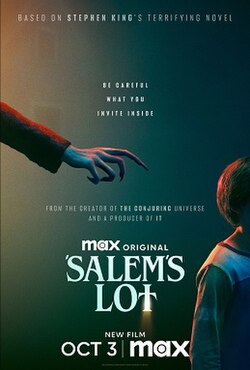
‘Salem’s Lot-2024

‘Salem’s Lot-2024

Director Gary Dauberman

Starring Lewis Pullman, Makenzie Leigh

Scott’s Review #1,537
Reviewed June 13, 2026

Grade: B-

Another attempt at resurrecting the well-known and scary 1975 Stephen King novel ‘Salem’s Lot results in a mediocre affair.

This is a shame because the novel, as well as Pet Semetary, scared the bejeezus out of me as a nerdy teen craving escapism.

The best ‘revival’ of ‘Salem’s Lot was a wonderful 1979 television miniseries that spanned nearly three hours. It lent credence to delving deeper into the robust and complex characters King created.

For a deep horror extravaganza, this is necessary.

Still, the 2024 offering of ‘Salem’s Lot is a watered-down approach to the original story, which it pairs with repeating glossy elements that were once extremely frightening and imaginative.

There’s little to no character development and a tepid romantic storyline that ultimately goes nowhere.

Overall, Stephen King doesn’t have a whole lot of luck with big-screen adaptations of his works. Carrie (1976) and The Shining (1980) are the two best, in my opinion.

Author Ben Mears (Lewis Pullman) returns to his childhood home, Jerusalem’s Lot (or Salem’s Lot), in search of inspiration for his next book, only to discover that his hometown is being preyed upon by a bloodthirsty vampire.

Gradually, most of the townspeople succumb to vampirism, explained later, because the town has no life anyway.

At the same time, Ben, his burgeoning love interest, Susan (Mackenzie Leigh), Doctor Cody (Alfre Woodard), schoolteacher Mark (Bill Camp), and eleven-year-old Mark Petrie (Jordan Preston Carter) must race against time to stop the madness from overtaking their beloved town.

As with many modern horror films, the first half of ‘Salem’s Lot is better than the second.

Pullman, son of famous actor Bill Pullman, and facially a dead ringer, is compelling in the lead role. An intelligent author, he returns to his hometown for inspiration, also recalling a horrific accident that killed both his parents.

He meets several interesting, on the surface anyway, characters, like the schoolteacher, the sheriff, and Susan, who, despite reading his last novel, doesn’t realize at first that Ben is the author.

Ben and Susan have a potential romance and a cool banter that envelops the audience. But that’s as far as we get with the pairing.

It’s peculiar that director Gary Dauberman keeps the time period in the mid-1970s for the automobiles featured, but little else is reminiscent of fifty years ago.

The characters all look very modern, from the hairstyles to the clothes, especially given the addition of a black female doctor and a prominent black family.

Kudos for the diversity, but it’s highly doubtful this would exist in a small rural town in the 1970s, especially not without a redneck or two around to cause chaos.

A fantastic sequence in the novel and miniseries, when pasty-faced schoolkid Danny (Nicholas Crovetti) is sacrificed, and returns to hover outside his pal Mark’s bedroom window, is neither thrilling nor scary. Instead, Mark casually casts Danny aside and runs to tell on him.

The villains also underwhelm.

Straker (Pilou Asbæk), a strange man from somewhere in Europe who opens an antique store in town and moves into the long-abandoned Marsten House, is scarcely featured and certainly not enough to get to know the character at all.

His vampire master, Kurt Barlow, who plans to create a vampire colony, is featured even less. He waits in a coffin in the basement of the house and snarls once or twice.

Nonetheless, the kills are fun if not unsurprising. Once benevolent characters turn into vampires and attempt to bite others.

The wackiest, probably unintentionally, is watching Susan’s mother bite her and later wield a shotgun to shoot anyone who has not turned.

But we don’t feel sorry for the victims because we never really knew them well enough to begin with. The quiet pacing is something the novel and the miniseries did exceptionally well.

By the conclusion, what started as a film with frightening potential turns into cheesy glowing crosses that sometimes work and sometimes don’t, and the character is reduced to saying a prayer in the hopes that the vampire won’t bite her.

‘Salem’s Lot (2024) is a rather tepid film with little to differentiate it from many other genre films and a weak effort in the many incarnations of King’s excellent book.
30 Days of Night-2007

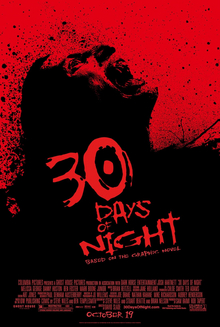
30 Days of Night-2007

Director David Slade

Starring Josh Hartnett, Melissa George

Scott’s Review #993

Reviewed February 25, 2020

Grade: B-

During the decade when 30 Days of Night (2007) was released, the trend leaned towards the vampire-horror genre, where bloodthirsty tyrants would do battle with the good folks of the land.

The film has outstanding elements: a tiny town, total darkness, and chaos.

The gritty conclusion is a predictable letdown as the film spins out of control into the silly and the formulaic.

Hartnett, at the time, was an A-list actor whose film career was dwindling, reduced to the horror circuit.

In Barrow, Alaska, which is said to be the northernmost town in the United States, the winter sunsets do not rise for 30 days and nights, providing a full month of complete blackness.

An evil force emerges from the black atmosphere and strikes terror into the town, and all hope rests on a husband-and-wife cop team, Sheriff Eben Oleson (Hartnett) and Stella Oleson (Melissa George).

The duo must protect a handful of survivors from a pack of vampires and battle the lack of communication and blizzard conditions in the frigid Arctic.

The film is based on a comic book miniseries of the same name, but 30 Days of Night is mostly influenced by two better films: 28 Days Later (2002) and 28 Weeks Later (2007), the former a groundbreaking film within the sub-genre- even the title is a copycat!

The result is nothing groundbreaking and rather run-of-the-mill story-wise. It seems too closely patterned after other films rather than having an identity of its own.

The best part of the film is the fantastic elements and trimmings created to provide an atmosphere. Highly effective, it carries the film and intrigues the compelled audience when the story lacks.

What is more frightening than a blinding whiteout, hungry vampires, or a town fraught with perilous fear? The spooky atmospheric trimmings make the lack of payoff even more jarring, leaving the film adequate, but little more.

The casting is mediocre and unrealistic.

I doubt any sheriff in a tiny, forgotten town would be as good-looking as Hartnett, nor is he believable as a powerful sheriff- he does not fit the part.

George, as estranged wife Stella, is neither good nor bad, but rather inconsistent. There is little chemistry between the couple, and both were cast for their looks, as they seem more like staged puppets than fleshed-out characters.

Regardless, any romantic entanglements between the characters are dull and insignificant.

The character development is not there.

Ben Foster, as “The Stranger”, is a great actor, but not in this film. Subsequently appearing in grand roles in Hell or High Water (2016) and Leave No Trace (2018), he is not at his best in this film.

The character is limited, whereas he could have added much more to a better-written script.

We know little about the townspeople, and it is unclear what the vampires’ motivations are beyond wreaking havoc and creating terror.

30 Days of Night (2007) is a marginally good film, mostly because of the way it looks, and the horror-flavored ingredients sprinkled throughout.

Despite some cool ways of killing off the evil vampires, the film never hits high gear, remaining neutral for most of the way and ending with a disappointing climax.

It is advisable to see the much superior and similarly produced and filmed 28 Days Later (2002).

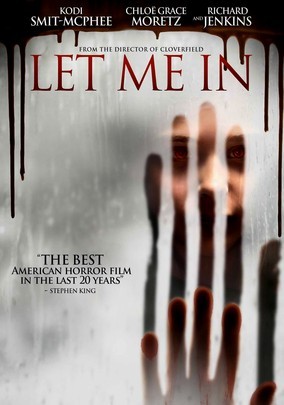
Let Me In-2010

Let Me In-2010

Director Matt Reeves

Starring Kodi Smit-McPhee, Chloe Grace Moretz

Scott’s Review #509

70135744

Reviewed November 4, 2016

Grade: A-

I loved Let Me In (2010).

It is nearly as exceptional as the original, Let the Right One In (2008), a Swedish film.

Billed as horror, it contains none of the typical horror clichés or corny dialogue; rather, it is mysterious, compelling, and character-driven.

This in itself is refreshing.

Additionally, the cinematography is exceptional in its coldness, darkness, and good old-fashioned ambiance.

Let Me In is about a twelve-year-old outcast named Owen (Kodi Smit-McPhee), who befriends a neighbor girl, Abby (Chloe Grace Moretz), who we learn is a vampire.

Owen is bullied at school and, through Abby, learns to stand up to his tormentors.

I am partial to international language films, so the American version, to me, lacks a bit of that engaging language. It is not…well, international, so that detracts slightly, but not much at all, and this effort is quite remarkable.

This film is a horror film- in the classic sense of containing vampires and not being played for goofs- and quite gory, but also a beautiful, emotional film, and the concepts of sadness and loneliness are explored.

Let Me In (2010) is one of the best horror films I’ve seen in recent years.

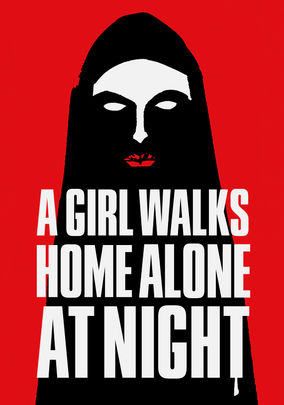
A Girl Walks Home Alone at Night-2014

A Girl Walks Home Alone at Night- 2014

Director Ana Lily Amirpour

Starring Sheila Vand

Scott’s Review #271

70301280

Reviewed August 24, 2015

Grade: A-

A Girl Walks Home Alone At Night is a highly creative, unique, independent horror film from 2014.

One of the many reasons I am a fan of independent cinema is to discover and promote little-seen gems.

The dialogue is in Persian, and the black-and-white cinematography is unique in modern film.

I notice similarities between this film and Let the Right One In (2008) (both the English and Swedish versions) in the frigid mood and love story it envelops.

This film is the debut of director Ana Lily Amirpour, and what a marvel she could become. Despite obvious influences by other directors, A Girl Walks Home At Night has a brilliant freshness and seems original and unpredictable.

The title accurately depicts the main story. A teenage girl (Sheila Vand) walks around the dark streets of a city aptly named Bad City in the Iranian underworld.

The film is shot in Southern California and could double for Detroit.

The girl, who has no name, has strange encounters with a myriad of peculiar individuals, including what appears to be a transgender prostitute, a vicious drug dealer, a nice yet mysterious young man named Arash, Arash’s father, who is hooked on drugs, and a mysterious cat.

She then embarks on a tender flirtation with Arash.

The overall plot, which I found secondary to the film’s look, centers on the Girl’s encounters with these individuals and their relationships with each other.

The Girl is a lonely vampire and feels isolated from society, but it is unclear what she is looking for. She is both destructive and sweet depending on the circumstance.

She takes her aggression out on the bad.

The most striking and impressive aspect is its dark, moody atmosphere. Brooding and cold-looking, the city reeks of death and loneliness.

The Girl speaks very little, so the viewer notices her expressions. Her eyes delve into her soul.

She is the most interesting of the characters, but the others, specifically Arash and the transgender prostitute, have potential, and we are curious to explore more about them.

Arash and his father have more depth than any of the supporting characters- Arash painfully lets his drug-riddled father stay with him and attempts to assist him with his issues.

One assumes that since the father’s wife (Arash’s mother) has died suddenly, he has taken a downward spiral, but this is only suggested to the audience.

We do know for sure where she is- in one scene we see the father angrily look at a photo of a middle-aged woman and is destroyed by her absence. He believes that the woman has taken on the body of the mysterious cat.

Arash caring for his father is a fascinating role reversal.

Wouldn’t we expect the young man to have a drug problem and the father the caregiver? This is interesting in itself.

The influences are plentiful, but most notable from a director’s standpoint is David Lynch. The black-and-white filming, along with the viewer’s point of view in one scene of a car driving down a dark highway, resembles Lynch’s Lost Highway (1997).

The moody background music and slow, methodical pacing give A Girl Walks Home Alone At Night a Lynch feel.

One curious element is The Girl’s interest in 1980s pop music- her bedroom wall is riddled with Madonna and similar pop stars from the 1980s posters.

The Girl even admits to listening to a sappy Lionel Richie tune.

It is unclear whether it even could be the 1980s, as time seems unimportant. The film strangely combines edgy, alternative filmmaking with commercial pop references.

I half expected The Girl to break into a rendition of “Pour Some Sugar On Me”.

I think Amir may be portraying the Girl’s desire to fit into mainstream society, knowing a vampire never can. This theory is proven when The Girl is melancholy when Arash buys her a hamburger, knowing she cannot enjoy it as he does.

Creative, with a dreary atmosphere and intelligent, well-thought-out, A Girl Walks Home Alone At Night (2014) is a strange, murky experience in film experimentation.

Amirpour is a fresh director worth watching.

Independent Spirit Award Nominations: Best First Feature, Best Cinematography

Only Lovers Left Alive-2014

Only Lovers Left Alive-2014

Director Jim Jarmusch

Starring Tilda Swinton, Tom Hiddleston

Scott’s Review #237

Only_Lovers_Left_Alive_English_film_poster

Reviewed April 24, 2015

Grade: B

Only Lovers Left Alive (2014) is a bizarre trip into the strange and unusual world of vampires.

The film moves slowly but becomes hypnotic, drawing me into the plot, though the plot itself seems almost secondary to the film’s gothic mood and dark ambiance.

Thanks to the wonderful Tilda Swinton, who I find mesmerizing in every film role she appears in, the methodical film never completely bored me and, at times, even fascinated me.

Set in the present, Swinton and Tom Hiddleston play vampires named Adam and Eve, lovers separated by distance. Adam is a musician living in a vast Victorian house in Detroit, and Eve resides in Tangier.

Realizing that Adam is lonely and suicidal, Eve makes the international trek to the United States to be with her love.

As they settle into a quiet existence immersed in music and thought, Eve’s rebellious sister, Ava (Mia Wasikowska), from Los Angeles wreaks havoc on their lives.

Also in the film is John Hurt, who plays Marlowe, an ancient vampire who assists Adam and Eve, who succumbs to sickness from tainted blood.

The film is a creative, atmospheric offering from edgy independent film director Jim Jarmusch, known for left-of-center fare like Broken Flowers (2005) and Coffee and Cigarettes (2003), both visual and visceral achievements.

While I didn’t completely love this film, I felt the story is its weakest point; the magical, beautiful arrangements almost make up for it.

Set entirely at night (when vampires are awake) and featuring several shots of Adam and Eve posed naked or almost naked in lovely, artistic angles, I think the film aims as much for a “look” as for storytelling and doesn’t fully center on the plot.

It is also a lovely romantic film, though not in the typical sense of silly misunderstandings and comical moments, but rather in romantic artistry, as Adam and Eve connect spiritually.

Married hundreds of years ago, Adam and Eve have been inexplicably separated by thousands of miles and coasts, though the reason is not explained.

Why are they the few remaining vampires alive? Does the human race know they are vampires or think they are odd-looking people?

They both have money to burn and pay a high cost for being vampires, as they either pay a contact to steal blood from hospitals to survive or obtain the blood elsewhere.

They are tempted to bite humans but resist those urges.

The film doesn’t explain why they are two of the few vampires left in the world, or answer other questions. Adam, supposedly a famous musician, is wealthy beyond words and lives in a haunted-looking mansion surrounded by music and musical instruments.

The plot holes, of course, are secondary to me. None of them matter.

The film has beautiful moments; it is musically centered, and Adam and Eve share tender dances on more than one occasion. The film is a pure love story, but a very left-of-center one.

I admire the film’s creativity and its willingness to go where most filmmakers dare not. Jarmusch dares to be different and deserves much praise.

My main critique is the pacing; the story barely matters, as the film feels more like an art experience than a “mainstream” film with a strong plot and focus.

Only Lovers Left Alive (2014) is a different type of film and one worth admiring.

Independent Spirit Award Nominations: Best Female Lead-Tilda Swinton, Best Screenplay

Argento’s Dracula-2012

Argento’s Dracula-2012

Director Dario Argento

Starring Thomas Kretschmann

Scott’s Review #158

70242567

Reviewed August 22, 2014

Grade: C-

As a huge fan of Dario Argento, his classic horror films such as Suspiria (1977) and Deep Red (1975) would surely land in my Top fifty of all time, not just in the horror genre; this film is a bit of a mess.

As I understand it, the story follows a young man named Harker, whom Count Dracula hires to work in his castle as a Librarian.

His wife, Mina, arrives later in the story and becomes the focal point of the film from that point on.

Another female named Tania rises from the dead to seduce and bite Harker. Dracula intervenes and wants to claim Harker as his own.

From this point on, Harker’s wife Mina attempts to look for her husband within the halls of Dracula’s castle.

The plot is hard to follow, uncompelling, and not one of Argento’s finest efforts.

An homage to Hammer horror films of the 1950s and 1960s, the film comes across as too campy, poorly performed, and miscast in places.

The actor who plays Count Dracula is not convincing and seems a strange choice for the part- too nice-looking?

It feels like Argento didn’t know whether to make the film serious or go completely over the top. Since when can Dracula change forms into a grasshopper, owl, and other creatures besides a bat?

Other characters like the Priest were introduced for no other purpose than to be killed.

On the positive side, the art direction is unsurprisingly amazing.

The film is filled with creepy sets, especially inside the mansion, and has a distinct 1970s feel. The ambiance effectively portrays a spooky, dark setting.

All in all, though, Argento’s Dracula (2012) is a disappointing experience, and much better films of the same subject matter have been covered in the past.