Category Archives: Psychological Thriller

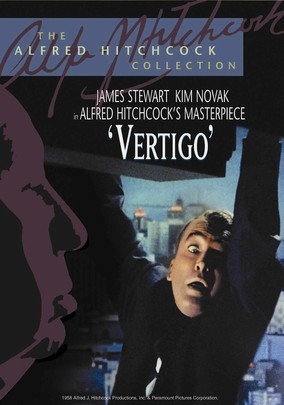
Vertigo-1958

Vertigo-1958

Director Alfred Hitchcock

Starring James Stewart, Kim Novak

Top 250 Films #1

Scott’s Review #151

1089727

Reviewed August 7, 2014

Grade: A

Over the years, Vertigo (1958) has quickly become one of my favorite Alfred Hitchcock films. With each repeated viewing, I learn, appreciate, or see something new.

It is an absolute masterpiece.

The primary appeal of Vertigo lies in its mystique and dream-like quality, which offer a beautiful cinematic experience. It is sometimes ominous, psychological, gloriously complex, and even confusing.

That is what makes it extraordinary.

Considering the time, the colorful opening visuals are dynamic, groundbreaking, and stunning.

The story involves a retired detective, Scottie, played by Hitchcock stalwart Jimmy Stewart. Scottie suffers from vertigo, which hinders his daily life.

After an incident in which a police officer is killed, and Scottie blames himself and his vertigo for causing the death, he whiles away the days brooding and keeping companionship with Midge, a college friend to whom he was once engaged.

One day, he is hired by another college friend to follow his wife, played tremendously by Kim Novak, who is acting strangely and periodically disappearing, obsessed with a painting of a woman from years past.

From this point, the plot twists and turns in a mysterious fashion, and a romantic, bizarre, and obsessive love story is intertwined.

Is Scottie in his right mind? Will his vertigo continue to haunt him? What is the secret to Madeleine and Judy? Is Midge as sweet as she appears?

The score to Vertigo is haunting and unforgettable, adding significantly to the film’s mood and ambiance.

Several location shots are featured in San Francisco, including the Golden Gate Bridge, steep streets, the Mission District, and the Redwood Forest.

As with all Hitchcock films, every set and detail is perfect, from paintbrushes, coffee mugs, curtains, and furniture to the gorgeous, bright red décor of the restaurant, which is heavily featured in the film.

How exquisite does Kim Novak look in the film??

Initially, it was critically panned upon its release, but it is now considered one of the greatest films. Its unique camera angles and slow, methodical pacing have influenced other films.

The film is not always an easy watch; it is complex, to be fair, but, like a fine wine, it improves with age.

Vertigo (1958) is a layered psychological thriller that gains more appreciation with each viewing.

Oscar Nominations: Best Sound, Best Art Direction

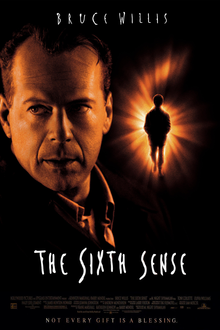
The Sixth Sense-1999

The Sixth Sense-1999

Director M. Night Shyamalan

Starring Bruce Willis, Haley Joel Osment

Top 250 Films #106

Top 40 Horror Films #20

Scott’s Review #182

Reviewed October 8, 2014

Grade: A

The Sixth Sense is a psychological thriller/horror film directed by M. Night Shyamalan, released in 1999, about ghosts, and was an incredible box-office and critical success at the time of its release, making the line “I see dead people” universally imitated.

Bruce Willis stars as Dr. Malcolm Crowe, a successful and admired child psychologist who lives a perfect life with his wife, Anna, in Philadelphia.

Enjoying a romantic night at home, Malcolm and Anna are interrupted by a deranged former patient, played by an unrecognizable Donnie Wahlberg.

Malcolm is shot by the patient, who also shoots himself, and the story picks up a year later as Malcolm takes an interest in Cole, a troubled 9-year-old boy, played by Haley Joel Osment.

Cole is a peculiar boy- an outcast taunted at school- who can see the dead.

He’s worried about his overworked mother, Lynn, who Toni Collette plays.

Meanwhile, Malcolm and Anna appear to be experiencing marital problems and lack meaningful communication with each other.

Anna begins to be pursued by a new beau, much to Malcolm’s chagrin. Malcolm and Cole develop a special bond as Malcolm convinces Cole to speak to and help the ghosts that he sees rather than be terrified of them.

As the plot slowly unfolds, Cole helps a recently deceased girl named Kyra Collins, who is around his age. Kyra gives Cole a videotape that reveals she was murdered and proves who killed her.

The subsequent scene is my favorite- there is a haunting quality to it, and the camera follows the events interestingly, slowly, and sedately.

The setting is a service at Kyra’s house, where family and friends gather to pay respects and support Kyra’s parents. Malcolm and Cole arrive and present Kyra’s father with the plain videotape.

The entire scene is powerful in its simplicity, yet it carries great emotional weight. It is slow, but devastating in its climax and reveals. Small nuances are revealed- why is Kyra’s mother wearing bright red when the other guests are all wearing black? Will Kyra’s younger sister be the next victim?

Superlative filmmaking.

A scene involving Cole’s teacher is riveting: sensing aspects of his teacher’s past, Cole realizes his teacher had a stuttering problem as a child.

When his teacher is condescending towards Cole, the young boy explodes with rage and begins a chant of “tuttering Stanley,” which reduces the teacher to childhood traumas.

Yet another powerful scene involves Cole and his mother sitting in a car caught in traffic- Cole admits the truth of his skill of seeing dead people to her and introduces an emotional story to her as proof.

This is a scene where Toni Collette shines brightly.

Well over a decade since The Sixth Sense was released, most people know the twist and the subsequent surprise ending, and it is such a joy to go back, see the manipulations in the story and in individual scenes, add them up, and revel in the clever way Shyamalan puts them together.

The Sixth Sense is not dated and is quite fresh, holding up tremendously well, and I still get chills during the big reveal all these years later.

But beyond this pleasure, the film is beautifully written. Somewhere between horror and psychological thriller, it successfully tells a ghost story with interesting characters and jumps-out-of-your-seat thrills that are not contrived or predictable in the traditional horror-film way.

From an acting perspective, Bruce Willis is amazing and under-appreciated as Malcolm- he is calm, cool, and collected. His performance is quite understated as the inquisitive and pensive psychologist.

More praise should have been reaped for Willis.

Haley Joel Osment gives an astounding performance of a lifetime- he emits an image to the audience of being strange yet sympathetic, and he relays his very frightening fear of the ghosts so well that the pain and conflict he endures are evident on his face.

Toni Collette is effective as the scared, concerned, haggard mother. Collette and Osment were rewarded with Academy Award nominations- sadly, Willis was not.

Shyamalan was subsequently ridiculed for his later films (The Village, 2001, and Unbreakable, 2001) – perhaps the manipulation and trickery from The Sixth Sense angered some people.

The Sixth Sense (1999) is a film that remains with you for days, weeks, even years, and can be revisited and rediscovered for an intelligent, chilling good time.

Oscar Nominations: Best Picture, Best Director-M. Night Shyamalan, Best Supporting Actor-Haley Joel Osment, Best Supporting Actress-Toni Collette, Best Screenplay Written Directly for the Screen, Best Film Editing

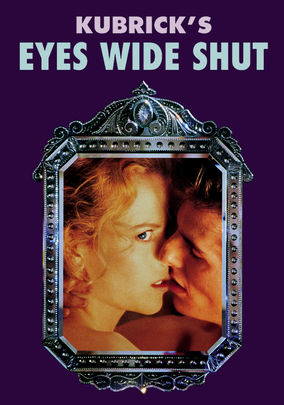
Eyes Wide Shut-1999

Eyes Wide Shut-1999

Director Stanley Kubrick

Starring Tom Cruise, Nicole Kidman

Top 250 Films #125

Scott’s Review #464

5670434

Reviewed August 14, 2016

Grade: A

Eyes Wide Shut is a film that I saw in theaters upon its release in 1999 and found fascinating, to say the least.

I have watched the film twice more in the years following, and it is even more fascinating today- it gets better and more nuanced with each viewing.

It is not an easy film to follow or explain, but it is rich in mystery and psychologically challenging.

A huge Stanley Kubrick fan, I found this film an eerie, plodding, cerebral psychological/sexual thriller.

The creepy piano score is very effective, and Tom Cruise and Nicole Kidman are both excellent as affluent, yet restless, thirtysomethings living in New York City.

Cruise plays Bill, a successful doctor, and Kidman his gorgeous wife, both sexually restless and escaping into fantasy and otherwise real dalliances with other partners as they bicker about fidelity and jealousy as they lounge in their underwear and smoke pot.

It’s a film about relationships, temptation, and desire, and does not always make perfect sense, but boy, will it leave you thinking.

The supporting characters are some of the most interesting I’ve ever seen, as they compel and mystify, and one wonders how they fit with the main characters.

The naughty Long Island orgy is as bizarre and surreal as one can imagine.

The movie reminds me somewhat of The Ice Storm (1997), Magnolia (1999), and Mulholland Drive (1992), which is the ultimate compliment as the aforementioned are film masterpieces.

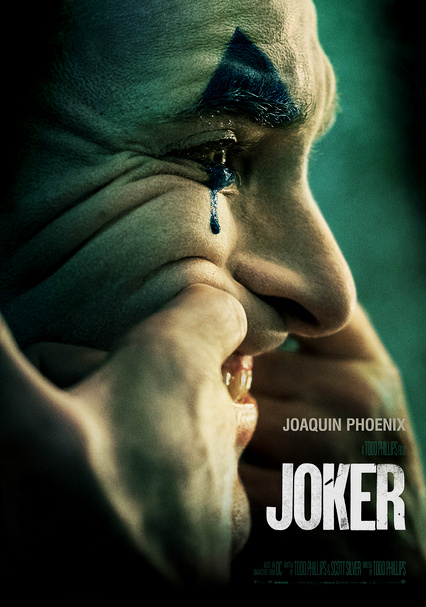
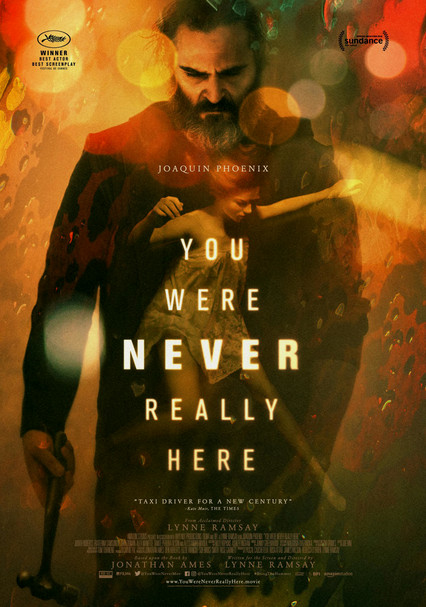
Joker-2019

Joker-2019

Director Todd Phillips

Starring Joaquin Phoenix

Top 250 Films #166

Scott’s Review #953

Reviewed November 1, 2019

Grade: A

Joker (2019) is a film that has divided audiences. Some love it, others loathe it. The experience is not your standard fun, superhero fare, with a hero’s rescue and the good triumphing over evil.

Despite the parlay into Batman territory, the film smacks the viewer across the face with its brutality, violence, and social and psychological injustices.

Joaquin Phoenix pummels the audience with an angry and bitter portrayal of the title character, easily one of the best performances of the year.

In one of the first scenes, before we even know the character, we experience a long, close-up of Phoenix laughing hysterically. We wonder what is so funny, before the revelation that he, Arthur Fleck, suffers from a nervous condition that causes inappropriate outbursts.

The year is 1981, and the fictional Gotham City, clearly a mirror image of New York City, serves as the setting. Times are tough, and crime is rampant.

Arthur lives in a dumpy apartment with his sickly mother, Penny (Frances Conroy), and visits a social worker regularly to receive his prescription medicine.

Arthur finds meager work as a party clown and aspires to be a stand-up comedian. After a gang attacks him in an alley, Arthur’s co-worker, Randall, encourages him to take a gun. Arthur invites his neighbor, single mother Sophie, to his stand-up comedy show, and they happily begin dating.

Finally, another person understands him. Segments of the population are disenfranchised and impoverished as Thomas Wayne, a billionaire philanthropist, runs for mayor of Gotham. A strange connection develops between Arthur, Penny, and Thomas, becoming central to the plot.

Can we discuss Phoenix’s bravura performance for a moment?

Suppose anyone thinks that Heath Ledger was phenomenal when he portrayed the same character in 2008’s The Dark Knight. In that case, they will be elated by Phoenix, who elevates the character to an entirely new level.

What Phoenix adds is strong sympathy for Arthur/the Joker and a care for the character. We feel sorry for him, but should we? He is a villain after all. One could easily debate whether his character can be considered the bad guy or the hero.

Regardless of the assessment, the performance is unforgettable.

A turn-off to some, which I found tremendously powerful, is the role reversal in the portrayal of the Wayne family, Bruce, and Batman characters.

Always deemed the “good guys”, in Joker, Thomas Wayne is self-centered, pompous, and embodies a sense of entitlement and snobbery.

Bruce is a young boy, but the implication is that the family is unkind, and what might the child grow up to believe?  Why is Batman/Bruce Wayne heralded as good and the Joker evil? It turns the tradition upside down into a twisted mind warp, and this is wonderfully creative and thought-provoking.

The best scene in the film, which triggers much of the subsequent violence and chaos, occurs when Arthur is invited to appear on a late-night talk show hosted by Murray Franklin (Robert De Niro). A week earlier, Franklin had played a humiliating clip of Arthur poorly performing stand-up.

Arthur decides to appear in full “Joker” attire, and the eventual discussion and words lead to tragic events. The scene is tense, intelligently written, and combative as the men spar over politics and class distinction.

Lastly, the musical score is dark, haunting, and mesmerizing without overtaking the film. Many key scenes of Arthur dancing and posturing are masterful, with the inclusion of the bombastic music.

He is a celebratory character, in his mind at least, and the music fuses into the scene with gusto and power. The combination of clowns and an incredible score adds significantly to the production.

Joker (2019) showcases a marvelous acting performance on the part of Phoenix, which combines a haunting musical score in its depth.

Providing a social commentary for people experiencing poverty and disenfranchisement, this film will divide viewers, probably based on preconceived expectations of a traditional Marvel-type superhero event.

The film offers much more than safer films like Wonder Woman (2017) or Black Panther (2018) ever could- a dark and violent character study.

Oscar Nominations: 2 wins-Best Picture, Best Director-Todd Phillips, Best Actor-Joaquin Phoenix (won), Best Adapted Screenplay, Best Original Score (won), Best Sound Editing, Best Sound Mixing, Best Cinematography, Best Makeup and Hairstyling, Best Costume Design, Best Film Editing

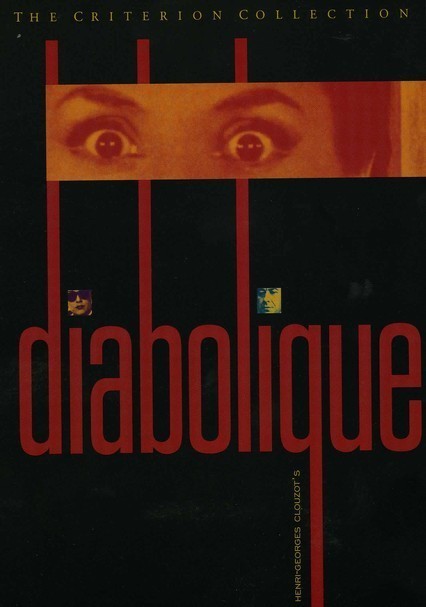
Diabolique-1955

Diabolique-1955

Director Henri-Georges Clouzot

Starring Simone Signoret, Vera Clouzot, Paul Meuisse

Top 250 Films #198

Top 40 Horror Films #27

Scott’s Review #878

Reviewed March 16, 2019

Grade: A

Diabolique (1955) is a masterful French thriller as compelling as frightening. It will have an insurmountable influence on future generations.

Shamefully remade and Americanized in 1996, starring Sharon Stone, a waste of time if you ask me, the original is the one to discover.

The film perfectly blends psychological intrigue, never-ending suspense, and even a good mix of horror that Hitchcock would find impressive (more about him later). Its pacing and frequent twists and turns make it brilliant.

Directed by Henri-Georges Clouzot, Les Diaboliques is set in a crumbling boarding school in Paris. Sadistic headmaster Michel Delassalle (Paul Meuisse) runs a tight ship but works for his Venezuelan wife, Christina (Vera Clouzot), who owns the school.

Michel is immersed in a torrid affair with schoolteacher Nicole Horner (Simone Signoret) and regularly abuses both women as well as his students. The two women embark on a plot to kill Michel, but when they succeed in their plan, Michel’s body goes missing.

The women panic.

In a few fun trivia tidbits, director Clouzot optioned the screenplay rights right after finishing Wages of Fear (1953), preventing Hitchcock from making the film. This movie helped inspire Hitchcock’s Psycho (1960).

Robert Bloch himself, the author of the novel version of Psycho, has stated in an interview that his all-time favorite horror film is Diabolique. If the film displays nuances incorporated in Psycho, this is undoubtedly the reason.

Clouzot also directs his wife, Vera, in the prominent role of Christina.

Hitchcock could have made the brilliance since the entire experience has his stamp and influence even though his best works lay ahead of him in 1955.

Still, from the Gothic mood to the “can’t believe your eyes” twisted, blood-curdling ending, the director immediately comes to mind every time I watch the film. The “shock” ending only exceeds expectations with a fantastic delivery.

The film takes an unusual stance on the dynamic between the two women, Christina and Nicole. Rather than take a traditional route and make the women rivals for the man’s affections, Clouzot makes the pair co-conspirators.

This only deepens their relationship as events unfold and take a darker and more dire turn.

They rely on each other as teammates rather than despise each other over their love for another man. Intelligently, they spend their energy ensuring the insipid man gets his just comeuppance for his dirty deeds.

Nicole leads Christina in the direction she needs to go.

The black-and-white cinematography is highly influential on the mood. With each unexpected twist or scene of peril, the lighting radiates suspense. The camera juxtaposes the frequent glowing of the white against the dark black, exuding a frightening, ghost-like presentation.

The entire setting of the school is laden with dark corners that provide good elements of foreboding and sinister moments to come.

As the women become more and more unnerved by the limitless possibilities that the missing body presents, many questions are asked but are impossible to answer. “Where is the body?”, “Could Michel be alive?” “If he is alive, is he hell-bent on revenge?” The viewer will also ask these questions throughout most of the final half.

When an unknown person begins to call the women, the questions multiply.

Clouzet uses frequent shots of objects to enhance the tension even further. There are close-ups of a dripping bathtub, a typewriter with a man’s hat and gloves, a woman’s feet as she removes her shoes, and a woman running in terror through the school.

These facets only enhance the overall experience as the suspense and the terror begin to mount.

Diabolique (1955) is considered one of the greatest thrillers of all time, and I concur with this assessment. A French version of Psycho (1960) that combines an acclaimed director’s ingenious subtle ideas into a giant web of delicious filmmaking.

The surprise ending is never seen coming, even if the viewer thinks they have the plot figured out. This point alone is reason enough for the film to realize its greatness.

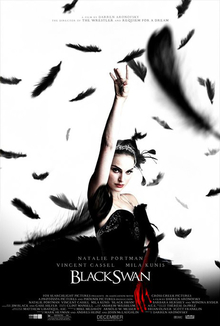
Black Swan-2010

Black Swan-2010

Director Darren Aronofsky

Starring Natalie Portman

Top 250 Films #221

Scott’s Review #735

Reviewed March 22, 2018

Grade: A

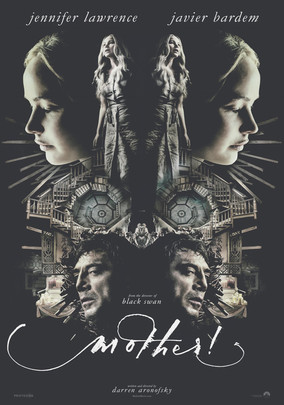
Darren Aronofsky, the director famous for the psychological and bizarre, most notably 2000’s Requiem for a Dream, 20008’s The Wrestler, and 2017’s mother!, can easily add 2010’s Black Swan to this category.

He weaves an unsettling tale involving the world of ballet centered around the Tchaikovsky work Swan Lake.

The film is dark, eerie, perverse, and utterly mind-blowing in its creativity- in short, Black Swan is a masterpiece.

The film reaped several Academy Award nominations, including a win for Natalie Portman as Best Actress.

In the competitive New York City ballet company, art director, Thomas Leroy (Vincent Cassel), is preparing to open the season with the compelling and complex, Swan Lake.

Deemed “too old,” star ballerina Beth McIntyre (Winona Ryder) is forced into retirement, much to her chagrin, allowing others to audition for the coveted lead role.

Aspiring talent, Nina Sayers (Portman), gives a flawless audition as the White Swan but lacks the depth to succeed as the Black Swan.

Despite this point, Nina wins the role and slowly becomes psychotic as she begins to embody the Black Swan in her quest for perfection.

Center stage, Portman embodies her character with mystique as we never know if she is living her dual role or if someone is messing with her.

As strange events begin to occur, Nina is insecure and on edge throughout- as she desperately wants to give testament to White Swan/Black Swan, she does not feel confident in the skin of Black Swan. She eventually teeters toward the edge of insanity.

Deserving the Oscar statuette she won, Portman delivers the best role of her career.

Black Swan would not have been the success that it was without the talents of the three most prominent supporting characters- Cassel, Mila Kunis (at the time unknown), as Lily/Black Swan, and legendary talent Barbara Hershey as Nina’s supportive yet haggard mother, Erica.

Just as Nina grows both suspicious of and distrustful of each of these characters’ motivations, so does the audience.

Is Lily a trusted friend? What does Nina know of her? Is Cassel’s Thomas manipulating Nina for a great performance or does he have sexual designs on her?

Is Erica a loyal confidante, a jealous bitch, vengeful about her stalled career?

The final scene of the film is a masterpiece in itself and perfectly wraps up the film in a perplexing, grotesque style.

As the big night finally arrives and doubt is cast on whether or not Nina will perform successfully, the entire scene is a riveting, climactic experience.

One will never forget the final shot of Nina, gushing with blood, and a grimace caked in stage makeup, as she professes a perfect performance to her musical director and castmates.

With this scene, we are left wondering whether she will ever recover from this performance.

The fabulous musical score is haunting and effective, and each piece is perfectly placed within the appropriate scene.

The heavy use of violins gives the soundtrack a frightening, almost horrific screeching quality, and the Chemical Brothers’ electronic songs, importantly used during Nina and Lily’s wild night out clubbing, are tremendously effective.

The 1948 masterpiece The Red Shoes, directed by the controversial Michael Powell, must have influenced Aronofsky.

Both contain similar subject matters of ballet and dancing on the edge of sanity; I can hardly think of two better films to serve as companion pieces, watched in tandem, than these two timeless greats.

Darren Aronofsky, along with a perfectly cast company with stellar, bombastic actors, and a classical music score by the great Tchaikovsky, with electronic elements mixed in, delivers a piece that works in spades.

2010’s chilling Black Swan is a modern-day classic that will be discussed as much as it is remembered as an incredibly important film.

Oscar Nominations: 1 win-Best Picture, Best Director-Darren Aronofsky, Best Actress-Natalie Portman (won), Best Cinematography, Best Film Editing

Independent Spirit Award Nominations: 4 wins-Best Feature (won), Best Director-Darren Aronofsky (won), Best Female Lead-Natalie Portman (won), Best Cinematography (won)

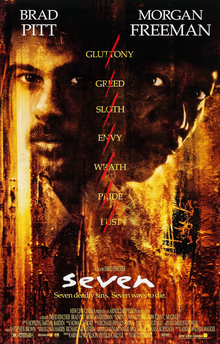
Seven-1995

Seven-1995

Director David Fincher

Starring Brad Pitt, Morgan Freeman

Top 250 Films #230

Scott’s Review #780

Reviewed June 29, 2018

Grade: A-

Many films containing a similar theme as Seven (1995) have come along over the years- some good, most mediocre.

The mixture of homicidal detectives tracking crazed killers has been done ad nauseam and more often than not, done with either poor writing or a predictable outcome, or both.

Instead of being a run-of-the-mill film, Seven serves as a blueprint for the tautness and unpredictability achievable with a familiar yet compelling concept, provided there is good writing and direction.

The film is incredibly brutal and riveting.

Respected director David Fincher assembles an all-star cast of Hollywood heavies, including Brad Pitt, Morgan Freeman, Kevin Spacey, and Gwyneth Paltrow, all of whom lend their talents to the well-crafted script.

It also raises the talent level to a respectable level, and, as great as the story is, with weaker actors, the stakes would not have been as high, and the film might even have been ruined.

A serial killer is on the loose in Los Angeles- detective duo William Somerset (a very good Freeman) is set to retire and is tasked with finding the killer. He is partnered with David Mills (Pitt), a young, hot-tempered man who has just moved to the city with his wife, Tracy (Paltrow).

Unbeknownst to David, Tracy is pregnant and unsure whether to keep the child- this point factors in heavily as events unfold.

The killer is using the seven deadly sins: greed, gluttony, sloth, lust, pride, envy, and wrath, as his motivation for the creative slayings.

In retrospect, Seven is very similar to the still-to-come Fincher work, 2007’s Zodiac, so much so that both films could be watched in sequence- one being a true story, the other pure fiction.

Both focus on the serial-killer element with a message; each has marvelous psychological intrigue and purpose. There are cat-and-mouse scenes aplenty for fans to enjoy.

At the risk of this point being a total stretch, I’d also argue that 1971’s Dirty Harry influenced Zodiac, Seven, and The Silence of the Lambs (1991).

A heinous killer shrouded in intelligence, danger, and motivation is a commonality of all of the aforementioned films, and numerous studies of each of the killers could be dissected if time permits.

Each killer is calculating and manipulative.

On that note, Kevin Spacey gives a tremendous performance as the cold and villainous John Doe. Clever and inventive, his victims are intended to suffer and suffer greatly.

Some of the kills could be included in the best of the torture-horror franchise, Saw (2004), as they are very twisted and brutal.

A supermodel is disfigured after being given a choice to call for help or overdose on pills, representing pride. A man is forced to consume food until his stomach ruptures, representing gluttony.

Spacey portrays his role as calm, cool, and collected, eliciting a terrifying response from audiences, especially as he toys with the detectives.

Still coming into his own as an actor in 1995, Pitt proves he can almost measure up (though not quite) with big-boy acting talents Spacey and Freeman.

Playing an ambitious man eager to prove himself in “the big city” with his pretty wife in tow, Pitt’s David is wholesome and family-oriented, yet has an edge.

All around the likable hero, Pitt is perfectly cast in the role and a large part of the film’s success.

The frightening final sequence still resonates with me after all of these years since Seven was released. In a classic standoff between Doe and the detectives, as is typical in these films, the climax is twisted, psychological, and gruesome.

I did not see this shocker coming, as it culminates in lives being forever changed. The expressions and actions of Freeman, Pitt, and Spacey are superlative.

Seven (1995) is a film basking in riches. On par with the best of the best in serial killer films, it is powerfully directed by Fincher. The film is fraught with grisly symbolism and its share of suspenseful sequences.

With powerful performances, it is a film that remains relevant and watchable decades after its original release.

Perhaps not quite on the level as Dirty Harry or The Silence of the Lambs, but pretty damned close, and that is impressive in itself.

Oscar Nominations: Best Film Editing

The Talented Mr. Ripley-1999

The Talented Mr. Ripley-1999

Director Anthony Minghella

Starring Matt Damon, Jude Law, Gwyneth Paltrow

Scott’s Review #1,259

Reviewed May 27, 2022

Grade: A

The Talented Mr. Ripley (1999) is a psychological thriller that is Hitchcockian and would make the famous director, the esteemed Alfred Hitchcock, damned proud.

The film features suspense, thrills, mystique, and great writing, and is an exceptional adaptation of Patricia Highsmith’s 1955 novel of the same name.

A fun fact is that Highsmith also wrote the novel that Hitchcock’s 1951 film Strangers on a Train was based on.

In my opinion, the title role is the best of Matt Damon’s lengthy career, rivaling that of his debut in Good Will Hunting (1998), also a tremendous effort.

His riveting portrayal showcases that he plays several layers simultaneously: calculating, sinister, vulnerable, jealous, and unhinged.

Sometimes all at once.

He was shockingly omitted from the Best Actor Oscar list, which is unforgivable considering his great work. Instead, he was nominated in later years for lesser films like Invictus (2010) and The Martian (2016).

With his blonde, clean-cut hairstyle, short and parted on the side, and big, studious glasses, he is half wholesome and half creepy.

The fact that the character is gay is icing on the cake and delicious for a film set in the 1950s, when having an alternative lifestyle was strictly forbidden.

The setting is mainly the lavish, sunny coastal Italy of the late 1950s. Tom Ripley (Damon) craves a lifestyle of luxury and manipulates his way into the life of wealthy playboy Dickie Greenleaf (Jude Law).

When Dickie’s father asks Tom to bring his errant son back home to America, Dickie, and his beautiful expatriate girlfriend, Marge Sherwood (Gwyneth Paltrow), never suspect the dangerous extremes to which Ripley will go to make their lifestyle his own.

The best part of The Talented Mr. Ripley is the compelling suspense and the twists and turns that result. It’s astounding how many layers the plot has without the experience feeling confusing or poorly paced.

Speaking of the pacing, this is another achievement of the film. Director Anthony Minghella wisely quickens the pace from the snail’s pace of his earlier film The English Patient (1996), which I loved.

We immediately learn a great deal about Tom and how he makes his living by charming people and forging signatures to make ends meet.

His innocent deceit soon turns fatal as he spirals downward and becomes a pathological liar and sociopath in addition to a cold-blooded murderer.

Law is tremendous as Dickie, and the bold character is ambiguous in his sexuality, while Tom’s is clearer. I love this about Law’s character. He is handsome and a ladies’ man, which would make him ripe for the picking for a closeted gay man in the 1950s to become enamored.

The key to ponder is whether the feeling is mutual. This remains ambiguous.

The acting, superior in every way, is made all the richer by the film’s character study, which cleverly dissects the relationship between Tom and Dickie.

The best scene occurs on a small boat as tensions reach a crescendo between the two men. This results in dire activity.

Besides the opening in New York, the rest of the story is set in Italy and is mostly shot on location. This only enhances my enjoyment of the film because it showcases the Mediterranean and southern Italy more than the more familiar cities.

Not to disappoint, astounding sequences in Rome and Venice do occur.

Because of the cinematography and locales, the film has a glossy, polished look, which is terrifically counterbalanced by the story’s darkness.

Think American Psycho (2000), but more subdued with a larger budget.

The Talented Mr. Ripley (1999) is one of the best to emerge from a terrific decade in cinema. It is not as well remembered as some others, but I strongly encourage a watch to uncover a series of riches driven by bold storytelling.

Oscar Nominations: Best Actor in a Supporting Role-Jude Law, Best Screenplay Based on Material Previously Produced or Published, Best Art Direction, Best Costume Design, Best Original Score

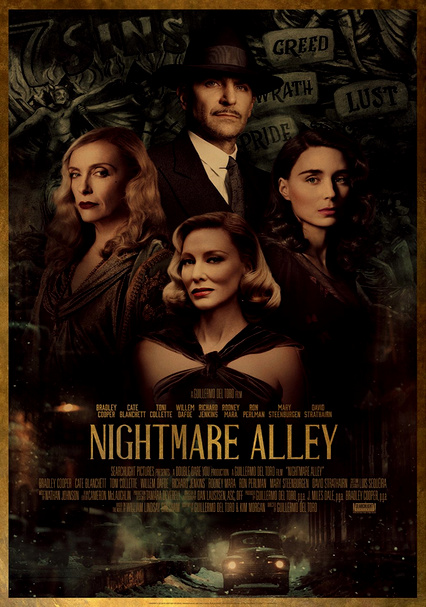
Nightmare Alley-2021

Nightmare Alley-2021

Director Guillermo del Toro

Starring Bradley Cooper, Cate Blanchett, Rooney Mara

Scott’s Review #1,229

Reviewed February 13, 2022

Grade: B+

I have not seen the original Nightmare Alley, made in 1947, so I can make no comparisons to how the film noir remake in 2021 compares, but I am a fan of respected filmmaker Guillermo del Toro.

His knack for creating such dark treats containing fantastical elements, as seen in Pan’s Labyrinth (2006) and The Shape of Water (2017), has similar tones.

Set back in the 1930s and the 1940s, when the United States of America suffered from the Depression and subsequently World War II, a midwestern carnival and then wintry Buffalo, New York, are the chosen settings for his latest film.

Nightmare Alley feels like two different films, and I prefer the first half by a small margin.

Del Toro is a major filmmaker, and while he creates an experience that is gorgeously shot and simmering with practical elements, it’s not one of his best films and certainly not on par with the gems mentioned earlier.

The story stretches believability at times and feels like the film noir elements from the original might have been included just for the sake of making it fit a defined category. The twist at the end shocks and disturbs, which cements the del Toro flavor.

To summarize, the film’s look is exceptional, and the story is engaging, but the two halves, one set in the Midwest and the other in Buffalo, feel disjointed.

When handsome and very charismatic but down-on-his-luck Stanton Carlisle (Bradley Cooper) meets the clairvoyant Zeena (Toni Collette) and her aging mentalist husband Pete (David Strathairn) at a traveling carnival, he creates a powerful act utilizing his ability to manipulate townfolks.

He has fled from a dark past involving his father and fire, but the exact details are unknown to us.

Moving on to Buffalo, he enshrouds the wealthy elite of 1940s New York high society. With the virtuous Molly (Rooney Mara) by his side, Stanton plots to con a wealthy yet vulnerable tycoon (Richard Jenkins) with the aid of a mysterious and pouty psychiatrist (Cate Blanchett) who might have tricks up her sleeve.

Since I adore Blanchett, I was eagerly awaiting her entrance, which unfortunately doesn’t come until midway through the film. Nonetheless, she makes quite an impression as she smokes and drinks in stylish glamour befitting gorgeous women of the time.

Moreover, her character of Lilith Ritter is cold and calculating, as the audience knows she is toying with Stanton, but we don’t know how or why.

While not quite a romantic triangle, Cooper has good chemistry with Mara but tremendous chemistry with Blanchett. Both actresses reunite from their turn together in Carol (2015), but have very little screen time together.

Each of the three delivers a mighty performance, with Cooper and Blanchett simply mesmerizing.

One can even forget the plot entirely and look at the film. It’s that good and polished.

From the dusty and depressing midwestern ordinary towns to the architecturally fabulous Buffalo, del Toro and team construct a lavish production design. Each costume and set piece is perfectly staged.

I was more attuned to the strange and creepy carnival characters, such as the ‘geek’, and the on-screen magnificence of Cooper and Blanchett than to caring as much as I should have about the storyline’s plot holes or inconsistencies.

The unsatisfying reveal about the relationship between Stanton and his father, or the backstory of the wealthy tycoon abusing young girls, only gave me mild interest. The story as a whole becomes too complex and unengaging for me to really care for a while.

The sweet spot of Nightmare Alley (2021) is the grand production design and the flawless acting. Besides an effective ‘oh, shit!’ moment at the conclusion, which confirms Cooper as a great actor, the story mainly meanders.

It’s a terrific effort, but not one of del Toro’s best.

Oscar Nominations: Best Picture, Best Cinematography, Best Production Design, Best Costume Design

The Game-1997

The Game-1997

Director David Fincher

Starring Michael Douglas, Sean Penn

Scott’s Review #1,226

Reviewed February 5, 2022

Grade: A-

The Game (1997) is a fantastic cat-and-mouse ‘game’ created by director David Fincher, who always gets some street cred where I’m concerned.

The thrills come a mile a minute, reaching a crashing crescendo in the final act.

It’s a film that produces a roller coaster, edge-of-your-seat thrill-ride, or whatever metaphor serves you best. The result is the same- a fantastic and deliciously wicked experience.

Hollywood A-listers Michael Douglas and Sean Penn team up with chemistry and radiance as brothers with a rivalrous streak.

But who is the cat and who is the mouse is the question of the day as the puzzle pieces continue to mount.

Anyone who knows Fincher’s work, especially films like Seven (1995) and Zodiac (2007) realizes that atmosphere and storytelling are his sweet spot and The Game never disappoints.

It grasps the viewer by the neck and never lets go.

The screenplay is intelligent and daring. Now, before anyone gets their knickers in a bit of a twist, I do not dare say that The Game is on the level of Zodiac or Seven, both masterpieces in my opinion.

But The Game plays its cards well and measures up well if we are ranking Fincher films.

Nicholas Van Orton (Douglas) is a successful banker who keeps mostly to himself, spending most nights alone in his luxurious home. When his estranged brother Conrad (Penn) returns to town on his birthday with an odd gift, Nicholas’s suspicions are piqued.

The gift is a personalized, real-life game that he cannot resist accepting. Beginning slowly, the game grows increasingly personal, and Orton fears for his life as he eludes agents of the mysterious game’s organizers.

With no one left to trust and his money all gone, Orton must find answers for himself before he goes off the rails into psychosis.

Let’s discuss everything but the story first.

The look of The Game is stunning, with perfect lighting and shadows exhibiting the mood. The editing, whether in rapid-fire motion or slow-motion, is brilliantly effective.

Do we feel sorry for the characters? That would be a resounding no, but that’s also the fun of The Game. As Orton spirals down a dark and mysterious path, we are not too invested in the character, so watching the ‘game’ is all the more enjoyable for the viewer.

The message delivered after The Game can either be loved or hated by viewers. I, for one, loved it. Chaos and uncertainty can be argued to be better than complacency, but is it? Nicholas may argue his case when his life is turned on its head.

The conclusion, while unsettling, is riveting and mind-blowing.

Penn has rarely been better, given a healthy dose of mystique and caginess, matched against a musical score that casts a ghostly light on his scenes. The actor does his best when playing a black sheep or an estranged character type, so Conrad is ripe for the picking.

Sandwiched in release between Seven (1995) and Fight Club (1999), both much better remembered than The Game (1997), that is a bit of a shame.

The film deserves a good dusting off, and fans of Fincher will undoubtedly enjoy piecing together a good, solid perplexity, or at least attempting to.

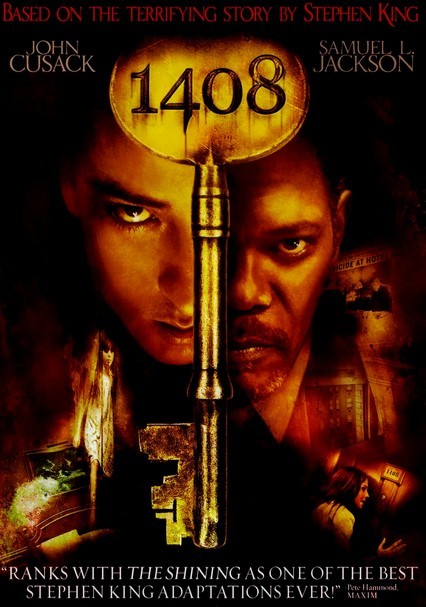
1408-2007

1408-2007

Director Mikael Hafstrom

Starring John Cusack, Samuel L. Jackson

Scott’s Review #983

Reviewed January 23, 2020

Grade: C+

A bundle of film adaptations of Stephen King novels has been born over the years.

1408 (2007) is one of many, and while suspenseful, the project might have been better served as a quick fifty-minute episodic television event rather than a big-screen effort.

The content seems displaced and disjointed, stretched too thin.

Nonetheless, big stars like John Cusack and Samuel L. Jackson provide some stamina to a film that slowly teeters into nonsense and a confusing conclusion.

Based on Stephen King’s 1999 short story of the same name, the film follows Mike Enslin (Cusack), an author who investigates allegedly haunted houses, and rents the titular room 1408 at the Dolphin, a New York City hotel, to see what all the fuss is about.

Although skeptical of the paranormal, he soon finds he cannot leave the room as bizarre events unfold.

The hotel manager, Gerald Owen (Jackson) attempts to convince Mike not to inhabit the notorious room, and intriguing is why?

The film is most successful when it focuses on the atmospheric and tense moments. The lighting and camera techniques evoke a closed-in, claustrophobic aura because the set is mostly a hotel room.

The use of psychological tension works better than a slice-’em, dice-’em approach.

During Mike’s examination of his room, the clock radio suddenly starts playing “We’ve Only Just Begun”, a hit song by The Carpenters. Mike assumes that Olin is pulling a prank to scare him.

At 8:07, the song plays again, and the clock’s digital display changes to a countdown starting from “60:00.”

This is creepy, and the viewer is intrigued by what will happen next.

The window slams down and wounds Mike’s hand. He begins to see ghosts of the room’s past victims, followed by flashbacks of his dead daughter Katie and his sick father.

This catapults Mike into terror, and he attempts to escape the room, fearing for his life.

He fails to escape, and the room appears to hold him prisoner until his wife, Lily (Mary McCormack), comes to the rescue.

What does Olin have to do with the events? Is Lily sinister or benevolent?

When Mike is out of the hotel room, the film falls apart. Containing too many weird circumstances to make much sense- a surfing event on the beach, a Molotov cocktail, a fire alarm, and a return to the hotel room- spins the viewer in too many directions as a hallucinogenic experience is created.

Before long, the viewer will stop caring. I know I did. On paper, these oddities sound intriguing, but they did not translate well to the screen.

Hafstrom directs the activity adequately and uses actors viewers are familiar with, which adds to its credibility.

With fewer talents or unknowns, the film might have felt low-budget or independent, and I think it, while not great, needs these actors to lend professionalism.

The star is naturally Cusack, who enjoys the most screen time as a man who only believes what his eyes and ears tell him, and not the silliness of spirits and ghosts.

The actor possesses an offbeat look, which adds to the film.

From a storyline perspective, 1408 never really catches fire. The film is neither pitiful nor a great adaptation of a Stephen King novel. The novel is hardly a household name, which does the film a few favors.

The result is fair to middling, with a promising first half followed by a dour second. 1408 (2007) will be forgotten five years after its release.

Midnight Lace-1960

Midnight Lace-1960

Director David Miller

Starring Doris Day, Rex Harrison

Scott’s Review #909

Reviewed June 13, 2019

Grade: B+

Midnight Lace (1960) is a straightforward psychological thriller made at a time when the genre was increasing in popularity.

The film was influenced by the Alfred Hitchcock craze, which was front and center at this time, and a robust departure for its lead, Doris Day, who until this time mainly was nestled securely in the romantic comedy domain.

The film is a good watch and a challenging role for Day, who proves she has the acting chops to carry the movie.

Day portrays Kit, an American heiress, newly married to British financier Tony (Rex Harrison), residing together in London. When she is terrorized by an odd voice in a London park one misty night, her panic is dismissed as rubbish, and pranksters have their way with her.

When the threats return and escalate with telephone calls, Tony alerts the authorities, who question whether Kit may be imagining things or creating a panic to gain attention from her husband.

Tony, in turn, begins to ask the same questions.

Day, an American sweetheart and forever good girl, was brave enough to tackle a role that was left of center for her.

Despite her acceptable acting and impressive range during scenes of peril, Doris Day is still Doris Day, and it is tough to shake the image of her playing herself.

Attractive, Day is not the sexpot type, so a few scenes of her being flirty by attempting to seduce Tony with sexy nighties do not work so well. Day has never looked lovelier than she does in this picture.

The plot rolls along with fantastic glossy production values, and I never found myself tuning out or wondering when the film would end.

The drama heightens minute by minute, turning into a whodunit, while the film wisely never disqualifies whether Kit could be staging the shenanigans herself.

Did she fall into a bus, or was she pushed? Why did she hire someone to call her? Is the menacing voice disguised? The questions become more frequent as the film progresses, which is what good thrillers should do.

I figured out only half of the big reveal, but the other half caught me off guard, and the finale was climactic and satisfying.

The film belongs to Day, but the additions of Harrison and the legendary Myrna Loy add class and flavor to a movie that could have been dismissed as only cliched in lesser hands.

Harrison is effective as the concerned but stoic husband, and the audience wonders whether Tony is involved in Kit’s stalking or is a caring man.

Does the subplot of a discovered embezzler in Tony’s company have anything to do with it? If so, how are the stories connected?

Handsome John Gavin, a Rock Hudson type who became famous for Psycho (1960), is a welcome addition as contractor Brian. He shows up at the right time to save Kit, making him a prime suspect.

Loy plays Kit’s Aunt Bea, who comes to town for a visit; the part is nothing special, but seeing the actress in whatever role she tackles is lovely.

Finally, Malcolm Stanley (Roddy McDowell) adds drama as a money-hungry man and son of Kit’s maid.

Characters are added to the story as potential suspects.

The viewer is treated to their share of exterior shots of London, which provides the film with enough British flavor, almost to forget that Day is American.

With the additions of Scotland Yard and an Inspector, the British culture is firmly placed, adding a wonderful British element.

Tony and Kit are rich, so their lavish home and exclusive neighborhood are finely placed on display.

The film’s title is represented in a cute scene when Kit seductively holds up a sexy outfit she purchased for Tony. The scene seems straight out of the 1980s slick television movie thriller genre and is primed for the Lifetime television network.

This is not a criticism because the title works well and holds tantalizing darkness.

Midnight Lace (1960) is a nearly forgotten film that is a fine watch and a lovely tribute to Doris Day’s talents. She makes the film her own and is the main reason to watch it.

Though she does not sing or play the girl next door, she does turn in an above-average performance, showing her range as an actress.

The rest of the film’s trimmings, especially the locale and the supporting actors, benefit the viewing pleasure the film possesses.

Oscar Nominations: Best Costume Design, Color

Golden Globe Nominations: Best Performance by an Actress in a Motion Picture-Drama-Doris Day

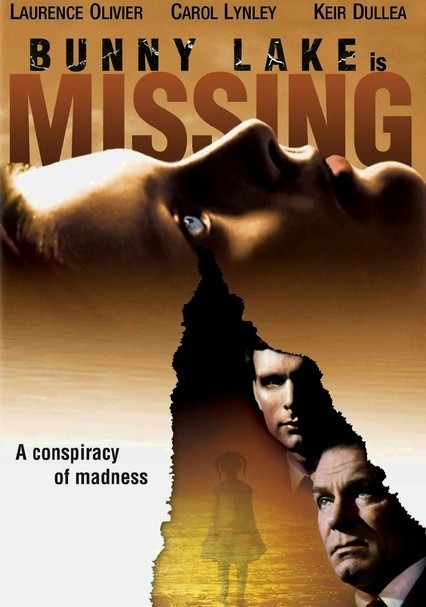
Bunny Lake Is Missing-1965

Bunny Lake Is Missing-1965

Director Otto Preminger

Starring Keir Dullea, Carol Lynley

Scott’s Review #877

Reviewed March 13, 2019

Grade: B+

Bunny Lake Is Missing (1965) is a taut psychological thriller that feels fresh and unpredictable, containing a mysterious, almost haunting quality throughout its running time.

The film focuses on one big question: Is the main character’s interpretation of events real or imagined? The uncertainty makes the film intriguing to watch. Glimpses of London locales also make for fun viewing, as the chaotic and creepy children’s school is the film’s primary location.

Though not remembered well, the film is still worthy of a watch.

Ann (Carol Lynley) is a single mother recently transplanted to London with her well-kept brother Stephen (Keir Dullea). When she hurriedly drops off her unseen daughter, Bunny, at her new preschool and instructs the school cook to watch her, the girl soon disappears.

When the police were called to investigate, they discovered nobody on staff had any eyes on the young girl. The plot thickens when it is revealed that all of Bunny’s belongings have been removed from Ann’s residence and that Ann had an imaginary childhood friend named Bunny.

Has Ann concocted the entire scheme herself for attention, or could she be harmful or psychotic?

The film offers several subtle nuances that either work or do not work. The opening credits are a lesson in cinematic creativity as the words present as slivers of paper torn down the middle.

Though the musical score during this sequence is not necessarily eerie, the complexity and ferocity present an ominous and certainly intriguing element.

This point is a wise move because it sets the tone for such a thriller as the film presents itself.

Otto Preminger’s black-and-white style is upbeat, enhancing the overall look of the picture. The muted tones evoke an effective ghost story style with an ambivalent chilling technique.

As the mystery is ultimately resolved, the introduction of new and peculiar characters offset the tangled plot as the look of the film remains constant.

As Horatio Wilson, Ann’s landlord, and Martita Hunt, the retired school headmistress, Noel Coward lives in the attic, which does wonders for adding creepy ch. Butters, but are they meant to be red herrings or keys to the big reveal?

A few gripes are that incorporating the English rock band The Zombies serves little purpose, and the addition is perplexing.  I’m not opposed to the band’s music, but the songs have nothing to do with the plot.

Seen on the television during a pub scene and later heard on a janitor’s radio during an escape scene, the odd placement seems little more than a marketing tool product placement.

Another miss is with the casting of Sir Laurence Olivier as Superintendent Newhouse. His talents are wasted mainly with little more than a throwaway role despite arguably being considered the lead.

As the straight man handling the investigation, his performance is adequate but limited, especially given his Shakespearean stage actor talents. His performance is both phoned in and beneath the historic actor.

The other roles are well-cast, especially Lindley and Dullea in key parts. For the film’s first portion, I assumed the pair were husband and wife until it was revealed otherwise, which is a lovely, unexpected nuance. Their chemistry is sweet and easy, and both perform their respective roles with poise and charisma.

1965, both were relatively novice young actors on the brink of stardom, though sadly short-lived. Their acting chops are firmly in place with this film, which is fun to witness.

For fans of psychological thrillers with an implied ghost story enveloped within its clutches, Bunny Lake Is Missing (1965) is worthy and mysterious entertainment with a surprise ending.

The film is not stellar, with some weaknesses, and is less than a pure classic, reminiscent of a good, solid Twilight Zone television episode.

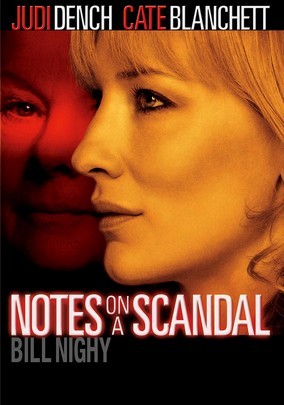
Notes on a Scandal-2006

Notes on a Scandal-2006

Director Richard Eyre

Starring Judi Dench, Cate Blanchett

Scott’s Review #793

Reviewed July 23, 2018

Grade: A

A British drama centering on the world of teachers, illicit affairs, and sexuality, Notes on a Scandal (2006) is a superlative effort with thrills and drama galore.

Featuring heavyweights like Judi Dench and Cate Blanchett, there is no way this film could be a dud based on the acting alone.

The chemistry between the women and the carefully crafted thrills created by director, Richard Eyre, make the film a compelling joy to view- perhaps multiple times for additional entertainment.

The story is told mainly from the perspective of Barbara Covett (Dench), a rigid and bored schoolteacher nearing retirement at a comprehensive school in London.

Barbara is a spinster and a closeted lesbian, constantly writing in her journal for comfort- this is the main narrative of the story and is tremendously effective.

When a young and attractive art teacher, Sheba Hart (Blanchett), arrives on the scene, Barbara fancies her and is determined to get closer.

After Sheba begins an illicit affair with a male student, Barbara discovers the shenanigans and uses the situation to her advantage.

The scandal results in both women’s careers being at risk, as well as Sheba’s troubled home life coming to fruition.

Notes on a Scandal is a good, solid psychological thriller/drama with enough twists and turns to keep the viewer engaged. The film is not very long- at one hour and thirty-two minutes, there is hardly any time for lagging.

The best achievements, however, are with the superior acting of the two leads. With other lesser talents, this film might have suffered from too much melodrama and not enough meat.

With great acting chops, Dench and Blanchett do not let this happen; instead, they treat the audience to a riveting affair.

As fantastic as Blanchett is, Dench’s Barbara is the standout, taking center stage throughout the film.

Interestingly, despite both actresses being leads, Dench received an Oscar nomination for Best Actress, while Blanchett was nominated for Best Supporting Actress.

But there is no question that both actresses deserved the praises they reaped- and then some.

Dench delivers such a delicious performance that she arguably makes the film worth watching. Wearing no makeup and dressed as conservatively as imaginable, the subject will cast an icy stare or thoughtful gaze that runs shivers up and down the viewer’s spine.

As conflict and drama unfold, Barbara proves she is nobody to be messed with.

Still, the character has an underlying vulnerable quality, simply yearning for affection and love from another woman. One wonders if she has ever really had the love she deserves.

Dench is brilliant at revealing Barbara’s nuances.

The film poses an interesting moral question that will leave some viewers undoubtedly not fans of Sheba’s.

The fact that she lusts after an underage male, Steven Connolly (Andrew Simpson), and has relations with him, while having a husband and disabled child at home, may be too much for some.

Surely, the character will not be championed by many, but I found Sheba complex and difficult to grasp.

This complexity is to the filmmaker’s credit and allows for a more layered character study of both Sheba and Barbara- neither is cut and dry.

An interesting aside of the film is what if the genders of the roles were reversed? Would the film have the same effect if Sheba were a male character and Steven were a teenage girl? What if Barbara were a straight woman? What if Barbara were a gay male character?

These other possibilities left me wondering as I watched the film. Wisely, I think director Eyre got things just right.

Notes on a Scandal (2006) is a film that reminds me of a British version of Fatal Attraction (1987) meets Single White Female (1992).

The story holds elements of each and was adapted from a 2003 novel of the same name. With frightfully good performances by both Dench and Blanchett, this film is a memorable thriller not to be missed.

Oscar Nominations: Best Actress-Judi Dench, Best Supporting Actress-Cate Blanchett, Best Adapted Screenplay, Best Original Score

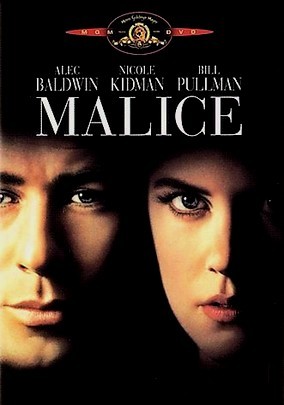
Malice-1993

Malice-1993

Director Harold Becker

Starring Alec Baldwin, Nicole Kidman, Bill Pullman

Scott’s Review #765

Reviewed May 29, 2018

Grade: B+

Malice (1993) is only one of a slew of husband and wife-themed thrillers to emerge from the early 1990’s- Unlawful Entry (1992), Sleeping with the Enemy (1991), and Deceived (1991) are other similar films that made lots of money during this time.

This slick filmmaking genre was popular as the new decade emerged and more complex storytelling graced screens.

The myriad twists and turns are both a positive and a negative for this film.

Keeping the audience guessing and on pins and needles is a key to success, eliciting a fun tone, as well as the tremendous star power of the cast (George C. Scott and Anne Bancroft are big-time heavies).

Then again, a few of the plot points become red herrings and thereby meaningless, and the overall plot and endless subplots become way more complex than they need to be.

In a plot that is dizzying to explain, Associate Dean Andy Safian (Bill Pullman) and his wife Tracy (Nicole Kidman) are embarking on a life together in Massachusetts as they purchase a grand Victorian house and plan to begin a family.

As a serial killer stalks the campus where Andy works, and implausibly results in him being the prime suspect, Tracy experiences health turmoil and is operated on by cocky yet brilliant Dr. Jed Hill (Alec Baldwin).

When dire events occur, the plot escalates, and the main characters’ motivations are called into question as truths and deceptions unravel.

When I first saw Malice in 1993 (in fact, I saw it twice the same year), I adored the multitude of plot points and devices. The film had the same effect as a speeding roller coaster ride- with endless twists and story revelations.

And to be fair, the film holds up pretty well, never seeming dated or of its time like many mainstream films.

The two startling reveals- Tracy and Jed being in cahoots and the mysterious eye witness living next door being blind- are clever bits of writing that immerse the audience on many levels.

The acting is top-notch- Kidman plays good and evil oh so well, and Bancroft’s cameo as Tracy’s mother is Oscar-worthy.

The chemistry between Pullman, Kidman, and Baldwin, and Pullman’s “nice guy” to Baldwin’s “jerk,” works quite well as the overlapping relationships play out.

Small yet meaningful roles by Bebe Neuwirth, Peter Gallagher, and Gwyneth Paltrow add layers to the wonderful casting.

And who can forget the often-parodied scene in which arrogant Dr. Jed launches into a monologue claiming to be infallible and to be God? This scene received tons of publicity and is arguably the defining moment of the film.

However, Malice’s strengths also sometimes become its weaknesses. As the events unfold, the plot becomes too confusing.

The school serial killer plot soon becomes a red herring as we realize it has little to do with the central plot- the Tracy/Jed alliance- except only to raise parenting questions.

Therefore, the big reveal of who the killer becomes is for naught. It’s the creepy janitor named Earl(Tobin Bell), hardly a surprise.

Furthermore, after the film ends and the viewer plays the events back to see if they add up, they will likely give up in frustration.

Malice is an above-average entry in a popular genre- who doesn’t like a good, solid thriller? With a talented cast and enough good medical thrills to balance with a college campus whodunit, there is plenty to please everyone who views this film.

Yes, some of the writing is preposterous and tough to believe, but Malice (1993) is a movie meant to escape with, sit back, and enjoy.

No Country for Old Men-2007

No Country for Old Men-2007

Director Ethan Coen, Joel Coen

Starring Tommy Lee Jones, Javier Bardem, Josh Brolin

Scott’s Review #745

Reviewed April 19, 2018

Grade: A

No Country for Old Men, made in 2007,  is arguably Joel and Ethan Coen’s greatest work save for the amazing Fargo (1996).

Achieving the Best Picture Academy Award and appearing on numerous Top Ten lists for its year of release, the film is one of their most celebrated.

Containing dark humor, offbeat characters, and fantastic storytelling, adding in some of the most gorgeous cinematography in film history, No Country for Old Men is one of the decade’s great films.

The time is 1980, and it’s set in western Texas as we follow the dangerous hitman Anton Chigurh, played wonderfully by Javier Bardem.

He escapes jail by strangling a deputy and is subsequently hired to find Llewelyn Moss (Josh Brolin), a hunter who has accidentally stumbled onto two million dollars in a suitcase that Mexican smugglers are desperate to find.

In the mix is Sheriff Tom Bell (Tommy Lee Jones), who is pursuing both men. Moss’s wife, Carla Jean (Kelly Macdonald), in turn becomes an important character as she is instrumental in the web of deceit the chain of events creates.

The film subsequently turns into an exciting cat-and-mouse chase with a dramatic climax.

The crux of the story and its plethora of possibilities are what make the events so exciting to watch. As characters are in constant pursuit of each other, the viewer wonders who will catch up to whom and when.

One quality that makes the film unique with an identity all its own is that the three principal characters (Moss, Bell, and Chigurh) seldom appear in the same scene, adding a layer of mystery and intrigue.

The hero and most well-liked of all the characters is, of course, Sheriff Bell- a proponent of honesty and truth. In contrast, the other two characters are less than savory types, especially the despicable Chigurh.

My favorite character in the story is Chigurh, as he is the most interesting, and Bardem plays him to the hilt with a calm malevolence- anger just bubbling under the surface.

One wonders when he will strike next or if he will spare a life, as he intimidates his prey by offering to play a game of chance, the toss of a coin to determine life or death.

He is one of cinema’s most vicious villains. With his bob-cut hairstyle and his sunken brown eyes, he is a force to be reckoned with by looks alone.

True to many other Ethan and Joel Coen films, the supporting or even the glorified extras are perfectly cast and filled with interesting quirkiness.

Examples of this include the kindly gas station owner who correctly guesses a coin toss and is spared his life. My favorite is the matter-of-fact woman at the hotel front desk, with her permed hair, who gives as good as she gets, and her monotone voice is great.

It is these smaller intricacies that truly make No Country for Old Men shine and are a staple of Coen Brothers films in general.

Many similarities abound between Fargo and No Country for Old Men, not the least of which is the main protagonist being an older and wiser police chief (Marge Gunderson and Tom Bell, respectively).

Add to this a series of brutal murders and the protagonist being from elsewhere and stumbling upon a small, bleak town. Of course, the extreme violence depicted in both must be mentioned as comparable.

Having shamefully only seen this epic thriller twice, I find No Country for Old Men (2007) a dynamic film, reminiscent of the best of Sam Peckinpah’s classics, such as The Getaway (1972) or The Wild Bunch (1967).

The Coen brothers cross film genres, blending thriller, western, and suspense that rival the greatest of Hitchcock’s films.

I cannot wait to see it again.

Oscar Nominations: 4 wins-Best Picture (won), Best Director-Joel and Ethan Coen (won), Best Supporting Actor-Javier Bardem (won), Best Adapted Screenplay (won), Best Sound Editing, Best Sound Mixing, Best Cinematography, Best Film Editing

Shutter Island-2010

Shutter Island-2010

Director Martin Scorsese

Starring Leonardo DiCaprio

Scott’s Review #567

Reviewed December 27, 2016

Grade: A-

Shutter Island (2010) is a great, psychological thriller, that being a Scorsese film, I had high expectations for. Lo and behold, I was not disappointed in the slightest.

Scorsese has a knack for making taut films, very violent, and with an edge. This film does not have the gore nor the blood that some of his other films have- especially since the subject matter is not mafia-related.

After Teddy Daniels (DiCaprio), a World War II veteran, turned U.S. Marshall investigates the disappearance of a female patient at a local psychiatric hospital, the case develops unforeseen layers.

The time is the 1950s.

Shutter Island is not your typical, run-of-the-mill thriller- it is much more than that and the complexities build and build. Not to be secondary to the interesting web of plot, but the art and set designs and visual effects are quite impressive- particularly during the storm scenes.

Leonardo DiCaprio is quite the gem, carrying the film in a demanding role, and working so well with Scorsese, as proven by his being a repeat player in his films.

All the performances (even tiny roles) were played with perfection- with flawless nuances- I mainly mean the hospital staff and patients.

The unpleasant violent images may upset some as well as the ending, but I found it to be an edge-of-your-seat, extremely well-made film. I hope that it is remembered for some time.

The Bridesmaid-2004

The Bridesmaid-2004

Director Claude Chabrol

Starring Benoit Magimel, Laura Smet

Scott’s Review #548

Reviewed December 14, 2016

Grade: B+

A more modern offering by Claude Chabrol (many of his films were made in the 1960s and 1970s), his 2004 film entitled The Bridesmaid, continues the tradition of compelling, macabre storytelling.

It immerses the viewer in the strange behavior of the central characters as they obsess over each other in one way or another.

The film is in French.

The Bridesmaid contains two plots, one explored fully, the other not explored as much as might have been hoped- the latter being the more interesting of the two.

Philippe is his mother Christine’s only son and the only male in the household. His two other sisters live there as well.

Christine is divorced and works as a hairdresser.

The family is a rather typical one, save for a creepy, incestuous bond between Philippe and Christine, their very romantic conversations, and Philippe’s penchant for carrying around a head statue carved to resemble his mother.

He regularly sleeps with the statue and kisses it on the lips.

As the youngest daughter is to be married, Philippe meets and bonds with one of the bridesmaids, Senta.

The two embark on a torrid love affair and become inseparable. As their love flourishes, Senta becomes obsessed with her undying love for Philippe and asks him to kill a stranger as a way of proving his love for her.

This leads to confusion as Senta kills another character, thinking this is what Philippe wants. Philippe becomes both afraid and titillated by the young girl.

The main plot is very reminiscent of the Hitchcock classic Strangers on a Train (1951), in which one party is bloodthirsty and the other a more innocent victim, yet in Chabrol’s film, the other party suffers from emotional issues of their own.

Senta is unbalanced, and a mysterious figure from her past, Rita, described as her stepmother, appears a few times as she dances with her much younger partner.

A local girl mysteriously disappears early in the film, which may be a red herring or may be related to the events of the film.

I was more intrigued by the mommy/son angle, but perhaps that is Chabrol’s way of confusing the audience. Oddly, the duo has simmering chemistry, yet each character never fesses up to being obsessed with the other.

It is merely implied.

Philippe dislikes Christine’s beau, who figures prominently in the main story of Senta’s machinations, but I wanted more of Christine and Philippe.

Stylistically, The Bridesmaid is dreamy and builds at a slow momentum, similar to Chabrol’s earlier films. We are aware that the story will play out in a strange, interesting fashion, but we do not always know which road Chabrol might take, nor which plot points may or may not be revealed.

Perhaps less developed than some of his fantastic earlier efforts, but a recommended watch for someone in the mood for a morbid, left-of-center story to sink one’s teeth into.

Claude Chabrol is a director I admire greatly for his use of fascinating elements that keep the audience guessing about what is coming next, and that is a joy in itself.

Mother-2009

Mother-2009

Director Bong Joon-ho

Starring Kim Hye-Ja 

Scott’s Review #480

70118372

Reviewed September 11, 2016

Grade: A

Mother (2009) is brilliant! I loved it and implored people to give the film a chance.

Years later, just desserts would be served. Director Bong Joon-ho would win the Oscar for Parasite (2019).

It is a South Korean film, made in 2009, that almost nobody has heard of, let alone seen, but it is fantastic.

It’s a shame that it did not get more notice, but sadly, some of the best films do not.

The plot revolves around a mysterious murder that occurs in a small South Korean village and a poor village woman’s mission to exonerate her mentally challenged son, who is convicted of the crime in a botched case.

The plot twists and turns and is compelling beyond belief. The real crux of the film is what lengths a mother will take to protect her son, a question many viewers can ask themselves.

Why Hye-Ja Kim, who plays the title character, was not nominated for an Oscar for this role is beyond me and quite a shame. She is a goldmine and gives a terrific, memorable performance.

The movie is stylistic and has moments that resemble Hitchcock and David Lynch combined. One does not know what will transpire from scene to scene, and that is the beauty of the film- besides the wonderful acting.

Once the film ends, viewers will feel compelled to discuss it, which is an accomplished feat.

I highly recommend it.

Independent Spirit Award Nominations: Best Foreign Film

The Nanny-1965

The Nanny-1965

Director Seth Holt

Starring Bette Davis

Scott’s Review #256

70089620

Reviewed July 11, 2015

Grade: B

The Nanny is a 1965 Hammer productions thriller starring legendary film icon Bette Davis as a mysterious nanny caring for a ten-year-old boy named Joey.

Joey has recently been released from a mental institution and returned home to resume everyday life, but has he been “cured”?

There is obvious tension between Joey and Nanny, but the audience doesn’t know what that tension is precisely. Why do they dislike each other? Why is Joey afraid of her?

As the plot unfolds, the suspense and tensions thicken as various events occur and Joey’s parents and Aunt Pen are further fleshed out. Past events are revisited, and the story becomes thrilling.

At one point, long before Joey’s return home, his younger sister has drowned, and the circumstances are vague. It has devastated the family, including Nanny. Joey has been blamed for her death, though he insists that Nanny is the culprit.

Nobody except the neighbor girl believes Joey, and the audience wonders who to believe and who to root for: Joey or Nanny. Davis, like Nanny, brings a warmness to her character, but is she sincere? Is it an act? Is Joey a sweet boy or maniacal?

These questions race through the audience’s minds as the film progresses. When Virginia, the mother, eats tainted food, the obvious conclusion is that the Nanny poisoned it since she prepared it. But why? Did she do this?

As the plot is slowly explained, there are a few chills, though the ending is not too surprising.

Any film starring Bette Davis is a treasure, though admittedly, it is not her finest work. Still, her finest work is challenging to match.

The Nanny is a good film, though not great. It is shot in black and white, which is a nice touch for a thriller.

The main reason to watch Davis’s performance is that it is always mesmerizing. Traditionally playing gruff, mean, or bitchy parts (especially in her later years), The Nanny allows Davis to play a sympathetic role.

She is seemingly sweet, proper, well-organized, and a perfect nanny on paper.

The role of Virginia, played by Wendy Craig, is a bit too neurotic and slightly over-acted. She is rather one-note as the fretting mother worried about her son. The character of the father is also a bit one-dimensional.

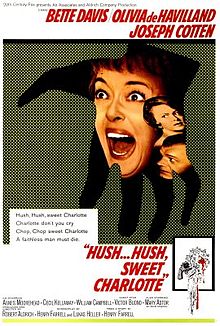
The Nanny is more of a classic thriller from the 1960s that is often lumped together with some of Bette Davis’s other films around the same period (Dead Ringer-1964, Hush, Hush, Sweet Charlotte-1964, and Whatever Happened to Baby Jane? -1966), and are in large part superior to The Nanny. As a stand-alone, it is a decent film.