Tag Archives: Richard Farnsworth

Misery-1990

Misery-1990

Director Rob Reiner

Starring Kathy Bates, James Caan

Scott’s Review #1,511

Reviewed January 18, 2026

Grade: A-

Kathy Bates and James Caan deliver exceptional performances in Misery (1990), a thriller/horror hybrid set in the snowy hills of remote Colorado over the course of a couple of winter months.

Caan plays famed novelist Paul Sheldon, who is held captive by Annie Wilkes (Bates), an obsessive and unpredictable fan. Bates won the Academy Award for Best Actress for her role.

Thanks to Rob Reiner’s superior direction, the film never lags and continuously keeps the tension boiling at a heart-racing pace. From an early sequence involving a terrible car accident to a slasher horror-worthy finale, Misery contains something for everyone.

The film is based on the enthralling 1987 Stephen King novel and a screenplay by Academy Award-winning writer William Goldman (All the President’s Men, 1976).

After completing his latest novel involving a beloved series character named Misery, Paul’s car careens off a snowy mountain road, leaving him stranded and unconscious. He is rescued by former nurse Annie, who claims to be his biggest fan.

Annie brings him to her remote cabin to recover, where her obsession takes a dark turn when she discovers that Sheldon is killing off Misery, her favorite character.

The success of Misery is due to the chemistry between Bates and Caan. While no romantic sparks exist, the taut scenes of captor and captee are enthralling as the audience nervously awaits what could happen next.

At first, thankfully rescued by Annie, Paul quickly realizes he may be better off dead. Seemingly shifting from kind to rage, Bates flawlessly reveals to the audience that something is not quite right with Annie.

As the actors play cat-and-mouse with their characters, each scene is potent as deeper levels of character texture are surfaced, especially with Annie. Why she is no longer a nurse is shocking.

They even share a tender scene dining over a lovely meal of meatloaf and red wine, though one character’s intentions are spoiled before too long.

Bits of dark humor surface mainly as Annie uses the words ‘cockadoodie’ and ‘poop’ and greedily munches on chips while watching her favorite game shows.

Keeping with the suspense, Reiner’s direction employs several jumps and starts as Annie suddenly appears out of the blue, fiendishly hovering over the injured Paul in his bed, with a look of rage or, in some cases, of unrequited love.

Comparisons to the television series Twin Peaks (1990-1991) and the films Fargo (1996) and What Ever Happened to Baby Jane? (1962) can be recognized.

Supporting characters, the capable Sheriff Buster (Richard Farnsworth) and the horny Deputy Virginia (Frances Sternhagen), are also a married couple, and the cold, snowy small town with peculiar characters like the folksy general store clerk comes to mind when thinking of the aforementioned 1990s efforts.

The claustrophobic bedroom setting where one bedridden sane character relies on an insane character for food and medicine recalls the 1960s cult classic well. When another character uncovers the charade and tries to save the victim, the audience lets out a brief sigh of relief before the rug is pulled out from under them.

Finally, with little to do as Paul’s book agent, it’s nonetheless a treat to see legendary screen actress Lauren Bacall appear in the film.

While many of Stephen King’s adaptations are mediocre or less, it’s nice to see Misery (1990) achieve its due. Alongside Stand By Me (1986), this makes two successful King adaptations by director Reiner.

Oscar Nominations: 1 win-Kathy Bates-Best Actress (won)

Gone With The Wind-1939

Gone With The Wind-1939

Director Victor Fleming/George Cukor

Starring Clark Gable, Vivien Leigh, Olivia de Havilland

Top 250 Films #22

Scott’s Review #201

70020694

Reviewed December 4, 2014

Grade: A

Gone with the Wind (1939) is the grand masterpiece of sweeping epic drama.

The film is based on Margaret Mitchell’s best-selling novel. Set in the American South (specifically, Georgia) during the Civil War era, it centers on the life of Scarlett O’Hara, a Southern belle who works on the cotton plantation Tara. After the South loses the war, she struggles to keep her plantation alive.

Initially, Scarlett cares little about the war but enjoys her spoiled, narcissistic lifestyle and romances with many men in the town, all vying for her attention. With all eyes on her, she revels in one sunny picnic and ball after another.

As war decimates the South, Scarlett must take over the plantation and survive the ravages of war.

Mixed in with the war theme is a romance between Scarlett and Rhett, one of cinema’s most recognized and enduring couples. Having gone through three directors (Victor Fleming, George Cukor, and Sam Wood), the film is as extravagant and precise in its style, attention to detail, and set design as films come.

At close to four hours, Gone with the Wind is a lavish production that can take an entire afternoon or evening to watch. It is divided into two halves—interestingly, Cukor directs the first half, and Fleming primarily directs the second.

It is a film that can be viewed and analyzed repeatedly, and the set pieces and flawless perfection alone are worthy of marvel. The first half is superior to the second, but that is like comparing prime rib to filet mignon—it’s a matter of personal preference.

The first half is brighter, cheery, and fantastic. The excellent Tara and neighboring plantation Twin Oaks host southern balls and parties filled with romance, gossip, and beautiful costumes. War is coming, but it is a delightful time of merriment.

The Southerners eagerly embrace the prospect of war, assuming it will last only two weeks and that they will emerge victorious. They party and celebrate.

The second half has a much darker tone.

By the beginning of the second half, Atlanta has burned, thousands of men have died, Tara is decimated, Scarlett’s mother has died, and her father has gone batty.

The rebuilding of the South is explored, the troubled Rhett and Scarlett marriage commences, their daughter dies, and the world-famous line uttered by Rhett to Scarlett, “Frankly my dear…. I don’t give a damn”.

Having been now directed by a different person (Fleming), the first and second halves almost seem like two separate films.

Vivien Leigh plays a beautiful role. In 1939, women were rarely portrayed as strong characters in films, so Gone with the Wind is groundbreaking for its portrayal of female characters.

Scarlett is selfish but rises above, is strong, saves her plantation, and succeeds as a successful businesswoman—almost unheard of in cinema in 1939. Her undying love for Ashley Wilkes but her inability to obtain him (he is married to his cousin Melanie) gives her a sympathetic vulnerability.

Clark Gable, already a massive star and the people’s choice to play Rhett, is charismatic and handsome. The fact that he and Leigh did not get along makes their fights and sexual tension electric. They love but hate each other, which is transmitted on screen.

Rhett is his own man—he defines himself as not a Northerner but not a Southerner. He is a vagabond and spends many nights at the local brothel in the company of Belle Watling. Rhett’s character is independent and strong.

The supporting characters are colorful, lively, and humorous. Aunt Pittypat’s dramatic worrying and smelling salts and Prissy’s insistence on expert childbirth when, in reality, she knows nothing is moments meant to lighten the mood.

Mammie, Scarlett’s mother figure, is a moral, kind, yet tough character. Melanie (Olivia de Havilland) is an even sweeter character, characterized by her caring and selflessness.

Lesser characters, such as Dr. Meade, Suellen, Carreen, India, and Frank Kennedy, serve their purpose and are no throwaways.

It is bothersome that, over the years, Gone with the Wind has been unfairly “feminized” once it began airing as an alternative to the annual Super Bowl. The assumption was that only women would enjoy it, which is silly.

I do not find this film to be a female film, and frankly, some of the battle scenes are pretty masculine, with epic fires and guns galore. Is Gone with the Wind now considered a racist film?

Perhaps so, and time has made the political incorrectness much more glaring- this point can be debated endlessly. Ashley participates in a hooded Klan organization and is portrayed as a hero in the film.

Indeed, throughout the film, the enslaved people are portrayed as happy, kindly, and comfortable with their place in life, vastly different from what transpired. However, Hattie McDaniel (Mammie) won the first-ever Oscar for a black actress, which was monumental progress and influence.

Using seemingly thousands of extras, the war-torn Atlanta scene where the camera rises up and up and up, panning down on hundreds of wounded and dead Union soldiers as Scarlett defeatedly walks among them, is still heartbreaking to watch and is a reminder of the power and destruction that war is.

Gone with the Wind is an epic masterpiece from the past that still holds up remarkably well. The sets, the rich characters, and the costumes can be admired and still inspire today.

Oscar Nominations: 8 wins-Outstanding Production (won), Best Director-Victor Fleming (won), Best Actor-Clark Cable, Best Actress-Vivien Leigh (won), Best Supporting Actress-Hattie McDaniel (won), Olivia de Havilland, Best Screenplay (won), Best Original Score, Best Sound Recording, Best Art Direction (won), Best Cinematography, Color (won), Best Film Editing (won), Best Special Effects

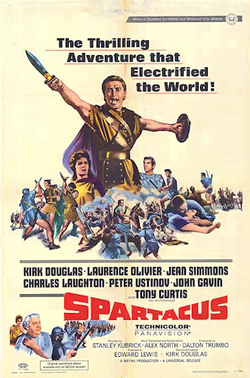
Spartacus-1960

Spartacus-1960

Director Stanley Kubrick

Starring Kirk Douglas, Laurence Olivier, Jean Simmons

Top 250 Films #247

Scott’s Review #1,250

Reviewed April 30, 2022

Grade: A

Typically, when influential director Stanley Kubrick’s name is uttered, films such as The Shining (1980), 2001: A Space Odyssey (1968), and Barry Lyndon (1975) are immediately thought of, and for obvious reasons.

The haunting, moody musical score, the long camera shots, the dark humor, and the clever camera tricks are easy to pinpoint.

1960, the director was hired to direct the gorgeous epic Spartacus after Hollywood star Kirk Russell unceremoniously fired the first director.

None of the previously mentioned elements are easy for me to notice and are more or less absent, but a grand battle scene in a luscious green field is very reminiscent of Barry Lyndon. This is likely because Spartacus was not Kubrick’s film entirely; instead, it belonged to others with more clout.

Spartacus is a brilliant film for many reasons. Some epics suffer from a hokey, cliched feel and can be overwrought, predictable, and tired.

The rebellious Thracian Spartacus (Russell), born and raised a slave, is sold to Gladiator trainer Batiatus (Ustinov). After training to kill for the arena, Spartacus turns on his owners and leads the other slaves in rebellion.

As the rebels move from town to town, their numbers increase as escaped slaves join their ranks. Under the leadership of Spartacus, they make their way to southern Italy, where they intend to cross the sea and return to their homes.

Spartacus is grand, sweeping, cinematically significant, and everything else you’d expect from a 1960s Hollywood epic with enormous stars of its day. Looking beneath the surface, the film is riddled with interesting tidbits like bisexuality, homoeroticism, and violence, more in tune with an art film or modern war film than the safety of a movie made during this time.

Particularly noteworthy is that Dalton Trumbo wrote the screenplay. One of the Hollywood Ten, he refused to testify before the House Un-American Activities Committee in 1947 during the committee’s investigation of alleged Communist influences in the motion picture industry.

After the release of Spartacus, it marked the beginning of the end of the Hollywood Blacklist for Trumbo and other affected screenwriters.

Thank goodness.

In a famous scene, recaptured slaves are asked to identify Spartacus in exchange for leniency; instead, each slave proclaims himself to be Spartacus, thus sharing his fate.

The suggestion is that this scene was meant to dramatize the solidarity of those accused of being Communist sympathizers during the McCarthy era.

Besides the political importance, Spartacus showcases a beautiful romance between Spartacus (Russell) and Varinia (Jean Simmons), a gorgeous slave girl. The tenderness and authenticity are palpable as many of their early scenes involve no dialogue but only longing and expression through both actors’ eyes.

I celebrated the connection between the actors at the forefront of much romance. Russell carries the film with calm masculinity, quickly making him heroic and likable.

He is the charismatic, good guy who has been wronged and ill-fated.

A sequence oozing with machismo and homoeroticism occurs when evil Crassus (Olivier) is bathed by his slave boy Antoninus (Tony Curtis). He seductively explains that while sometimes he prefers snails, he also likes oysters. The implication is that he is bisexual, brazenly so, and expects the youngster to become his sex slave.

The warmth of the bathtub and the luxurious atmosphere contrast with the proximity and touch of both male characters.

In 1960, this scene was way ahead of its time.

The conclusion of Spartacus is melancholy and surprising. Having bested Rome’s cruelty, one might have expected to see Spartacus and Varinia happily ride off into the sunset.

This doesn’t happen, and the film is more affluent in it. There is pain and despair as there were in real life. Wisely sparing complete doom and gloom, the ending is satisfying as one central character escapes a deadly demise and conjures ahead.

Spartacus (1960) is one of the greats. It has muscle and texture, and many below-the-surface nuances are ripe for discussion. For these reasons, it’s a must-see.

Oscar Nominations: 4 wins-Best Supporting Actor-Peter Ustinov (won), Best Art Direction-Color (won), Best Cinematography-Color (won), Best Costume Design-Color (won), Best Film Editing, Best Music Score of a Dramatic or Comedy Picture

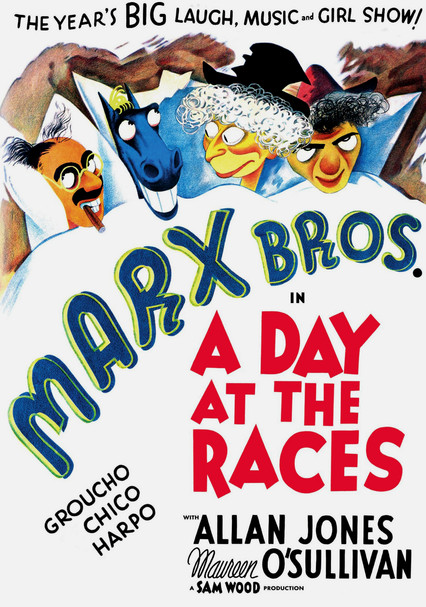
A Day at the Races-1937

A Day at the Races-1937

Director Sam Wood

Starring Groucho Marx, Chico Marx, Harpo Marx

Scott’s Review #1,011

Reviewed April 13, 2020

Grade: B

The Marx Brothers created a collection of successful films throughout the 1920s and 1930s, including A Day at the Races (1937), which continues the zany adventures of the bumbling men.

Not as laugh-out-loud funny as their earlier works, particularly the memorable Duck Soup (1933), which is considered their best achievement, the film has trademark chuckles and physical comedy for miles that celebrate their vaudeville roots.

A horse and a private sanitarium are the major players in this installment.

The film suffers from a myriad of stereotypes and startling racial overtones, as any apt viewer will likely need to remind themselves of the decade the film was made. Thankfully, these scenes are brief and not the highlight of the story.

A Day at the Races belongs to the Marx Brothers as their klutzy humor and one-liners are the best parts, leaving the romantic leads and the foils as standard characters. Backstage problems were prevalent, leaving some continuity issues for the final product.

Judy Standish (Maureen O’Sullivan) owns the struggling Standish Sanitarium, which she can barely afford to keep afloat. The devious J.D. Morgan (Douglass Dumbrille) owns a nearby racetrack and nightclub and aspires to use the sanitarium space to open a successful casino.

Hugo Z. Hackenbush (Groucho Marx), a horse doctor, treats the wealthy Mrs. Upjohn (Margaret Dumont), who she thinks is a “real” doctor, and agrees to back the sanitarium financially, but only if Hackenbush runs it.

Suspicions arise when Morgan and his business manager attempt to locate the real Hackenbush in Florida.

Meanwhile, Judy’s fiancé, singer Gil Stewart (Allan Jones), who performs in Morgan’s nightclub, has just spent his life’s savings on a racehorse named Hi-Hat. He hopes that the horse he purchased from Morgan will win a big race and the money will save the sanitarium.

Hi-Hat is afraid of Morgan and runs away whenever he hears Morgan’s voice. All the principal players gather for a hysterical conclusion as an exciting horse race ensues with a case of mistaken identity mixed in for good measure.

The main attractions are Groucho, Harpo, and Chico, as they provide a robust dose of clumsy, action-filled pranks, misunderstandings pop, and bops that keep them fluttering about the silver screen in a fast-paced fashion.

The other characters serve as either foils or support for the trio of funny men, so much so that they feel like stock characters. Jones and O’Sullivan have some chemistry as the straight leads and a few tender moments, but neither is the film about them.

The running time of one hour and fifty minutes feels long for a genre film like this, and several scenes meant only to balance the physical comedy could have been eliminated.

The famous exchange between Hackenbush and Mrs. Upjohn, in which she exclaims, “I’ve never been so insulted in all my life!” and he replies, “Well, it’s early yet,” is a classic comedy and heartwarming to the eyes and ears, as the pacing between the characters is nice.

A Day at the Races (1937) feels dated during some scenes and is a stark reminder that inclusion did not always exist in cinema and that laughs were to be had at the expense of minority groups. Putting this aside, the writing is witty and entertaining as a comic creation and a perfect showcase for the Marx Brothers to continue their fantastic run of films.

The film might be suggested as part of a marathon or binge-watching effort rather than as a stand-alone since better chapters can be found elsewhere.

Oscar Nominations: Best Dance Direction