Tag Archives: Veronica Cartwright

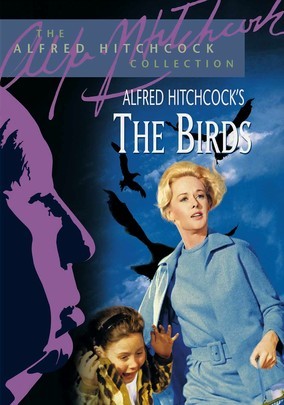
The Birds-1963

The Birds-1963

Director Alfred Hitchcock

Starring Tippi Hedren, Rod Taylor

Top 250 Films #6

Top 40 Horror Films #2    

Scott’s Review #173
308926

Reviewed September 22, 2014

Grade: A

The Birds is one of director Alfred Hitchcock’s finest works.

Made in 1963, following Psycho, it continues Hitchcock’s run of successes, both commercially and critically.

It is set in northern California (in San Francisco and Bodega Bay) and tells the story of unexplained bird attacks in a peaceful small bay town.

Tippi Hedren plays Melanie Daniels, a wealthy socialite from San Francisco who drives to Bodega Bay to pursue a love interest, Mitch Brenner.

Mitch, played by Rod Taylor, is a successful attorney who meets and shares a flirtation with Melanie the day before at a pet store in San Francisco. He regularly visits his mother (Jessica Tandy) and sister (Veronica Cartwright) in Bodega Bay.

Once Melanie arrives in town, birds begin to attack the locals living in the sleepy community periodically.

The Birds is a film that has held up incredibly well and is as exciting and horrifying today as it was in the past.

One intriguing aspect of the film is that it offers no rhyme or reason for the bird attacks, which keeps the viewer guessing when a gull swoops down and attacks innocent Melanie.

It is entirely mysterious and open to interpretation- are birds fed up with being caged?

Are the love birds that Melanie purchased the cause of the attacks? Do the birds hate humans? Why do they attack the children? Why do they peck the eyes of their victims out?

One could spend hours debating these questions.

A major creative success of the film is its decision to eliminate a musical score. The eerie silence and the loud sounds of the birds attacking create a haunting dynamic.

My favorite scene of The Birds features Melanie sitting on a wooden bench in the schoolyard, enjoying a cigarette. Behind her is a deserted jungle gym. She barely notices a tiny bird innocently flying past her and landing on the jungle gym.

She continues smoking her cigarette. The viewer sees what Melanie cannot- as slowly, hundreds of birds land on the jungle gym behind her.

Without music, the scene is deadly silent and dramatic, shifting from close-ups of Melanie to long shots of the birds gathering behind her.

Another interesting aspect of The Birds is the character relationships. Mitch’s mother, Lydia, is afraid of losing her son, so she initially despises Melanie. Mitch’s ex-girlfriend, schoolteacher Annie Hayworth, strikes up a close friendship with Melanie; one might expect them to be rivals.

A hysterical mother lashes out at Melanie, calling her evil and blaming her for the attacks.

During the long periods of calm, one wonders when the next attack will occur—and we know it will. We searched for clues to identify what triggers the attacks, but we found none.

This makes for brilliant and suspenseful filmmaking. They hardly come better than the masterpiece The Birds (1963).

Oscar Nominations: Best Special Effects

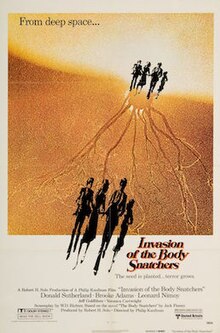
Invasion of the Body Snatchers-1978

Invasion of the Body Snatchers-1978

Director Philip Kaufman

Starring Donald Sutherland, Brooke Adams, Veronica Cartwright

Top 250 Films #217

Top 40 Horror Films #31

Scott’s Review #1,434

Reviewed July 22, 2024

Grade: A-

Even though this film is a remake and remakes are usually not as good as the original, I am partial to the 1978 version of Invasion of the Body Snatchers versus the 1956 release.

This might even be one of the best remakes ever.

The 1950s version has a campy science-fiction element popular in the decade, featuring frightening, otherworldly elements like The Day the Earth Stood Still (1951) or Invaders from Mars (1953), which were meant to promote the idea of invaders taking over Earth.

This was enough to scare the bejesus out of middle America, USA, and their white picket fence-encased neighborhoods.

The 1970s version eschews camp in favor of a straight-ahead sci-fi/horror hybrid. A glamorous, artistic approach oozes from the 1970s and from various exterior sequences in San Francisco, making it superior to the original.

It’s a more polished and mainstream-ready product that works better for this film.

By far the best scene is the final scene between a perfectly cast Donald Sutherland and Veronica Cartwright, which left chills going up and down my spine.

I won’t spoil the fun, but suffice it to say that the actor’s facial expressions make the scene exceptional, especially when paired with the creepy sound effects.

Director Philip Kaufman also toys with his audience when he teeters ambiguously between his leading ladies. Is Cartright the ‘final girl’ or is it Brooke Adams? In parallel to Hitchcock’s Psycho (1960), the lead may not be who you assume it to be.

Matthew Bennell (Donald Sutherland) is a health inspector who assumes that when his friend and colleague Elizabeth (Brooke Adams) complains of her husband’s strange mood, it’s a cheating husband or an exaggerated concern.

He begins to worry, however, as more people report similar observations about their loved one’s strange behavior.

His concern is confirmed when writer Jack Bellicec (Jeff Goldblum) and his wife (Veronica Cartwright) discover a mutated corpse that creates a citywide epidemic in which humans are replaced by alien doubles devoid of humanity or emotion.

The casting is first-rate, especially because Sutherland is front and center. The actor does wonders with his bulging blue eyes and a spacey demeanor. This works well in a film where we wonder whether his character is ‘one of them’.

He’s also a good actor and easily carries the film along with Adams and Cartright.

Kaufman peppers the film with eerie atmospheric elements like the mysterious parasitic alien race scurrying to harvest before their planet dies, and small seed pods amid hallucinogenic pink flowers.

The success is mainly due to the audience being left uncertain about whether to hate the aliens or feel sorry for them. Since they are ambiguous, this leaves confusion and, therefore, a sense of empathy.

Speaking of the exterior sequences, a great one takes place on the streets of San Francisco, where a hysterical man warns Elizabeth and Matthew of danger as a mob pursues him. He is then killed in a hit-and-run, surrounded by emotionless onlookers.

Eagle-eyed viewers will spot Kevin McCarthy, the leading man in the 1950s film, and director Don Siegel.

When this scene plays, it is eerie and underscores that the small group of friends must stick together against a mob of clones.

Wisely, Kaufman assures readers that the story does not play for laughs or appear over-the-top or silly. The gritty camera angles, superior makeup crew, and wonderfully practical sound effects confirm that he is making a film to be remembered.

Taking what the 1950s version created but only scratched the surface of the potential during a cinematically safe decade, the 1978 Invasion of the Body Snatchers has muscle and compels from start to finish.

Years later, it still holds up wonderfully well alongside similar stylistic and popular horror films such as Jaws (1975), Carrie (1976), Dawn of the Dead (1978), and Halloween (1978).

On a larger level, it also confirms the 1970s as the greatest decade for horror films.

In the Bedroom-2001

In the Bedroom-2001

Director Todd Field

Starring Tom Wilkinson, Sissy Spacek, Marisa Tomei

Scott’s Review #1,313

Reviewed October 29, 2022

Grade: A

Todd Field is an American actor and director who has made very few films. This shows that he must choose his projects carefully.

Little Children (2006) is one of my favorite films.

Based on a 1979 short story called ‘Killings’ by Andre Debus, In the Bedroom (2001) is an independent project representing what independent films do brilliantly. They tell stories about real people, with emotions, conflict, choices to make, and repercussions to face.

The story depicted in In the Bedroom is one that anyone viewing the film can either directly relate to or sympathize with any number of characters within.

The film centers on the inner dynamics of a family in transition. Matt Fowler (Tom Wilkinson) is a successful small-town doctor practicing in Maine and married to Ruth Fowler (Spacek), a music teacher.

Their son Frank (Nick Stahl) is involved in a summertime love affair with an older single mother, Natalie Strout (Marisa Tomei). He professes it to be merely a fling but her violent ex-husband is jealous.

As the beauty of the summer comes to an end, these characters find themselves amid an unimaginable tragedy. They must make difficult choices to persevere through the dark autumn and winter.

Having seen the film when it was released in 2001 and not again until 2022 I wondered how it would hold up over twenty years later. Would it feel dusty and dated or fall into the ‘one and done category like many films do?

The story is just as riveting and this is because of superior acting by the entire cast and exceptional direction and pacing by Field.

The lurid, quiet landscape is still and lonely in most scenes and this is frightening unto itself. The lush and serene Maine water, lobsters, lighthouses, and cabins are fraught with danger because of the human threat lurking in its midst.

The atmosphere is everything.

Fields reveals a story about a small town and the secrets buried beneath the surface. Even during a summer barbeque, there is tension when an unwelcomed guest arrives unannounced. With glances between characters, there is a lot of unspoken communication.

The acting is top-notch, especially Wilkinson and Spacek. Before the tragedy, they both hedgingly accept their son’s relationship with an older woman but hope it’s only a phase. They see the relationship as a major roadblock to his education at a good university.

After the tragedy, Matt and Ruth change. She becomes angry and cold, he is stoic and vengeful. Both actors seamlessly portray their characters just like real-life people.

Other players like Marisa Tomei and Nick Stahl as the younger couple met with tragedy perform their roles flawlessly.

This is a major reason why In the Bedroom resonates so well. Any viewer can put themselves in the shoes of Matt, Ruth, or even Natalie Strout. Circumstances can change our perspectives and turn us into different people, at least temporarily.

The last sequence is great. A decision made by Matt and Ruth is shocking and will follow them for the rest of their lives. The key is that they do not hastily make this decision but rather calmly ponder and strategize each step.

They are satisfied and have no regrets.

In the Bedroom (2001) is an emotionally honest and compelling journey into the exploration of character. It is powerful and humanistic, draws the viewer in quietly, and takes a forceful grip. It uses silence to its advantage making that silence haunting and melancholy.

Oscar Nominations: Best Picture, Best Director-Todd Field, Best Actor-Tom Wilkinson, Best Actress-Sissy Spacek, Best Supporting Actress-Marisa Tomei, Best Adapted Screenplay

Independent Spirit Nominations: 3 wins-Best First Feature (won), Best Male Lead-Tom Wilkinson (won), Best Female Lead-Sissy Spacek (won), Best Screenplay

Bernice Bobs Her Hair-1976

Bernice Bobs Her Hair-1976

Director Joan Micklin Silver

Starring Shelley Duvall, Veronica Cartwright 

Scott’s Review #1,141

Reviewed May 12, 2021

Grade: B+

Much transpires within Bernice Bobs Her Hair (1976), a short film based on a short story by famed author F. Scott Fitzgerald.

For the non-literary crowd, Fitzgerald penned the worldly The Great Gatsby, a treasured story set in the 1920s on Long Island, New York.

The story was adapted into a television production in 1976 for PBS’s The American Short Story.

Bernice Bobs Her Hair is a quieter story than Gatsby, and more peculiar, resulting in a fabulous tale of revenge set a 1920, the cusp of the American Jazz Age.

The setting is presumed to be Long Island or Westchester County, New York, though that’s never confirmed.

Regardless, our main character, Bernice (Shelley Duvall), hails from Wisconsin and visits her family.

The visit isn’t exactly peaches and cream, as you can imagine.

The bitchy and sophisticated Marjorie (Veronica Cartwright), Bernice’s cousin, pities her for being awkward and unlikable, and for being far inferior to the elitist company she keeps. She rolls up her sleeves and becomes determined to shape Bernice into a sophisticated vixen, molding her into a girl who gets what she wants.

The idea ends up biting her in the ass.

Bernice, mocked for being quiet and dull, blossoms into a brave young woman, titillated by the attention of the society boys. She delights in having her pick of the litter and daringly proclaims to have her hair bobbed in a few days, to the shock and chagrin of the rich group of friends.

Would a young woman ever dare to do something so drastic for attention? Hell, she’ll have to go to a barber and be sheared!

Marjorie’s jealousy intensifies as Bernice’s confidence soars, culminating in a dramatic and satisfying conclusion.

Duvall is delightful in the role. The actress, very unconventional looking, appears the prettiest I’ve ever seen her, even when she plays dowdy. Telling so much with her wide-eyed and expression-filled eyes, she seduced me into her world of mystique and wonderment. Duvall has a charisma all her own and fascinates in any film she appears in.

Not to be overlooked, Veronica Cartwright brings Marjorie to life with fury and pizazz, also doing so much with her trademark blue eyes. The actresses work so well together as they eventually play a seductive game of will and wit.

For the boys, there are a few love interests to note. I loved seeing Bud Cort, struggling for work after his groundbreaking role in 1971’s Harold & Maude, appear in the short film. Insecure, he is nonetheless smitten with Bernice, just as Draycott Deyo (Patrick Reynolds) is.

Other handsome suitors like Mark LaMura, of daytime television fame, appear.

The costumes and sets are lavish and fitting to the 1920s, which enhanced my enjoyment. The hot summer setting also infuses the film with smoldering and rigid tension, enhancing the experience. There is nothing like escaping into the past in style and enchantment.

The final revenge is extremely fulfilling as the classes clash. The socially awkward Bernice conquers the WASP-y Marjorie like a plain Jane would a beautiful evil princess. It’s quite satisfying.

The entire experience of Bernice Bobs Her Hair (1976) is pleasing and compelling. The kicker is that when Bernice does indeed ‘bob her hair’, she looks amazing and trendy for the decade to follow. She gets her just desserts in more ways than one, and the audience cheers her to victory!

The Children’s Hour-1961

The Children’s Hour-1961

Director William Wyler

Starring Audrey Hepburn, Shirley MacLaine, James Garner

Scott’s Review #620

Reviewed March 3, 2017

Grade: B+

The Children’s Hour (1961) is one of the earliest films to center around an LGBTQ+ theme and the subsequent scandals the subject would provoke in the innocent year of 1961-pre Civil Rights and pre-Sexual Revolution.

However, since the film was made in the year that it was, homosexuality was presented as something dark and evil rather than something to be accepted or even embraced.

Still, the film and its director, William Wyler, are brave enough to recognize the topic. Still, they cannot create a compelling film rich with well-written characters and some soap opera-style drama.

The Children’s Hour is based on a play from 1934 and written by Lillian Hellman.

The setting appears to be New England, perhaps Connecticut or Massachusetts, though the film never identifies the exact area.

College friends Karen (Audrey Hepburn) and Martha (Shirley MacLaine) open a private all-girls boarding school catering to their affluent community. They run the school with Martha’s Aunt Lilly, a faded Broadway actress who often hen-pecks the women.

Karen has been dating handsome obstetrician Joe (James Garner) for two years. When he proposes marriage, she hesitantly accepts, which saddens Martha.

All the while, spoiled brat child Mary, furious over being punished by her teachers, plots revenge against Martha and Karen and embellishes a heated discussion between the ladies into a scandalous lie she whispers to her grandmother (Fay Bainter).

The grandmother promptly tells the parents of the other students, who remove their children from the school en masse. The lie is that Karen and Martha are lovers, and Mary witnessed the two women kissing.

Meanwhile, Mary is blackmailing a fellow student, Rosalie (Veronica Cartwright), over a stolen bracelet.

The town ostracizes Martha and Karen.

The Children’s Hour becomes even more compelling when one of the women begins to realize that she does indeed have homosexual feelings towards the other woman and has always harbored anger and resentment as well as feeling “different” from other women.

As well-written as the film is, the fact that the audience does not get to hear what Mary whispers to her grandmother is instead telling and prevents the film from being even more powerful than it is.

Also, the downbeat conclusion to the film sends a clear message that in 1961, audiences were not ready to accept lesbianism as anything to be normalized or to be proud of.

The decision was made to make it abundantly clear that one of the central characters is not a lesbian. Any uncertainty may have risked freaking out mainstream audiences at the time.

Since the traditional opposite-sex romance between Karen and Joe is at the forefront of the film, I did not witness much chemistry between actors Hepburn and Garner. Still, I might have been at the point of achieving a subliminal sexual complexity.

The Children’s Hour and William Wyler deserve heaps of praise for going so far as to suggest that censorship in film in 1961 would allow them to offer nuggets of progressivism mixed into a brave film.

Incidentally, Wyler made another version of this film in 1936 named These Three. Because of the Hays Code, any hint of lesbianism was forbidden, causing Wyler to create a standard story of a love triangle between the three, with both Martha and Karen pining after Joe.

What a difference a couple of decades make!

MacLaine and Hepburn must be credited with carrying the film and eliciting nice chemistry between the women. However, it is too subtle to be realized if the chemistry is of a friendship level or a sexual nature.

And I adore how Wyler makes both characters rather glamorous and avoids stereotypical characteristics.

Oscar Nominations: Best Supporting Actress-Fay Bainter, Best Sound, Best Art Direction, Black-and-White, Best Cinematography, Black-and-White, Best Costume Design, Black-and-White

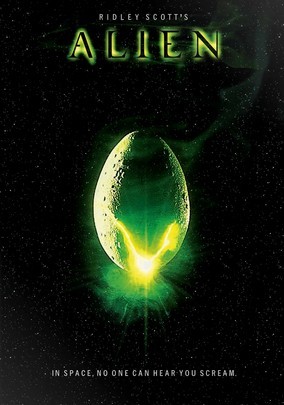
Alien-1979

Alien-1979

Director Ridley Scott

Starring Tom Skerritt, Sigourney Weaver

Scott’s Review #94

60029356

Reviewed July 5, 2014

Grade: A-

Alien is a science-fiction success from 1979 that began a long-running franchise and made Sigourney Weaver a household name.

It has the brilliant direction of Ridley Scott, who sets up the atmosphere and camera angles perfectly.

Arguably, in both the horror and science fiction genres, the film is riveting from start to finish.

Weaver stars as Warrant Officer Ellen Ripley, a member of a spaceship returning to Earth. The ship picks up a distress signal and is ordered to investigate. They discover an alien existence.

From this point, the film certainly has a horror element, as the members of the doomed spacecraft are knocked off one by one in a pure horror fashion, but the brilliant part is that you do not know when or how, and many of the deaths come out of nowhere.

The captivating visual effects in this film elevate it, and the narrow spacecraft tunnels and hallways are stunning.

The villain of the film, the alien, is masterful as it is mysterious to the audience. The fact that it is only sporadically seen only adds to the tension.

Alien (1979) is a memorable classic that ranks high on the sci-fi genre list of excellent films.

Oscar Nominations: 1 win-Best Art Direction, Best Visual Effects (won)