Tag Archives: Maika Monroe

Longlegs-2024

Longlegs-2024

Director Oz Perkins

Starring Maika Monroe, Blair Underwood, Nicolas Cage

Scott’s Review #1,487

Reviewed August 1, 2025

Grade: A-

Oz Perkins, already making his mark in the modern horror genre with films like The Blackcoat’s Daughter (2015) and The Monkey (2025), offers an eerie little gift sure to creep many viewers out.

Add-ons like nuns, sacrifices, satan, and the like usually freak religious church-goers out, which is a testament to the achievement Perkins makes.

Giving credibility to Perkins is being the son of Anthony Perkins, aka Norman Bates from the 1960s Hitchcock masterpiece, Psycho.

That’s some horror legacy, and he gets more and more comfortable with the genre.

The story follows Lee Harker (Maika Monroe), a quiet FBI agent in the 1990s, who is tasked with tracking down an occultist serial killer responsible for murdering multiple families throughout Oregon.

Harker, reminiscent of Jodie Foster’s Clarice from The Silence of the Lambs (1991), is serious and grounded with a tinge of tension and insecurity. She has been through some trauma that could be a key to unlocking the mystery.

Does she have a secret connection to the tragic events that includes the victims sharing a birthday pattern? With her birthday approaching, things become more and more perilous.

Besides the disquieting tone of the film being filled with terror, Nicolas Cage, who produced, plays Longlegs (also known as Dale Kobble), an elusive Satanic serial killer.

On screen for only a short amount of time, Longlegs/Cage leaves an impression. With long hair and a pasty face, he looks like a cross between the Joker and Pennywise the Clown, with lipstick and a super-creepy, demonic voice.

There is something very off about him.

Buffalo Bill, the serial killer from The Silence of the Lambs, also bears a resemblance to Longlegs.

The first sequence leaves an indelible impression—a young girl on a snowy afternoon peers across her vast front yard to her family’s paneled station wagon. It is the 1970s.  Suddenly, Longlegs appears and charmingly announces he forgot his long legs.

The scene made the chills run down my spine.

The atmosphere makes the film as good as it is. There is a lonely, isolated feeling throughout, like events take place in a secluded, middle-of-nowhere setting. And, this consists of both interior and exterior scenes.

Set in the Pacific Northwest, United States, specifically Oregon, the geography is perfect for a rash of patriarchal killings. Mysteriously, a seemingly normal father kills his wife and kids without hesitation. A pattern develops involving an upcoming birthday of the family’s daughter.

In an effective sequence, one of the family deaths is featured on-screen, mirroring Stanley Kubrick’s The Shining (1980). A long camera shot from far away makes the viewer feel like they’re in the room and watching voyeuristically.

Blood splays, an ax impales a victim from behind, and death and destruction have never looked finer in cinema.

Perkins incorporates a visual satisfaction that makes the film work, especially given the horror genre.

The fact that Longlegs, the villain, is frightening to look at makes the film a significant win and probably Perkins’ best work.

Yes, the story has a surprise ending, including one character’s deal with the devil. The final plot summation is shocking but rather far-fetched. While gripping, it doesn’t seem possible, and a supernatural suspension of disbelief is required.

The occult and spiritual possession are the ingredients that make Longlegs startling but not realistic.

Special shout-outs to actors Kiernan Shipka and Alicia Witt, who brilliantly portray their minor yet monumental characters with top-notch acting.

What Longlegs (2024) lacks in making sense—a common theme among modern horror films with camera-heavy trimmings over storyline plausibility, if I’m being honest—it succeeds with a visual wizardry.

The mood of terror is the film’s most significant victory.

It Follows-2014

It Follows-2014

Director David Robert Mitchell

Starring Maika Monroe

Scott’s Review #306

It_Follows_(poster)

Reviewed December 23, 2015

Grade: A-

It Follows (2014) is a mysterious, unique, dreamlike (or shall I say nightmarish!) independent horror film that is a pleasant throwback to old-school horror films (my favorites!), with a supernatural twist thrown in.

Newcomer David Robert Mitchell directs the film very well, with wonderful cinematography and creative camera angles.

This film isn’t glossy; it has a raw, almost videotaped feel, which I found wonderful. The film was shot entirely in and around Detroit, giving it a cold, industrial look.

The film begins on a dramatic note, leaving the viewer immediately curious.

A young woman flees her suburban home and nervously stands on the street looking back at her house.  A neighbor asks if she needs help.

She returns, collects her things, and hurriedly drives to the beach. She suspects something or someone is watching her. She tearfully phones her father and tells him she loves him.

The next scene appears to be the following morning, and the woman is lying murdered on the beach in a grotesque position- her leg strangely bent.

This is a fantastic way to begin the film, and it quickly reveals the premise.

The main character is Jay (Maika Monroe), an attractive college-aged girl. She lives with her sister, Kelly, and is good friends with their next-door neighbors, Paul and Yara. Another neighbor and classmate, Greg, also plays a role in the plot.

Jay is on a date with Hugh, and things are going well. They attend a classic film. They sneak into a deserted lot and have sex. Afterward, Hugh chloroforms Jay and the weirdness begins.

A strange woman appears, and Hugh tells Jay she must pass on a curse. Otherwise, an entity in the form of another person that nobody else can see but the victim will get Jay, and she will be doomed.

I love the throwback elements to 1970s and 1980s horror, but it’s vague when the film is set- purposely so, I imagine- as many cars are 1970s and 1980s models.

Only one cell phone is used throughout, but most of the time it could be present or past.

Even the houses appear dated.

Story-wise, It Follows is tough to figure out and open to a certain level of interpretation. Is the film anti-sex? Is the story a metaphor for sexually transmitted diseases?

The victims become possessed by the entity after sex and then must pass it to another unwitting victim, sexually.

I notice some similarities to John Carpenter films- specifically the classic Halloween from 1978. Jay sits in a classroom (ironically in the back row next to the window, à la Jamie Lee Curtis in Halloween) and sees a strange older woman slowly lumbering towards her, eyes fixed on her.

Later, the three main girls casually walk around the neighborhood, engaging in small talk similar to Laurie, Lynda, and Annie on Halloween.

The ending- a scene in the indoor community swimming pool where the kids try to catch the spirit is a bit hokey and unresolved. However, I did enjoy the final scene- a peaceful one in which I was unsure if the entity had been destroyed or remained.

A sequel perhaps?

I give It Follows (2014) major props for its styling and creativity, while giving classic horror fans a good old-fashioned treat without much CGI.

Independent Spirit Award Nominations: Best Director-David Robert Mitchell, Best Cinematography, Best Editing

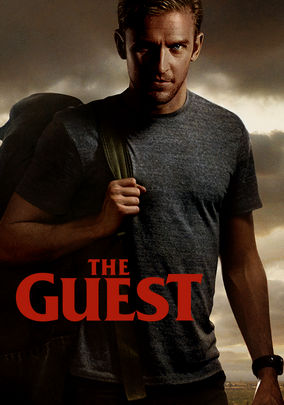
The Guest-2014

The Guest-2014

Director Adam Wingard

Starring Dan Stevens, Maika Monroe

Scott’s Review #220

70300664

Reviewed February 7, 2015

Grade: C-

The Guest is a 2014 thriller that can perhaps be classified under the adage “it’s so bad that it’s good,” though as I pondered writing this review, that might be a bit of a stretch.

As poor as the film is, I still enjoyed something about it.

The premise is simple. A Midwestern family, the Petersons, is suddenly visited by a veteran soldier named David, who claims to be a friend of the parents’ deceased son, Caleb.

David easily insinuates himself into their lives, and the Petersons invite him to stay a few days to rehash details about Caleb.

The family is middle-class yet struggling financially, and it consists of a mother and father, a college-aged daughter named Anna, an actress eerily resembling a young Gwen Stefani, and a bullied, timid, high school-aged son named Luke.

From the get-go, something feels off about David, but his motives remain unclear to the audience.

The film has plenty of issues.

For starters, the acting is rather poor. The most notable actors are Dan Stevens (Downton Abbey), Sheila Kelley (L.A. Law), and a collection of unknowns.

Stevens and Kelley give better performances, and I found Stevens particularly believable in a role opposite his Downton Abbey alter ego.

The rest of the cast is wooden and uncompelling.

The weakest parts of The Guest are the inane plot points and the 1980s-style soundtrack. Were the filmmakers going for a retro throwback? The film is set in present times, so this aspect remains a mystery.

The story starts interestingly. Is it a Fatal Attraction (1987) type of film? What is David’s motive? What was his relationship with the deceased Caleb? Does he intend to help or harm the family?

The reveal towards the end of the film is implausible, ridiculous, and disappointing. Without giving too much away, the government plays a major role in the film, but it does little to provoke sympathy for any of the characters, only eliciting more confusion.

The attempted (and botched) love story between David and Anna does not work. They have little chemistry, and the rooting value is not there, especially as he picks up her drunken best friend at a party.

Is the audience supposed to root for David and Anna, or is it merely a weak sub-plot to the thrill aspect of the film? I suspect the latter.

Despite all these negatives, I didn’t despise the film as it trucked along; rather, I found it more of a mess than anything else.

It is not a good film, but there is something slightly appealing about it. Some of the death scenes are well done, and the budding friendship between David and the bullied son is rather sweet.

The son is enamored with the strong, masculine David, and David, in turn, serves as a protector, humiliating the bullies who gave the kid a black eye.

The film doesn’t delve into a sexual angle, but it is a bond that is cheerful to see. It has a nice, warm element.

Another impressive point of The Guest is that it ends with a surprise that leaves room for a sequel. However, because the film didn’t achieve success, I doubt a sequel will ever see the light of day.

A poorly written, weakly acted film, The Guest (2014) has moments of interest but fails miserably as a viewing experience.

By the end, I still had no idea what the main character was motivated by, which is a huge problem.

Confusing and convoluted are the adjectives best to describe this film.

Independent Spirit Award Nominations: Best Editing

Labor Day-2013

Labor Day-2013

Director Jason Reitman

Starring Kate Winslet, Josh Brolin

Scott’s Review #116

70284279

Reviewed July 17, 2014 

Grade: B+

Labor Day (2013) is quite simply a modern love story.

Set in 1987 on a hot Labor Day weekend in New Hampshire, a boy and his mother are approached by an escaped convict pleading for help.

They reluctantly agree, and what follows is a weekend of mixed emotions and bonding among the three.

Kate Winslet and Josh Brolin have great chemistry as the leads, and although the film feels like it was set in 1987, it looks quite modern.

The woman is divorced and insecure and bordering on being a shut-in. The son is more like the parent, taking care of her and running errands.

An older version of the son narrates the film (played by Tobey Maguire). Questions run through the viewer’s mind throughout the film, which is a major positive.

Can the convict be trusted? Is he guilty or is there more to the story? Is the mother falling for him or pretending to escape?

All the action plays out over one weekend while the town is on high alert and everyone searches for the escaped convict, and most of it takes place in the family home, giving the film a stage-production feel.

The film includes tense moments and flashbacks of both the convict’s and the woman’s lives before they meet, so we, as viewers, get to know them well.

Despite their differences, the couple has a rooting value to them thanks to Brolin’s and Winslet’s talents.

Labor Day (2013) is a well-made film that received little recognition.