Tag Archives: Martin Stephens

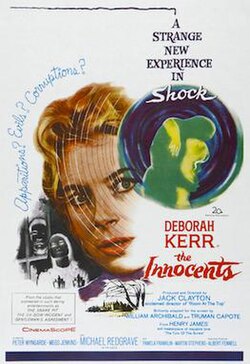
The Innocents-1961

The Innocents-1961

Director Jack Clayton

Starring Deborah Kerr

Top 250 Films #94

Top 40 Horror Films #17

Scott’s Review #639
Reviewed April 29, 2017

Grade: A

The Innocents is a 1961 British psychological horror film that tells a ghost story, based on the novella “The Turn of the Screw” by Henry James.

Although it is a horror film, it contains few traditional elements, such as contrived frights, jumps, and blood. Instead, the film succeeds by using lighting and magnificent cinematography by Freddie Francis.

And, of course, fantastic storytelling and direction from Jack Clayton.

Deborah Kerr gives an excellent turn as a beleaguered governess hired by a wealthy bachelor (Michael Redgrave) to tend to his young niece and nephew, Flora and Miles.

The setting is a lavish yet creepy mansion located outside London. As the Uncle goes away to India on business, Miss Giddens, with no previous experience, is left to tend to Flora and Miles, who both begin acting strangely.

To complicate matters, Miss Giddens sees sinister ghosts lurking around the property. The ghosts are former household servants who have passed away, of whom Miss Giddens has never met.

Miss Giddens is assisted only by the kindly housekeeper, Mrs. Grose, who tells her about the servants’ tragic deaths.

The Innocents, shot in black and white, uses sound to its advantage. This, combined with the interesting camera angles and focus shots—mainly of the ghosts Miss Giddens sees—makes the film unique and scary.

When she hears strange voices, she becomes convinced that Miles and Flora are playing tricks on her, engaging in games with her. The whispers’ sounds are haunting and do wonders for the effects, chilling the viewer as the film progresses.

Is Miss Giddens imagining the voices and visions, or is this an actual reality? Could the children be sinister and playing a vicious prank on her? Could Mrs. Grose be evil?

Nobody else within the household sees or hears anything amiss- or admits to it.

Kerr, a treasured actress, plays the part with emotional facial expressions and genuine fear, so much so that she wins the audience over as we side with and empathize with her character. Still, is she a woman on the verge of a mental breakdown? Does she have past mental problems?

Like her uncle, we know nothing of her past, only that she claims to be the daughter of a minister. How, then, does she have stylish, expensive clothes? Could she only be pretending to be a governess? Has she run away from her past?

The Turn of the Screw is a true ghost story, but The Innocents is a bit different —it relies, successfully, on being more of a character-driven story.

As Miss Giddens becomes convinced that the servants’ spirits have possessed both children, she makes it her mission to rescue them from the spirits. We have an ominous feeling that events will not end well, and they do not.

Several scenes will frighten the viewer, as Miss Giddens sees a haggard ghost (the female servant) standing quietly in the distance by a lake while Flora dances chirpily; the image of the distant ghost is eerie and well shot.

The film draws comparisons to the classic Hitchcock film Rebecca (1940). Each is set in a large mansion and features complex villains portrayed as deceased.

Also, the main character’s sanity is in question.

With a compelling story and the nuts and bolts that add clever effects and a chilling conclusion, the film succeeds as an excellent and intelligent horror film.

With great acting all around, including fantastic performances by child actors, The Innocents (1961) scares the daylights out of any horror fan and uses exterior and interior scenes to make the film an all-around marvel.

The Witches-1967

The Witches-1967

Director Cyril Frankel

Starring Joan Fontaine

Scott’s Review #1,096

Reviewed December 29, 2020

Grade: B

Legendary film actress Joan Fontaine chose a Hammer horror film as her final role. While not high-brow art, these films are an entertaining treat for horror fans.

They are frequently macabre, clever, and make the most of a small budget.

In The Witches (1967), Fontaine leads the way, adding class and huge star quality. The film is good, but not great, with an unfulfilling ending. The cinematography and Fontaine’s involvement are the best aspects.

Also worthy of mention in the acting department is Kay Walsh, a talented British actress, who is terrific as the seemingly kind woman who becomes a crazed witch. She adds professionalism to a pivotal role. The other supporting actors play their parts well, ensuring that the craft of acting is respected.

I adore the British flair that Hammer films always have.

Fontaine plays Gwen Mayfield, an English schoolteacher who accepts a new job as the headmistress of the local school in the quaint village of Heddaby. The quiet town is exactly what Gwen needs after suffering a nervous breakdown while residing in Africa.

She experiences a small flirtation with the Reverend Alan Bax (Alec McCowen), who confesses that he is not overly religious. Stephanie is his sister, played by Walsh.

Before long, Gwen becomes immersed in the worlds of two of her students, Ronnie (Martin Stephens) and Linda (Ingrid Brett). Ronnie insists that Linda is being abused, which prompts Gwen to investigate. Meanwhile, Gwen discovers a voodoo doll and sleuths to find out what is going on in the village.

Events lead her to a sanitarium, and finally to a coven of witches, intent on human sacrifice.

The Witches has a late-1960s look and feel, which adds some sophistication. Gwen is draped in stylish clothes and jewelry and wears a cute, trendy bob haircut.

The set design is cool, with groovy, colorful furniture that makes the tight budget work to its full advantage.  Alan and Stephanie’s estate is particularly impressive with modern furniture, drapes, and various trimmings.

Another positive is the hefty amount of exterior sequences offered.

Director Cyril Frankel, who directed many episodes of the popular British television series The Avengers, provides a similar production, so The Witches feels like a long episodic series. The luxurious English village is sunny, calming, and atmospheric, brightening the film’s atmosphere.

This nicely counterbalances the themes of demons, voodoo, and witches.

Frankel builds the story momentum throughout The Witches at a good pace, but this is lost in the final act, which is way too abrupt. During the first three-quarters of the production, we are led to believe that Gwen is either crazy, imagining the strange events, or that one of the townspeople is gaslighting her.

It’s easy to deduce that the latter is what is going on, and the fun is figuring out who is doing the dirty deeds.

When the culprit is revealed (and it’s displayed on the cover art!), the conclusion is underwhelming. An attempted cemetery human ritual to remove life from Linda and infuse it into Stephanie so that she can live forever is weak.

After an odd sequence of the townspeople dancing and writhing around like nutcases in an unintentionally laugh-out-loud example of overacting, Gwen foils Stephanie’s plan. The witch succumbs to death, a victim of her heinous plan backfiring.

It is hinted that Gwen and Alan (who are revealed to be good) will forge a romance in the future, but I would have liked to have gotten a stronger sense of their budding attraction during the film. Still, it is likely the two will ride off into the sunset together, safely.

While not as gory as other Hammer films, The Witches (1967) instead features exceptional performances and tells a decent story, interesting until the low-key finale.

I expected a bit more from the ending, which simmers out instead of electrifying.

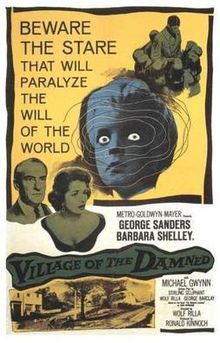
Village of the Damned-1960

Village of the Damned-1960

Director Wolf Rilla

Starring George Sanders, Barbara Shelley

Scott’s Review #701

Reviewed November 30, 2017

Grade: B

Village of the Damned is a 1960 black and white horror film released during a spectacular year for the film genre- and specifically for the horror genre.

With legendary films such as Hitchcock’s Psycho and Michael Powell’s British Peeping Tom making their debuts at the same time, what a coincidence that Village of the Damned (also British) shares the same year.

The film is a satisfying treat- certainly not on par with the aforementioned duo of masterpieces, but on its terms, it is a fine film with just enough suspense and intrigue to make it a memorable affair.

Anything in movie horror involving children is downright creepy, so German director Wolf Rilla is wise to adopt a film based on a 1957 novel entitled The Midwich Cuckoos by John Wyndham.

I adore the title and wish Rilla had kept it for the film. Alas, he did not, but the story is well-written and almost like an extended episode of The Twilight Zone or a similar television chapter from the 1960s—it just seems like more of an episodic experience.

No disrespect, of course, but the film does not contain the bombast expected from a feature film, but rather a compartmentalized, small tale.

In the sleepy little town of Midwich, England, a polarizing force suddenly and without warning overtakes the city, causing all the inhabitants to fall unconscious and into a state of inactivity.

Attempts by the military to enter the town fail, even as an airplane crashes to the ground after attempting to cross into Midwich.

As quickly as these events occur, the townspeople “wake up” and resume normalcy. Two months later, all women of childbearing years suddenly become pregnant, causing gossip and intrigue. As the years pass, the children look similar, with platinum-blonde hair, piercing eyes, and rapid growth spurts.

Furthermore, they all are telepathic and communicate with each other in this manner.

The central characters include a prominent professor, Gordon Zellaby (George Sanders), and his wife, Anthea (Barbara Shelley). They are the parents of one of the children, named David, who appears to be the leader of the other children.

As the children become increasingly menacing and intelligent as they grow older, sometimes hurting or killing other townspeople by somehow “possessing” their thoughts, Gordon must race to find a way to trap and stop the children from more dastardly deeds.

The use of black and white cinematography and the small-town setting successfully give Village of the Damned an eerie and mysterious vibe, is little or no bloodshed nor the traditional horror-themed elements- hence the above Twilight Zone reference.

The film does not need these to succeed, as the psychological mystique is compelling enough. We wonder, “What is wrong with these kids?” and “Why do they act so strangely?” “Are they possessed?” and  “Is this some weird experiment?”

The answers are never really explained in detail.

Slight negatives to the film are the only limited character development among any prominent characters such as Gordon or Anthea, and these roles are one-dimensional- the children are the stars.

Sanders and Shelley are adequately cast, but I can think of numerous other actors who could have played these parts well.

The conclusion to Village of the Damned is unspectacular, and I was left with an unsatisfied feeling, especially as related to other more satisfying aspects of the film as a whole.

I felt like a bit of potential was not reached.

Gordon merely orchestrates a big event, sacrificing himself to destroy the children, and the film ends.

Village of the Damned was followed by a 1963 sequel entitled, Children of the Damned, which was not deemed a critical nor a commercial success.

Years later, in 1995, the film was remade and directed by John Carpenter but also received poor reviews.