Category Archives: Gothic

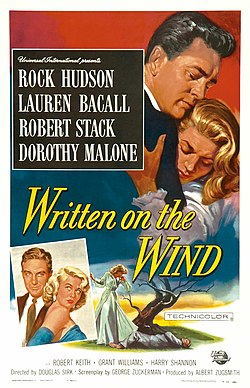
Written on the Wind-1956

Written on the Wind-1956

Director Douglas Sirk

Starring Rock Hudson, Lauren Bacall, Robert Stack

Scott’s Review #1,529
Reviewed April 20, 2026

Grade: A-

The terms ‘melodrama’ and ‘soap opera’ unfortunately come with a negative connotation, conjuring up disparaging adjectives like sappy or overwrought. Mix in poor acting, and you’ve got yourself a bad film.

But director Douglas Sirk, well known in the 1950s for his Hollywood melodramas like All That Heaven Allows (1955), Imitation of Life (1959), and Written on the Wind (1956), crafts beautiful visual effects amid powerful performances and compelling storylines.

Casting A-list movie stars only adds to the credibility.

Written on the Wind stars Rock Hudson and Lauren Bacall as complicated characters on the cusp of a relationship, but hindered by other selfish characters who are determined to pursue their own romantic desires.

Hudson starred in an impressive six Douglas Sirk films while Bacall’s career was beginning to wane, leading her to accept the role.

The action makes stops in New York City and Miami before settling in oil-rich Texas, where a central dysfunctional family dynasty led by Jasper Hadley (Robert Keith) is the main focus.

Hadley’s alcoholic son, Kyle (Robert Stack), is in love with Lucy (Bacall), whom he woos and marries. At the same time, Kyle’s scheming, self-destructive sister, Marylee (Dorothy Malone), has her sights set on Kyle’s childhood best friend, the dashing Mitch (Hudson), who longs for romance with Lucy.

The foursome banter, lust after, and become involved in dramatic situations, which lead to secrets and eventually death. Subjects like alcoholism, unrequited love, miscarriage, murder, and a court trial are explored.

While the situations may sound like nothing more than a sudsy afternoon daytime drama, the acting and rich writing more than raise the film above mediocrity.

The juicy sequences alone will entice the rabid viewer.

The exceptional chemistry between Hudson and Bacall is a winning formula, and viewers easily root for them to be together, and they immediately seem destined to be. Their scenes smolder with passion and determination, but both characters are too righteous and benevolent to let anything happen.

After all, Lucy is married to Kyle, and learns she is pregnant, though she remains terribly unfulfilled.

It’s easy to like Mitch and Lucy, especially when they’re contrasted with unsympathetic characters like Kyle and Marylee. Rich and spoiled, Kyle is a lustful playboy, a womanizer, and terribly insecure and jealous.

Marylee is a boozy nymphomaniac, callous and never satisfied.

Kyle and Marylee are not explored as much as they might have been with a longer running time, so they have hints of being one-dimensional. But both actors’ powerful performances leave audiences mesmerized by their characters.

Marylee nearly steals the show with her fiery bedroom negligee dance to a hi-fi blaring “Temptation,” while another character dies tragically a floor below.

You might say we ‘love to hate’ both characters.

Since Sirk and Hudson were both gay, though not publicly so at the time (1956), keen viewers can notice hidden clues about the situations Hudson might have been facing in real life.

We can see how Hudson would have had attractive women like Marylee fawning over him and practically begging him to bed them. Unable to be receptive to their advances, instead, he would feel guilty and lonely.

Besides wonderful writing, Sirk’s direction is inspiring. The opening sequence features a clever ‘the beginning is the ending ‘ approach that many filmmakers borrowed over the years in their cinematic works.

The audience immediately sees Kyle stagger outside the palatial mansion, brandishing a gun and finally collapsing. While the wind whistles, a desk calendar is shown with the pages quickly turning to eighteen months prior when the story really begins.

This opening scene will be recreated at the end of the film, making for instant attention.

Other spicy add-ons, like fine furniture throughout the estate, a grand dinner beginning with a fruit-cocktail appetizer, more than a few sophisticated martinis served, and modern sports cars being driven, lend a robust flair of wealth and glamour to the production.

A sequence was even modeled after a flashy Manhattan nightclub, the 21 Club.

For a trip into a world of wealthy yet tortured characters, Written on the Wind (1956) is top-notch. Some cliches can be forgiven, as melodrama was hardly done any better than this film.

Oscar Nominations: 1 win-Best Supporting Actor-Robert Stack, Best Supporting Actress-Dorothy Malone (won), Best Song-‘Written on the Wind.’

Golden Globe Nominations: Best Performance by an Actress in a Supporting Role in any Motion Picture-Dorothy Malone
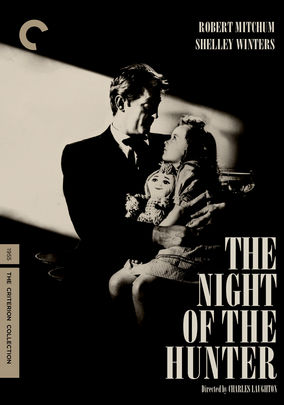
The Night of the Hunter-1955

The Night of the Hunter-1955

Director Charles Laughton

Starring Robert Mitchum, Shelley Winters

Top 250 Films #61

Scott’s Review #351

804679

Reviewed January 9, 2016

Grade: A

The Night of the Hunter (1955) is a fairy tale for adults. Although it is categorized as a thriller, it certainly teeters on the edge of being a horror film. In addition to being well-written, it also contains breathtaking cinematography.

Made in the mid-1950s, it is shot in black and white and tells the tale of good versus evil in a small town. The film is a masterpiece and one of my all-time favorites.

The film is both creepy and intelligent, and director Charles Laughton is responsible for its considerable success. Although it was not a success upon release, it has only finally received its due admiration as the years pass.

The film is way ahead of its time.

It is based on the 1953 novel by Davis Grubb.

The time is the 1930s, and the setting is rural West Virginia along the Ohio River. Ben Harper, a local family man, robs a bank and hides the stolen money inside his daughter’s doll.

His son and daughter (John and Pearl) are central characters in the story. Caught, Ben is out of the picture, leaving his wife, Wilma (Winters), vulnerable and alone.

A serial killer, Reverend Harry Powell (Mitchum), a misogynist, is on the loose disguised as a preacher. In prison with Ben, he knows the money is hidden and is determined to find out where it is. He has designs on wooing Wilma.

When dire events occur, John and Pearl are left along the river to seek refuge with a kindly older woman, Rachel Cooper (Lillian Gish).

The film is majestic, haunting, and artistic. Each scene seemingly glows as the dark black-and-white colors mix gorgeously with tranquility despite the dark tone of the subject matter.

The Night of the Hunter also has a dream-like visual quality. In one pivotal scene, we see a dead body submerged at the bottom of the river. The scene is horrific, with bulging eyes and bloating beginning to set in, but it is also creatively beautiful.

The flowing hair of the victim and the posture are mesmerizing scenes that stick with you for some time.

Poetic and a sense of good versus evil, this is clearly laid out as Powell has two words imprinted on the knuckles of each hand: “L-O-V-E” and “H-A-T-E.”  These words form the basis of the film, as both can be applied to the characters.

My favorite scene is when John and Pearl travel along the Ohio River, fleeing from their rival. The shapes of the trees mirrored by the flowing river are incredible, and I can watch this scene again.

A thriller, written intelligently well, with creativity for miles, is a recipe for pure delight. Director Laughton directed only this one film, encouraging creative collaboration and participation from his actors, which is evident in the resulting masterpiece.

The Night of the Hunter (1955) has had a profound influence on numerous directors.

The Innocents-1961

The Innocents-1961

Director Jack Clayton

Starring Deborah Kerr

Top 250 Films #94

Top 40 Horror Films #17

Scott’s Review #639

Reviewed April 29, 2017

Grade: A

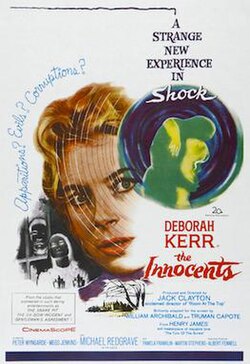
The Innocents is a 1961 British psychological horror film that tells a ghost story, based on the novella “The Turn of the Screw” by Henry James.

Although it is a horror film, it contains few traditional elements, such as contrived frights, jumps, and blood.

Instead, the film succeeds by using lighting and magnificent cinematography by Freddie Francis.

And, of course, fantastic storytelling and direction from Jack Clayton.

Deborah Kerr gives an excellent turn as a beleaguered governess hired by a wealthy bachelor (Michael Redgrave) to tend to his young niece and nephew, Flora and Miles.

The setting is a lavish yet creepy mansion located outside London. As the Uncle goes away to India on business, Miss Giddens, with no previous experience, is left to tend to Flora and Miles, who both begin acting strangely.

To complicate matters, Miss Giddens sees sinister ghosts lurking around the property. The ghosts are former household servants who have passed away, of whom Miss Giddens has never met.

Miss Giddens is assisted only by the kindly housekeeper, Mrs. Grose (Megs Jenkins), who tells her about the servants’ tragic deaths.

The Innocents, shot in black and white, uses sound to its advantage. This, combined with the interesting camera angles and focus shots—mainly of the ghosts Miss Giddens sees—makes the film unique and scary.

When Miss Giddens hears strange voices, she becomes convinced that Miles and Flora are playing tricks on her, engaging in games. The whispers’ sounds are haunting and do wonders for the effects, chilling the viewer as the film progresses.

Is Miss Giddens imagining the voices and visions, or is this an actual reality? Could the children be sinister and playing a vicious prank on her? Could Mrs. Grose be evil?

Nobody else within the household sees or hears anything amiss- or admits to it.

Kerr, a treasured actress, plays the part with emotional facial expressions and genuine fear, so much so that she wins the audience over as we side with and empathize with her character.

Still, is she a woman on the verge of a mental breakdown? Does she have past mental problems?

Like the uncle, we know nothing of her past, only that she claims to be the daughter of a minister. How, then, does she have stylish, expensive clothes? Could she only be pretending to be a governess? Has she run away from her past?

The Turn of the Screw is a true ghost story, but The Innocents is a bit different —it relies, successfully, on being more of a character-driven story.

As Miss Giddens becomes convinced that the servants’ spirits have possessed both children, she makes it her mission to rescue them from the spirits. We have an ominous feeling that events will not end well, and they do not.

Several scenes will frighten the viewer, as Miss Giddens sees a haggard ghost (the female servant) standing quietly in the distance by a lake while Flora dances chirpily; the image of the distant ghost is eerie and well shot.

The film draws comparisons to the classic Hitchcock film Rebecca (1940). Each is set in a large mansion and features complex villains portrayed as deceased.

Also, the main character’s sanity is in question.

With a compelling story and the nuts and bolts that deliver clever effects and a chilling conclusion, the film succeeds as an excellent, intelligent horror film.

With great acting all around, including fantastic performances by child actors, The Innocents (1961) scares the daylights out of any horror fan and uses exterior and interior scenes to make the film an all-around marvel.

A Streetcar Named Desire-1951

A Streetcar Named Desire-1951

Director Elia Kazan

Starring Marlon Brando, Vivien Leigh

Top 250 Films #231

Scott’s Review #872

Reviewed March 2, 2019

Grade: A

A Streetcar Named Desire (1951) is an adaptation of Tennessee Williams’s dark and dreary Broadway play.

The stellar cast includes three of the four original members of the stage version who brought the film to the big screen.

Tremendous acting and a morbid southern setting will leave the viewer transfixed and wondering what chaos and drama will next unfold.

The story is sad, pitiful, and quite heavy as each character suffers guilt, resentment, rage, or regret, but these elements make the film a pure classic.

Aging southern belle Blanche DuBois (Vivien Leigh) has lost her valuable southern plantation and flees her aristocratic livelihood to New Orleans to live with her working-class sister Stella (Kim Hunter) and brother-in-law Stanley Kowalski (Marlon Brando).

Unhappy, Blanche immediately becomes snobbish toward ordinary people and offends many with her prim and proper manners.

Stanley feels slighted by Blanche, who is convinced she is keeping Stella’s inheritance. This leads to conflict. Stanley meets Mitch (Karl Malden) and may have a shot at happiness.

Blanche is the most painful and well-dissected character. A fun fact is that Leigh is the only Actor among the four principals who did not appear in the original stage version, in which Jessica Tandy played the role.

Leigh was undoubtedly cast because of her star power at the time. She dives full steam ahead into the role, delivering the perfect blend of pathos and courage while adding the most complexity.

Reduced to a life among the poor and struggling, the reality is harsh for the once-wealthy heiress who has lost all her money through no fault of her own, her estate taken by creditors after her husband’s tragic death, assumed to be suicide.

Almost as complicated is Stanley, played stunningly by Brando, an actor who, with this film, was beginning to embark on Hollywood success that would surround him throughout most of the 1950s.

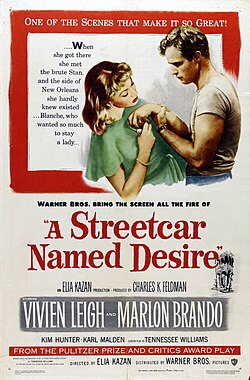
The most prominent film cover art features a tee-shirt-clad Brando, his muscular arms and torso on display, and his smoldering bad-boy pose.

The sexual tension between Stanley and Blanche is undeniable, as their love/hate relationship is filled with unbridled passion.

Their carnal attraction is mainly due to the brutish masculinity that Brando exudes on camera.

The combined supporting performances by Kim Hunter and Malden are almost as complex as the leads’ and just as important to recognize.

Hunter portrays Stella as wounded and put-upon, yet not weak. She has strength but is unsure who to trust or whether to leave her husband.

Malden plays Mitch as benevolent and trusting, enamored with Blanche until her secrets are finally revealed.

Heartbroken, even he, the kindest character in the group, is left unhappy. Malden excels at imbuing Mitch with an everyman and graceful quality.

Who can ever forget the poignant, melancholy wails of “Stella! Stella! Stella!” from the tragic Stanley, a moment forever etched in cinematic history? He longingly begs for Stella’s forgiveness as he looks towards the sky.

The suggested rape, although not shown, is a powerful tidbit and controversial in the film for 1951. The audience not seeing the action is arguably just as intense as seeing it, as imagination can often be more prominent.

The black-and-white cinematography adds emotional treasures. It captures the bleak life in New Orleans, and the characters’ struggles and hardships are wonderfully portrayed.

The run-down tenement where most of the film takes place is dour, suffocating, and dingy, perfectly enveloping the characters’ lives.

Hopelessness and depression are commonalities as director Elia Kazan creates a film that grasps his audience and never lets go.

A Streetcar Named Desire is about conflict, pain, and the human desire for love, thwarted by realism and dire circumstances.

Each of the four characters can be dissected, sympathized with, and is worthy of discussion. This only proves the complexities of each.

I challenge anyone a make a good comparison to Who’s Afraid of Virginia Woolf? (1966) and A Streetcar Named Desire have similar qualities.

The film set an Oscar record when it became the first film to win in three acting categories (a feat only since matched by Network in 1976).

It won awards for Actress in a Leading Role (Leigh), Actor in a Supporting Role (Malden), Actress in a Supporting Role (Hunter), and Art Direction.

A Streetcar Named Desire (1951) is not an easy watch, but it is assuredly a feast of excellent acting and heartbreaking, wounded characters.

Oscar Nominations: 4 wins-Best Motion Picture, Best Director-Elia Kazan, Best Actor-Marlon Brando, Best Actress-Vivien Leigh (won), Best Supporting Actor-Karl Malden (won), Best Supporting Actress-Kim Hunter (won), Best Screenplay, Best Scoring of a Dramatic or Comedy Picture, Best Sound Recording, Best Art Direction, Black-and-White (won), Best Cinematography, Black-and-White, Best Costume Design, Black-and-White

Golden Globe Nominations: 1 win-Best Motion Picture-Drama, Best Performance by an Actress in a Motion Picture-Drama-Vivien Leigh, Best Performance by an Actress in a Supporting Role in any Motion Picture-Kim Hunter (won)

The Brides of Dracula-1960

The Brides of Dracula-1960

Director Terence Fisher

Starring Peter Cushing, Yvonne Monlaur

Scott’s Review #1,218

Reviewed January 9, 2022

Grade: B+

It’s always impressive to me what Hammer Film Productions do with such a limited budget, mainly from a set and art direction perspective. With small funds, they can create gloomy yet beautiful set structures that are highly creative and appear lavish.

To the savvy viewer, this tidbit can make each film a treasure trove of enjoyment if only to look beyond the central activity and notice the style.

The Brides of Dracula (1960) is no exception.

The film is a sequel to the 1958 film Dracula (also known as Horror of Dracula), though the character of Count Dracula does not appear and is instead mentioned only twice. Fans of these films know that Christopher Lee portrays Dracula. Instead, the vicious vampire at the film’s center is Baron Meinster, a disciple of Dracula, played by David Peel.

The villain even bites his mother, played by Martita Hunt, making her undead and terrifying to the residents of a Spanish village.

Van Helsing (Peter Cushing) is the hero and must drive a stake through the heart of the vampire baron before he deviously makes innocent Marianne (Yvonne Monlaur) his bride.

Cushing is a familiar figure in Hammer horror film lore. He leads the charge as the film’s hero. I love the character because he is heroic and unflinching, always calm, cool, and collected in the face of sheer horror.

The sets are gothic and brilliant, especially the gloomy castle owned by the Baroness and her son. When she invites Marianne to spend the night, a threatening servant named Greta treats her to a stylish room and a ravishing dinner.

The exteriors are as good as the interiors and portray the village within Transylvania as cozy and homespun. Outside, the prominent inn run by the locals is inviting as much as it feels forbidden and haunted.

When Marianne is abandoned in the village by her terrified coach driver, we know that secrets or living creatures are waiting to be unearthed.

These atmospheric additions will compel audiences to tune in and enjoy the horrific moments.

Speaking of horror, The Brides of Dracula feels enough like camp and not scary, and comic elements exist throughout. No better example of this is the bumbling and boozy Doctor Tobler, played by character actor Miles Malleson.

While many moments are over the top, especially when a vampire character bares their fangs in the best hammy way, the film never feels foolish or amateurish.

A considerable misstep is naming the film The Brides of Dracula when no Dracula is ever found. I incorrectly assumed the Baron was Dracula until after the final credits rolled. This is a sneaky way to capitalize on the name recognition of Dracula.

There are too many fun moments in the film to harbor much resentment. Of the brides, my favorite is Gina, played by Andree Melly, who looks the most frightening.

The Brides of Dracula (1960) is an entertaining and pleasing chapter in the Hammer horror catalog. The expected elements include a crucifix and a healthy dose of holy water.

The Woman in Black-2012

The Woman in Black-2012

Director James Watkins

Starring Daniel Radcliffe, Janet McTeer

Scott’s Review #429

70206133

Reviewed June 21, 2016

Grade: C

The Woman in Black (2012) is an example of a recent trend in modern horror films. The positives are great effects (shadows, lighting, ghosts, some scares), but the story is not compelling and makes no sense causing it to be a negative.

The eerie setting of foggy London and a creepy seaside village are perfect.

The cinematography dynamic instantly elicits a feeling of dread, coldness, and secrets.

From that point, the story sinks into a chaotic mess of unbelievable twists that, instead of compelling, only confuses the viewer until he or she no longer cares.

That is a shame.

I give Daniel Radcliffe credit for trying to shake his Harry Potter image by going the horror route. I suspect that is the entire point of the film, as it centers around Radcliffe, but it seemed like I was still watching a Harry Potter movie.

Nice effects, but poor story. This Woman in Black (2012) will be forgotten before long.