Category Archives: Supernatural Horror

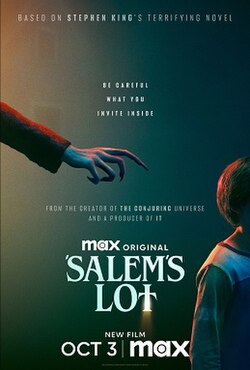
‘Salem’s Lot-2024

‘Salem’s Lot-2024

Director Gary Dauberman

Starring Lewis Pullman, Makenzie Leigh

Scott’s Review #1,537

Reviewed June 13, 2026

Grade: B-

Another attempt at resurrecting the well-known and scary 1975 Stephen King novel ‘Salem’s Lot results in a mediocre affair.

This is a shame because the novel, as well as Pet Semetary, scared the bejeezus out of me as a nerdy teen craving escapism.

The best ‘revival’ of ‘Salem’s Lot was a wonderful 1979 television miniseries that spanned nearly three hours. It lent credence to delving deeper into the robust and complex characters King created.

For a deep horror extravaganza, this is necessary.

Still, the 2024 offering of ‘Salem’s Lot is a watered-down approach to the original story, which it pairs with repeating glossy elements that were once extremely frightening and imaginative.

There’s little to no character development and a tepid romantic storyline that ultimately goes nowhere.

Overall, Stephen King doesn’t have a whole lot of luck with big-screen adaptations of his works. Carrie (1976) and The Shining (1980) are the two best, in my opinion.

Author Ben Mears (Lewis Pullman) returns to his childhood home, Jerusalem’s Lot (or Salem’s Lot), in search of inspiration for his next book, only to discover that his hometown is being preyed upon by a bloodthirsty vampire.

Gradually, most of the townspeople succumb to vampirism, explained later, because the town has no life anyway.

At the same time, Ben, his burgeoning love interest, Susan (Mackenzie Leigh), Doctor Cody (Alfre Woodard), schoolteacher Mark (Bill Camp), and eleven-year-old Mark Petrie (Jordan Preston Carter) must race against time to stop the madness from overtaking their beloved town.

As with many modern horror films, the first half of ‘Salem’s Lot is better than the second.

Pullman, son of famous actor Bill Pullman, and facially a dead ringer, is compelling in the lead role. An intelligent author, he returns to his hometown for inspiration, also recalling a horrific accident that killed both his parents.

He meets several interesting, on the surface anyway, characters, like the schoolteacher, the sheriff, and Susan, who, despite reading his last novel, doesn’t realize at first that Ben is the author.

Ben and Susan have a potential romance and a cool banter that envelops the audience. But that’s as far as we get with the pairing.

It’s peculiar that director Gary Dauberman keeps the time period in the mid-1970s for the automobiles featured, but little else is reminiscent of fifty years ago.

The characters all look very modern, from the hairstyles to the clothes, especially given the addition of a black female doctor and a prominent black family.

Kudos for the diversity, but it’s highly doubtful this would exist in a small rural town in the 1970s, especially not without a redneck or two around to cause chaos.

A fantastic sequence in the novel and miniseries, when pasty-faced schoolkid Danny (Nicholas Crovetti) is sacrificed, and returns to hover outside his pal Mark’s bedroom window, is neither thrilling nor scary. Instead, Mark casually casts Danny aside and runs to tell on him.

The villains also underwhelm.

Straker (Pilou Asbæk), a strange man from somewhere in Europe who opens an antique store in town and moves into the long-abandoned Marsten House, is scarcely featured and certainly not enough to get to know the character at all.

His vampire master, Kurt Barlow, who plans to create a vampire colony, is featured even less. He waits in a coffin in the basement of the house and snarls once or twice.

Nonetheless, the kills are fun if not unsurprising. Once benevolent characters turn into vampires and attempt to bite others.

The wackiest, probably unintentionally, is watching Susan’s mother bite her and later wield a shotgun to shoot anyone who has not turned.

But we don’t feel sorry for the victims because we never really knew them well enough to begin with. The quiet pacing is something the novel and the miniseries did exceptionally well.

By the conclusion, what started as a film with frightening potential turns into cheesy glowing crosses that sometimes work and sometimes don’t, and the character is reduced to saying a prayer in the hopes that the vampire won’t bite her.

‘Salem’s Lot (2024) is a rather tepid film with little to differentiate it from many other genre films and a weak effort in the many incarnations of King’s excellent book.

Final Destination Bloodlines-2025

Final Destination Bloodlines-2025

Director Zack Lipovsky, Adam Stein

Starring Kaitlyn Santa Juana, Brec Bassinger

Scott’s Review #1,489

Reviewed August 9, 2025

Grade: B+

Final Destination Bloodlines (2025) is the sixth installment in the Final Destination film franchise, but the first in fourteen years, making the film feel more like a relaunch than a retread.

I’ll gladly see any new (or old) chapters since I enjoy the once inventive premise, which is now familiar territory and part of the brand.

The plots are based on the idea of a small group of people who escape impending death after one visionary individual has a sudden premonition and warns them about a major disaster that is about to occur.

Of course, Death cannot be tricked for long.

After avoiding their deaths seen in the visions, the survivors are later killed one by one in bizarre accidents caused by an unseen force.

The unique deaths are the fun part.  From a garbage truck compactor, a malfunctioning MRI machine, and a deadly vending machine, the anticipation is in the killings and how they will be showcased.

Events begin in 1969, marking the best segment of Final Destination Bloodlines and one of the greatest in the series.

Young adults, Iris (Brec Bassinger) and Paul (Max Lloyd-Jones), embark on a lavish opening celebration of the Skyview, a high-rise restaurant tower that resembles the Seattle Space Needle. He awkwardly plans to propose, and she intends to reveal that she is pregnant.

The scene is shockingly tender and emotional since we immediately care about the couple, a pleasant surprise in the horror genre.

As the lovebirds sip champagne at the sophisticated bar, Iris is unsettled by the skyscraper’s lofty height and an unnerving feeling of dread and destruction as revelers hoot and holler on a glass dance floor.

Eventually, the tower collapses following a deadly chain reaction, killing everyone inside.

The Mad Men-style art direction and set design are magnificent and polished, adding worlds of style to the film. The pacing also works with appropriate tension throughout the extended sequence.

The action shifts to 2024, and a violent recurring nightmare plagues Stefani (Kaitlyn Santa Juana), revealed to be Iris’s granddaughter. She heads home to track down the one person who might be able to break the cycle and save the Reyes family from the grisly demise that inevitably awaits them.

The 2024 events are what you’d expect from the Final Destination films, and while decent, they don’t compare to the superior 1969 part.

The most fun is watching the cat-and-mouse setup of the presumed chain of events.

At the Reyes family barbeque, an accidental chunk of broken glass, a mislaid sharp rake, a fiery grill, and a torn trampoline are all possible death objects revealed as the family sips drinks and revels in outdoor activities and chatter.

Or are they merely red herrings?

The genius is forcing the audience to look around their own homes and decipher how many different objects could lead to their deaths.

Santa Juana is excellent at carrying the film, playing a relatable girl next door. Her likability keeps the audience invested in her as she attempts to break the cycle.

Other characters are more stock. The annoying tattoo artist cousin, the absentee mother looking for a second chance, and the uptight female cousin. They are all intended victims that Death will surely pluck.

They all play second fiddle to the bloody deaths, which are the main attraction.

Notably, a recurring character played by Tony Todd returns before the actor’s death, getting a lovely sendoff. His character’s appearance, in both 1969 and 2024, ties in deliciously with the history of the franchise.

Giving fresh breath to a formerly aging franchise, Final Destination Bloodlines (2025) is much better than expected. It adds charm and fulfillment, making it a treat for longtime fans of the past twenty-five years.

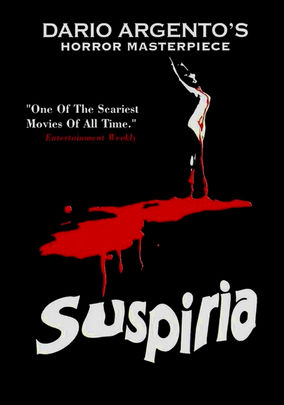
Suspiria-1977

Suspiria-1977

Director Dario Argento

Starring Jessica Harper

Top 250 Films #53

Top 40 Horror Films #11

Scott’s Review #339

60037424

Reviewed January 9, 2016

Grade: A

Suspiria is a horror masterpiece, made in 1977, by my favorite Italian horror director, Dario Argento.

A combination of complex storytelling, glossy colors, and a unique art direction makes this film a treasure and an influence in “the look” of a film attempting to achieve an interesting art direction choice.

The color red is highly prevalent throughout Suspiria, which is fitting given the film’s subject matter of witchcraft and demons. The musical score is brilliant and chilling.

This film is perfect and one of my favorites.

The film takes place in Germany, and the opening sequence is fantastic. We meet our heroine, Suzy Bannion (Jessica Harper), an American ballet student, as she arrives in blustery Munich to attend a prestigious ballet school.

The shot of the driving wind and rain as she exits the airport is a great example of this film’s ultimate style.

Suzy meets a creepy taxi driver who takes her to the school, where she witnesses a frantic student, Pat Hingle, fleeing. A mysterious voice over the intercom then denies Suzy access to the school.

The film’s focus then briefly shifts to Pat’s perspective as she meets a sinister fate while staying with a friend.

One fantastic aspect of Suspiria is that we know something is wrong at the ballet academy; we do not know what or who is involved. With great creativity, Dario Argento builds a set that is modern and sophisticated yet laced with an undercurrent of menace.

As we meet the supporting characters, Madame Blanc (Joan Bennett) and Miss Tanner (Alida Valli), we know something is not right with them either. Blanc is kindhearted; Tanner is a drill sergeant, but both seem to have something to hide and claim to know nothing of Pat’s terror.

There is also Daniel, the blind piano player, whose seeing-eye dog suddenly turns vicious.

The plot is complex and does not always make perfect sense, but the elements of Suspiria make it a masterpiece.  Pat’s death scene is laced with greatness as she dangles from a high glass ceiling dripping blood. Her hysterical friend is sliced to bits by the falling glass.

This is the best double-death scene in horror film history.

When creepy maggots invade the school, leaving the girls feeling unsafe, the film goes all out. A later scene involving Suzy’s best friend and fellow student, Sarah, attempting to flee the school via the basement, only to struggle in a pit of razor wire, is splendid.

Much of Suspiria is dubbed in English, mainly because the actors speak either German or Italian. Still, Jessica Harper and Joan Bennett have distinctive voices that lend texture and richness to the dialogue.

Suspiria (1977) is a grand horror film, not solely for its mysterious story, but for all the added components that Argento throws into the mix- strange characters, weird sets, and a heavy dose of blood-red- pretty fitting.

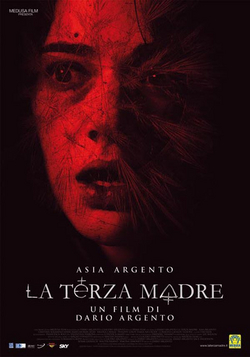
Mother of Tears-2007

Mother of Tears-2007

Director Dario Argento

Starring Asia Argento

Top 250 Films #227

Top 40 Horror Films #35

Scott’s Review #1,360

Reviewed May 13, 2023

Grade: B+

Mother of Tears (2007) is a film I have a great fondness for, and I’ll never forget its debut in my life.

It is the very first film my husband and I saw in a movie theater together. So, I’m pretty partial to the nostalgic feeling it evokes on a personal level.

Both fans of esteemed horror director Dario Argento, we cohabitated in the dusty art theater one rainy Saturday evening following a delicious Italian dinner on one of our first dates.

The atmosphere was nearly as perfect as an Argento film itself since he is known for operatic, visceral, and visual perfection.

The film is the concluding installment of Argento’s supernatural horror trilogy The Three Mothers, preceded by Suspiria (1977) and Inferno (1980. It depicts the confrontation with the final “Mother” witch, known as Mater Lachrymarum.

Grisly deaths await several unlucky Italian citizens after an American archaeology student named Sarah Mandy (Asia Argento) innocently releases a demonic witch from her ancient prison.

A mysterious urn comes into her possession, and when it is attempted to be restored at the Museum of Ancient Art in Rome, all hell breaks loose.

Sarah has a personal connection to the witch because her mother was once embroiled in a feud with the witch.

Making Mother of Tears a family affair and a source of comfort for viewers of Argento’s work, daughter Asia plays the lead character. At the same time, younger brother Claudio co-produces the picture with Dario.

Religion is always a fun theme in horror, especially in the oft-targeted Roman Catholic church. Like The Exorcist did in 1973, and many other horror films followed over the years, the religion is mocked in the kindest of ways.

As an ode to previous works involving children, a child is massacred, and more than one baby is sacrificed in the name of Mater Lachrymarum, so be forewarned if this is a dealbreaker for some.

Who doesn’t enjoy a coven of witches flocking down on Rome, screeching at passerby folks and wreaking havoc on the sacred city, now overcrowded with demons?

For the bloodthirsty types who crave a healthy dose of bloodletting, Mother of Tears lets the floodgates spill wide open.

One poor woman is speared through her private area and upwards, while another’s mouth and face are expanded until they pop. Several eyes are violently gouged.

You get the idea.

It’s recommended to watch Suspiria and Inferno first for chronological ease, but this isn’t a must; a stand-alone viewing will do just fine.

Nothing can match the sheer madness and visual mastery of 1977’s Suspiria, and Mother of Tears is the weakest of the three films, but this is not a gripe, merely a comparison.

They work well together, and the final confrontation involving Sarah and Mater Lachrymarum’s fight over a red tunic is the highlight.

The dark texture of the filming mixed with glowing lights and red colors is easily noticeable. This aligns well with religious or occult characters such as a monsignor, a cardinal, and various witches.

The film, though American-made, feels Italian and is quite authentic. Further, it naturally sits well with films of Argento’s heyday, the 1970s and 1980s. Most, if not all, actors appear to be Italian or European, adding flavor and culture to the experience.

If one has traveled to Rome, many exterior shots of the ancient city appear, adding to the enjoyment. Sarah ravages the streets and scurries through the vast train station in one powerful sequence.

Since trains are the main mode of transportation in Italy, viewers can transport themselves back to a previous trip.

To know Dario Argento is to love him. Mother of Tears (2007) may not measure up to his very best works, but it is an entertaining and enthralling visit to the macabre world.

It may or may not win over new fans, but it will satisfy the director’s existing fans.

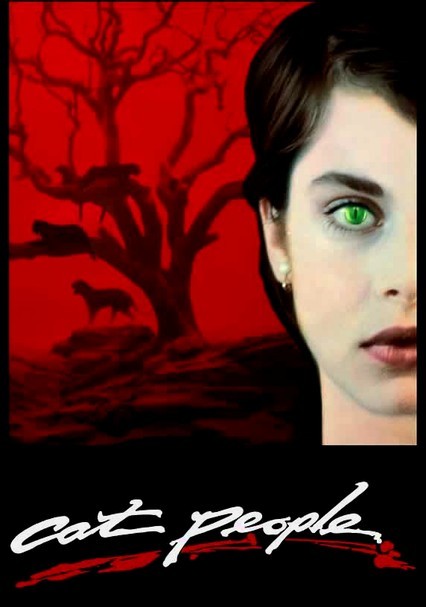
Cat People-1982

Cat People-1982

Director Paul Schrader

Starring Nastassja Kinski, Malcolm McDowell

Scott’s Review #1,275

Reviewed July 10, 2022

Grade: B+

Cat People (1982) is a mysterious, psychological journey into the strange universe of humans possessing cat-like qualities, sometimes with a tendency towards vicious limb extraction and other mauling techniques.

It’s an absurd premise, though admittedly clever, with an identity all its own.

Feeling slightly dated, mostly due to the early-1980s synthesizer-like musical score, film style, and the casting of some actors at the top of their game, Cat People is nonetheless enjoyable and sexual.

Especially recommended is a late Friday or Saturday night viewing with as little light as possible for the best ambiance.

Since our rented DVD copy was ravaged by poor visual quality and hard-to-hear sound, a thought is to buy the film.

The 1982 version of Cat People is directed by Paul Schrader, who is best known for writing or co-writing Scorsese’s greats Taxi Driver (1976) and Raging Bull (1980).

The director also has his own share of films, including ones as recent as 2021.

His production is a remake of one made some forty years earlier, which I have not seen.

The mood of Cat People is overwhelmingly sensual and violent, a horror-thriller tale. The action immediately gets off to a sexually perverse start when, during presumably prehistoric days, a wild black panther impregnates a young girl offered to him via sacrifice.

The message is clear that this results in a weird human/cat hybrid coming into existence.

In the present, Irena Gallier (Nastassia Kinski) harbors a dark family secret she despises. She reconnects with her estranged brother, Paul (Malcolm McDowell), who shape-shifts into a savage beast. He lives in the southern city of New Orleans and has spent time in a mental hospital.

Irena visits the local zoo and finds herself attracted to handsome zoologist Oliver Yates (John Heard), even as her brother makes his incestuous advances toward her. Inevitably, the family curse rears its ugly head when Paul rips the arm off one of the zoo workers played by a young Ed Begley Jr.

I like tremendously how Schrader incorporates New Orleans as the central setting. Having nothing really to do with the story, the French-influenced city is nice to look at, as restaurant scenes feature Creole-style and other southern/European sophisticated little gems.

Ruby Dee is cast as a wacky housekeeper named Female, rippling with New Orleans flair, and who is aware of the terrible family secret.

Nastassja Kinski is perfectly cast as the provocative and sultry main character, and she effortlessly leads the charge. Others like Heard and Annette O’Toole, who were A-list stars in the early 1980s, provide a time capsule of Hollywood relevancy.

Unfortunately, this also makes Cat People feel like it’s from another time, and the 1980s film style is painfully obvious.

The growling and vicious cats feel both scary and fake during close-ups, but imagine the trickery of using real-life leopards? The filmmakers did the best they could, and this is also obvious.

Some sequences are quite grisly, and when they aren’t, there are best-remembered scenes of peril and intrigue. O’Toole’s character of Alice (another zoologist) takes a late-night dip in a swimming pool and is harassed by a menacing Irena.

Earlier, a great scene occurs when a prostitute named Ruthie visits her client in a dingy motel room, only to realize that her john is a mean leopard. We assume she will be ripped to shreds, but this dubious honor is saved for another slutty character whom Paul picks up at a funeral.

An attempted triangle among Irena, Oliver, and Alice goes nowhere, and it’s bewildering that the decision was even made to try. The power couple is Irena and Oliver, whose smoldering love scenes are sensual and skin-heavy, professing almost-immediate love for each other.

With enough explicit sex and gratuitous violence to keep many viewers titillated, Cat People (1982) has positives and negatives. When it was released, I bet it was a potboiler of juicy, relevant intrigue, but the film hasn’t held up quite as well as some others.

The Convent-2000

The Convent-2000

Director Mike Mendez

Starring Adrienne Barbeau

Scott’s Review #1,246

Reviewed April 16, 2022

Grade: C+

I debated whether to give Adrienne Barbeau top-billing recognition for The Convent (2000).

After all, she doesn’t even appear, save for a quick silhouette scene that probably wasn’t even the actress, until the final third of the film.

Since I am a fan of Barbeau’s work, mainly the television series Maude, and films like The Fog (1980) and Escape From New York (1981), I decided to throw caution to the wind and cement her star status.

The film itself is not very good and could use all the help it can get. It’s campy beyond belief, amateurish, hokey, and poorly acted, with enough ridiculous one-liners to make me wonder whether director Mike Mendez was purposely trying to make a bad film.

But before I get all curmudgeonly and smack this film in the face with an ‘F’ rating, I’d like to justify my more-than-generous ‘C+’ rating.

If The Convent had tried to take itself seriously and produced shit like this, I would have gone for the jugular in my review, but it knows it’s a silly film and instead embraces this fact wholeheartedly.

Still, I kept wondering whether the film was some nod to the slasher film genre that took over the world from the late 1970s until the late 1980s, or if it feebly tried to merge the slasher and zombie genres to produce something fresh.

If made in, say, 1985, The Convent would have fit snugly amongst the heaps of other similarly themed films patterned after superior feasts like Halloween (1978) and Nightmare on Elm Street (1984).

The film opens impressively enough when a young woman named Christine walks into a convent and goes batshit crazy, shooting every nun she sees and burning the place to the ground.

I grinned because Christine looked exactly like Uma Thurman’s character in Quentin Tarantino’s 1994 masterpiece, Pulp Fiction, with bright red lipstick and dark shades. Even her outfit looks the same.

Unfortunately, that’s where any parallels end. From this point, the plot is basic and uninspired.

A coed named Clorissa (Joanna Canton) joins her best friend Mo (Megahn Perry) and a group of college students on a dare to venture into the aforementioned convent (now rebuilt) and tangle with nun and priest spirits rumored to be inhabiting the structure.

After Mo is left alone and the rest of the bunch dine at Denny’s, the plot goes from standard to wacky as the returning students are bitten and become possessed by Satanists who want to beckon Satan back to earth.

There is an attempt to sacrifice a virgin among the group to help with this.

Conveniently, Christine (now older) lives down the street after spending a thirty-year stint in the loony bin. The badass woman comes barreling to the rescue with her motorcycle and an arsenal of machine guns to kick Satan’s ass.

The fun begins when Barbeau finally appears. With her dangling cigarette and macho talk, the actress is in her comfort zone. The dialogue between her and the other characters is so bad that, once again, I wondered whether this was the intent. I truly hope it was.

The robotic heads twitching and the green-eyed students now glowing align perfectly with the gimmicky art direction and juvenile special effects. I’ve seen better on a 3 pm daytime soap opera.

Rapper Coolio easily plays the most irritating character in a ridiculous role as a loud policeman. This attempt at comedy fell completely flat, and I was more entertained by the gay satanist who cleverly decides that if he and another virgin boy have sex, they will be spared.

Once the credits rolled, I was happy not to have to endure any more of the one-hour and twenty-minute experience.

After my five-minute reflection, I decided to interpret the film as a comical satire rather than anything more.

The Convent (2000) isn’t distinct enough to earn the ‘it’s so bad it’s good’ award because it lacks any identity.

However, for a midnight movie that is so goofy and over-the-top that there is plenty to mock, the film is a fun time.

And, it’s always a joy to see Barbeau in anything she is willing to appear in.

The Brides of Dracula-1960

The Brides of Dracula-1960

Director Terence Fisher

Starring Peter Cushing, Yvonne Monlaur

Scott’s Review #1,218

Reviewed January 9, 2022

Grade: B+

It’s always impressive to me what Hammer Film Productions do with such a limited budget, mainly from a set and art direction perspective. With small funds, they can create gloomy yet beautiful set structures that are highly creative and appear lavish.

To the savvy viewer, this tidbit can make each film a treasure trove of enjoyment if only to look beyond the central activity and notice the style.

The Brides of Dracula (1960) is no exception.

The film is a sequel to the 1958 film Dracula (also known as Horror of Dracula), though the character of Count Dracula does not appear and is instead mentioned only twice. Fans of these films know that Christopher Lee portrays Dracula. Instead, the vicious vampire at the film’s center is Baron Meinster, a disciple of Dracula, played by David Peel.

The villain even bites his mother, played by Martita Hunt, making her undead and terrifying to the residents of a Spanish village.

Van Helsing (Peter Cushing) is the hero and must drive a stake through the heart of the vampire baron before he deviously makes innocent Marianne (Yvonne Monlaur) his bride.

Cushing is a familiar figure in Hammer horror film lore. He leads the charge as the film’s hero. I love the character because he is heroic and unflinching, always calm, cool, and collected in the face of sheer horror.

The sets are gothic and brilliant, especially the gloomy castle owned by the Baroness and her son. When she invites Marianne to spend the night, a threatening servant named Greta treats her to a stylish room and a ravishing dinner.

The exteriors are as good as the interiors and portray the village within Transylvania as cozy and homespun. Outside, the prominent inn run by the locals is inviting as much as it feels forbidden and haunted.

When Marianne is abandoned in the village by her terrified coach driver, we know that secrets or living creatures are waiting to be unearthed.

These atmospheric additions will compel audiences to tune in and enjoy the horrific moments.

Speaking of horror, The Brides of Dracula feels enough like camp and not scary, and comic elements exist throughout. No better example of this is the bumbling and boozy Doctor Tobler, played by character actor Miles Malleson.

While many moments are over the top, especially when a vampire character bares their fangs in the best hammy way, the film never feels foolish or amateurish.

A considerable misstep is naming the film The Brides of Dracula when no Dracula is ever found. I incorrectly assumed the Baron was Dracula until after the final credits rolled. This is a sneaky way to capitalize on the name recognition of Dracula.

There are too many fun moments in the film to harbor much resentment. Of the brides, my favorite is Gina, played by Andree Melly, who looks the most frightening.

The Brides of Dracula (1960) is an entertaining and pleasing chapter in the Hammer horror catalog. The expected elements include a crucifix and a healthy dose of holy water.

Final Destination-2000

Final Destination-2000

Director James Wong

Starring Devon Sawa, Ali Larter

Scott’s Review #1,186

Reviewed October 16, 2021

Grade: B

Following the commercial success of Wes Craven’s Scream in the mid-1990s, the horror genre was once again a hot ticket item.

New Line Cinema capitalized on this financial goldmine by creating the popular Final Destination franchise in 2000.

Five films were created in total.

The Final Destination films all have the same premise. A small group of people escapes impending death after one individual sees a sudden premonition and warns the others about the mass-casualty accident that is about to happen.

Their luck is unfortunately short-lived.

After avoiding their foretold deaths, the survivors are systematically killed off one by one in bizarre accidents caused by an unseen force creating complicated chains of cause and effect.

There is no way they can cheat death, and the bastard will have his way with them.

The upside is that the deaths are highly creative and oodles of fun for the bloodthirsty horror viewer to feast upon. Instead of a knife-wielding maniac, the protagonist is an evil force, which at the time was a neat little add-on that made the film unique.

The victims are mainly teenagers or twenty-something characters, who are the target audience for these and most other horror films.

In Final Destination (2000), high school student Alex Browning (Sawa) is about to embark on a fabulous senior class trip to Paris. A group of his schoolmates joins him.

Just before takeoff, as the group settles in for their eight-hour journey from New York to Charles de Gaulle Airport, Alex has a premonition and sees the plane explode moments after it leaves the ground.

Alex becomes unruly and insists that everyone get off the plane, and seven people, including Alex, are forced to disembark. All watch as the plane explodes in an enormous fireball, killing everyone on board.

He and the other survivors have briefly cheated death, but will not be able to avoid their fate for very long. One by one, these lucky survivors fall victim to the Grim Reaper.

I have seen each one of the Final Destination films and enjoyed them all. Typically, the first film is the best, but I argue that part 2 is the best, but that is irrelevant to this review.

The premise is extremely clever and instantly absorbing. Instead of the dated “final girl,” one assumes that Alex will be the last survivor, and that may or may not be true, as a twisted game of figuring out which order the seven survivors will be killed is based on their seating arrangements on the flight that nearly drives Alex mad.

It’s the perfect engagement for the viewer.

As a clue, director James Wong, who co-wrote the screenplay, creates stock characters like the dumb jock, Carter Horton, with the muscle car, played exceptionally well by Kerr Smith, and the douchey Billy Hitchcock (Seann Williams Scott).

There is a teacher and FBI agents thrown in for good measure, so it becomes obvious who is going to be killed off.

The fun is watching them get killed. Delicious deaths like being run over by a bus, embedded by flying knives, and a good old-fashioned decapitation by flying shrapnel are to be enjoyed.

The final sequence, ironically set in Paris, is exceptional as three survivors are left, and they feel safe. They are not safe at all, as one of them suddenly realizes, resulting in a clever final kill, followed by sudden end credits.

This is narrowly usurped by the brilliant plane crash premonition scenes as Alex teeters between reality and premonition.

The plane explosion is highly effective and is shown from inside the fuselage. The visual effects, which used a miniature Boeing 747, are wonderful to watch with heart-racing detail and excitement.

At times during Final Destination, the action lags, and Ali Larter, who plays Clear Rivers, is not the greatest actress. Her silly battle with electric sparks while sitting in a car is not the film’s finest sequence.

Final Destination (2000) is a fun popcorn film with some admirable, unexpected turns. It stays true to the horror formula while offering some unique additions that feel fresh.

It’s a roller coaster ride meant to be enjoyed and not overanalyzed. The innovation suitably balances the fun.

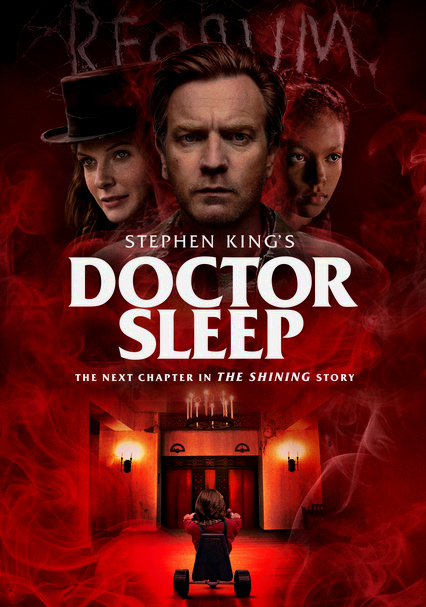
Doctor Sleep-2019

Doctor Sleep-2019

Director Mike Flanagan

Starring Ewan McGregor

Scott’s Review #1,026

Reviewed May 22, 2020

Grade: B

Based on the 2013 novel of the same name written by Stephen King, a sequel to his own 1977 novel The Shining, Doctor Sleep (2019) is also a direct sequel to the film adaptation of The Shining (1980).

Events are set several decades after the original events and incorporate elements from the 1977 novel as well. A fun fact is that King hated the film version of The Shining but approved of the script for Doctor Sleep.

The first and last parts of the film are superior to the rest, mainly succeeding when elements of The Shining are incorporated.

The rest meanders and teeters too much into supernatural and computer-generated imagery territory, taking away from the haunting ghost story elements that made the original The Shining such a frightening treasure.

Ewan McGregor plays Danny Torrance, the little kid scarred from the trauma he suffered when his father Jack went mad at the looming Overlook hotel decades earlier.

Danny, now a grown man and a suffering alcoholic, lives a life that is out of control, suppressing his “shining” gifts that allow him to possess psychic abilities.

Hitting rock bottom, Dan moves to a tiny town in New Hampshire and befriends Billy Freeman (Cliff Curtis), who sponsors him in AA. Dan is regularly visited by the spirit of Dick Hallorann, the deceased chef from the hotel who teaches Dan how to contain his demons.

Meanwhile, the True Knot, a cult of psychic vampires led by Rose the Hat (Rebecca Ferguson), extend their lifespans by consuming “steam”, a psychic essence released as they torture and kill those who have the shining.

They primarily feed on young children and pursue Abra Stone (Kyleigh Curran), a young girl whose shining is even more potent than Dan’s. She communicates telepathically with him and forms a pact to destroy Rose and her cronies.

Let’s take the good with the bad.

The film gets off to a perfect start with the recreation of scenes from The Shining when Danny rides his big wheel throughout the winding 1970’s 1970s-style hallways of The Overlook and gazes at the forbidden Room 237.

The synth musical score that made The Shining atmospheric and unforgettable is also included as the bass-infused heartbeat is showcased amid overhead camera angles, a clear ode to The Shining.

The finale of Doctor Sleep comes full circle as Dan and Abra travel from New Hampshire to snowy Colorado and revisit the Overlook, now tattered and ill-forgotten from decades of abandonment.

The showdown between Dan, Abra, and Rose treats fans to clips of Jack Nicholson and Shelly Duvall.

Visits from familiar characters and sets, such as the ghostly bartender, the conjoined twins, the wrinkled, old, naked woman, the gushing elevator blood, and the hedge maze, make their return, providing a lovely feeling of nostalgia.

Unfortunately, between the first thirty minutes and the final thirty minutes, there are another ninety minutes of screen time that don’t always work. For starters, a running time of two hours and thirty-two minutes feels too long for a horror film, and the filler lying in between is that much more apparent.

The action meanders, especially given the anticipated final battle, which is inevitable.

Taking nothing away from either Ferguson or Curran, who are fine in their respective roles of Rose and Abra, neither is the most interesting aspect of Doctor Sleep. They are new characters in the novel and therefore the film but are secondary to Dan and his intricate relationships with Jack, Wendy, and Dick.

The only parts of the story that were interesting to me were the connections and thoughts Dan had to experiences forty years earlier.

The battle scenes between Rose, Abra, and other characters do nothing for the story and take the film too far in the direction of the supernatural and slick technological aspects that The Shining didn’t need.

Since Doctor Sleep was adapted from the successful recent King adaptations of It Chapter Two (2019) and Pet Sematary (2019), perhaps this is the reason for the modern additions.

If Doctor Sleep (2019) could be sliced and diced to eliminate the middle and keep the bookends of the beginning and finale, the result would have paid proper homage to The Shining (1980); instead, we get only halfway there.

The film has some nice elements and stays true to its history, but it contains a few unnecessary additions that detract from its overall quality. And how can a film ever compare to the greatness of The Shining (1980)?

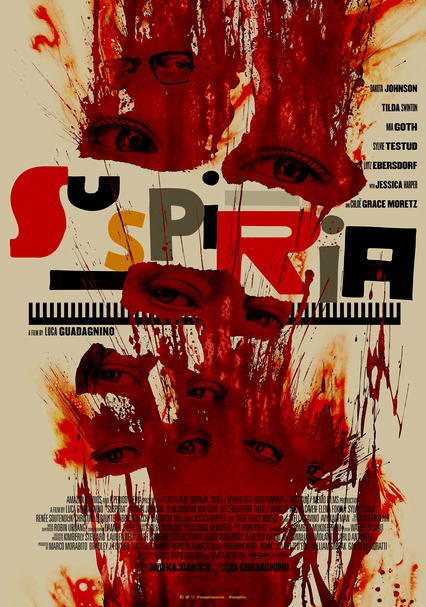
Suspiria-2018

Suspiria-2018

Director Luca Guadagnino

Starring Dakota Johnson, Tilda Swinton

Scott’s Review #864

Reviewed February 7, 2019

Grade: B-

Dario Argento’s 1977 creative masterpiece is the original Suspiria, an orgy of style and visual spectacles carefully immersed within a standard slasher film appropriate for the times.

Some might deem it foolish to attempt a remake.

Argento’s film contains comprehensive and defined story elements, while the new Suspiria (2018) changes course with a brazen attempt to achieve the same mystique as the original. Instead, it offers a plodding and mundane story that is almost nonsensical and does not work.

Thankfully, a bloody and macabre finale brings the film above mediocrity.

Director Luca Guadagnino, fresh off the Italian and LGBT-themed Call Me by Your Name (2017), a bright film peppered with melancholy romance and lifestyle conflict, could not be more different from Suspiria.

The respected director parlays into the horror genre with two of Hollywood’s top talents, Tilda Swinton and Dakota Johnson, and a nice nod to the original film with a small appearance by leading lady Jessica Harper.

The premise of Suspiria remains intact, as the period is once again 1977, and the location remains Berlin, Germany. Susie Bannion (Johnson) is a gifted American dancer who joins the prestigious Tanz dance academy run by a coven of witches, where she unearths demonic tendencies.

Coinciding with her arrival is the disappearance of another student, Patricia Hingle, and the revelation that her psychotherapist Josef Klemperer (Swinton) has Patricia’s journals chronicling details of the dastardly coven.

From an acting perspective, Swinton impresses the most as she tackles three distinctive roles: an elderly and troubled psychotherapist, artistic director Madame Blanc, and Mother Marko, an aging witch.

Each character is vastly different, allowing the talented actress to immerse herself in the various characters. She is so convincing that I did not realize while watching the film that she played the psychotherapist or that a female played the character.

I admit to not being a fan of Dakota Johnson for perceptively using her Hollywood royalty to rise the ranks to film stardom or her lackluster film roles thus far—think Fifty Shades of Grey or the innumerable sequels—but she does not do much for me in the central role of Susie.

The miscast is more palpable compared to Harper’s rendition of the role decades earlier.

Johnson is predictably wooden and quite painful to watch, especially matched against a stalwart like Swinton in many scenes. Lithe and statuesque, the young actress does contain the physical qualities of a dancer, so there is that.

As a stand-alone film, my evaluation of Suspiria might be less harsh, but the original Suspiria is held at such lofty heights that this is impossible.

The problem is with the screenplay, as compelling writing is sparse. Much of the plot makes little sense and does nothing to engage the viewer at the moment. Slow-moving and meandering, lacking a spark or an abrupt plot breakthrough, I quickly lost interest in what was going on.

The interminable running time of over two and a half hours is unnecessary and unsuccessful.

Before I rake entirely Suspiria across the coals, my cumulative rating increases with the astounding and garish final sequence, which features a plethora of blood and dismemberment in a sickening witches’ sabbath.

As Klemperer lies incapacitated after being ambushed by the witches, one girl is disemboweled, followed by decapitation, as the bold use of red is blended into the lengthy sequence. As the withered and bloated Mother Markos relinquishes her title, an incarnation of Death is summoned, and heads explode.

The finale plays out like a horrible dance sequence.

To add to the above point, the visuals and cinematography are its highlights. By using mirrors and possessing a dream-like quality, the film looks great and harbors an eerie, stylistic, and deathly crimson hue. The resulting project is one of spectacle and intrigue rather than a sum of its parts.

Rather than approaching the film with an introspective or cerebral motif, it is recommended that you simply go with the flow and let it fester.

Guadagnino deserves credit for bravely attempting to undertake the creation of such a masterpiece and bringing it to audiences in 2018.

Suspiria (2018) lacks plot or pacing and is the second runner-up to the original. The story is not worth making heads or tails of since it is not interesting enough to warrant the effort.

Ultimately, skip this version and stick to the brilliance of the Argento effort, or better yet, do not compare the two films at all.

Independent Spirit Award Nominations: 2 wins- Best Cinematography (won), Robert Altman Award (won)

Drag Me To Hell-2009

Drag Me To Hell-2009

Director Sam Raimi

Starring Alison Lohman, Justin Long

Scott’s Review #591

Reviewed January 7, 2017

Grade: B

Drag Me To Hell (2009) is a fairly predictable, modern-day horror film, with some supernatural elements and special effects that make it slightly above average.

Directed by Sam Raimi (of Spider-Man fame), one can see his stamp on it, as he has a way of horror camp. 1983’s cult classic, Evil Dead, directed by Raimi, is evidence of this.

Young Loan Officer Christine Brown, played by Alison Lohman, is bucking for a promotion and intent on impressing her boss by being a stickler for the rules.

She chooses the wrong day to do this, as an older woman desperately needing a loan is denied one by Christine.

The angry woman places a curse on Christine, causing her life to spin out of control. She has a mere three days to remove the curse before her soul is “dragged to hell”.

As with most horror films involving a curse, the plot is completely unrealistic and filled with holes. The film also tries to be both serious and comical at times- sometimes succeeding, sometimes not.

In a few scenes, I was not sure if the intention was to be comical or if it was unintended, but periodically the acting was over the top.

With all that said, if one is interested in a fun horror film that has a few scares and is not too gory (it is rated PG-13 after all), one will enjoy Drag Me To Hell (2009).

The Final Destination-2009

The Final Destination-2009

Director David R. Ellis

Starring Bobby Campo, Shantel VanSanten

Scott’s Review #587

Reviewed January 7, 2017

Grade: B

The Final Destination (2009) is a fun, entertaining film, and exactly what one might expect from a film of this nature, of the horror genre, and by this time the fourth in the series.

The 3-D effects are a nice and needed addition to the franchise as a way of keeping it modern and fresh.

The film has the expected additives- an attractive cast, mediocre acting, and ridiculous situations, which inevitably lead to the fated kills- in typical grisly fashion.

As audiences of the Final Destination films know, characters cannot tempt fate, and there is a specific order to the deaths. The only aspect that sets The Final Destination apart from its predecessors is the 3-D effects.

The story is reminiscent of the original version of Final Destination, made in 2000, only instead of an airport, the action begins at a raceway, where the main character of the film, Nick O’Bannon, has a premonition of a grisly accident at the racetrack.

After he saves some folks from their deaths, they believe they have “cheated” “death”, but before long, fate has other plans for them.

Some fun kills include decapitation by a flying tire, a sharp rock emitted from a lawnmower, a crushing tub, and a speeding ambulance.

The film’s novel concept, originally fresh and unique, has become expected and rather redundant. The fun part is the creative kills.

The film is the perfect movie to sit back, relax, have fun, see some interesting deaths, and be entertained by.

Devil-2010

Devil-2010

Director John Erick Dowdle

Starring Chris Messina

Scott’s Review #523

70142822

Reviewed November 23, 2016

Grade: B

Devil (2010) is an enjoyable thriller/horror film deemed the first in a trilogy, though it is unknown if the subsequent films will see the light of day since this film was not a smash success at the box office nor was it critically acclaimed.

A fun fact is that the screenplay is based on a story written by respected director, M. Night Shyamalan.

The premise is delicious;  set in Philadelphia, a man suddenly jumps from a tall skyscraper to his death. We learn from a narrator that the devil takes many forms and makes his presence known by suicide.

Detective Bowden (Messina) is called to investigate the death.

Eventually, five people are stuck in an elevator and one is a killer, presumably the devil. The film is a whodunit of sorts and a tale of morality, good versus evil.

Parts of the film are a bit hokey and suspension of disbelief is certainly required, but Devil is also a decent, edge-of-your-seat thriller.

Being only rated PG-13, the film tones down the gore and the death in favor of lighter, tamer activity.

The revelation of the actual killer is surprising and rather enjoyable.

The Fog-2005

The Fog-2005

Director Rupert Wainwright

Starring Tom Welling, Maggie Grace

Scott’s Review #444

70038804

Reviewed July 4, 2016

Grade: D

The Fog is a 2005 remake of the 1980 film The Fog, and overall, it is not very good.

It sucks.

Why the original creators, John Carpenter and Debra Hill, had anything to do with it is completely beyond me, unless they needed some fast cash.

It is so modernized that it loses the mystique that the original had.

The credit it does deserve is for a few good scares and for keeping with the same characters as the original. Otherwise, it is largely a disaster.

For starters, the ending is completely different from the original and includes some ridiculous, silly fantasy elements that don’t work at all.

An interesting actress in the television series Lost (2004-2010), Maggie Grace, attempting to embark on a film career, is wooden and one-dimensional.

There is no good acting in the entire movie. Not that I expect great acting in a horror film, but it just adds to the mess of storytelling and writing.

A big fail.