Tag Archives: Ted Levine

The Silence of the Lambs-1991

The Silence of the Lambs-1991

Director Jonathan Demme

Starring Anthony Hopkins, Jodie Foster

Top 250 Films #64

Top 40 Horror Films #15

Scott’s Review #320

14546747

Reviewed January 3, 2016

Grade: A

The Silence of the Lambs (1991) has the honorary achievement of being one of only three films to win the top five Oscar statuettes, having been awarded Best Picture, Best Director (Jonathan Demme), Best Adapted Screenplay, Best Actor (Anthony Hopkins), and Best Actress (Jodie Foster) at the 1991 Oscar ceremonies.

This is no small feat, especially considering the film was released in March (not an Oscar-happy month) and is a horror film.

These elements speak volumes about the level of mastery in The Silence of the Lambs, and the film holds up incredibly well as the years go by.

The film was a sleeper hit at the time of its release and gradually built momentum throughout the year, becoming a phenomenon and a classic forever.

The film is adapted from the novel of the same name by Thomas Harris and, despite being a horror film, contains little gore.

The film stars Foster as Clarice Starling, an FBI trainee, sent by her superiors to interview the infamous Hannibal Lecter.

Hannibal, “The Cannibal”, is a highly intelligent former psychiatrist who has been banished to a maximum security insane asylum after having been found guilty of killing and eating his victims.

The FBI hopes that Hannibal will aid them in a current case involving “Buffalo Bill”, a serial killer who skins his female victims.

Hannibal and Clarice embark on an intense and strange relationship in which he gets under her skin and questions her unhappy childhood in exchange for information about “Buffalo Bill”.

This relationship leaves Clarice vulnerable, though the pair develops a strong connection. As Hannibal makes increasingly demanding demands in exchange for information, he eventually escapes from custody in a chilling, bizarre escape.

The psychological elements and the intense relationship between Hannibal and Clarice are of monumental importance, and Hopkins and Foster share an amazing chemistry.

Hopkins gives a top-notch and downright creepy performance as the cannibalistic killer. His mannerisms are stiff and calculating, his tone of voice monotone, and he embodies his character, making him a legendary and recognizable presence in film history.

Two memorable lines he utters are: “I do wish we could chat longer, but I am having an old friend for dinner,” and “I ate his liver with some fava beans and a nice Chianti.”

The character of “Buffalo Bill” is as terrifying as Hannibal Lecter.

Portrayed by Ted Levine, the character is maniacal, sexually confused, and otherwise downtrodden. A tailor, he aspires to make a full “woman suit” from his victim’s skin. His current hostage, a Senator’s daughter, is kept confined in an old well and terrorized by Bill’s antics.

His famous line, “It puts the lotion on, or it gets the hose again,” still terrifies me.

Highly influential, imitated for years to come, and featuring multiple lines and characters permanently etched into film history, The Silence of the Lambs (1991) is a classic not soon forgotten.

The film was followed by multiple sequels, none of which come close to the power and psychological complexities of the original.

Oscar Nominations: 5 wins-Best Picture (won), Best Director-Jonathan Demme (won), Best Actor-Anthony Hopkins (won), Best Actress-Jodie Foster (won), Best Screenplay Based on Material Previously Produced or Published (won), Best Sound, Best Film Editing
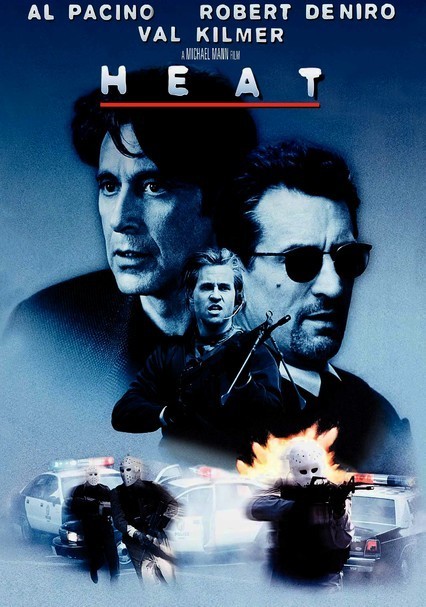
Heat-1995

Heat-1995

Director Michael Mann

Starring Al Pacino, Robert De Niro

Scott’s Review #1,228

Reviewed February 12, 2022

Grade: A-

Fans of the popular 1980s NBC television series, Miami Vice, will recall that Michael Mann was the Executive Producer of the show during its run.

He has a distinctive crime-thriller style that pairs perfectly with Heat, a sizzling 1995 offering starring two film greats, Al Pacino and Robert De Niro.

The fact that the pair do not appear together on screen too often can be forgiven because, when they do, the stars align, and the power of quiet scenes cannot be outdone. I savored the moment when they first appeared together.

Quality over quantity.

De Niro plays Neil McCauley, a lifelong criminal who is trying to handle the damage caused by one of his men while also planning one last big heist before retiring to parts unknown.

He meets a lovely young Los Angeles-based artist, played by Amy Brenneman, in a diner, and the two plan to relocate abroad.

Meanwhile, Lieutenant Hanna (Al Pacino) is a seasoned officer attempting to track down McCauley and his cohort while dealing with the chaos in his own life, including his wife’s (Diane Venora) infidelity and his stepdaughter’s (Natalie Portman) unhinged mental health.

McCauley and Hanna discover mutual respect, even as they try to thwart each other’s plans. The two characters become doppelgangers of one another.

The situation culminates in a cat-and-mouse chase on the tarmac at LAX airport.

To say that Heat is a by-the-numbers 1990s thriller is a fair assessment, although it’s way better than that classification, and it’s of that genre.

For starters, the acting is superior, and obviously, De Niro and Pacino bring a level of professionalism to the film in the lead roles.

My favorite scene is not the one you’d most expect me to say, but rather a quiet and powerful chit-chat in a small coffee shop. They are rivals, having lived opposite lives, yet their troubled lives mirror each other.

Without a doubt, Hanna wants to bring McCauley to justice, yet he admires him and sees parts of himself in him. The feeling is mutual, and the two actors relay this revelation without actually speaking the words.

Viewers immerse themselves in the characters, pivoting from this powerful scene.

There are a ton of characters in Heat, but each one feels like they have much to offer.

Juicy storylines are introduced but never forgotten, even if not part of the main canvas. Hanna’s wife and stepdaughter play a central role in the final act, even though they appear only in the first chapter.

In supporting roles, Val Kilmer and Ashley Judd share beautiful chemistry and a melancholy storyline as a damaged couple trying to survive surrounded by a life of crime.

At two hours and fifty-two minutes, there is plenty of time for each character to make their mark.

I love the rich character development that Heat offers, but sometimes it’s admittedly tough to keep track of the characters’ motivations and how they tie into the main action.

Mann’s style is all over the place, and even the musical score brought me back to the episodic song intervals that Miami Vice created.

The moody, dark atmosphere of dingy, crime-infested Los Angeles is perfectly set against glossy, glamorous high-rise and sprawling estate scenes. The bright and luminous city skyline is a feast for the eyes.

The cop/criminal dynamic is the main draw as Heat flexes its masculine muscles scene after scene. A bloody bank heist gone wrong at the beginning of the film cements what Mann is trying to create here.

A guy’s film with enough juice to hook the introspective film viewer, too.

Not remembered as well as it probably should be, Heat holds up surprisingly well when compared to similar but hokey 1990s action films like Lethal Weapon and the Die Hard films.

Though there’s not a whole lot new in Heat (1995), rich writing and powerful acting win out every time, and, of course, Pacino and De Niro are worth the price of admission.

Birth-2004

Birth-2004

Director Jonathan Glazer

Starring Nicole Kidman

Scott’s Review #1,124

Reviewed March 18, 2021

Grade: B+

Because of the film’s complex storyline, Birth (2004) is a tough sell for most cinema lovers.

A grown woman embarking on any romance with a ten-year-old boy will turn off viewers, though, can you even imagine if the genders were reversed?

I was fascinated by the premise and the endless possibilities of a conclusion.

I’m not quite sure what I expected to happen ultimately, but I felt slightly underwhelmed by the ending.

All in all, it is a daring effort that I wish had more payoff.

The first hour or so is extremely provocative.

Nicole Kidman excels at making the unbelievable material as believable as possible, and Jonathan Glazer directs the film very well, giving it a haunting, mysterious Stanley Kubrick vibe.

The director would come into name recognition following his 2013 masterpiece Under the Skin.

The film opens with a voiceover of an unknown man, a professor, lecturing about his disbelief in reincarnation. The audience then sees the man jogging through New York City’s Central Park, where he collapses and dies.

It takes Anna (Kidman) ten years to recover from the death of her husband, Sean (the professor), but now she’s on the verge of marrying her boyfriend, Joseph (Danny Huston), and finally moving on.

We suspect she may not be completely keen on marrying Joseph, but most of their relationship is unclear. We know that she aches for Sean.

On the night of their lavish engagement party, a young boy named Sean (Cameron Bright) turns up, claiming to be her dead husband reincarnated.

At first, she ignores the child, thinking it’s a joke, but his knowledge of her former husband’s life is uncanny, leading her to realize that he could be telling the truth slowly.

Anna is conflicted to say the very least, and Kidman effortlessly makes the audience believe that what is considered ridiculous might be true.

Is there a supernatural element here?

Her family members, led by her mother, Eleanor (Lauren Bacall), are disbelieving and antagonistic towards the boy for disrupting Anna’s life.

An issue is that, other than one supporting character, Clara (Anne Heche), who has a great opening sequence burying mysterious letters, the others have next to nothing to contribute to the story except to brood and get angry.

Bacall, in particular, is completely wasted in a role that any other older actress could have played.

Parallels to Rosemary’s Baby (1968) are hard not to make. Anna dons a similar pixie haircut to Rosemary. They both reside in swanky, old-style New York City high-rises with a ghostly, haunting feel.

The ambiance is a positive.

My favorite camera shot that Glazer includes is a lengthy one of Kidman’s Anna. In a close-up, the character’s reactions are on full display for what feels like several minutes. Kidman gets to show her tremendous range- tears, shock, realization.

I’ve noticed a similar shot in a handful of modern films, and it’s an actor’s delight- a viewer’s too!

The finale, without giving much away, is interesting to a point. The big reveal involving Clara is intriguing until the viewer backtracks and tries to add up all the events.

The fact is, they don’t add up, and I longed for something more concrete or believable.

There is no good payoff.

Birth (2004) doesn’t always add up to satisfaction, but it’s edgy, gloomy, and unpredictable, and I enjoyed those facets enough to recommend it.

This is not a mainstream film like Ghost (1990) with a similar theme- it’s much more cerebral and thought-provoking.

Kidman’s performance is the main draw here, but it’s tough to find a film in which she isn’t great.

Shutter Island-2010

Shutter Island-2010

Director Martin Scorsese

Starring Leonardo DiCaprio

Scott’s Review #567

Reviewed December 27, 2016

Grade: A-

Shutter Island (2010) is a great, psychological thriller, that being a Scorsese film, I had high expectations for. Lo and behold, I was not disappointed in the slightest.

Scorsese has a knack for making taut films, very violent, and with an edge. This film does not have the gore nor the blood that some of his other films have- especially since the subject matter is not mafia-related.

After Teddy Daniels (DiCaprio), a World War II veteran, turned U.S. Marshall investigates the disappearance of a female patient at a local psychiatric hospital, the case develops unforeseen layers.

The time is the 1950s.

Shutter Island is not your typical, run-of-the-mill thriller- it is much more than that and the complexities build and build. Not to be secondary to the interesting web of plot, but the art and set designs and visual effects are quite impressive- particularly during the storm scenes.

Leonardo DiCaprio is quite the gem, carrying the film in a demanding role, and working so well with Scorsese, as proven by his being a repeat player in his films.

All the performances (even tiny roles) were played with perfection- with flawless nuances- I mainly mean the hospital staff and patients.

The unpleasant violent images may upset some as well as the ending, but I found it to be an edge-of-your-seat, extremely well-made film. I hope that it is remembered for some time.