Tag Archives: Jodie Foster

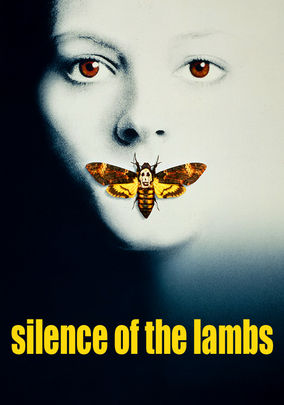
The Silence of the Lambs-1991

The Silence of the Lambs-1991

Director Jonathan Demme

Starring Anthony Hopkins, Jodie Foster

Top 250 Films #64

Top 40 Horror Films #15

Scott’s Review #320
14546747

Reviewed January 3, 2016

Grade: A

The Silence of the Lambs (1991) has the honorary achievement of being one of only three films to win the top five Oscar statuettes, having been awarded Best Picture, Best Director (Jonathan Demme), Best Adapted Screenplay, Best Actor (Anthony Hopkins), and Best Actress (Jodie Foster) at the 1991 Oscar ceremonies.

This is no small feat, especially considering the film was released in March (not an Oscar-happy month) and is a horror film. These elements speak volumes for the level of mastery that is The Silence of the Lambs and the film holds up incredibly well as the years go by.

The film was a sleeper hit at the time of release and gradually built momentum throughout the year, becoming a phenomenon and forever a classic.

The film is adapted from the novel of the same name- written by Thomas Harris and, despite being a horror film, contains little gore. The film stars Foster as Clarice Starling, an FBI trainee, sent by her superiors to interview the infamous Hannibal Lecter.

Hannibal, “The Cannibal”, is a highly intelligent former psychiatrist who has been banished to a maximum security insane asylum after having been found guilty of killing and eating his victims.

The FBI hopes that Hannibal will aid them in a current case involving “Buffalo Bill”, a serial killer who skins his female victims.

Hannibal and Clarice embark on an intense and strange relationship in which he gets under her skin and questions her unhappy childhood in exchange for information about “Buffalo Bill”.

This relationship leaves Clarice vulnerable, though the pair develop a strong connection. As Hannibal makes more and more demands in exchange for information, he eventually escapes from custody and a chilling and bizarre escape.

The psychological elements and the intense relationship between Hannibal and Clarice are of monumental importance and Hopkins and Foster share an amazing chemistry.

Hopkins gives a top-notch and downright creepy performance as the cannibalistic killer. His mannerisms are stiff and calculating, his tone of voice monotone, and he simply embodies his character, making him a legendary and recognizable presence in film history.

Two memorable lines that he utters are, “I do wish we could chat longer, but I am having an old friend for dinner.”, and “I ate his liver with some fava beans and a nice Chianti”.

The character of “Buffalo Bill” is as terrifying as Hannibal Lecter.

Portrayed by Ted Levine, the character is maniacal, sexually confused, and otherwise downtrodden. A tailor, he aspires to make a full “woman suit” costume out of his victim’s skin. His current hostage, a Senator’s daughter, is kept confined in an old well and terrorized by Bill’s antics.

His famous line, “It puts the lotion on or it gets the hose again” still terrifies me.

Highly influential, mimicked for years to come, and containing multiple lines and characters permanently etched in film history, The Silence of The Lambs (1991) is a classic not soon forgotten.

The film was followed by multiple sequels, none of which come close to the power and psychological complexities of the original.

Oscar Nominations: 5 wins-Best Picture (won), Best Director-Jonathan Demme (won), Best Actor-Anthony Hopkins (won), Best Actress-Jodie Foster (won), Best Screenplay Based on Material Previously Produced or Published (won), Best Sound, Best Film Editing
Taxi Driver-1976

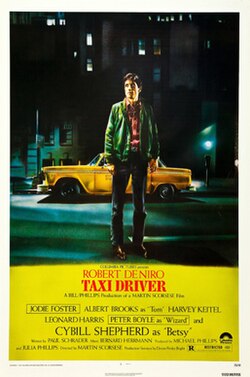
Taxi Driver-1976

Director Martin Scorsese 

Starring Robert De Niro, Cybill Shepherd, Jodie Foster

Top 250 Films #130

Scott’s Review #776 

Reviewed June 20, 2018

Grade: A

It is incredibly tough to choose a favorite among Martin Scorsese’s films, since nearly all of them are exceptionally well-made.

Goodfellas (1990), Raging Bull (1980), and Taxi Driver (1976) immediately come to mind. Taxi Driver may be Scorsese’s darkest film of all.

The thriller is intense, dangerous, and ferocious, led by a riveting performance by Robert De Niro, a regular in the director’s earlier films. The film is nail-biting and compelling, and a great, character-driven watch.

Set in the bustling and (at that time) decrepit New York City shortly following the Vietnam War, Travis is a veteran suffering from some degree of post-traumatic stress disorder.

Lonely and angry, he works as an overnight taxi driver who falls for a snooty presidential campaign worker, Betsy (Cybill Shepherd).

He also forges a relationship of a protective nature with an underage prostitute, Iris (Jodie Foster). As he gradually spirals out of control due to the unhappiness surrounding him, he plots to kill Betsy’s boss while protecting Iris from her pimp (Harvey Keitel).

One great aspect of Taxi Driver is the extremely good performance by De Niro. Along with Jake LaMotta’s later role in Raging Bull, Travis Bickle’s role is my second favorite of his. With Bickle, he is unpredictable, on edge, and angry, as De Niro infuses the character with those qualities in a seamless fashion.

As he teeters on the brink of insanity and is ready to snap at any given moment, the character is impossible not to watch with both fear and marvel.

De Niro is that brilliant. 

While not to be outdone by the aforementioned negative and dangerous qualities, Travis also possesses a few benevolent traits, making the character complex. In large part, this comes into play with the protective nature he develops towards Iris.

Almost like a big brother/kid-sister dynamic, the deranged man treats her with kindness rather than taking advantage of her as he easily could have. The diner scene, in which the two actors (De Niro and Foster) share it, is rich in interesting dialogue and binds the characters together.

Travis also harbors love and hate emotions towards Betsy (Cybill Shepherd). As she is a political volunteer for a potential presidential candidate, Travis first encounters her while spying on her through the large glass windows where she works.

Coaxing her to accept a date, they have coffee and eventually attend a film together. Betsy is offended since the film is pornographic, and their date goes south fast. After a vicious showdown between the pair at the campaign office, Travis goes off the deep end and plots revenge.

The gritty, atmospheric approach Scorsese takes in Taxi Driver is an enormous highlight of the film. Dingy, dark, and dangerous, the director creates numerous scenes that show just how seedy New York City was in the 1970s.

Working the night shift, sure to bring out the rancid and most decaying elements of the city, Travis experiences many cretins and undesirables in his work- and arguably is one of them!

Many scenes feature the notorious 42nd Street and its accompanying porn theaters that made New York City famous (or infamous!) at the time.

In one of the film’s most frightening (and best) scenes, Travis can get his hands on a gun. He practices drawing his weapon in the mirror, repeatedly uttering the famous line “You talkin’ to me?” as we wonder if he will pull the trigger.

The scene is fraught with cerebral tension and quite frightening. Later, when Travis shaves his head and brandishes a mohawk, his new look is downright terrifying.

Scorsese creates a dark world enriched by his incredible cinematography and astounding portrayals of compelling characters in dangerous, unstable times.

Taxi Driver (1976) is a treasure to watch closely and appreciate as a timeless piece of art. Instead of decaying in the vaults of cinema, the film gets better and better with age.

Oscar Nominations: Best Picture, Best Actor-Robert De Niro, Best Supporting Actress-Jodie Foster, Best Original Score

Nyad-2023

Nyad-2023

Director Elizabeth Chai Vasarhelyi, Jimmy Chin

Starring Annette Bening, Jodie Foster, Rhys Ifans

Scott’s Review #1,429

Reviewed June 28, 2024

Grade: B+

Nyad (2023) is a perfect example of a film made much better by the performances of its lead actors.

Heavyweights, Annette Bening, and Jodie Foster bring heart to their characters, making the viewer empathize and fall in love with them even when not likable.

Despite receiving Oscar nominations for both actors I semi-resisted watching the film and had it on my list for quite some time before biting the bullet and pressing play.

The previews enshroud the film in safety offering a feel-good, Cinderella-type story, pleasant but perhaps little more. A sports biography at that any nitwit searching Google could tell how the film would go.

The conclusion while inspiring is unsurprising and, spoiler alert, Bening as famous swimmer Diana Nyad, dramatically lumbers onto the sand of the Florida Keys amid cheers and chants of ‘Diana, Diana, Diana!’.

She is breathless and haggard but acknowledges her fans and friends.

Filmmakers, Elizabeth Chai Vasarhelyi and Jimmy Chin only needed to add slow-motion filmmaking to make this thunderous ovation more sappy. 

But they didn’t, and the husband and wife directors do an admiral job of incorporating various colors and cool editing tricks to make Nyad a bit more cutting-edge than it might have been.

The true story of tenacity, courage, friendship, and the human spirit’s triumph, is explored by telling of the life of world-class athlete Diana Nyad.

Three decades after giving up marathon swimming in exchange for a prominent career as a sports journalist, at the age of sixty, Diana has an epiphany.

She completes an epic swim of one hundred-and-ten-mile trek from Cuba to Florida, a feat she failed decades earlier. It takes her four years along with her best friend and coach Bonnie Stoll (Foster) and a dedicated sailing team.

Bening and Foster have tremendous chemistry and every scene together sizzles with authenticity and humanism. Both are gay, it’s assumed they are longtime partners or a married couple. But it’s explained early on that they dated ‘for a minute’ and became best friends.

It turns into a film about female friendship and determination rather than romance. Other than Diana’s one feeble attempt at dating an uptight Los Angeles blonde neither woman date at all.

The flashier role goes to Bening who does not mind looking hideous in her film roles. Determined and aggressive, she slowly transforms into bloated, puffy, and unrecognizable, especially after her long swims.

A wonderful actor, Bening powerfully relays Nyad’s absolute need to attempt this historic feat. She sees her life passing her by and even though she is hardly a failure she doesn’t see herself as anything more.

Foster on the other hand is calm cool and collected, quite familiar with Nyad’s trials and tribulations and bouts of neediness. She’s spent years cow-towing to these needs.

But, Foster’s Bonnie is hardly a patsy or merely a supportive friend. She’s way more. In a brilliant scene, Bonnie confronts Diana and the pair have a blow-up scene. Bonnie needs more from her life and deserves it.

The women grow even closer after this emotional scene.

The film’s mid-section got a bit boring and I found myself tuning out until the big finale I knew was coming.

Since I knew Diana would eventually achieve her goal the three or four attempts feel dull. Bad weather, a jellyfish, fatigue, or other issues force the team to cancel the attempt.

Going in I would have guessed I’d rate Nyad (2023) a ‘B’ but thanks to Bening and Foster a ‘B+’ is a must.

There is so much to be said for brilliant acting and these two ladies know how to deliver the goods.

Oscar Nominations: Best Actress-Annette Bening, Best Supporting Actress-Jodie Foster

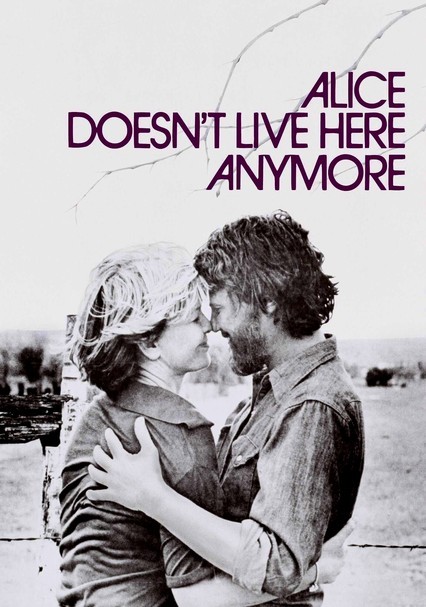
Alice Doesn’t Live Here Anymore-1974

Alice Doesn’t Live Here Anymore-1974

Director Martin Scorsese

Starring Ellen Burstyn, Kris Kristofferson, Diane Ladd

Scott’s Review #1,075

Reviewed October 27, 2020

Grade: A-

Deserving of the Best Actress statuette she won for her role, Ellen Burstyn carries the film Alice Doesn’t Live Here Anymore (1974) from start to finish with drama and comedy.

I can’t watch any performance of Burstyn’s without smarting at how she lost the same award years later, after her frighteningly good performance in Requiem for a Dream, released in 2000.

She was defeated by Julia Roberts, who delivered an adequate, though unexceptional, performance in Erin Brockovich (2000).

But, I digress.

A character study, Alice Doesn’t Live Here Anymore, tells the powerful story of a woman (Burstyn) forced to begin a new life and forge her path after her husband is killed in a car accident.

She is thirty-five years old and wary of the approaching middle age as she pursues a singing career. She is joined by her young son, Tommy (Alfred Lutter), and faces fear and loneliness as the pair embarks on a journey throughout the southwestern United States.

She dates, fights, and does a soul search, finally landing a job as a waitress at a roadside diner.

On paper, this film could have been reduced to television movie status, as the premise sounds kind of corny and sentimental.

Shocking to me is that Martin Scorsese directed it. Best known for male-driven mobster pictures like Goodfellas (1993), Gangs of New York (2002), and The Irishman (2019), Martin Scorsese’s introspective female-journey film doesn’t seem like his thing.

A fun fact is that he agreed to direct at Burstyn’s urging, since she wouldn’t have starred otherwise. The actress surmised that the script needed more darkness and grit, which it contains without losing its heart.

A strange yet lovely photographed scene kicks off the picture and seems to be an homage to The Wizard of Oz (1939). With a dusty, golden backdrop, a young Alice looks like Dorothy with an idyllic life.

Suddenly, Alice’s mother bellows her to come home for dinner. She responds with salty language. The scene feels out of place based on the rest of the film, but it looks good.

Burstyn made me care about Alice from the first scene containing adult Alice. Alice is a good person. She is hard-working and strives to please her husband, hoping he will enjoy the delicious dinner she has prepared for him. He barely grunts at the meal and has a tumultuous relationship with Tommy, whom Alice spoils.

This plot point returns later in the film.

Alice is not a doormat; however, she provides humor and comic relief during tense moments. She also shares a warm friendship with her neighbor. We do not know what the husband’s demons are (depression?).

He and Alice share an emotional moment in bed one night before he dies the next day.

With her marriage behind her and limited financial means, Alice and Tommy take to the road. I adore the relationship between the two. Tommy is not always easy to parent, exhausting his mother with typical young adult nonsense.

It’s easy to forget that he has lost his father and has no direction. Their relationship is complicated, but there is much love.

The juiciness comes when Alice finally lands a singing gig at a seedy lounge bar and meets the maniacal Ben, played flawlessly by Harvey Keitel.

At first, he is charming and attentive, wooing her like she’s never been wooed before. When she learns he is married, he turns psycho, and she is forced to leave town.

The meat of the film comes when Alice begins working at the diner and meets her new friend, Flo (Diane Ladd), and her new love, David (Kris Kristofferson). After some trials and tribulations, Alice realizes her life is not so bad.

As much as there are dramatic elements, Alice Doesn’t Live Here Anymore is not a soap opera or overwrought. The scenes and situations bristle with energy and authenticity, thanks to the great acting and fluid direction.

My favorite scenes occur at the diner. With greasy blue-plate specials and dishes piled with ham, eggs, and hash browns, the working-class extras are perfectly positioned around the diner.

In the background, they lend a feeling of rush, chaos, and family traditions. The diner scenes are where Alice bonds the most with Flo and David, and they are delicious.

Alice Doesn’t Live Here Anymore (1974), a lighter, wholesome production, was turned into a popular television sitcom in the late 1970s, titled Alice. It’s a progressive story about a woman on her own, getting it done, and mustering the courage to face whatever life throws at her.

It’s an inspiring story for both women and men.

Oscar Nominations: 1 win-Best Actress-Ellen Burstyn (won), Best Supporting Actress-Diane Ladd, Best Original Screenplay