Tag Archives: Haley Joel Osment

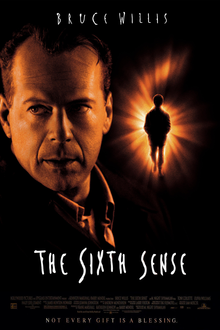
The Sixth Sense-1999

The Sixth Sense-1999

Director M. Night Shyamalan

Starring Bruce Willis, Haley Joel Osment

Top 250 Films #106

Top 40 Horror Films #20

Scott’s Review #182
Reviewed October 8, 2014

Grade: A

The Sixth Sense is a psychological thriller/horror film directed by M. Night Shyamalan, released in 1999, about ghosts, and was an incredible box-office and critical success at the time of its release, making the line “I see dead people” universally imitated.

Bruce Willis stars as Dr. Malcolm Crowe, a successful and admired child psychologist who lives a perfect life with his wife, Anna, in Philadelphia.

Enjoying a romantic night at home, Malcolm and Anna are interrupted by a deranged former patient, played by an unrecognizable Donnie Wahlberg.

Malcolm is shot by the patient, who also shoots himself, and the story picks up a year later as Malcolm takes an interest in Cole, a troubled 9-year-old boy, played by Haley Joel Osment.

Cole is a peculiar boy- an outcast taunted at school- who can see the dead.

He’s worried about his overworked mother, Lynn, who Toni Collette plays.

Meanwhile, Malcolm and Anna appear to be experiencing marital problems and lack meaningful communication with each other.

Anna begins to be pursued by a new beau, much to Malcolm’s chagrin. Malcolm and Cole develop a special bond as Malcolm convinces Cole to speak to and help the ghosts that he sees rather than be terrified of them.

As the plot slowly unfolds, Cole helps a recently deceased girl named Kyra Collins, who is around his age. Kyra gives Cole a videotape that reveals she was murdered and proves who killed her.

The subsequent scene is my favorite- there is a haunting quality to it, and the camera follows the events interestingly, slowly, and sedately.

The setting is a service at Kyra’s house, where family and friends gather to pay respects and support Kyra’s parents. Malcolm and Cole arrive and present Kyra’s father with the plain videotape.

The entire scene is powerful in its simplicity, yet it carries great emotional weight. It is slow, but devastating in its climax and reveals. Small nuances are revealed- why is Kyra’s mother wearing bright red when the other guests are all wearing black? Will Kyra’s younger sister be the next victim?

Superlative filmmaking.

A scene involving Cole’s teacher is riveting: sensing aspects of his teacher’s past, Cole realizes his teacher had a stuttering problem as a child.

When his teacher is condescending towards Cole, the young boy explodes with rage and begins a chant of “tuttering Stanley,” which reduces the teacher to childhood traumas.

Yet another powerful scene involves Cole and his mother sitting in a car caught in traffic- Cole admits the truth of his skill of seeing dead people to her and introduces an emotional story to her as proof.

This is a scene where Toni Collette shines brightly.

Well over a decade since The Sixth Sense was released, most people know the twist and the subsequent surprise ending, and it is such a joy to go back, see the manipulations in the story and in individual scenes, add them up, and revel in the clever way Shyamalan puts them together.

The Sixth Sense is not dated and is quite fresh, holding up tremendously well, and I still get chills during the big reveal all these years later.

But beyond this pleasure, the film is beautifully written. Somewhere between horror and psychological thriller, it successfully tells a ghost story with interesting characters and jumps-out-of-your-seat thrills that are not contrived or predictable in the traditional horror-film way.

From an acting perspective, Bruce Willis is amazing and under-appreciated as Malcolm- he is calm, cool, and collected. His performance is quite understated as the inquisitive and pensive psychologist.

More praise should have been reaped for Willis.

Haley Joel Osment gives an astounding performance of a lifetime- he emits an image to the audience of being strange yet sympathetic, and he relays his very frightening fear of the ghosts so well that the pain and conflict he endures are evident on his face.

Toni Collette is effective as the scared, concerned, haggard mother. Collette and Osment were rewarded with Academy Award nominations- sadly, Willis was not.

Shyamalan was subsequently ridiculed for his later films (The Village, 2001, and Unbreakable, 2001) – perhaps the manipulation and trickery from The Sixth Sense angered some people.

The Sixth Sense (1999) is a film that remains with you for days, weeks, even years, and can be revisited and rediscovered for an intelligent, chilling good time.

Oscar Nominations: Best Picture, Best Director-M. Night Shyamalan, Best Supporting Actor-Haley Joel Osment, Best Supporting Actress-Toni Collette, Best Screenplay Written Directly for the Screen, Best Film Editing

A.I. Artificial Intelligence-2001

A.I. Artificial Intelligence- 2001

Director Steven Spielberg

Starring Haley Joel Osment

Scott’s Review #1,052

Reviewed August 13, 2020

Grade: B+

A bit of a history lesson about the film A.I. Artificial Intelligence (2001).

The final cinematic version is based on the 1969 short story “Supertoys Last All Summer Long” by Brian Aldiss, which director Stanley Kubrick purchased and developed in the 1970s.

Left unfinished for years, and the subsequent passing of Kubrick after he had started to collaborate with Steven Spielberg, the film was finally carved into a final project by Spielberg.

Upon close study, the film possesses the mark of both directors, with the edge going to Spielberg.

The tone of the story contains a creepiness and oddity familiar to fans of Kubrick, like he may have been thinking along the lines of a similar theme to the brilliant 2001: A Space Odyssey (1968).

Both center around robots and a futuristic world. Spielberg adds a humanistic, sympathetic, and slightly melancholy edge as he did with E.T. the Extra-Terrestrial (1982), so that we adore the main character and want justice for him.

In contrast, Kubrick made his version of an extra-terrestrial in 2001: A Space Odyssey a scary villain.

The results are mostly good, but uneven in parts.

The premise is solid and grasps our attention. The time is the twenty-second century, when the polar ice caps have melted, submerging many coastal cities. It’s also a time when humans live side by side with “mechas,” or sentient robots.

Henry and Monica Swinton are suffering because their son Martin has a rare disease and is placed in suspended animation.

They are given a Mecha child who can experience love.

Henry and Monica fall in love with David and, in a plot twist worthy of a daytime soap opera, Martin returns to life, becomes jealous of David in a plot reminiscent of The Good Son (1993), tries to frame David for monstrous deeds, and David is nearly shipped off to parts unknown.

This is Spielberg’s first crack at screenwriting in nearly twenty-five years, since Close Encounters of the Third Kind (1977), and he does a decent job.

It’s no secret that both films, along with E.T. the Extra-Terrestrial, share common themes, so he feels comfortable with these subjects.

The humanity is there, but the screenplay is often too busy with story points coming and going at a rapid pace.

I wanted a deeper dive into Henry and Monica to understand their characters better and what makes them tick. I felt their pain of having (sort of) lost a child, but not why they needed to fill the void so quickly.

Osment is extremely good in a film so complex that other elements could easily have overshadowed his performance.

Instead, he powers through, adding complexities to a character the audience falls in love with, aching and yearning along with him. David is faced with terrible, life-changing news of not only being adopted but of not even being human.

His determination to find out who he truly is takes the viewer down a path of both entertainment and adventure, but also of bitter emotion.

A.I. Artificial Intelligence (2001) has a lot going on, and critically speaking, maybe too much. Spielberg fleshes out the original short story and tasks the viewer with enduring a global warming message, important, but a trite overdone, and sympathizing with David, the lonely robot boy.

The story becomes an exciting adventure, and the complexities of being human and almost human are explored, though not quite satisfactorily.

Osment and Law are terrific with dazzling chemistry, and the visuals and musical score are astounding. Osment should have received a Best Actor Oscar nomination, following the one he received for The Sixth Sense (1999).

Oscar Nominations: Best Musical Score, Best Visual Effects

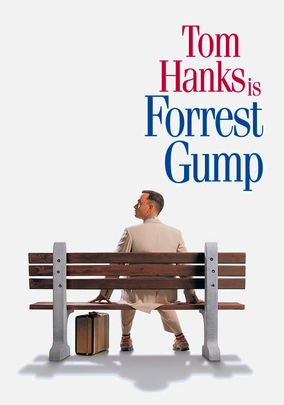
Forrest Gump-1994

Forrest Gump-1994

Director Robert Zemeckis

Starring Tom Hanks

Scott’s Review #362

60000724

Reviewed January 9, 2016

Grade: A

Awarded a bevy of Academy Awards in 1994, Forrest Gump is a film that is ingrained in many people’s memories, as it was a monster hit in the mid-1990s.

Some complained that the film’s unrealistic nature was silly and the story too saccharine. Still, it is an innocent, sweet piece about a simple-minded man’s journey through life and the insurmountable success he achieves.

I adore the film largely from a sentimental standpoint and for the memories it conjures up when I watch it years later.

I find the film to be a comfort.

Zemeckis, a feel-good film director (Back to the Future, 1985, Who Framed Roger Rabbit?, 1988), carves a whimsical tale of a fellow, Forrest Gump (played brilliantly by Tom Hanks), a slow-witted, but gentle soul, from Alabama, and his decades-long journey through life.

His lifelong love is Jenny (played by Robin Wright), a troubled girl who relies on Forrest throughout their decades-long friendship.

Forrest is always in the right place at the right time and influences historical events in his innocent way.

Forrest Gump is unique in its clever use of editing to incorporate Forrest into real-life historical events, which is a big part of the film’s appeal.

In one instance, Forrest meets with Richard Nixon and reveals the Watergate scandal. He also met President John F. Kennedy after winning a football scholarship.

And who can ever forget the numerous lines made famous from the film- “Stupid is as stupid does”, and “Life is like a box of chocolates. You never know what you are going to get.”, to name just two.

What I love most about the film is its heart, and the relationships Forrest shares with the central characters in his life are rich in depth. Forrest’s haggard but kind mother (Sally Field) loves her son, and they share a tender, emotional relationship.

When Forrest enlists in the Army during the Vietnam War, his grizzled commanding officer, Lt. Dan Taylor (an Oscar-nominated performance by Gary Sinise), surprisingly becomes one of Forrest’s closest friends.

The film takes a darker turn when we begin to see a more human side to Taylor after a horrible accident, which leaves him without legs. To counterbalance this tragedy, Forrest is comically wounded in the buttocks.

I am not sure whether I love or loathe Jenny as a character.

Wright is perfect at giving her some vulnerability, and her terrible upbringing can excuse some of her actions and lead her to take advantage of Forrest, arguably for her own gain.

Still, she has Forrest’s heart, so she cannot be all that bad.

A favorite scene takes place in Washington, where Forrest speaks at an anti-war rally. Jenny, in the crowd, recognizes Forrest, and their reunion is sweet. Jenny, now a hippie and expelled from school, returns to Forrest’s life.

The fates of both Jenny and Mrs. Gump are scenes that will undoubtedly require tissues to get through, as they are tender and emotional as can be.

Zemeckis’s Forrest Gump (1994) has emotion, sweetness, and heart, and those are nice qualities for a film to have.

It is not too sappy, overwrought, or manipulative; instead, it provides an honest story.

Oscar Nominations: 6 wins-Best Picture (won), Best Director-Robert Zemeckis (won), Best Actor-Tom Hanks (won), Best Supporting Actor-Gary Sinise, Best Screenplay Based on Material Previously Produced or Published (won), Best Original Score, Best Sound Effects Editing, Best Sound, Best Art Direction, Best Cinematography, Best Makeup, Best Film Editing (won), Best Visual Effects (won)