Tag Archives: Tracey Walter

The Silence of the Lambs-1991

The Silence of the Lambs-1991

Director Jonathan Demme

Starring Anthony Hopkins, Jodie Foster

Top 250 Films #64

Top 40 Horror Films #15

Scott’s Review #320

14546747

Reviewed January 3, 2016

Grade: A

The Silence of the Lambs (1991) has the honorary achievement of being one of only three films to win the top five Oscar statuettes, having been awarded Best Picture, Best Director (Jonathan Demme), Best Adapted Screenplay, Best Actor (Anthony Hopkins), and Best Actress (Jodie Foster) at the 1991 Oscar ceremonies.

This is no small feat, especially considering the film was released in March (not an Oscar-happy month) and is a horror film.

These elements speak volumes about the level of mastery in The Silence of the Lambs, and the film holds up incredibly well as the years go by.

The film was a sleeper hit at the time of its release and gradually built momentum throughout the year, becoming a phenomenon and a classic forever.

The film is adapted from the novel of the same name by Thomas Harris and, despite being a horror film, contains little gore.

The film stars Foster as Clarice Starling, an FBI trainee, sent by her superiors to interview the infamous Hannibal Lecter.

Hannibal, “The Cannibal”, is a highly intelligent former psychiatrist who has been banished to a maximum security insane asylum after having been found guilty of killing and eating his victims.

The FBI hopes that Hannibal will aid them in a current case involving “Buffalo Bill”, a serial killer who skins his female victims.

Hannibal and Clarice embark on an intense and strange relationship in which he gets under her skin and questions her unhappy childhood in exchange for information about “Buffalo Bill”.

This relationship leaves Clarice vulnerable, though the pair develops a strong connection. As Hannibal makes increasingly demanding demands in exchange for information, he eventually escapes from custody in a chilling, bizarre escape.

The psychological elements and the intense relationship between Hannibal and Clarice are of monumental importance, and Hopkins and Foster share an amazing chemistry.

Hopkins gives a top-notch and downright creepy performance as the cannibalistic killer. His mannerisms are stiff and calculating, his tone of voice monotone, and he embodies his character, making him a legendary and recognizable presence in film history.

Two memorable lines he utters are: “I do wish we could chat longer, but I am having an old friend for dinner,” and “I ate his liver with some fava beans and a nice Chianti.”

The character of “Buffalo Bill” is as terrifying as Hannibal Lecter.

Portrayed by Ted Levine, the character is maniacal, sexually confused, and otherwise downtrodden. A tailor, he aspires to make a full “woman suit” from his victim’s skin. His current hostage, a Senator’s daughter, is kept confined in an old well and terrorized by Bill’s antics.

His famous line, “It puts the lotion on, or it gets the hose again,” still terrifies me.

Highly influential, imitated for years to come, and featuring multiple lines and characters permanently etched into film history, The Silence of the Lambs (1991) is a classic not soon forgotten.

The film was followed by multiple sequels, none of which come close to the power and psychological complexities of the original.

Oscar Nominations: 5 wins-Best Picture (won), Best Director-Jonathan Demme (won), Best Actor-Anthony Hopkins (won), Best Actress-Jodie Foster (won), Best Screenplay Based on Material Previously Produced or Published (won), Best Sound, Best Film Editing

Philadelphia-1993

Philadelphia-1993

Director Jonathan Demme

Starring Tom Hanks, Denzel Washington

Top 250 Films #171

Scott’s Review #782

Reviewed July 3, 2018

Grade: A

Having the powerful distinction of being one of the first Hollywood LGBT films to deal with heavy issues such as HIV/AIDS and homophobia, Philadelphia (1993) is a film to champion.

The film does contain some less-than-positive stereotypes across the board, but it was a tremendous box office success and, more importantly, introduced a large audience to a still (at that time) taboo subject.

Hopefully, this had a tremendous effect on creating an understanding of a vicious disease and its ramifications.

Tom Hanks deservedly won the Best Actor Oscar for his lead performance as an AIDS and discrimination victim, as did the heartbreaking theme song “Streets of Philadelphia”, penned by Bruce Springsteen, win for Best Original Song.

Director Jonathan Demme creates a world that is quite realistic in portrayal at the corporate level. Hotshot attorney Andrew Beckett (Hanks) has a promising future at one of the country’s largest law firms in Philadelphia.

Assigned a high-profile case, it is noticed that Andrew has developed lesions across his body and is subsequently fired from the firm.

After deciding to sue the firm and having no luck finding an attorney to represent him, he finally meets struggling black attorney Joe Miller (Denzel Washington), who begrudgingly takes the case to gain exposure.

Philadelphia is a film that is a courtroom drama with a cause, firmly ensconced in the “message movie” genre. A lesser version, and perhaps one made even a decade or so after 1993, might be reduced to the Hallmark television movie category.

Fortunately, the timing is perfect, and Philadelphia can be remembered as a film championing LGBT rights.

Hanks’s performance is just dynamic- his character is meant to be empathetic, a victimized man unjustly suffering not only discrimination but a death sentence.

The audience knows what is to come, and as Andrew loses more weight and appears more sullen and haggard, the tale grows sadder.

The final act of Andrew’s court victory is to be celebrated, but it is also heartbreaking as a feeble and dying Andrew now lies close to death.

Hanks brilliantly infuses Andrew with courage, heart, and values, so much so that he becomes a hero to the audience even if their sexuality is different than his.

As much as the undying love for Hanks is deserved, the powerful supporting cast is a treasure. Washington is not as sympathetic a character as Andrew is, but he learns a lesson and eventually sets his machismo aside.

The heart-wrenching death scene culminating in the hospital room involves lover Miguel (Antonio Banderas), surrounded by Andrew’s family, all-embracing as one. There is beauty mixed with tragedy in this one scene alone.

Even Mary Steenburgen, as the tough defense lawyer, shows some heart. And who can say more about the dynamic Joanne Woodward as Andrew’s mother?

Unfortunately, there are a few stereotypes to endure, and sadly, many early LGBT films (and some still do!) include these for emphasis- or perhaps ignorance? Nonetheless, these make the film seem slightly dated, given the progress LGBT people have made in the decades since it was released.

Joe Miller is portrayed as a macho guy afraid to be viewed as gay- he even jokes around about being a “man” with his wife. Joe also grimaces when he shakes hands with Andrew and suddenly realizes Andrew has AIDS.

Nearly all of Andrew and Miguel’s gay friends are effeminate- this hardly seems possible.

Such is a monumental achievement when a film breaks barriers by telling a story of critical importance. Philadelphia (1993) does just that by patiently asking its audience for tolerance, understanding, and heart.

In return, the film educates, floods with emotion, and breaks hearts. Other LGBT films would come along that were arguably even better, but Philadelphia is a groundbreaking experience sure to be remembered as the first of its kind.

Oscar Nominations: 2 wins-Best Actor-Tom Hanks (won), Best Original Screenplay, Best Original Song-“Streets of Philadelphia” (won), “Philadelphia”, Best Makeup

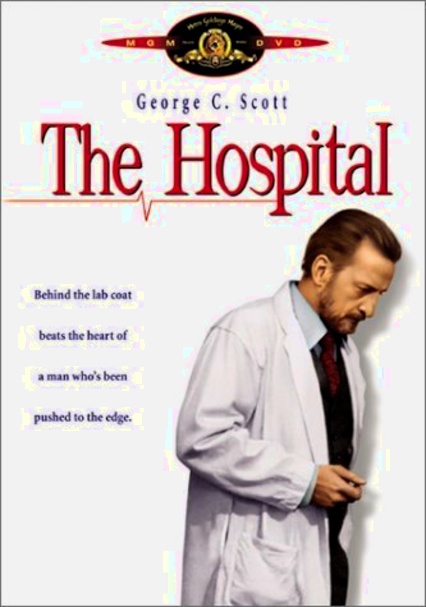
The Hospital-1971

The Hospital-1971

Director Arthur Hiller

Starring George C. Scott, Diana Rigg

Scott’s Review #1,369

Reviewed June 11, 2023

Grade: A

An example of the freedom to craft one’s vision in cinematic works during the first half of the 1970s, The Hospital (1971) is a testament to creativity and exceptional writing, and to what can happen when studios and producers leave the creatives alone to make the film they want to make.

One can dismiss any preconceived notions of the classic medical dramas that flooded television networks during the 1970s and 1980s. The Hospital is not formulaic or contrived.

No, The Hospital is a dark work drooling with satirical examples of the politics and shenanigans within the medical community. Oftentimes, secondary activities come at the cost of reasonable care and quality medicines.

Before you imagine a doctor and nurse cavorting in a janitor’s closet, it’s a deeper film than it appears on the surface, despite the inclusion of witty comedy.

Lax patient care, staff deaths, and the dismissal of nearby residents because of a new drug rehabilitation project are explored in this fascinating film.

At a rundown Manhattan teaching hospital, chief of staff Herb Bock (George C. Scott) is riddled with multiple personal and professional problems after two doctors and one nurse are found dead almost simultaneously.

He assumes the rash of deaths is due to dimwitted staff who are overworked amid the chaos.

Suicidal, he meets the intelligent daughter of a patient who knocks him off his feet with her studious personality and reflections on the world. Diana Rigg plays Barbara Drummond.

The immediately noticeable, clever, well-paced screenplay is by Paddy Chayefsky, who won the Oscar for writing the film. Immediately, the chaos of a city hospital is exposed, but not in a cliched way like a series like ER or Grey’s Anatomy might show.

Nobody is going into cardiac arrest on the operating table or having convulsions in the waiting room amid lame dramatic music.

The Hospital is more cerebral than that.

Unknown patients and little-known hospital staff go about their everyday business like clockwork until confusion with daily tasks causes events to go awry.

Like real-life.

The brilliance is how director Arthur Hiller casts regular-looking actors in almost all the roles. They look and act like everyday hospital staff to set the proper tone. This is even before we meet and get to know Herb and Barbara. They answer phones, walk around with charts, and hustle after emergencies.

Chayefsky and Hiller mirror director Robert Altman in many ways, mostly in their dialogue and in how seemingly unimportant scenes can mean a whole lot.

In robust soliloquy-style scenes between Herb and Barbara, the audience ‘gets them’. They are both desperate, wounded, and unhappy yet possess the sophistication and awareness to realize how similar they are.

They immediately connect, fall in love, and nearly run off together. It’s that simple. They are willing to flee their lives after meeting for five minutes. But will they ultimately take that plunge?

A key character is revealed to be Barbara’s father, and a whodunit begins after it comes to light that the deaths are not accidents. Who is responsible and what their motivation is is the key to the story.

Scott does terrific work with his character, rivaling his excellent performance a year earlier in Patton (1970). Herb is more introspective with the world on his shoulders.

The Hospital has more than one daring scene. Herb, though impotent, basically throws Barbara down on the table and rapes her. The shocker is that she makes light of it the next day and almost seems to have enjoyed it.

Barbara and Herb are both complex characters that the audience needs to ruminate over.

My favorite part of The Hospital (1971) is the setting. That Hiller puts you inside what a real urban hospital was like in 1971 is brilliance. The satire comes into play with the writing, which questions decision-making and incompetence within the hospital walls.

The result is a scathing look at hospital practices that will resonate with anyone terrified of entering a hospital, only never to come out again.

Oscar Nominations: 1 win-Best Actor-George C. Scott, Best Original Screenplay (won)

I Spit on Your Grave-2010

I Spit on Your Grave-2010

Director Steven R. Monroe

Starring Sarah Butler

Scott’s Review #492

70138803

Reviewed October 9, 2016

Grade: B+

Too often in the horror genre, remakes of classic or cult classic gems are spewed out with high hopes but little worth, and more often than not, quickly forgotten and fading into oblivion.

This is not the case with I Spit on Your Grave.

I Spit on Your Grave is a 2010 remake of the original 1978 film and is just as disturbing.

Having seen the original and been shocked by the content, I didn’t expect the same from the retelling.

Much to my surprise, this version contains the same intensity and is fraught with brutality- however, not in an unnecessary way.

The film tells the story of a young writer who leaves the hustle and bustle of New York City for a couple of months of relaxation in the country to work on a novel.

While there, she is brutally raped by a bunch of local men.

As terrible as this is, the victim then exacts revenge on all of them, one by one, which is the real crux of the story, and we cheer on her (just as brutal) vengeance.

The rape scenes are quite intense and difficult to watch, but necessary, as the viewer wants the perpetrators tortured and maimed…which they are.

This film is for horror fans who like it brutal.

Annie Hall-1977

Annie Hall-1977

Director Woody Allen

Starring Woody Allen, Diane Keaton

Scott’s Review #48

261909

Reviewed June 19, 2014

Grade: A

Annie Hall (1978) is one of Woody Allen’s finest works, and that says something as his list of wonderful films goes on and on (Manhattan, Blue Jasmine, and Interiors) are gems.

Annie Hall is a witty, intelligent, great comedy. It is sharply written, quirky, and neurotic all rolled into one.

Comedy is a tough genre. Romantic comedies are even tougher to get right.

My favorite part of the film is Woody Allen himself. Some might say he plays himself, but he is engagingly hysterical as the neurotic, skeptical, Jewish, cynical New York man named Alvy.

He meets and falls in love with equally neurotic Annie Hall, played by Diane Keaton.

They quarrel, love, and traverse from New York to California and back.

There are some very funny scenes (lobster, movie theater line, and the drive-through Manhattan), and the intelligent, crisp dialogue makes this a top-notch comedy.

Oscar Nominations: 4 wins-Best Picture (won), Best Director-Woody Allen (won), Best Actor-Woody Allen, Best Actress-Diane Keaton (won), Best Screenplay Written Directly for the Screen Based on Factual Material or Story Material Not Previously Published or Produced (won)