Tag Archives: Michael Cristofer

The Exorcist-1973

The Exorcist-1973

Director William Friedkin

Starring Ellen Burstyn

Top 250 Films #59

Top 40 Horror Films #13

Scott’s Review #326
14546619

Reviewed January 5, 2016

Grade: A

Making a lasting mark on cinematic history and impossible to be unfamiliar with in some form of pop culture, The Exorcist (1973) is a classic supernatural horror film that transcends the genre and becomes a Hollywood success story.

Along with Rosemary’s Baby (1968) and The Omen (1976), these three films share haunting “religious” themes and explore dark, sinister topics such as “god versus the devil” and “good versus evil.”

The Exorcist is a masterpiece on every level and is adapted from the 1971 hit novel of the same name.

The story centers on “demonic possession” and was quite simply a shocking subject when The Exorcist was released in 1973, scaring the wits out of those brave enough to see it (especially Christians) everywhere.

Some abhorred the subject matter and refused to have any part of the film; their loss.

Ellen Burstyn stars as Chris MacNeil, a noted actress who relocates to Georgetown to film a movie. Along with her is her twelve-year-old daughter, Regan (Linda Blair).

As filming wraps, Regan begins acting strangely—making noises, becoming belligerent, and urinating on the floor during a dinner party.

Worried, Chris enlists the assistance of priests (Max von Sydow and Jason Miller).

Things progress from bad to worse as Regan spirals out of control, and Chris and the priests determine that an exorcism is the only resolution to the problem.

The Exorcist, directed by William Friedkin, sets up the film in a clever way, using various technical elements to build tension.

For starters, the eerie musical score is highly effective at scaring the audience, similar to that of Rosemary’s Baby.

The film is also lit very well, so it appears dark with dim lighting- the cinematography and the windy rustling of leaves in the exterior sets are great.

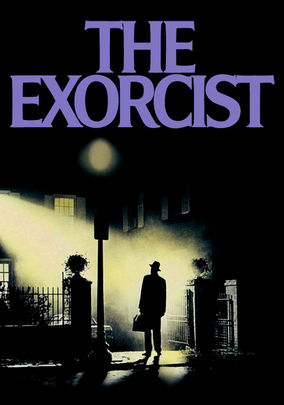
The cover art should reflect the film’s unique style: black and white. A man with a hat and suitcase peers up at the second floor of a house where a glowing light illuminates. The image is intriguing and haunting.

Enough cannot be said for Linda Blair’s performance as Regan, especially in the final act. During the “pea soup” and “Jesus crucifix” scenes, a different voice was used, but Blair’s facial expressions and emotions are admirable.

As Regan is bedridden, angry, scared, and emotional, there is no limit to Blair’s range. Throughout a large part of the film, she is a sweet, young girl, innocent, so much so that her transformation is both shocking and disturbing to witness.

The final act of the film- the “exorcism” is riveting and a groundbreaking aspect of film history. The terrifying scene, all taking place in one child’s tiny bedroom, elicits fright and is nail-bitingly intense.

The Exorcist (1973) is a highly influential film that has inspired filmmakers for decades and still resonates with audiences today.

Oscar Nominations: 2 wins-Best Picture, Best Director-William Friedkin, Best Actress-Ellen Burstyn, Best Supporting Actor-Jason Miller, Best Supporting Actress-Linda Blair, Best Screenplay Based on Material from Another Medium (won), Best Sound (won), Best Art Direction, Best Cinematography, Best Film Editing

Golden Globe Nominations: 4 wins-Best Picture-Drama (won), Best Director-William Friedkin (won), Best Actress-Drama-Ellen Burstyn, Best Supporting Actor-Max von Sydow, Best Supporting Actress-Linda Blair (won), Best Screenplay (won), New Star of the Year-Actress-Linda Blair
Chronic-2015

Chronic-2015

Director Michel Franco

Starring Tim Roth

Scott’s Review #682

Reviewed September 18, 2017

Grade: A-

Chronic (2015) is a brave film, a character study, that offers an in-depth look at the life of a male nurse. He has rich relationships with his patients.

The film also reflects not just the patients’ obvious physical needs, but the strong effects their dying has on the main character.

The film is quite bleak, with a quiet tone and very long scenes with little dialogue, but it’s a treasure in bold storytelling and brazen reflection.

The film is a subdued work requiring attention and focus.

Yes, some would deem Chronic to be slow, and most would describe it as “a downer”, but dismissing the film is a mistake, as it offers rich writing and an in-depth look at a vocation and lifestyle misunderstood or confusing to most people.

Tim Roth, famous for his bad-boy roles, especially in Quentin Tarantino films, does an about-face, delivering a superb, subdued performance as David Wilson, a lonely, depressed nurse in the Los Angeles area.

He is a quiet, kindly man whose internal pain registers on his face as he dutifully treats his mostly close-to-death patients, sometimes attending their funerals after they have expired.

Initially, we meet David as he treats a sickly young woman. Once beautiful, she is now haggard, and I cringed when the woman’s nude, skeleton-like body is on display as David washes her with a washcloth.

The filmmakers do not gloss over his tender attention to her private areas, shot gracefully rather than garishly.

Still, the long scene is frighteningly realistic.

When the woman succumbs to AIDS, David reluctantly becomes involved in a celebratory drink with a newly engaged young couple after he goes to a bar to unwind.

When he pretends the deceased woman is his wife, he receives sympathy, but the couple quickly becomes aloof when he reveals what she died of.

Does he do this purposely to push the couple away? Throughout the film, we realize that David thrives on being with his patients and can do no other work.

In contrast, he has difficulty with relationships with “normal” people.

Perplexities abound in this film, which makes the viewer think and ponder throughout and after the story ends.

For example, David searches a young girl’s Facebook account, looking at her photos; later, he finds the girl, who is studying medicine, and they happily reunite.

Is she his daughter or the daughter of a deceased patient?

Later, David is sued by an affluent family and subsequently fired after he watches porn with an older man to lift his spirits. There is a glimmer of uncertainty where we are not sure what David’s sexual orientation is.

In the most heartbreaking sequence of all, David begins caring for a middle-aged woman with progressive cancer.

Martha (Robin Bartlett) is strong-willed and no-nonsense and makes the painful decision not to continue with chemotherapy after suffering chronic nausea and later soiling herself.

It is apparent that her family only visits her out of obligation, as she lies to them that her cancer is gone and she is in the clear. She then pleads with David to end her life with dignity using a heavy dose of morphine- the sequence is heartbreaking.

The final scene will blow you away, and I didn’t see this conclusion coming. The event left me questioning the entire film, wondering how all the pieces fit together.

Surely, being overlooked for an Oscar nomination, Tim Roth proves he is a layered, complex, full-fledged actor in a painful yet necessary story called Chronic (2015).

Independent Spirit Award Nominations: Best Feature, Best Male Lead-Tim Roth