Tag Archives: Marjorie Bennett

What Ever Happened to Baby Jane?-1962

What Ever Happened to Baby Jane? -1962

Director Robert Aldrich

Starring Bette Davis, Joan Crawford

Top 250 Films #68

Top 40 Horror Films #16

Scott’s Review #193

70048556

Reviewed November 14, 2014

Grade: A

Baby Jane kicked off a trend, prominent throughout the 1960s, of aging Hollywood actresses starring in horror films (interestingly, Bette Davis and Joan Crawford each did two—the others being Dead Ringer and Strait-Jacket), with varying degrees of success.

What Ever Happened to Baby Jane (1962), directed by Robert Aldrich, stars Davis and Crawford as, ironically enough, two aging Hollywood actresses, Jane and Blanche Hudson.

Jane (Davis), a child star in the 1920s nicknamed Baby Jane, with an adorable signature song, “I’ve Written a Letter to Daddy,” has long since faded from the spotlight but continues to dress in her Baby Jane costume, consisting of a little girl dress with hair in curls and ribbons.

Blanche, however, achieved success as an adult in the 1930s until a tragic accident left her wheelchair-bound and subsequently ruined her career.

She then became a popular film star, much more popular than Jane.

Blanche and Jane now while away the years in a crumbling mansion in Los Angeles. Blanche is entirely dependent on her unbalanced sister for care.

Jane is resentful of Blanche’s success and popularity and plans to relaunch her career in her once-famous alter ego.

The film has macabre comedic elements but never veers too far over the edge into camp or foolishness. It is also a very psychological film, as Jane mentally abuses Blanche and plays mind games with her to gain the upper hand.

Davis had a ball with this role, as her appearance alone is frightful – a grown woman of a certain age in blonde curls, pancake makeup, and a baby doll dress – she looks hideous!

What Ever Happened to Baby Jane reminds me quite a bit of Billy Wilder’s masterpiece Sunset Boulevard in several ways.

For example, both feature successful stars of years past with delusions of returning to their former fame, both feature older women who are more than a bit unbalanced, and both films are set in sunny Los Angeles.

Two of the film’s supporting actors are well cast, adding significantly to the film, and deserve recognition.

Victor Buono, later made famous for his role of King Tut in the popular late 1960s television series Batman, is highly effective as the opportunist sloth, Edwin Flagg, who aids Jane in her comeback attempt.

Maidie Norman as the Hudson sisters’ black housekeeper, Elvira, loyal to Blanche but never a fan of Jane’s, slowly becomes wise to Jane’s sinister plot and does a fantastic acting job when she stands up to the manipulative sister.

For 1962, a black maid verbally assaulting a white woman employer was still somewhat taboo, and kudos to the film for bravely going there; it is a highly effective scene.

The fact that Davis and Crawford famously despised each other in real life gives the audience an edge in scenes where the two women physically and verbally clash.

The film features wonderfully quotable dialogue. “We got rats in the cellar,” Jane utters matter-of-factly as she serves Blanche a cooked rat on a bed of lettuce for lunch one day, and cackles fiendishly when she hears Blanche scream in disgust.

One aspect of the film that has taken me three viewings to become aware of and that I love is the musical score throughout the film- it features multiple and creepy versions of Jane’s signature song, “I’ve Written a Letter to Daddy,” with varying tempos.

This film must use suspension of disbelief. Why does Blanche not pound and scream at her bedroom window to alert the neighbor of trouble instead of casually tossing a note out the window?

Blanche struggles to descend the steps by sliding down them and then cannot slide across the floor to escape the mansion, which is silly.

The film is so gripping that I happily overlook these errors and instead enjoy the suspenseful film, which features two actresses, rivals both on and off-screen, that make this film a bit too realistic —a realism that makes for delightful film-watching.

Oscar Nominations: 1 win-Best Actress-Bette Davis, Best Supporting Actor-Victor Buono, Best Sound, Best Cinematography, Black-and-White, Best Costume Design, Black-and-White (won)

Golden Globe Nominations: Best Performance by an Actress in a Motion Picture-Drama-Bette Davis, Best Performance by an Actor in a Supporting Role in any Motion Picture-Victor Buono
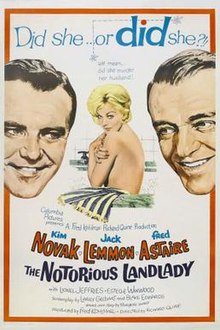
The Notorious Landlady-1962

The Notorious Landlady-1962

Director Richard Quine

Starring Kim Novak, Jack Lemmon, Fred Astaire

Scott’s Review #1,390

Reviewed August 16, 2023

Grade: B+

If viewers can overlook The Notorious Landlady (1962) ‘s messy nature and intermittent schizophrenic pacing, the film is enjoyable.

It’s not platinum status, but it’s a decent enough flick, especially for Kim Novak and Jack Lemmon fans, who were big stars. This is the third and final film that the duo starred in.

Like the film, their chemistry fluctuates, but it is appealing to see Novak in a comic role, whereas the genre is familiar territory for the funny Lemmon.

After her husband mysteriously disappears, Carly Hardwicke (Novak) finds renting a room in her lovely London apartment impossible because everyone assumes she’s responsible.

American diplomat William Gridley (Jack Lemmon) is new to the city and desires to live with Carly. It doesn’t hurt that Carly is easy on the eyes. William becomes smitten with her, unaware of her troubles.

When his boss, Franklyn Ambruster (Fred Astaire), learns what Gridley has stumbled into, the two men try to clear her name. A series of lies and misunderstandings catapult events into a compelling mystery.

Even though neither William nor Carly is British, the foggy locale works well and provides a foreign mystery. They reside in a courtyard-type home, from which neighbors can see in or out to other apartments. This comes into greater play towards the end of the film.

This is just one example of Alfred Hitchcock’s influence on 1954’s Rear Window, which director Richard Quine heftily borrows. He’s wise to do so since he secured Novak, fresh from her role in Vertigo (1958) two years earlier.

Shit, even the title ‘The Notorious Landlady’ borrows the title of the 1946 Hitchcock masterpiece, ‘Notorious.’

There’s also a secret locked door that Carly references and forbids anyone from entering, adding suspense and foreboding.

Despite the tepid chemistry between the stars, I ultimately enjoyed their romance. It’s a hard sell that the gorgeous Carly would fall head over heels for the everyman William, but she does.

They win me over during a dramatic scene where an attempted romantic dinner of steaks goes awry, and instead, a massive fire erupts. The burgeoning lovers cling together in a sweet embrace that cements their appeal.

The tension is supposed to be about whether Carly murdered her husband and has designs on William. Red herrings like kitchen poisons and the like make an appearance, but I was more interested in the impending mystery of said husband than really believing she’d want to kill William.

The last act introduces a threatening character, an unexpected villain, and a race to save another character in dangerous peril.

A courtroom scene also adds to the tension.

The central storyline is satisfying, edge of your seat, and suspenseful. I assume Quine was going for it.

The Notorious Landlady shifts genres a whopping three times in the story! The tone is all over the place: first, romantic comedy, then suspense and drama, and finally, slapstick.

During the finale, when Carly and William race to a retirement community and scramble to stop an out-of-control wheelchair, I half expected Laurel & Hardy or The Little Rascals to make a cameo.

Poor Fred Astaire has little to do and struggles to be relevant compared to Novak and Lemmon’s characters. At times, I even forgot he was still in the film.

The Notorious Landlady (1962) is an entertaining vehicle and a must-see for fans of Novak or Lemmon eager to see a largely forgotten film that offers something fun.

Airport 1975-1974

Airport 1975-1974

Director Jack Smight

Starring Charlton Heston, Karen Black, George Kennedy

Scott’s Review #1,060

Reviewed September 8, 2020

Grade: B+

Possessing all the disaster film genre schmaltz, proper trimmings, and then some, Airport 1975 (1974) is good, hammy entertainment that gleefully satisfies. However, artistic types will be embarrassed to admit how much they like it.

The Towering Inferno (1974) and Earthquake (1974) were among the highest-grossing films of the year, and it is little wonder why. The offering has enough adventure and peril to satisfy the entire family.

I watched this film practically in tandem with Airport (1970) and it feels a letdown by comparison, but that hardly matters. Both are very good.

With great anticipation, the filmmakers paid a ton of cash to secure a bevy of Hollywood stars of yesteryear, ensuring they could rake in the box office.

Most are past their prime but still marketable. What a treat to see legendary silent film star Gloria Swanson playing herself as a passenger.

The unequivocal star and hero of the film is Charlton Heston, as he also was in Earthquake. Karen Black, Myrna Loy, Linda Blair, Susan Clark, Nancy Olson, and George Kennedy (reprising his role from the first Airport) round out the stellar cast.

Worth its price of admission is watching the opening credits to see who is in the cast.

Unlike Airport, which wisely spent much of its time inside the actual airport setting up the events and stories, Airport 1975 takes flight right away and crafts its trials and tribulations within the aisles and cockpit of the plane.

We learn right off the bat that the main romantic couple is Heston and Black. Captain Alan Murdock (Heston) apparently cannot commit to Chief Stewardess Nancy Pryor (Black), and they plan to meet up in Los Angeles to discuss the drama further.

We know they will have more to do with each other as her flight to La La Land takes off.

Quickly, a small plane flown by businessman Scott Freeman (Dana Andrews) is diverted to Salt Lake City airport, and he suffers a massive heart attack while descending.

His plane naturally crashes into the cockpit of the enormous Boeing 747, killing two pilots and blinding the other.

With no one able to fly the plane, Nancy must figure out how to avert disaster as it cascades over mountains and contemplates a fuel leak. Murdock and crew try to land the plane remotely or get somebody up there to save the day.

Predictably, Murdock is that man.

If Airport 1975 weren’t so damned fun, it would be offensive since it’s riddled with gender stereotypes. Screenwriter Don Ingalls composes a project so fraught with machismo and masculinity that the female characters have little chance to do much of anything without being saved by a man.

Let’s cite a couple of examples. Nancy is left alone in the open cockpit to navigate the plane.

Worth mentioning is that her hair remains perfect throughout.

Anyway, Murdock must explain to her how to check various controls, which he does as if she were a five-year-old learning the alphabet, referring to a picture of the “little airplane” and calling her “dear”.

She rattles off a puzzled “what?” before figuring out where or what the “little airplane” is.

Secondary Stewardess Bette (Christopher Norris) is boy-crazy, asking Nancy if the flight crew is “sexy” before making googly eyes at the Latin pilot, Julio (Erik Estrada). He is married, but that doesn’t seem to bother either of them.

They flirt while he orders her to bring him a cup of coffee. The male characters telling the female characters to get them drinks is a common theme in Airport 1975.

Naturally, Murdock eventually makes it on board to take over the controls and land the plane.

We imagine Nancy’s character thinking, “Good Heavens, thank goodness a man arrived just in the nick of time to save all of us!” She is promptly sent to get Murdock a drink and fluff pillows.

But these are gripes I can look past, given that if this film were made in 2020, Nancy would either land the plane or Murdock would be a female character and Nancy a male character.

Imagine that!

The real threats are the peril and drama associated with the events on the flight.

A sick kid (Linda Blair) must reach land quickly so that she can be provided medical assistance, while a crack in the airplane’s ceiling could burst at any moment, killing everyone on board.

For popcorn-fueled entertainment sure to please any viewer, Airport 1975 (1974) is a perfect late-afternoon, rainy-day suggestion.

It is advisable not to look too deeply into the stereotypes and contrived setups, or this will ruin the fun. Instead, hop aboard and enjoy the bumpy flight from the comfy cushions of your living room with the assurance that you will land safe and sound.

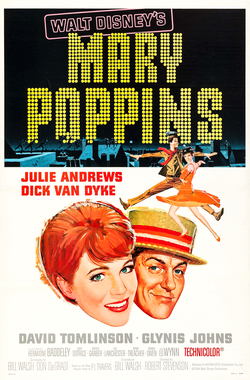
Mary Poppins-1964

Mary Poppins-1964

Director Robert Stevenson

Starring Julie Andrews, Dick Van Dyke

Scott’s Review #965

Reviewed December 9, 2019

Grade: A-

Mary Poppins (1964) is a lovely Walt Disney production that shines with zest and an ample supply of good, cheery tunes. A family affair, it will hardly disappoint, with sing-alongs and enchanting stories for miles.

It’s tough to knock a film that has it all, but it sometimes borders on sickeningly sweet wholesomeness with too much schmaltz mixed in.

This can easily be forgiven because of the robust music, dazzling visual effects, and perfect casting, which make the film enjoyable entertainment for all.

The Banks family resides in London, England. The foursome consists of George and Winifred Banks, along with children Jane and Michael. They live a comfortable and happy upper-middle-class existence.

When their nanny quits after the children run away to chase a kite, the panicked George requests a stern, no-nonsense nanny, while the children (now returned home) desire a kind, sweet one. Through magic, a young nanny (Julie Andrews) descends from the sky using her umbrella.

Mary Poppins teaches the children to enjoy chores through tunes with the help of a kindly chimney sweep, Bert (Dick Van Dyke).

Mary Poppins cheerily takes the children on several adventures, teaching them valuable lessons. The drama involves light situations such as the irritable George threatening to fire the nanny because she is too cheerful or a mini-scandal at the bank where George works.

These side stories are trivial and non-threatening since the film is really about the antics of the magically odd nanny and her relationship with the children.

The film is unique because it combines live-action with animation and is magical and inventive. This is most evident during sequences that feature animals, especially the superb scene where Mary Poppins transports Bert, Jane, and Michael into a picture where they ride a carousel and stroll the day away.

The appearance of horses and a fox makes the scene beautifully crafted and filled with joy.

The casting could be no different and is flawless across the board. Standouts are Andrews and Van Dyke, the former appearing in her very first film role.

Not to be usurped by her most iconic role as Maria in the following year’s brilliant The Sound of Music (1965), Andrews possesses a benevolent and delightful spirit that works perfectly in the role, to say nothing of her powerful voice.

Van Dyke, as the romantic interest, is equally well-cast, and together the chemistry is easy and apparent.

Mary Poppins was met with critical acclaim when it was released when Disney ruled the roost and musicals were a dime a dozen.

It received thirteen Academy Award nominations, including Best Picture—a record for any film released by Walt Disney Studios—and won five: Best Actress for Andrews, Best Film Editing, Best Original Music Score, Best Visual Effects, and Best Original Song for “Chim Chim Cher-ee.”

This was quite a feat as the film was up against My Fair Lady (1964), which won the biggest prize.

Rated G and box-office success, Mary Poppins (1964) is a legendary Walt Disney film that uses creative techniques and musical numbers to develop a finely finished product.

The song standouts are “A Spoonful of Sugar”, “Chim Chim Cher-ee”, and “Supercalifragilisticexpialidocious”, as each offers candy for the ears and immeasurable fun.

The classic songs and the cohesive sentimentality make this one easy to enjoy with repeated viewings.

Oscar Nominations: 5 wins-Best Picture, Best Director-Robert Stevenson, Best Actress-Julie Andrews (won), Best Screenplay Based on Material from Another Medium, Best Song-“Chim Chim Cher-ee” (won), Best Music Score-Substantially Original (won), Best Scoring of Music-Adaptation or Treatment, Best Sound, Best Art Direction, Color, Best Cinematography, Color, Best Costume Design, Color, Best Film Editing (won), Best Special Visual Effects (won)

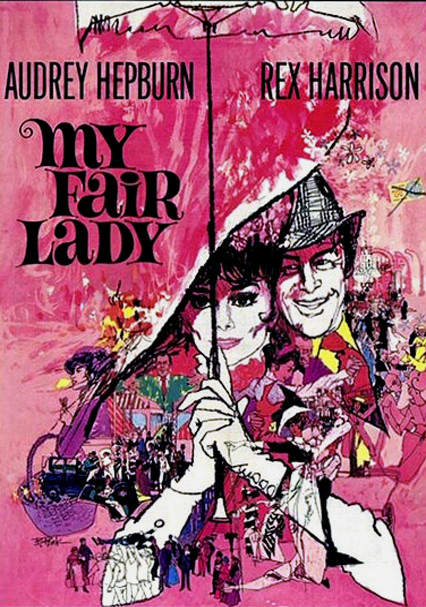
My Fair Lady-1964

My Fair Lady-1964

Director George Cukor

Starring Audrey Hepburn, Rex Harrison

Scott’s Review #938

Reviewed September 6, 2019

Grade: A-

Winner of the Best Picture Academy Award (it would not have been my choice), My Fair Lady (1964) is a good product that is based on the stage version, in turn, based on the famous 1913 stage play Pygmalion by George Bernard Shaw.

The musical’s central negative aspect is its casting choices. Hepburn and Harrison have only mediocre chemistry, and Hepburn does not sing. However, the film is enchanting and filled with lavish sets, colorful costumes, and earnest songs, making it entertaining for the whole family.

The iconic Eliza Doolittle (Hepburn) and Henry Higgins (Harrison) are household names to every fan of the musical genre.

Set in London, sophisticated and arrogant Professor Higgins, a scholar of phonetics, is intent on proving that the tone and accent of one’s voice determine one’s lot in society.

As an experiment, he chooses flower saleswoman Eliza, with her horrid Cockney accent, and is determined to crown her duchess of a ball.

Unaware of his scheme but soon to find out she has been had, romance eventually blooms as the song “I’ve Grown Accustomed to Her Face” becomes essential.

My Fair Lady is quite the epic, with a runtime of two hours and fifty-two minutes, which is lofty for a film.

The misty London setting adds layers of mystique and atmosphere, and the cinematography drizzles with color and pizzazz, making the overall content look fantastic.

Because of the length of the film and the magnificent trimmings, the production looks like a spectacle, reminiscent of the elegant extravagance of the 1950s and 1960s, when musicals made into films were grand and robust.

It’s no wonder this helped it win Best Picture, Best Director, and many other awards. Hollywood loves this film.

When dissected and analyzed, social and class systems are a large part of the film amid the cheery singing, dancing, and big-screen bombast. Social status and hints of socialism pepper the production, rising way above the fluff it could have been if just a “boy from the good side of the tracks meets girls from the wrong side.”

Eliza’s father, Alfred (Stanley Holloway), a waste collector, is also an opportunist. He sings his story during “With a Little Bit of Luck.” The differences between the “haves” and the “have nots” are evident.

Since the chemistry is limited, I never bought Harrison and Hepburn as a romantic duo. The teacher/student angle somewhat works, though always bothersome, but Henry’s self-assured behavior and superior attitude make him tough to root for.

The controversy surrounding the film includes the decision to dub nearly all of Hepburn’s singing with another singer’s voice. This devastated the actress and cost her an Academy Award nomination. Her snub is especially jarring, given the dozen other nominations it received.

The story is heartwarming and follows the like-minded theme of a hero rescuing a damsel in distress. Hints of Cinderella (1950) and even Pretty Woman (1990) glisten, with only a hint of male chauvinism that does not ruin the experience or reduce the film to a dated guy film, as with Pretty Woman.

“I’m an Ordinary Man” describes how women ruin men’s lives and are not the most progressive or female-friendly of all the numbers.

My Fair Lady (1964) is a film from the past that begs to be viewed on the big screen so that all its qualities can be enjoyed. Like Lawrence of Arabia (1963), it is best viewed in a wide-angle, enormous theater setting to ensure that all its aspects are noticed and enjoyed.

It’s a Hollywood film done tremendously well. Young viewers would be wise to be exposed to this film to delight in the cinematic treats.

Oscar Nominations: 8 wins-Best Picture (won), Best Director-George Cukor (won), Best Actor-Rex Harrison (won), Best Supporting Actor-Stanley Holloway, Best Supporting Actress-Gladys Cooper, Best Screenplay Based on Material from Another Medium, Best Scoring of Music-Adaptation or Treatment (won), Best Sound (won), Best Art Direction, Color (won), Best Cinematography, Color (won), Best Costume Design, Color (won), Best Film Editing

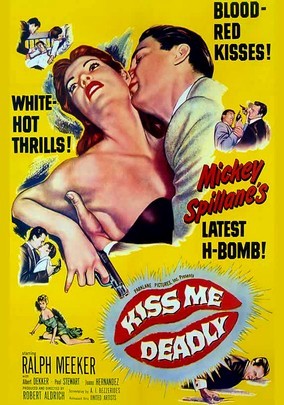
Kiss Me Deadly-1955

Kiss Me Deadly-1955

Director Robert Aldrich

Starring Ralph Meeker, Cloris Leachman

Scott’s Review #391

60020642

Reviewed April 2, 2016

Grade: A-

Kiss Me Deadly is a 1955 noir drama that influenced many subsequent films. After years of keeping it on my “to see” list, I finally got around to viewing this influential gem and now realize its power.

At times, it is confusing and perplexing and requires additional watching. I rate it an A——; however, I can see its grade rising to a solid A upon subsequent viewings.

Still, Kiss Me Deadly has much respect from me as a lover and appreciator of a good film.

The mysterious plot goes like this: Mike Hammer (played by Ralph Meeker) is a stern Los Angeles private eye. One evening, driving along a lonely country road, he picks up a hitchhiker, Christina (Cloris Leachman’s film debut), who is clad only in a trench coat.

He quickly realizes she has escaped from a mental institution but is compelled by her desperation.  When thugs catch up to them, this sets off events as Mike spends his days investigating the strange turn of events.

The plot twists and turns in innumerable ways and becomes complex but fascinating. A peculiar glowing box, which everybody seems to want, comes into play.

Wonderfully directed by Robert Aldrich, Kiss Me Deadly features unique and creative uses of lighting, camera angles, and moody shadows to significant effect, and this is one of the first aspects I noticed.

Shot in highly effective black and white, allowing Kiss Me Deadly a murky, suspicious look- as if danger and doom might be around every corner.

Meeker and Maxine Cooper as Velda, Mike’s secretary/lover, make a nice pair, as they are good-looking, but a rather B-movie type couple, in contrast, to say, Cary Grant and Eva Marie Saint, two gorgeous upper echelon Hollywood stars of the day.

Casting those stars might have changed the tone of the film.  Meeker and Cooper bring, perhaps, a blue-collar look to the film. Nevertheless, the chemistry works.

An interpretive film, Kiss Me Deadly undoubtedly influenced later film noir classics such as Chinatown (1974), L.A. Confidential (1997), and Pulp Fiction (1994), as well as science-fiction films and, arguably, Raiders of the Lost Ark (1981).

The list could go on as Kiss Me Deadly crosses into numerous genres.

The ending is highly complex, spooky, and downright weird. It is one of the craziest endings I have ever experienced.

Once the mysterious box is opened, the film becomes a strange Twilight Zone episode with screeching sounds. The explosion is open to complete interpretation and changes the dynamic. I had the enormous fortune to view the alternate ending not released in theaters.

Mike and Velda’s fates were vastly different from one end to another. My preference was the alternate ending. Sometimes, the studios play things too safe.

What does it all mean? Nuclear weapons, the apocalypse, the Cold War, glowing boxes, and detective work are many elements in one film.

A conversation about Kiss Me Deadly (1955) could be enjoyed, as it speaks volumes about the film’s high quality.

I look forward to seeing this revolutionary film again for further appreciation.

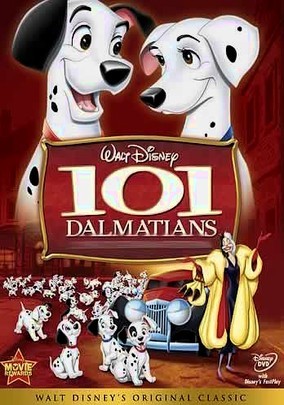
101 Dalmatians-1961

101 Dalmatians-1961

Directors Wolfgang Reitherman, Hamilton Luske, Clyde Geronimi

Voices Rod Taylor

Scott’s Review #226

205524

Reviewed March 8, 2015

Grade: A-

101 Dalmatians (1961) is a darling Walt Disney film that encompasses wholesomeness, love, and devotion.

Set in London, which adds a level of sophistication to the film, it tells the story of a lonely songwriter named Roger Radcliffe, who lives in a flat with his faithful and devoted Dalmatian, Pongo. Theirs is a happy existence, but something is missing.

Pongo, voiced by Rod Taylor (of The Birds-1963, fame), is determined to find a mate for himself and Roger and sets about to do just that by watching ladies and their dogs walk the streets in front of their homes.

He finds the perfect match for both (Anita for Roger and Perdita for him). The four of them look forward to years of happiness together until a sinister friend of Anita’s, Cruella De Vil, enters the story.

Cruella sees profit in the Dalmatians and attempts to steal and destroy them.

Cruella De Vil is a delicious villain and certainly one of the most entertaining in animated film history, but more than that, she is comically devious. Her maniacal laugh and witty language make her a perfect foil for a wholesome couple and wonderful, cute little pups.

The audience does not root for her, but there is something wicked and fun about her over-the-top character.

The 1961 film has an incredible artistic direction that animation today lacks —the scenes look like beautiful drawings.

There is a Mad Men quality to the design.

The “look” differs from current animation in that it is sleek and constructed skillfully, not loud, fast, and bombastic.

I love that the film is told from the perspective of the Dalmatian Pongo and Perdita, not from the perspective of human beings. The central characters, Pongo and Perdita, tell the story about their dogs, which adds to their empathy for the animals. We see their attempts to rescue all of the stolen dogs.

Also outstanding is how all of London’s dogs (and various other species of animals) band together in rescue. They work as a team to save and protect their own, who are being mistreated and sent to slaughter.

An enjoyable scene involves the climactic car chase between Cruella’s gaudy luxury car and a furniture van. As the pups use the van to escape, a cat-and-mouse game ensues, providing comedy and dramatic flair.

The scene is among the most suspenseful in the film, as the vehicles weave along dirt and back roads toward London.

In addition to this riveting scene are others involving the dogs tiptoeing past their captives as we cross our fingers they will not be heard and subsequently caught, and an adorable scene showcasing the dogs’ cleverness at covering their spots with soot to escape.

A heartwarming, inspirational film for the entire family to enjoy many times over, 101 Dalmatians (1961) will leave you smiling and humming.

It is a truthful, fantastic film about love for animals.