Tender Mercies-1983
Director Bruce Beresford
Starring Robert Duvall
Scott’s Review #1,279
Reviewed July 22, 2022
Grade: B+
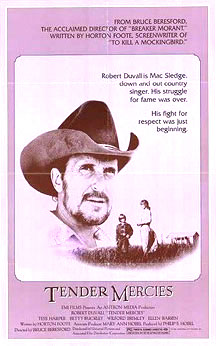
Tender Mercies (1983) is a quiet, down-home film about a country musician struggling with alcohol addiction, god, and a tepid musical career.
Anyone who starts a yawn will have the same reaction I did when reading the premise.
It’s not the most original idea, but the film works surprisingly better than I initially expected. The 1983 film is largely forgotten now, but its legacy is a Cinderella story.
Funding and a marketing push were limited, resulting in low box-office returns, but the Academy sure took notice, heaving five nominations its way.
It’s quite a departure for those expecting actor Robert Duvall to mirror his characters in The Godfather (1972) and The Godfather: Part II (1974).
Tender Mercies is an actor’s film, and it belongs squarely to Duvall, who delivers a wonderful performance perfectly carved out for an Oscar nomination. He instills himself into the role of a drunken, washed-up country star vowing to stay straight.
Duvall does more than act, crafting and performing his songs in a role that stands side by side with his best work in The Apostle (1998).
He won the coveted Academy Award for Tender Mercies.
Though the tone is low-key, filming was anything but, and reports of disagreements and blow-ups between Duvall and director Bruce Beresford surfaced.
The Australian director was later made famous for Driving Miss Daisy (1989) and, at one point, even considered quitting the production.
The story tells of alcoholic drifter Mac Sledge (Duvall), who awakens one day in the middle of rural Texas after a night of heavy drinking.
He wakes up in a run-down roadside motel and gas station.
He meets the owner, a young widow named Rosa Lee (Tess Harper), and offers to perform maintenance work at the motel in exchange for a room. Rosa, whose husband was killed in the Vietnam War, is raising her young son, Sonny (Allan Hubbard), on her own.
Mac and Rosa become smitten with each other, attending church and building a life of solitude together. Demons surface when it is revealed that Mac is a once-famous country singer with a currently famous ex-wife, Dixie Scott (Betty Buckley).
When a chance for a career comeback appears, Mac must choose between his new life and the life he let slip through his hands.
The story works well for several reasons.
At the forefront, Mac is a likable guy whom the audience pulls for. Instead of the tried-and-true story of a man battling his demons and being ‘saved’ by a woman, Mac is already on the road to recovery and has the desire to stay sober.
Rosa Lee and Sonny merely serve as steady influences versus the bright lights and broken hearts of the country music world.
Mac also has a chance to be a father figure. The bad stuff has already transpired in the past, so the audience is spared having to endure a pile of shit in exchange for a big payoff at the end of the film.
A couple of negatives keep the film from being a masterpiece.
On the wagon, Mac is tempted to down a bottle of whiskey after a tragedy, but he resists the urge, choosing to pour the devil’s juice out onto the ground. Is that a big surprise?
Buckley does her best with a one-note character, clearly in existence as an obstacle to Mac’s happiness.
But at its core, Tender Mercies is about relationships, and though it’s a slow under texture, the low-key scenes between Mac and Rosa Lee, and Mac and Sonny, are delicious.
The scenes prove that good, crisp dialogue with grace and heart trumps car chases any day.
They discuss life!
The cinematography of remote Texas is magical in its vastness and its loneliness. Key expressions on Duvall’s face match the Western landscape perfectly.
I’m not a religious guy, and I’m not a country & western guy, but I enjoyed the story Tender Mercies (1983) served up quite a bit.
The combination of superb acting, an emotionally charged, character-driven story, and a fabulous glimpse into the dry state of Texas made for a compelling ninety-minute viewing experience.
Oscar Nominations: 2 wins-Best Picture, Best Director-Bruce Beresford, Best Actor-Robert Duvall (won), Best Screenplay-Written Directly for the Screen (won), Best Original Song-“Over You”
Golden Globe Nominations: 1 win-Best Picture-Drama, Best Director-Bruce Beresford, Best Actor- Drama- Robert Duvall (won), Best Supporting Actress-Tess Harper, Best Original Song-“Over You”