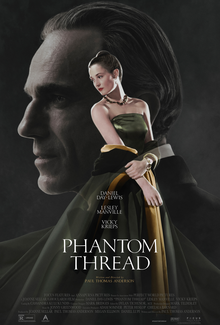
Phantom Thread-2017
Director Paul Thomas Anderson
Starring Daniel Day-Lewis, Vicky Krieps, Lesley Manville
Scott’s Review #722
Reviewed January 31, 2018
Grade: A
Phantom Thread is a 2017 gem that should ideally be studied in film schools and remembered for decades to come, or at the very least discussed and dissected among those fortunate enough to see it currently.
Set in England during the 1950s and centering on the dress-making industry, the film mixes romance with a bizarre psychological element that leaves the viewer breathless as the final act comes to a dramatic and startling conclusion.
Daniel Day-Lewis brilliantly portrays Reynolds Woodcock, an esteemed and famous dressmaker who lived and worked in London in the 1950s.
He creates lavish dresses for the members of high society, including the wedding gown for the famous Belgian princess. Masterful at his work, he is also controlling and demanding, requiring plenty of support and attention from his equally controlling sister, Cyril (Lesley Manville).
When he meets Alma Elson, a waitress from a countryside resort, the pair fall into a relationship. She acts as his assistant, muse, and lover. Complexities develop between Reynolds, Alma, and Cyril as the plot progresses in cerebral and nail-biting fashion.
The film is ravishing and a feast for the eyes if only for the classic costumes alone. Each dress that Reynolds creates is exceptional and at the height of glamour. His domineering nature only makes this realistic as perfection is his modus operandi and his dresses are evidence of this.
In one particularly fantastic sequence, Reynolds begrudgingly creates a dress for the boozy Barbara Rose, a rich and mature woman who promptly falls asleep drunk at her wedding and soils the garment.
A livid Reynolds, along with Alma, strips Barbara of the dress, rather than see her sleep in and tarnish it.
However, the main draw to the film is the excellent, intricate main plot involving Reynolds, Cyril, and Alma.
This weaving of personalities and their nuances must be attributed to the fabulous direction of Paul Thomas Anderson, known for edgy, dark films such as 1997’s Boogie Nights and 1999’s Magnolia.
He comes up with a masterpiece in Phantom Thread.
The three principal characters are pretty unlikeable and the viewer’s allegiances may change throughout the tale. Appearing to be the innocent, debutante character of the film, the character of Alma will be surprised, especially in the film’s final act.
A successful nuance is the scenes involving characters breaking bread with others as events unfold over Danishes, omelets, and crisp asparagus. Sometimes the banter involves discussions and debates about the preparation of the food.
This characteristic is a dream for any foodie and the meals aid in the progression of the plot.
Earlier in the film, Alma is scolded by a maid for nearly picking poisonous mushrooms, which later becomes a major clue and part of the film’s conclusion.
During a pivotal scene between Reynolds and Alma, she prepares a delicious mushroom omelet for her love as motivations, secrets, and desires surface.
The grand twist that Anderson reveals at the end of the film will only leave the viewer open-mouthed and quickly reviewing the events and circumstances of the entire movie.
Anderson’s close-up scenes are magical, and each actor is allowed to be very expressive. The camerawork in several breakfast scenes—Alma and Cyril gazing at each other, revealing emotions that border between hatred and mutual respect—is effectively done.
Manville, in particular, does so much with her blue eyes as she sips coffee and peers over her cup with venomous indignation at her foe.
How splendid is the comparison of Cyril to the famous Hitchcock villainous Mrs. Danvers from the classic 1940 film in her cold and creepy mannerisms?
I hope that Phantom Thread will eventually be appreciated and analyzed as a cinematic work of art.
Deservedly honored with a 2017 Best Picture, Best Actor, Best Supporting Actress, Best Director, and Best Costume Academy Award nomination, the film is a lesson in excellent writing, bizarre angles, and essential effects.
Let’s hope that this film will be recognized as the great work it is.
Oscar Nominations: 1 win-Best Picture, Best Director-Paul Thomas Anderson, Best Actor-Daniel Day-Lewis, Best Supporting Actress-Lesley Manville, Best Original Score, Best Costume Design (won)