Category Archives: Circus

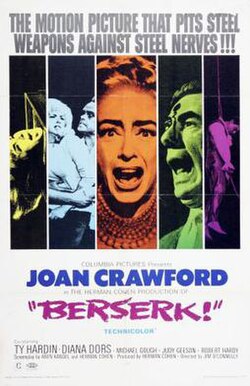
Berserk! -1968

Berserk! -1968

Director Jim O’Connolly

Starring Joan Crawford

Scott’s Review #1,534
Reviewed May 25, 2026

Grade: B

Joan Crawford, legendary Hollywood screen star, appears in Berserk! (1968), a British horror-thriller vehicle that was one of her last roles.

Trog (1970) was her final film role.

She portrays Monica Rivers, a ringmistress of a traveling circus in the London area. Monica is no-nonsense and man-hungry, known to bed some of the talent as she confidently hunts her prey.

As the co-owner of the circus, Monica is always preoccupied with filling seats and making money, a bottom-line gal.

Following the suspicious ‘accidental’ death of a tightrope walker, Rivers is pleased to see her profits increase because of the drama. She soon hires handsome Frank Hawkins (Ty Hardin) to replace him.

But when performers start to meet gruesome deaths, it becomes apparent that a killer is on the loose. Monica must juggle pesky detectives lurking around with accusations that she may be the killer.

While I enjoyed the film, which serves as a compelling whodunit first and foremost, not to mention Crawford’s appeal, it is only moderately above mediocre.

As expected, Crawford leads the charge and gives the project her best effort. Deliciously callous and self-serving, the role of Monica is one Crawford can sink her teeth into as unsympathetic as she is.

Her many outfits are glamorous, especially given the circus setting, and her cigarette smoking, nearly a trademark, makes her look powerful.

An aging star, her romantic pairing with Hardin, young and muscular, is borderline silly since she could easily be his grandmother. Weirdly, in a couple of scenes with him, Crawford looks much older and more ragged than in other scenes, while Hardin is bare-chested and buff.

There is little chemistry between the two.

The whodunit works well, as a myriad of suspects have both the cause and the motivation for the killings.

Monica, Frank, performer Matilda (Diana Dors), and others are suspects.

A colorful yet dark circus setting is wonderful in any horror film. The peculiar yet stereotypical characters, such as the strongman, the bearded lady, and others, are incorporated, as are scenes of characters following one another or lurking in the shadows.

The mostly nighttime scenes work well.

The final reveal of the killer is startling and surprising, which greatly improves the film. There is satisfaction when a viewer is genuinely surprised by a whodunit rather than having guessed the killer from the start.

However, the killer’s motivations are lackluster and hard to believe. The sequence is also very rushed and wrapped within five minutes of screentime.

Rather than systematically kill victims off one by one, the killer might have had a sit-down conversation over tea to flesh out the issues that are the motivation for the murders.

Another perplexity is Crawford’s lack of a British accent. Having grown up in England and with the circus in her family for 50 years, Monica wouldn’t be American.

While a real circus was used for the myriad scenes involving elephants, dog performers, and others, director Jim O’Connell overdoes it to the detriment of the action.

The scenes are cute, but they slow down the plot.

Berserk! (1968) is a watchable effort largely due to Crawford’s stunning screen presence and a solid whodunit. It is hardly on her greatest-hits film reel, but it is not disastrous either.
The Greatest Show on Earth-1952

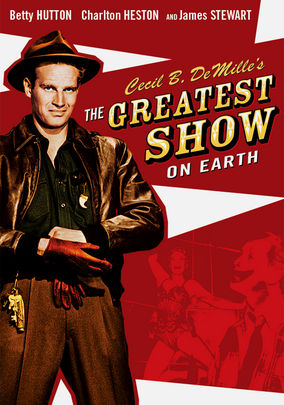
The Greatest Show on Earth-1952

Director Cecil B. DeMille

Starring Charlton Heston, Betty Hutton, James Stewart

Scott’s Review #204

60034703

Reviewed December 14, 2014

Grade: B+

Considered by some critics to be one of the worst Best Picture winners of all time, The Greatest Show on Earth (1952) is quite an impressive Hollywood spectacle.

It tells the story of the world’s largest railroad circus as it launches a tour across the United States, with plenty of drama throughout.

The film stars Charlton Heston, Betty Hutton, and James Stewart as the general manager, acrobat, and clown of the show, respectively.

The film used over 1,400 real Ringling Bros. and Barnum & Bailey employees and hundreds of animals in its production, giving it an authentic circus feel.

Unfortunately, the film also has a schmaltzy quality and lacks strong acting, which, surprisingly, does not bother me and, strangely enough, works in a way.

Various characters have affairs with each other or fall in and out of love rather quickly- it makes for good drama, anyway.

Of course, the main appeal is the extravagant show. While the drama sometimes takes center stage, the lavish production and actual circus events shine through.

My favorite character, and arguably the only interesting character with any depth, in The Greatest Show on Earth is Buttons the Clown, played by James Stewart.

Buttons wears his clown costume, complete with full makeup, at all times. He is kind and mysterious. We learn that he “mercy killed” his dying wife and has joined the circus for protection from the police.

A wonderful human being, he was once a Doctor and tends to anyone in the circus troupe who needs assistance. Later in the film, he plays a vital role after a tragic accident.

His heartbreaking, tender conversation with his elderly mother, whom he only sees in secret once a year for a few seconds as she tearfully and discreetly visits him in the audience, is painfully sad to watch and such a sweet scene.

The Greatest Show on Earth’s best scene by far, still impressing today, is the massive train wreck near the conclusion.

The special effects and direction in Cecil B. DeMille’s 1952 film are brilliant. The train perfectly derails one night—it collides with an oncoming train and derails, highly effective in its enormity.

The scene does not look silly.

The way all the drama comes together in this scene—Harry, the crooked midway concessionaire and vicious elephant trainer; Klaus, who is responsible for the accident; Button’s true identity being revealed; and a significant character in peril—makes it top-notch and a satisfying conclusion to the film.

The stories involving Brad, Holly, Sebastian, and Angel are soapy and melodramatic, making them the film’s weakest point.

As a viewer, I couldn’t care less which character lusted after which or who wound up in bed together, but the movie itself is a spectacle, which is my main enjoyment.

The brightness, the revelry, and the circus performances are all wonderful.

Oscar Nominations: 2 wins-Best Motion Picture (won), Best Director-Cecil B. DeMille, Best Story (won), Best Costume Design, Color, Best Film Editing

Golden Globe Nominations: 3 wins-Best Motion Picture-Drama (won), Best Director-Motion Picture-Cecil B. DeMille (won), Cinematography-Color (won)