Tag Archives: Roy Kinnear

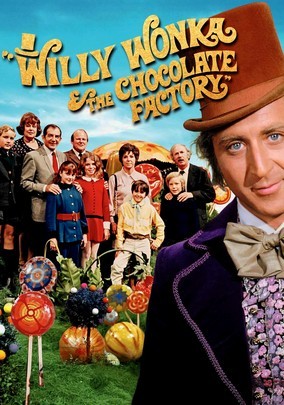
Willy Wonka and the Chocolate Factory-1971

Willy Wonka and the Chocolate Factory-1971

Director Mel Stuart

Starring Gene Wilder, Jack Albertson

Top 250 Films #35

Scott’s Review #206

60020949

Reviewed December 18, 2014

Grade: A

More than just a children’s movie, Willy Wonka and the Chocolate Factory (1971) is a terrific, imaginative, fantasy film that is timeless and meant for all ages to enjoy.

The mastery and creativity of the sets and art direction are astounding, and the story is sweet, whimsical, and captivating. Often, with children’s movies, we are treated to stories that are either dumb or contrived, which will entertain five-year-olds but bore or cringe adults.

Willy Wonka and the Chocolate Factory is none of the above. It is intelligent, filled with magic, and has a heart.

Charlie Bucket is a poor child whose mother earns a living by washing clothes. Along with his four bedridden grandparents, they lives a meager existence in a small cottage somewhere in Europe.

Particularly close with his Grandpa Joe, the two of them become obsessed with a contest held by mysterious Willy Wonka, the owner of an enormous chocolate factory nearby.

The contest consists of five “Golden tickets” being hidden in Wonka bars. The five lucky winners will receive a lifetime supply of candy and a tour inside the long-since-closed chocolate factory.

After a series of circumstances, Charlie obtains one of the tickets and the adventure begins.

The build-up to the trip into Willy Wonka’s factory is gripping- mainly because the viewer knows that a magical treat is in store and is filled with curiosity- what will the chocolate factory look like? What is Mr. Wonka like?

The four other winners- Augustus Gloop, Veruca Salt, Violet Beauregarde, and Mike Teevee are all unique and creatively written characters- all spoiled brats in their way, so Charlie is the “normal” child and has a true rooting value to him.

As the five children, along with a designated parent- or in Charlie’s case, Grandparent, begin their journey throughout the chocolate factory the audience is treated to a psychedelic experience with fantastic sets- a river made of chocolate, an entirely edible garden, lickable wallpaper, a bubble room, and a frightening riverboat.

The film is bright and colorful within the walls of the factory which perfectly contrasts Charlie’s dreary existence in the outside world.

As the four bratty children meet their fates in joyfully imaginative ways- gum chewer Violet blows up like a blueberry after chewing experimental Wonka gum that she is warned not to, Veruca is deemed rotten after throwing a fit and topples down a garbage chute.

The film is breathtaking and imaginative, filled with wonderment.

Gene Wilder plays the role of Wonka as over-the-top and it works tremendously.

All of the child actors play their roles competently as each character is distinguished from the others.

I love the scary riverboat tunnel scene as it is frightening, psychedelic, and magnificent. I also love the contrast between the enchanting colorful second half to the bleakness of the first. The sets are some of my favorites in their lavishness.

Specifically, the relationship between Charlie and Grandpa Joe is wonderful. Grandpa Joe is a father figure to Charlie, but so is Willy Wonka in a completely different way.

The greed of the children is also interesting and one hurrahs as each one gets his or her comeuppance.

The songs from the film are remarkable and quite cutting edge- each time one of the lucky five golden ticket winners meets their doom, the Oompa Loompas sing a tune that visually has weird shapes and colors-psychedelic and very hippy, of the late 1960’s-early 1970s era.

Other numbers such as “I’ve Got a Golden Ticket”, “Cheer up Charlie”, and “The Candy Man” are memorable.

A film for the ages, Willy Wonka and the Chocolate Factory (1971) is a celebration of creative film and quite cerebral at times and is far superior to most children’s fantasy/musical films.

Skip the 2005 remake starring Johnny Depp and enjoy the original.

Oscar Nominations: Best Scoring: Adaptation and Original Song Score

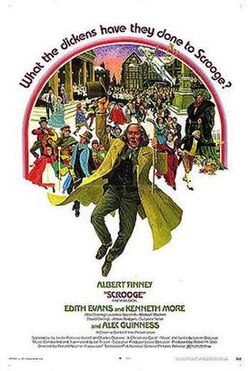
Scrooge-1970

Scrooge-1970

Director Ronald Neame

Starring Albert Finney, Alec Guinness

Top 250 Films #186

Scott’s Review #561

Reviewed December 25, 2016

Grade: A

A classic perfect for watching around the holidays, perhaps accompanied by a roaring fire and a bit of brandy, Scrooge (1970) is a magical, musical experience; the entire family should adore it.

The film is a retelling of Charles Dickens’ 1843 story, A Christmas Carol.

Set in London with spectacular London-style art direction, it is perfect in its depiction of life around the holidays in the historic city, circa the nineteenth century.

To be clear, this is the musical version of the popular tale, not to be confused with the 1935 or the 1951 versions of the story.

The film is not as dark or scary as those films are. Instead, the 1970 Scrooge would be a fantastic companion piece to the 1968 classic Oliver!, both based on Dickens stories and both mixing fantastic musical scores with dramatic elements.

Albert Finney takes center stage in flawless form as the old, cantankerous, miser Ebenezer Scrooge. He plays the character as both an older man and, through flashbacks, a young man (Finney was merely 34 years old at the time of filming).

Guinness, indeed a high-caliber actor, is effective as the ghost of Jacob Marley- Scrooge’s former business partner. Scrooge is a moneylender, mainly to the working class, and is unforgiving in his collection of debts.

Filled with hatred for all things good, especially the Christmas holiday, Scrooge refuses to attend a family Christmas dinner hosted by his nephew, Fred, or to give to any charities. He begrudgingly gives his minion and bookkeeper, Bob Cratchit, Christmas Day off.

Finally left alone on Christmas Eve night, Scrooge is visited by the spirit of Jacob Marley, who tells Scrooge that three ghosts will visit him during the night.

In a chilling scene, Marley takes Scrooge on a journey through the sky, where he is greeted by spirits doomed to traverse the Earth, as Jacob is, with shackles acquired from their life as living beings.

Since they are greedy and wicked, they are doomed in the afterlife, just as Scrooge will be if he does not change his ways.

In an excellent subplot, we get to know the Cratchits, led by their father, Bob, a poor but earnest man. The family has little, but makes the most of what they do have, and appreciates the glorious holiday. They prepare a meager Christmas bird and savor being together as a family.

Their youngest, Tiny Tim, is lame, and he lusts over a lavish train set in the local toy shop. Cratchit epitomizes goodness and richness of character, contrasting with Ebenezer Scrooge.

As Scrooge is visited by the ghosts of Christmas past, present, and Christmas yet to come, he slowly realizes he needs to change his ways before it is too late. The audience is treated to stories of Scrooge’s youth, as we understand what has made him the miserly older man that he is today.

The clear highlight of this film is its musical numbers that will leave even the most tone-deaf humming along in glee. Throughout each sequence, we are treated to various numbers.

My favorite is “Thank You Very Much”, as it first appears during the Ghost of Christmas Yet To Come sequence.

By this time, feeling more sympathetic and appreciative, Scrooge merrily dances and sings along with the townspeople, unaware of the fact that they are celebrating his death and are dancing on his coffin to celebrate the fact that their debts are now free and clear.

This catchy tune is a reprise at the end of the film.

Other cheery numbers are “Father Christmas” and “I Like Life”, which perfectly categorize the film as a merry, holiday one, despite its occasional dark tone. This is necessary to avoid making Scrooge too bleak.

I also adore the vivid set designs as the gorgeous city of London is perfectly recreated to show the festive Christmas holiday. The film is not high-budget, but it makes the most of it by using small yet lavish sets.

Scrooge is a perfect holiday film, with fantastic tunes and a meaningful story that comes across on screen as a celebration of life, never edging toward contrived or oversaturated.

A wonderful holiday feast.

Oscar Nominations: Best Original Song Score, Best Original Song for the Picture-“Thank You Very Much”, Best Costume Design, Best Art Direction

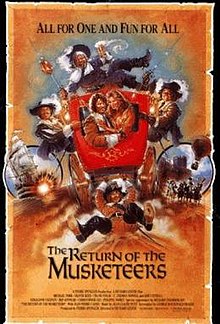
The Return of the Musketeers-1989

The Return of the Musketeers-1989

Director George Lester

Starring Michael York, Oliver Reed, Kim Cattrall

Scott’s Review #1,401

Reviewed September 24, 2023

Grade: B

The Return of the Musketeers (1989) is the third Musketeers film directed by Richard Lester, following 1973’s The Three Musketeers and 1974’s The Four Musketeers.

George MacDonald Fraser wrote each screenplay.

This is key to mention because a strong continuity flow helps the film be fun and charming. The results of the same person directing and writing resonate on screen in several ways. The characters feel truthful and their motivations are clear.

A rich sense of the history of the characters is apparent making the film a pleasing adventure for fans of the franchise.

After ambitious Oliver Cromwell (Alan Howard) overthrows the king, Cardinal Mazarin (Philippe Noiret) enlists a down-and-out D’Artagnan (Michael York) to rally the Musketeers against him.

Porthos (Frank Finlay) accepts the mission at once, but Athos (Oliver Reed) and Aramis (Richard Chamberlain) hesitate at first. Eventually, the three reunite, but they are soon torn apart by infighting and a situation from their past.

They get a chance at redemption when they are sent to England to save the life of King Charles I (Bill Paterson).

There is some slapstick play to endure making The Return of the Musketeers feel juvenile at times when characters are bopped over the head or otherwise trip and fall in silly form.

For this type of adventure film, the plot is too complicated and veers in different directions a shade too often. I wondered more than once if I was in France or England.

This makes the minor characters difficult to keep track of and Christopher Lee’s character of Comte de Rochefort once again has little to do.

The costumes and the French setting are a major victory and the history lessons provided especially the British and French kings and queens are more than fulfilling. We delved into our history books to determine which King Louis reigned when and who was aligned with the film (it’s Louis the XIV during the 1600s).

The point of the film made fifteen years after the second film is to please fans and the result is a swimming success. I’m a sort of fan with my hubby being a big fan and we both enjoyed the resurfacing of familiar characters.

It feels like old-home week. The reunion of the musketeers feels like witnessing a family reunion. As D’Artagnan, Porthos, Athos, and Aramis embraced each other we felt the warmth along with them.

Since the characters played by Raquel Welch and Faye Dunaway (Milady) were dead a creative idea was to introduce her daughter to the story, Justine played by Kim Cattrall. Athos also has a son named Raoul, played by C. Thomas Howell.

This provides a further nod to history and introduces compelling lead characters who have a connection to familiar characters.

It is also an example of good writing and storytelling. Despite the characters being new to the audience we already care about them based on their tie to other beloved characters.

Making the film more sentimental, a sad occurrence happened while filming. Actor Roy Kinnear who plays lovable Planchet died following an on-camera accident in which he fell off a horse.

His role was completed by using a stand-in, filmed from the rear, and dubbed-in lines from a voice artist.

The film is dedicated to him.

Reuniting most of the original cast years later makes The Return of the Musketeers (1989) a warm experience. Beautiful costumes locales and history raise the film above expectations considering it’s a third installment.

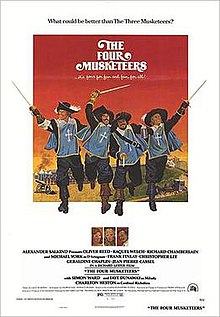
The Four Musketeers-1974

The Four Musketeers-1974

Director Richard Lester

Starring Oliver Reed, Michael York, Faye Dunaway

Scott’s Review #1,379

Reviewed July 17, 2023

Grade: B

The Four Musketeers (1974) is a sequel to the film The Three Musketeers made a mere year earlier. It takes the second half of the famous novel by French author Alexandre Dumas with the original film covering the first half.

A recommendation is to watch the sequel directly after the original so there is less struggle to figure out what is going on. I did not do that so connecting the plot points was a struggle.

A further negative is the omission of any English subtitles making hearing or ascertaining the events of the film difficult. British accents are tough.

King Louis XIII’s (Jean-Pierre Cassel) four swashbuckling heroes engage in chivalrous and daring adventures when Cardinal Richelieu (Charlton Heston) and his evil accomplice Milady de Winter (Faye Dunaway), kidnap the queen’s dressmaker, Constance (Raquel Welch).

The heroes are D’Artagnan (Michael York), Athos (Oliver Reed), Porthos (Frank Finlay), and Aramis (Richard Chamberlain).

It’s a British swashbuckler film so the adventures are prevalent and the physical comedy is fast and furious. It’s like a sitcom at times with over-the-top and outlandish fight sequences and one-liners.

The frequent low-cut tops on the female characters are intended to channel the male viewer’s thirteen-year-old boy.

The film gets darker than I anticipated in the final act which is to its credit with two deaths. This surprised me in a good way because so much of The Four Musketeers is light-hearted.

The death by the beheading of a major character is well-done. The heroes watch an executioner perform his duties to the fiendish character from across a lake. The decapitation is not exactly shown but it’s done almost in a tremendously effective silhouette and from a distance.

The costumes and attention to detail from a historic perspective are superior elements of the film. One can imagine being in the French countryside during the Anglo-French War in the 1600s. The sets and lighting are bright so the result is colorful and picturesque style.

The cast is made up of several A-list Hollywood stars of the time and each adequately does their share to light up the screen. My favorites are Dunaway as the villainess and Reed as a ‘good guy’, a refreshing change for the actor who usually appears as the heavy.

Reed and Dunaways share some scenes mostly in flashbacks that made me want to see more of their romance but this is not to be. Athos was unaware that Milady de Winter was a criminal which left a permanent branding mark.

Still, what little I got featured tremendous chemistry between the pair and I would have liked to have seen more.

Where the film loses me a bit is with the silliness which follows the same formula that made The Three Musketeers a success. Feeling redundant were the endless sword fight scenes and tongue-in-cheek winking.

The film tries hard to be a comedy but adds in darker moments too so it leaves an unbalanced quality.

Some actors get short shrift. Christopher Lee as Count De Rouchfort is a secondary villain and has little to do except prance around in a wig, uniform, and eye patch. His character is no Dracula and does not feel dangerous.

The Four Musketeers (1974) is good entertainment from a solidly professional cast. Hardly a masterpiece it’s a bang ’em up comedy adventure with a few moments of death and destruction.

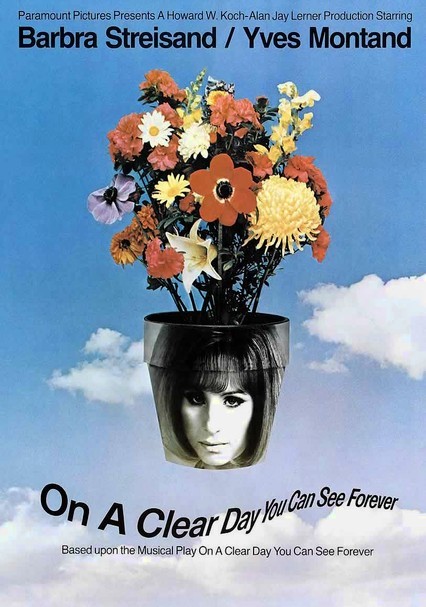
On a Clear Day You Can See Forever-1970

On a Clear Day You Can See Forever-1970

Director Vincente Minnelli

Starring Barbra Streisand, Yves Montand

Scott’s Review #921 

Reviewed July 19, 2019

Grade: B+

On a Clear Day You Can See Forever (1970) is a very obscure film that deserves better than to be relegated to the unknown.

Released during a time when the Hollywood musical had lost its luster, it feels like a last-gasp effort to keep the genre alive, serving as a star vehicle for Barbra Streisand.

The film suffers from severe editing problems with a large portion being cut, so much so that the result is a choppy and disjointed feel, tough to follow as is but left untouched the film could have been a creative masterpiece.

In a particularly convoluted plot that spans two time-periods, chain-smoking New Yorker, Daisy Gamble (Streisand) is convinced by her uptight fiancee Warren (Larry Blyden) to attend a class taught by Marc Cabot (Yves Montand), a psychiatrist.

When she is accidentally hypnotized by Cabot he realizes she speaks in the voice of an early nineteenth-century woman named Melinda, and he becomes obsessed with her while she teeters between two existences.

The screenplay was written by Alan Jay Lerner and adapted from his book for the 1965 stage production.

Film director Vincente Minnelli fuses fantasy with a musical to create an experimental piece extremely left of center- this is not your standard 1950s or 1960s MGM experience with merry or clap-along tunes.

Some of the more memorable numbers include “On a Clear Day” which is a reprise at the end of the film, “He Isn’t You” and “Love with All the Trimmings”.

Casting Streisand is a monumental choice as she carries the film on her shoulders. Belting out numbers is the singer-turned-actress’s forte and she never disappoints. She is fascinating to watch in the neurotic role as she smokes and prances around, usually in a tizzy or a state of peril (self-induced).

The performance impresses as a different style than many of her other films and she has never portrayed a livelier character. Streisand overcomes a few challenges of the film, winning in spades.

She shares little to no chemistry with co-star Montand who is not only too old for her, but he is not the greatest actor. If the film’s intent, which I suspect, was to make the pair the main draw then this failed.

Streisand’s chemistry with John Richardson, who plays Sir Robert Tentrees to her Melinda in the other time-period, excites her. The duo smolders with passion but sadly, most of the nineteenth-century scenes are the ones that are sacrificed making most of it a jumbled mess.

Much more interesting would have been to leave the entire film intact.

An oddity is Jack Nicholson’s almost nonexistent role of Tad Pringle, a mostly non-described brother of Daisy’s. Is he also her neighbor?

In 1970 Nicholson was only on the cusp of super-stardom and it questionable is whether some of his parts were left on the cutting-room floor, but the limited character is strange and unsatisfying. In another role, there would have been some possibility of romantic entanglement.

Throughout the film, I wondered how On a Clear Day You Can See Forever might have worked with someone other than Streisand in the roles.

I kept ruminating about how good Liza Minnelli might have been in the roles with her non-classic looks (like Streisand) and bombastic voice. Her high dramatic flair and capable New York-style would have made results interesting, but Streisand hits it out of the park.

On a Clear Day You Can See Forever (1970) is a brave attempt at something fantastical, brimming with potential that is left feeling cluttered and messy.

With a delicious leading lady whom the camera adores and enough creative sets and rigorous energy to keep one guessing, the film stumbles with many problems and leaves viewers incomplete.