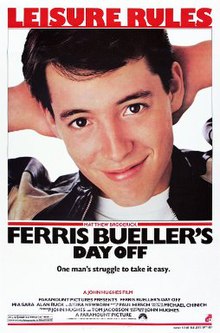
Ferris Bueller’s Day Off-1986
Director John Hughes
Starring Matthew Broderick
Scott’s Review #1,396
Reviewed September 7, 2023
Grade: B
Ferris Bueller’s Day Off (1986) is one of the best-known films in John Hughes’s 1980s teen coming-of-age comedy collection.
On par with The Breakfast Club (1985) and Pretty in Pink (1986) in name recognition memory banks, especially for teenagers growing up in this decade.
Iconic moments like Ben Stein’s teacher’s monotone attendance roll call, the repeated phrase ‘Bueller’, and the term ‘Save Ferris’, which became the name of an alternative rock band, are legendary.
The film has its creative moments, and Matthew Broderick’s portrayal of the title character is charming and star-making.
Watching the film decades later, though, the slapstick feels overwhelming compared to the drama, and there isn’t much angst like in other Hughes films.
There isn’t much deeper meaning beyond skipping school for a day and going on an adventure.
This makes Ferris Bueller’s Day Off fun and lighthearted, but sillier than more mature Hughes films. The film is about being young, free, and having fun, but not much more, and the hijinks between the students and the authority figures sometimes feel tired.
Ferris Bueller (Broderick) is brilliant at skipping school and getting away with it despite being an intelligent student. He causes the high school principal, Rooney (Jeffrey Jones), much irritation and ultimately pursues him to catch Ferris in the act.
The young man plans one final outing before graduation with his best pal Cameron (Alan Ruck) and his girlfriend Sloane (Mia Sara). They ‘borrow’ Cam’s father’s expensive Ferrari and journey through the streets of Chicago.
Ferris’s sister, Jeanie (Jennifer Grey), seethes with rage at her brother’s antics while their successful but dimwitted parents, Katie (Cindy Pickett) and Tom (Lyman Ward), remain clueless.
The film’s strengths are its frequent shots of Chicago and Broderick himself, which keep it from feeling like a mediocre relic decades after its release.
Broderick followed in the footsteps of contemporaries like Michael J. Fox and Emilio Estevez as the cool, likable all-American boy next door.
His performance makes the film better than it might have been, and it’s fun to watch him outwit rivals like the principal and other villains he encounters.
Hughes creates a nice ‘day in the life’ style that follows the characters from early morning until evening, which keeps the events contained well.
A high point of the film, and where it picks up steam, comes when the gang reaches Chicago. We suspect the teenagers, while they skip school with fibs, a just suffering from ‘senioritis’ and are otherwise superior students.
This is confirmed by the sophisticated and intellectually stimulating places they visit.
They have lunch at a swanky French restaurant and visit the world-renowned Art Institute of Chicago for good old-fashioned culture. Not to appear too snobby, they hobnob with blue-collar folks at an afternoon Cubs baseball game.
What feels dated about Ferris Bueller’s Day Off is the ditziness of Ferris’s parents. The teen easily bamboozles his parents with a feigned illness, and when his father spots Ferris in a nearby taxi, he shrugs it off as his imagination.
The most laughable example of the parents’ cluelessness is when mom Katie, in the passenger seat, doesn’t seem to notice her son running in front of their car when sister Jeanie slams on the brakes. She instead scolds Jeanie for driving recklessly.
These and other setups involving the over-the-top principal feel more like clichés than genuine laugh-out-loud moments. But this was common in 1980s comedies.
Ferris Bueller’s Day Off (1986) feels fresh in some parts but dated in others, making the experience humorous but hardly legendary.
Whereas The Breakfast Club holds up very well, this film doesn’t.
Golden Globe Nominations: Best Actor-Comedy or Musical- Matthew Broderick