Tag Archives: Mark Boone Junior

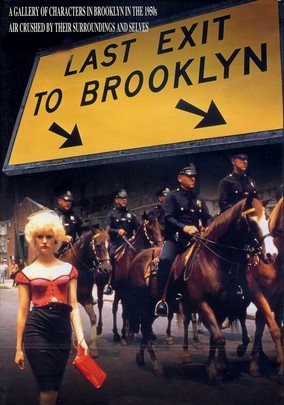
Last Exit to Brooklyn-1989

Last Exit to Brooklyn-1989

Director Uli Edel

Starring Stephen Lang, Jennifer Jason Leigh

Top 250 Films #176

Scott’s Review #152

70141619

Reviewed August 13, 2014

Grade: A-

Last Exit to Brooklyn (1989) is a slice-of-life film set in lower-class Brooklyn, NY, in the early 1950s.

It tells the story of a group of struggling neighborhood people- sex workers, union members, drag queens, etc., whose lives intersect. Also in the neighborhood is a military base where soldiers come and go on their way to war-torn Korea.

The central characters, though there are several with small yet interesting stories, are Harry, played by Stephen Lang, a sexually conflicted union worker with a wife and newborn child.

He is in love with a selfish drag queen, and Marilyn Monroe lookalike, Tralala, played superbly by Jennifer Jason Leigh, a prostitute whose best days are behind her, and who will do anything for attention.

The sets and cinematography in the film are very well done- the feeling of despair and hopelessness is accomplished by the dowdy streets, homes, and bars that the cast frequents.

Some of the characters are sympathetic- the aforementioned plus Tralala’s love interest, the Diner boy madly in love with Tralala, and the virginal seeming (but not really) Donna, portrayed by a young Rikki Lake.

Other characters are abhorrent in their violence and hatred.

Last Exit to Brooklyn is quite a dark film and sometimes tough to watch, but it captures a dreary time and atmosphere. The Brooklyn set is excellent in its dreariness.

Jennifer Jason Leigh is the standout as the tough-talking, boozy prostitute who is losing her luster, and the final scene of the film is truly a heartbreaker.

The topics of union, strike, bisexuality, gangs, and drag queens are covered, and unique characters and conflict/loneliness are presented.

This film is an overlooked gem from 1989.

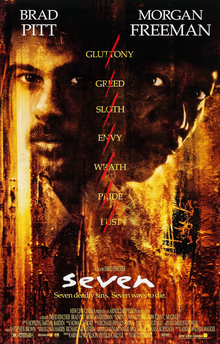
Seven-1995

Seven-1995

Director David Fincher

Starring Brad Pitt, Morgan Freeman

Top 250 Films #230

Scott’s Review #780

Reviewed June 29, 2018

Grade: A-

Many films containing a similar theme as Seven (1995) have come along over the years- some good, most mediocre.

The mixture of homicidal detectives tracking crazed killers has been done ad nauseam and more often than not, done with either poor writing or a predictable outcome, or both.

Instead of being a run-of-the-mill film, Seven serves as a blueprint for the tautness and unpredictability achievable with a familiar yet compelling concept, provided there is good writing and direction.

The film is incredibly brutal and riveting.

Respected director David Fincher assembles an all-star cast of Hollywood heavies, including Brad Pitt, Morgan Freeman, Kevin Spacey, and Gwyneth Paltrow, all of whom lend their talents to the well-crafted script.

It also raises the talent level to a respectable level, and, as great as the story is, with weaker actors, the stakes would not have been as high, and the film might even have been ruined.

A serial killer is on the loose in Los Angeles- detective duo William Somerset (a very good Freeman) is set to retire and is tasked with finding the killer. He is partnered with David Mills (Pitt), a young, hot-tempered man who has just moved to the city with his wife, Tracy (Paltrow).

Unbeknownst to David, Tracy is pregnant and unsure whether to keep the child- this point factors in heavily as events unfold.

The killer is using the seven deadly sins: greed, gluttony, sloth, lust, pride, envy, and wrath, as his motivation for the creative slayings.

In retrospect, Seven is very similar to the still-to-come Fincher work, 2007’s Zodiac, so much so that both films could be watched in sequence- one being a true story, the other pure fiction.

Both focus on the serial-killer element with a message; each has marvelous psychological intrigue and purpose. There are cat-and-mouse scenes aplenty for fans to enjoy.

At the risk of this point being a total stretch, I’d also argue that 1971’s Dirty Harry influenced Zodiac, Seven, and The Silence of the Lambs (1991).

A heinous killer shrouded in intelligence, danger, and motivation is a commonality of all of the aforementioned films, and numerous studies of each of the killers could be dissected if time permits.

Each killer is calculating and manipulative.

On that note, Kevin Spacey gives a tremendous performance as the cold and villainous John Doe. Clever and inventive, his victims are intended to suffer and suffer greatly.

Some of the kills could be included in the best of the torture-horror franchise, Saw (2004), as they are very twisted and brutal.

A supermodel is disfigured after being given a choice to call for help or overdose on pills, representing pride. A man is forced to consume food until his stomach ruptures, representing gluttony.

Spacey portrays his role as calm, cool, and collected, eliciting a terrifying response from audiences, especially as he toys with the detectives.

Still coming into his own as an actor in 1995, Pitt proves he can almost measure up (though not quite) with big-boy acting talents Spacey and Freeman.

Playing an ambitious man eager to prove himself in “the big city” with his pretty wife in tow, Pitt’s David is wholesome and family-oriented, yet has an edge.

All around the likable hero, Pitt is perfectly cast in the role and a large part of the film’s success.

The frightening final sequence still resonates with me after all of these years since Seven was released. In a classic standoff between Doe and the detectives, as is typical in these films, the climax is twisted, psychological, and gruesome.

I did not see this shocker coming, as it culminates in lives being forever changed. The expressions and actions of Freeman, Pitt, and Spacey are superlative.

Seven (1995) is a film basking in riches. On par with the best of the best in serial killer films, it is powerfully directed by Fincher. The film is fraught with grisly symbolism and its share of suspenseful sequences.

With powerful performances, it is a film that remains relevant and watchable decades after its original release.

Perhaps not quite on the level as Dirty Harry or The Silence of the Lambs, but pretty damned close, and that is impressive in itself.

Oscar Nominations: Best Film Editing
The Game-1997

The Game-1997

Director David Fincher

Starring Michael Douglas, Sean Penn

Scott’s Review #1,226

Reviewed February 5, 2022

Grade: A-

The Game (1997) is a fantastic cat-and-mouse ‘game’ created by director David Fincher, who always gets some street cred where I’m concerned.

The thrills come a mile a minute, reaching a crashing crescendo in the final act.

It’s a film that produces a roller coaster, edge-of-your-seat thrill-ride, or whatever metaphor serves you best. The result is the same- a fantastic and deliciously wicked experience.

Hollywood A-listers Michael Douglas and Sean Penn team up with chemistry and radiance as brothers with a rivalrous streak.

But who is the cat and who is the mouse is the question of the day as the puzzle pieces continue to mount.

Anyone who knows Fincher’s work, especially films like Seven (1995) and Zodiac (2007) realizes that atmosphere and storytelling are his sweet spot and The Game never disappoints.

It grasps the viewer by the neck and never lets go.

The screenplay is intelligent and daring. Now, before anyone gets their knickers in a bit of a twist, I do not dare say that The Game is on the level of Zodiac or Seven, both masterpieces in my opinion.

But The Game plays its cards well and measures up well if we are ranking Fincher films.

Nicholas Van Orton (Douglas) is a successful banker who keeps mostly to himself, spending most nights alone in his luxurious home. When his estranged brother Conrad (Penn) returns to town on his birthday with an odd gift, Nicholas’s suspicions are piqued.

The gift is a personalized, real-life game that he cannot resist accepting. Beginning slowly, the game grows increasingly personal, and Orton fears for his life as he eludes agents of the mysterious game’s organizers.

With no one left to trust and his money all gone, Orton must find answers for himself before he goes off the rails into psychosis.

Let’s discuss everything but the story first.

The look of The Game is stunning, with perfect lighting and shadows exhibiting the mood. The editing, whether in rapid-fire motion or slow-motion, is brilliantly effective.

Do we feel sorry for the characters? That would be a resounding no, but that’s also the fun of The Game. As Orton spirals down a dark and mysterious path, we are not too invested in the character, so watching the ‘game’ is all the more enjoyable for the viewer.

The message delivered after The Game can either be loved or hated by viewers. I, for one, loved it. Chaos and uncertainty can be argued to be better than complacency, but is it? Nicholas may argue his case when his life is turned on its head.

The conclusion, while unsettling, is riveting and mind-blowing.

Penn has rarely been better, given a healthy dose of mystique and caginess, matched against a musical score that casts a ghostly light on his scenes. The actor does his best when playing a black sheep or an estranged character type, so Conrad is ripe for the picking.

Sandwiched in release between Seven (1995) and Fight Club (1999), both much better remembered than The Game (1997), that is a bit of a shame.

The film deserves a good dusting off, and fans of Fincher will undoubtedly enjoy piecing together a good, solid perplexity, or at least attempting to.

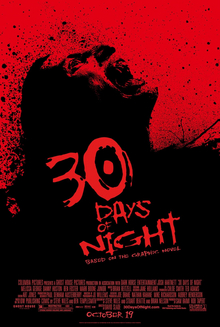
30 Days of Night-2007

30 Days of Night-2007

Director David Slade

Starring Josh Hartnett, Melissa George

Scott’s Review #993

Reviewed February 25, 2020

Grade: B-

During the decade when 30 Days of Night (2007) was released, the trend leaned towards the vampire-horror genre, where bloodthirsty tyrants would do battle with the good folks of the land.

The film has outstanding elements: a tiny town, total darkness, and chaos.

The gritty conclusion is a predictable letdown as the film spins out of control into the silly and the formulaic.

Hartnett, at the time, was an A-list actor whose film career was dwindling, reduced to the horror circuit.

In Barrow, Alaska, which is said to be the northernmost town in the United States, the winter sunsets do not rise for 30 days and nights, providing a full month of complete blackness.

An evil force emerges from the black atmosphere and strikes terror into the town, and all hope rests on a husband-and-wife cop team, Sheriff Eben Oleson (Hartnett) and Stella Oleson (Melissa George).

The duo must protect a handful of survivors from a pack of vampires and battle the lack of communication and blizzard conditions in the frigid Arctic.

The film is based on a comic book miniseries of the same name, but 30 Days of Night is mostly influenced by two better films: 28 Days Later (2002) and 28 Weeks Later (2007), the former a groundbreaking film within the sub-genre- even the title is a copycat!

The result is nothing groundbreaking and rather run-of-the-mill story-wise. It seems too closely patterned after other films rather than having an identity of its own.

The best part of the film is the fantastic elements and trimmings created to provide an atmosphere. Highly effective, it carries the film and intrigues the compelled audience when the story lacks.

What is more frightening than a blinding whiteout, hungry vampires, or a town fraught with perilous fear? The spooky atmospheric trimmings make the lack of payoff even more jarring, leaving the film adequate, but little more.

The casting is mediocre and unrealistic.

I doubt any sheriff in a tiny, forgotten town would be as good-looking as Hartnett, nor is he believable as a powerful sheriff- he does not fit the part.

George, as estranged wife Stella, is neither good nor bad, but rather inconsistent. There is little chemistry between the couple, and both were cast for their looks, as they seem more like staged puppets than fleshed-out characters.

Regardless, any romantic entanglements between the characters are dull and insignificant.

The character development is not there.

Ben Foster, as “The Stranger”, is a great actor, but not in this film. Subsequently appearing in grand roles in Hell or High Water (2016) and Leave No Trace (2018), he is not at his best in this film.

The character is limited, whereas he could have added much more to a better-written script.

We know little about the townspeople, and it is unclear what the vampires’ motivations are beyond wreaking havoc and creating terror.

30 Days of Night (2007) is a marginally good film, mostly because of the way it looks, and the horror-flavored ingredients sprinkled throughout.

Despite some cool ways of killing off the evil vampires, the film never hits high gear, remaining neutral for most of the way and ending with a disappointing climax.

It is advisable to see the much superior and similarly produced and filmed 28 Days Later (2002).