Tag Archives: Herbert Marshall

Foreign Correspondent-1940

Foreign Correspondent-1940

Director Alfred Hitchcock

Starring Joel McCrea, Laraine Day

Scott’s Review #1,158
Reviewed July 2, 2021

Grade: B+

As a superfan of all films Alfred Hitchcock, I had been chomping to see some of his older selections before he took American audiences by storm throughout his 1950s and 1960s heyday.

Many people do not realize just how many films the “Master of Suspense” made that are not household names.

Foreign Correspondent, made in 1940, is a black-and-white production and a prominent precursor for his later works. Much of the fun is zeroing in on particulars that would be featured in later films.

Hitchcock favorites, such as a tower, a circling airplane, an unwitting and innocent man involved in a political plot, and a false identity, are served up. The director’s obsession with female characters wearing glasses is undoubtedly part of the fun.

What Hitchcock fan doesn’t giggle with glee after discovering the director’s trademark cameo appearance in each of his films?

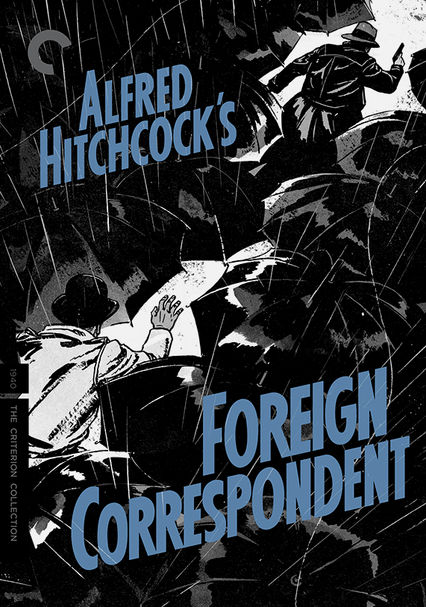
As an aside, I love the cover artwork for this film.

Foreign Correspondent isn’t one of the best-remembered Hitchcock films because it’s only perfect rather than exceptional.

In 1940, the director was getting his groove following a surprising Best Picture Oscar win for Rebecca (1940), a film that was a very early American effort. He was still finding his footing in production values.

The legendary Costume Designer Edith Head and Music Composer Bernard Hermann had not joined the fold yet as they would in masterpieces like The Man Who Knew Too Much (1956) and Vertigo (1958), and it shows. The musical score is ordinary, more or less what a picture made in 1940 sounded like.

The costumes are decent but lack the grandeur and style that Head brought to the productions.

New York City-based crime reporter John Jones, later renamed Huntley Haverstock, played by Joel McCrea, is reduced to producing dull copy despite the world being on the cusp of war. His editor hopes a change of scenery will be what Jones needs to get back on track and provide a juicy story.

He is re-assigned to Europe as a foreign correspondent. When he stumbles on a spy ring, he attempts to unravel the truth with the help of a politician, Stephen Fisher (Herbert Marshall), his daughter Carol (Laraine Day), and an English journalist (George Sanders). But can any or all of them be trusted, or are they in cahoots with the bad guys for their gain?

The plot alone immediately reminded me of Saboteur (1942). Both involve a complicated (maybe overly?) story of government, investigations, and sabotage.

They also each focus on a couple attempting to outwit or outrun authorities. They are both filmed with black and white cinematography.

Foreign Correspondent contains its share of thrills and compelling moments. The best sequence is when John is nearly shoved off the tower of Westminster Cathedral by a hitman, who ultimately plummets to his death. The obvious parallel is to Vertigo, especially when the nuns give the sign of the cross after the body falls.

Other mentions include a terrific airplane finale with astounding, long-lasting special effects. Also unforgettable is a windmill sequence that will remind any Hitchcock fan of the famous cropduster scene from North By Northwest. I half expected a character to exclaim, “The windmill is turning where there isn’t any wind.”

At two hours, even in run time, Foreign Correspondent is a good fifteen minutes too long. The plot takes some time to pick up speed, and John and Carol’s chemistry is relatively weak. They are certainly no Mitch and Melanie like from The Birds (1963).

Foreign Correspondent (1940) is a second-tier Alfred Hitchcock film with enough components to serve as a solid opening act for North By Northwest. This is not such a bad thing, and the film holds its own against similarly patterned films of its day.

Oscar Nominations: Best Motion Picture, Best Supporting Actor-Alan Basserman, Best Original Screenplay, Best Cinematography, Best Art Direction, Best Visual Effects

Midnight Lace-1960

Midnight Lace-1960

Director David Miller

Starring Doris Day, Rex Harrison

Scott’s Review #909

Reviewed June 13, 2019

Grade: B+

Midnight Lace (1960) is a straightforward psychological thriller made at a time when the genre was increasing in popularity.

The film was influenced by the Alfred Hitchcock craze, which was front and center at this time, and a robust departure for its lead, Doris Day, who until this time mainly was nestled securely in the romantic comedy domain.

The film is a good watch and a challenging role for Day, who proves she has the acting chops to carry the movie.

Day portrays Kit, an American heiress, newly married to British financier Tony (Rex Harrison), residing together in London. When she is terrorized by an odd voice in a London park one misty night, her panic is dismissed as rubbish, and pranksters have their way with her.

When the threats return and escalate with telephone calls, Tony alerts the authorities, who question whether Kit may be imagining things or creating a panic to gain attention from her husband.

Tony, in turn, begins to ask the same questions.

Day, an American sweetheart and forever good girl, was brave enough to tackle a role that was left of center for her.

Despite her acceptable acting and impressive range during scenes of peril, Doris Day is still Doris Day, and it is tough to shake the image of her playing herself.

Attractive, Day is not the sexpot type, so a few scenes of her being flirty by attempting to seduce Tony with sexy nighties do not work so well. Day has never looked lovelier than she does in this picture.

The plot rolls along with fantastic glossy production values, and I never found myself tuning out or wondering when the film would end.

The drama heightens minute by minute, turning into a whodunit, while the film wisely never disqualifies whether Kit could be staging the shenanigans herself.

Did she fall into a bus, or was she pushed? Why did she hire someone to call her? Is the menacing voice disguised? The questions become more frequent as the film progresses, which is what good thrillers should do.

I figured out only half of the big reveal, but the other half caught me off guard, and the finale was climactic and satisfying.

The film belongs to Day, but the additions of Harrison and the legendary Myrna Loy add class and flavor to a movie that could have been dismissed as only cliched in lesser hands.

Harrison is effective as the concerned but stoic husband, and the audience wonders whether Tony is involved in Kit’s stalking or is a caring man.

Does the subplot of a discovered embezzler in Tony’s company have anything to do with it? If so, how are the stories connected?

Handsome John Gavin, a Rock Hudson type who became famous for Psycho (1960), is a welcome addition as contractor Brian. He shows up at the right time to save Kit, making him a prime suspect.

Loy plays Kit’s Aunt Bea, who comes to town for a visit; the part is nothing special, but seeing the actress in whatever role she tackles is lovely.

Finally, Malcolm Stanley (Roddy McDowell) adds drama as a money-hungry man and son of Kit’s maid.

Characters are added to the story as potential suspects.

The viewer is treated to their share of exterior shots of London, which provides the film with enough British flavor, almost to forget that Day is American.

With the additions of Scotland Yard and an Inspector, the British culture is firmly placed, adding a wonderful British element.

Tony and Kit are rich, so their lavish home and exclusive neighborhood are finely placed on display.

The film’s title is represented in a cute scene when Kit seductively holds up a sexy outfit she purchased for Tony. The scene seems straight out of the 1980s slick television movie thriller genre and is primed for the Lifetime television network.

This is not a criticism because the title works well and holds tantalizing darkness.

Midnight Lace (1960) is a nearly forgotten film that is a fine watch and a lovely tribute to Doris Day’s talents. She makes the film her own and is the main reason to watch it.

Though she does not sing or play the girl next door, she does turn in an above-average performance, showing her range as an actress.

The rest of the film’s trimmings, especially the locale and the supporting actors, benefit the viewing pleasure the film possesses.

Oscar Nominations: Best Costume Design, Color

Golden Globe Nominations: Best Performance by an Actress in a Motion Picture-Drama-Doris Day

The Little Foxes-1941

The Little Foxes-1941

Director William Wyler

Starring Bette Davis, Herbert Marshall, Teresa Wright

Scott’s Review #866

Reviewed February 14, 2019

Grade: A-

Any film starring the ravishing and dynamic Bette Davis is worth watching. Still, The Little Foxes (1941) was released during the Hollywood legend’s heyday, and the actress elicits an intense character portrayal.

The film is a complex story of Southern scheming and contains enough intrigue to keep the viewer compelled after a slow start.

Filmed in black and white and due to its age, the film quality is not the best, the story nonetheless builds in suspense, especially during the final thirty minutes. This culminates in a frantic conclusion, with Davis deservedly taking center stage.

Southern matriarch Regina Hubbard Giddens (Davis) is sophisticated and angry. The female member of an affluent family is in a time when men rule the roost and her brothers control the family money, leaving her with little power.

Living nearby, Benjamin (Charles Dingle) and Oscar (Carl Benton Reid) flaunt their wealth while Regina struggles for every crumb she can get. After the family embarks on a deal to profit from a cotton mill merger, Regina schemes to score riches by any means necessary.

The southern setting with luxurious estates and more than its share of cultural and cuisine flavors serves The Little Foxes well with a palpable atmospheric style. With an antebellum, white dress, grits, and brandy featured, the goodness and girth of a proper way of living are featured.

Prominent black characters exist, primarily serving as the household help or various service roles to white folks, for 1941 this was considered progressive for studios to feature minorities so heavily and must be praised for the inclusiveness.

Throughout the run of the film, I felt a push/pull whether I sympathized with Regina or despised the character.

Comparisons to Gone With the Wind (1939) entered my mind, many having to do with Regina herself. Flirtatious when she wants to be coquettish to fit her needs, she is a cross between Scarlett and Melanie.

I even began to champion the character at one point and the plight of a female in the early 1900s who could not be taken seriously as a businesswoman.

The Little Foxes is brazen in that it champions a strong and determined female character. Regina will not merely stand behind any man but chooses to stand on her own two feet.

Cinema in the 1940s was known for portraying female characters as independent and self-sufficient, and this film is a prime example of this movement.

In the film’s final act, there can be no denying the true colors of Regina, and any sympathy or comparisons to the characters are ultimately dismissed diabolically. The character is faced with the choice to either do the right thing and save a life or cross the line and let a beloved character die.

The scene is pivotal and emotional when she chooses the latter. She has made an important decision that she can never reverse.

Director William Wyler shoots the astounding Davis in myriad ways central to the character’s motivations. Appearing determined and driven in some scenes and downright devious in others, Davis excels at doing so much with her enormous and expressionistic eyes.

The Little Foxes portrays her as a complex and unrelenting character tailor-made for Davis’s talents.

To say that Regina gets away with murder is an unfair statement. Wyler makes it clear that despite benefiting financially, the character is forever shrouded in suspicion by her brother and her daughter (Teresa Wright), who decidedly embarks on a new life in Chicago, never to see her mother again.

This leaves Regina fearful and lonely in her grand house.

The Little Foxes (1941) succeeds as a showcase for the emerging talents of stalwart Bette Davis, and it is a good, solid drama. Schemes, conspiracy, and backstabbing are prevalent themes, but the film also contains a melancholy subtext of loneliness and fear.

Appropriately, Ms. Davis is awarded the final shot, a close-up that reveals the star power she had begun to muster as her career was in full swing.

Oscar Nominations: Outstanding Motion Picture, Best Director-William Wyler, Best Actress-Bette Davis, Best Supporting Actress-Patricia Collinge, Teresa Wright, Best Screenplay, Best Scoring of a Dramatic Picture, Best Art Direction-Interior Decoration, Black-and-White, Best Film Editing