Tag Archives: James Rebhorn

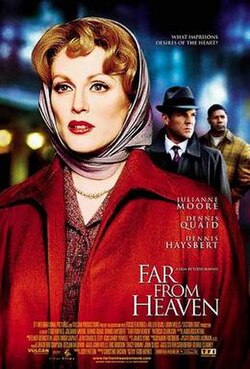
Far From Heaven-2002

Far From Heaven-2002

Director Todd Haynes

Starring Julianne Moore, Dennis Haysbert

Top 250 Films #127

Scott’s Review #332

60025011

Reviewed January 8, 2016

Grade: A

Far From Heaven (2002) is a gorgeous film, set in 1950’s upper-class and sophisticated Connecticut, that tackles not one, but two, separate social issues, in a wonderful story-telling fashion.

An interracial couple fraught with discrimination, and a homosexual husband hiding his secret lifestyle encompass this amazing film by acclaimed director Todd Haynes.

In years to follow, Haynes would also direct such masterpieces similar to the period (and story) of Carol (2015).

For starters, the cinematography and art direction are simply breathtaking- the beautiful and colorful small town in Connecticut, on the surface, prim and proper, is oozing with secrets and scandal just waiting to bubble to the surface.

An aerial view of the town allows the viewer to see this perfectly carved town in a sweeping motion.

Far From Heaven contains many similarities to All That Heaven Allows, made in 1955, and also focuses on a great scandal in a small, seemingly idyllic New England town.

Cathy Whitaker (Julianne Moore) seems to have everything perfectly styled and kept at home in affluent Connecticut, a successful husband named Frank (Dennis Quaid), who is an advertising executive, beauty, and a neighborhood filled with friends.

One night when Frank is working late, Cathy surprises him with dinner at the office, only to be surprised herself by catching Frank passionately kissing another man. In an awkward scene, Frank admits to Cathy that he needs conversion therapy, but instead turns to alcohol and continues to secretly see men.

Devastated, Cathy befriends her gardener, Raymond Deagan (Haysburt), a handsome black man, and slowly begins a relationship with him. Needless to say, this causes gossip and scandal amongst the townspeople.

Far From Heaven is fantastic story-telling, weaving, in essence, two main social stories together.

Frank questions his sexuality, afraid to admit he is gay and risking his reputation and career. Undoubtedly, he is a tormented individual and we see him slowly come to terms with his sexuality.

Haynes, fantastic at crafting a worthy story, carves a similar tale in 2015’s Carol, only she is a woman confident about her sexuality, but hiding it from society. Since the time in both films is the 1950s, the sexual revolution has not occurred, let alone anything gay-related.

The center story though belongs to Cathy and Julianne Moore portrays her to perfection. I would argue that Cathy is Moore’s best role- along with Amber Waves from Boogie Nights.

Hurt and betrayed by her husband, she suddenly is filled with new and dangerous emotions- falling in love with a black man in a not very open-minded time.

Moore and Haysbert have fantastic chemistry from their very first scene together.

I love how Haynes showcases the perfection of the town- the lawns are perfectly mowed, the flower beds flawless, and everyone appears cheerful and colorful. But when something in their little town becomes amiss (in this case Cathy going against the grain) the fangs come out and the animals bear their teeth.

A wonderful scene showcases Cathy and Raymond’s slow dancing in a solely black bar. They sway as one and Cathy is accepted by the black patrons. Raymond (and his daughter) are not treated the same way by the white folks of the town once they catch wind of the shenanigans going on between the interracial couple.

Far From Heaven (2002) is a beautiful film- from the way it looks and is shot, to the powerful acting performances all around. Moore may be the star and the central character of the film, but Quaid and Haysbert certainly deserve their due.

They each give layered performances as wounded and tortured men- and the conclusion of the film- perceived as open-ended- is also not a happily ever after climax.

Oscar Nominations: Best Actress-Julianne Moore, Best Original Screenplay, Best Original Score, Best Cinematography

Independent Spirit Award Nominations: 5 wins-Best Feature (won), Best Director-Todd Haynes (won), Best Female Lead-Julianne Moore (won), Best Supporting Male-Dennis Quaid (won), Best Cinematography (won)

The Talented Mr. Ripley-1999

The Talented Mr. Ripley-1999

Director Anthony Minghella

Starring Matt Damon, Jude Law, Gwyneth Paltrow

Scott’s Review #1,259

Reviewed May 27, 2022

Grade: A

The Talented Mr. Ripley (1999) is a psychological thriller that is Hitchcockian and would make the famous director, the esteemed Alfred Hitchcock, damned proud.

The film contains suspense, thrills, mystique, and great writing, and is an exceptional adaptation of the 1955 Patricia Highsmith novel of the same name.

A fun fact is that Highsmith also wrote the novel on which Hitchcock’s 1951 film Strangers on a Train was based.

In my opinion, the title role is the best of Matt Damon’s lengthy career, rivaling that of his debut in Good Will Hunting (1998), also a tremendous effort. His riveting portrayal showcases that he plays several layers simultaneously: calculating, sinister, vulnerable, jealous, and unhinged.

Sometimes all at once.

He shockingly was omitted from the Best Actor Oscar list which is unforgivable considering his great work. Instead, he was nominated in later years for lesser films like Invictus (2010) and The Martian (2016).

With his blonde clean-cut hairstyle, short and parted on the side, and big, studious glasses, he is half wholesome and half creepy.

The fact that the character is gay is icing on the cake and delicious for a film set in the 1950s when having an alternative lifestyle was strictly forbidden.

The setting is mainly lavish and sunny coastal Italy in the late 1950s. Tom Ripley (Damon) craves a lifestyle of luxury and manipulates his way into the life of wealthy playboy Dickie Greenleaf (Jude Law).

When Dickie’s father asks Tom to bring his errant son back home to America, Dickie, and his beautiful expatriate girlfriend, Marge Sherwood (Gwyneth Paltrow), never suspect the dangerous extremes to which Ripley will go to make their lifestyle his own.

The best part of The Talented Mr. Ripley is the compelling suspense and the twists and turns that result. It’s astounding how many layers of the plot exist without the experience being confusing or paced poorly.

Speaking of the pacing, this is another achievement of the film. Director Anthony Minghella wisely quickens the action from the snail’s pace of his earlier film The English Patient (1996) which I loved.

We immediately know much about Tom and how he makes his living by charming people and forging signatures to make ends meet. His innocent deceit soon turns fatal as he spirals downward and becomes a pathological liar and sociopath in addition to a cold-blooded murderer.

Law is tremendous as Dickie and the bold character is ambiguous in his sexuality while Tom’s is clearer. I love this about Law’s character. He is handsome and a lady’s man which would make him ripe for the picking for a closeted gay man in the 1950s to become enamored.

The key to ponder is whether the feeling is mutual or not. This remains ambiguous.

The acting, superior in every way, is made all the richer because the film is a character study, and the relationship between Tom and Dickie is cleverly dissected.

The best scene occurs on a small boat as tensions reach a crescendo between the two men. This results in dire activity.

Besides the action starting in New York, the rest of the story takes place in Italy and is mostly shot on location. This only enhances my enjoyment of the film because it showcases the Mediterranean and southern Italy more than the more familiar cities.

Not to disappoint, astounding sequences in Rome and Venice do occur.

Because of the cinematography and locales, the film has a glossy and polished look which is terrifically counterbalanced to the darkness of the story. Think American Psycho (2000) but more subdued with a larger budget.

The Talented Mr. Ripley (1999) is one of the best to emerge from a decade in cinema that was terrific. It is not as well-remembered as some others but I strongly encourage a watch to uncover a series of riches led by bold storytelling.

Oscar Nominations: Best Actor in a Supporting Role-Jude Law, Best Screenplay Based on Material Previously Produced or Published, Best Art Direction, Best Costume Design, Best Original Score

The Game-1997

The Game-1997

Director David Fincher

Starring Michael Douglas, Sean Penn

Scott’s Review #1,226

Reviewed February 5, 2022

Grade: A-

The Game (1997) is a fantastic cat and mouse ‘game’ created by director David Fincher who always gets some street credibility where I’m concerned. The thrills come a mile a minute reaching a crashing crescendo in the final act.

It’s a film that produces a roller coaster, edge-of-your-seat thrill-ride, or whatever metaphor serves you best. The result is the same- a fantastic and deliciously wicked experience.

Hollywood A-listers Michael Douglas and Sean Penn team up with chemistry and radiance as brothers with a rivalrous streak. But, who is the cat and who is the mouse is the question of the day as the puzzle pieces continue to mount.

Anyone who knows Fincher’s work, especially films like Seven (1995) and Zodiac (2007) realizes that atmosphere and storytelling are his sweet spot and The Game never disappoints.

It grasps the viewer by the neck and never let’s go.

The screenplay is intelligent and daring. Now, before anyone gets their knickers in a bit of a twist, I do not dare say that The Game is on the level of Zodiac or Seven-both masterpieces in my opinion. But The Game plays its cards well and measures up well if we are ranking Fincher films.

Nicholas Van Orton (Douglas) is a successful banker who keeps mostly to himself spending most nights alone in his luxurious home. When his estranged brother Conrad (Penn) returns to town on his birthday with an odd gift Nicholas’s suspicions are piqued.

The gift is a personalized, real-life game that he cannot resist accepting. Beginning slowly, the game grows increasingly personal, and Orton begins to fear for his life as he eludes agents from the mysterious game’s organizers.

With no one left to trust and his money all gone, Orton must find answers for himself before he goes off the rails into psychosis.

Let’s discuss everything but the story first. The look of The Game is stunning with perfect lighting and shadows exhibiting the mood. The editing, whether in rapid-fire motion or slow-motion is brilliantly effective.

Do we feel sorry for the characters? That would be a resounding no but that’s also the fun of The Game. As Orton spirals down a dark and mysterious path we are not too invested in the character so watching the ‘game’ is all the more enjoyable for the viewer.

The message delivered after The Game can either be loved or hated by viewers. I, for one, loved it. Chaos and uncertainty can be argued to be better than complacency but is it? Nicholas may argue his case when his life is turned topsy turvy.

The conclusion, while unsettling, is riveting and mind-blowing.

Penn has rarely been better being given a healthy dose of mystique and caginess matched up against a musical score that shines a ghostly light on his scenes. The actor does his best when playing a black sheep or estranged character type so Conrad is ripe for the picking with potential.

Sandwiched in release between Seven (1995) and Fight Club (1999), both much better remembered than The Game (1997), that is a bit of a shame.

The film deserves a good dusting off and fans of Fincher will undoubtedly enjoy piecing together a good, solid perplexity or at least attempting to.

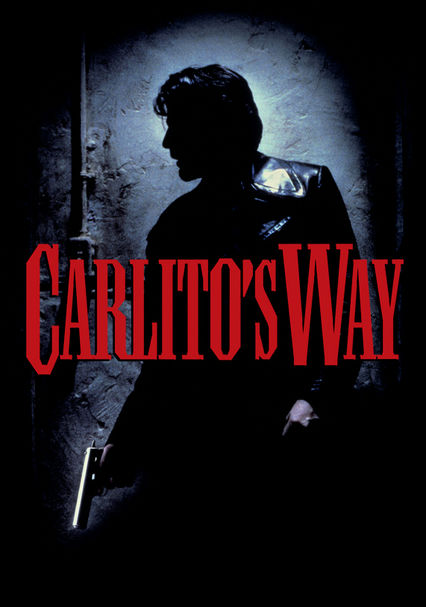
Carlito’s Way-1993

Carlito’s Way-1993

Director Brian De Palma

Starring Al Pacino, Sean Penn

Scott’s Review #1,224

Reviewed January 29, 2022

Grade: B

Brian De Palma would be firmly planted in my Top 10 favorite directors of all time- maybe even the Top 5.

His daring and juicy Dressed to Kill (1980) and horrific Carrie (1976) are still visually mesmerizing to me.

Carlito’s Way (1993) takes De Palma into New York mobster territory, similar in vein to his 1983 disappointment, Scarface (1983).

The latter is set in Miami, while the former offers many reminders of its New York City setting, like street signs and other exterior trimmings of the Big Apple, especially in Spanish Harlem.

Sequences also occur on Long Island, New York, and Rikers Island.

The film is based on two novels written in the 1970s, when the events are supposed to be set. This doesn’t work as well as you might think, but more about that later.

Carlito’s Way itself is a solid mobster film that borrows from many others, including Scarface, The Godfather (1972), and Goodfellas (1990).

If I were to take ten mobster films, it might get lost somewhere in the middle.

But it’s still an above-average watch and sprinkles pleasant De Palma familiarities like slow-motion dreamlike sequences and a terrific chase through the subway and Grand Central Station that will bring a smile to Dressed to Kill fans.

It’s just not one of the best Brian De Palma films nor one of the best mobster films.

Released on a technicality after years in prison, Carlito Brigante (Pacino) swears to give up his criminal ways. Still, it’s not long before the ex-con is sucked back into the New York City underworld thanks to his shady lawyer and friend Dave Kleinfeld (Sean Penn).

All he wants to do is save enough money to leave town and retire in paradise.

Carlito reconnects with his aspiring actress/dancer girlfriend, Gail (Penelope Ann Miller), while young and dangerous gangster Benny Blanco (John Leguizamo) plots revenge on Carlito and Kleinfeld after being slighted.

Kleinfeld has also stolen money from a dangerous convict, so that’s an added stressor for both him and Carlito.

The time is very odd. It’s supposed to be the 1970s, as the musical score suggests, as disco party music blasts during club scenes. The clothes and hairstyles somewhat align, but there is a strange 1980s feel, which is even stranger given the film was shot in the 1990s.

The chemistry between Pacino and Miller is okay, but nothing terrific either, although it grows during the film.

At first, I wondered what they saw in one another, but the pair slowly won me over. By the end, I was rooting for them to ride off into paradise together.

The best part of Carlito’s Way is the final thirty minutes or so. On the run from the bad guys, Carlito and Gail decide to meet on a late-night train bound for Florida. There, they will forget their troubles and live happily ever after on the beach.

Oh, and by the way, Gail is now pregnant.

De Palma, as he usually does, creates a dazzling climax. I was mesmerized by the cat-and-mouse chase scenes and what Grand Central looked like in the early 1990s when the film was shot.

And there’s also the terrific running-from-subway-car-to-subway-car chase scene, just like in Dressed to Kill.

As an aside, Pacino, who is Italian, is playing a Puerto Rican character. One character comments that Carlito could almost pass for an Italian. Given Pacino’s heritage in the very Italian Godfather films, this anecdote made me chuckle.

Penn and Pacino give it their all and craft unusual characters, especially Penn, and it’s a delight to see great actors play off one another.

Carlito’s Way (1993) has some hits and some misses and borrows heavily from similar films, including De Palma’s films. This too often makes it a comparison film rather than one with its own identity.